A simple pickleball consistency benchmark: miss no more than 1 serve and 1 return per game, keep 70% of third shots neutral or unattackable, and limit routine unforced errors to 1–2 per game. Drills help, but real consistency shows up under pressure.
“Be more consistent.”
It might be the most common advice in pickleball — and also one of the least helpful.
Because what does it actually mean?
Does consistency mean you can hit 50 dinks in a row during a drill? Does it mean you never miss a return? Does it mean you play safe all the time? Does it mean your third shot drop lands in the kitchen 8 out of 10 times? Or does it mean you simply don’t fall apart when the score is 9-9?
The real answer is more interesting: consistency in pickleball means you can repeat the right shot, with enough quality, often enough, under real-game pressure.
That last part matters. A player who can hit 50 cooperative dinks in a row during warmup is not automatically “consistent.” That player is good at cooperative dinking. Real consistency shows up when the ball is lower than expected, your partner is moving, the opponent is pressuring your backhand, and the score is tight.
Why “50 Dinks in a Row” Is Not the Whole Answer
Let’s start with the classic dink test.
If you can dink 50 balls in a row with a cooperative partner, that is useful. It shows touch, patience, paddle control, and rhythm. But it is not the same as being a consistent dink player in games.
Why?
Because game dinks are not neutral. They come with purpose.
Your opponent may move you wide. They may speed up off the bounce. They may dink to your inside foot. They may change height, spin, pace, and direction. They may make you decide whether to dink, reset, counter, or leave the ball.
That means a better consistency test is not: can I hit 50 dinks in a row?
It is: can I hit 8–12 quality dinks in a row while changing direction, staying low, avoiding pop-ups, and not giving my opponent an attackable ball?
For most rec players, that is a much more meaningful benchmark. A 50-ball drill proves you can repeat a motion. A live dink exchange proves you can repeat a decision.
That is the missing piece.
The Three Layers of Pickleball Consistency
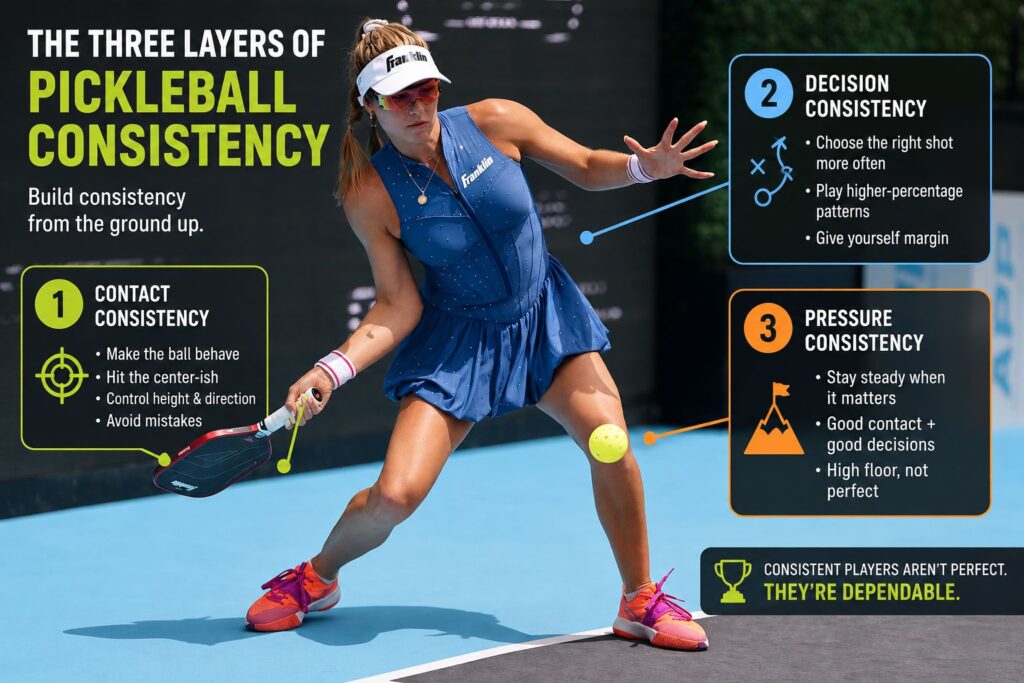
To make this useful, I like to break consistency into three layers.
1. Contact consistency
This is the basic layer.
Can you hit the center-ish of the paddle often enough? Can you keep the ball in? Can you control the height and direction? Can you avoid mishits, shanks, net balls, and wild launches?
This is where beginners and lower-intermediate players live for a while.
If your contact is inconsistent, everything else becomes unstable. You cannot build reliable drops, resets, counters, drives, or dinks if the ball is coming off a different part of the paddle every time.
Contact consistency is built through:
✓ stable posture
✓ simple swing paths
✓ quiet wrist
✓ clean spacing
✓ contact in front
✓ repeatable footwork
✓ enough margin over the net
This is the “make the ball behave” stage.
2. Decision consistency
This is where many 3.0–4.0 players get stuck. They can make shots. They just don’t choose the right one often enough.
They attack balls below the net.
They drive when off balance.
They try to speed up from bad contact.
They dink crosscourt for five balls, then panic-flick the sixth.
They hit a great drop, then run forward blindly and get burned.
That is not a stroke problem. That is a decision-consistency problem. A consistent player does not just make more balls. They choose more appropriate balls.
They know when to:
✓ return deep instead of cute
✓ drop instead of drive
✓ reset instead of counter
✓ dink instead of speed up
✓ attack only when the ball is high enough
✓ give themselves margin instead of painting lines
This is why coaches often connect consistency with reducing unforced errors and playing higher-percentage patterns. Better Pickleball’s Tony Roig puts the principle very simply: give yourself a larger margin of error, because smaller margins make errors more likely.
That is consistency in one sentence: stop choosing shots with tiny margins when a bigger-margin shot would do the job.
3. Pressure consistency
This is the advanced layer. Can you still make good contact and good decisions when the point matters?
At 2-2, a player may look calm and reliable. At 9-9, they may rush, grip tighter, stop moving their feet, and try to win the rally too early.
Pressure consistency means your floor stays high when the moment gets louder.
That does not mean you never miss. It means your misses make sense. You miss while trying to execute the right pattern, not because you emotionally hijacked the point.
One source describing the road to consistency defines it as more than fewer errors: reliable execution under pressure, sound decisions in live play, emotional recovery after mistakes, and knowing your role on the court.
That is exactly right for rec players.
A consistent player is not perfect. A consistent player is dependable.
The Real Measurement: Unforced Errors
If you want a practical way to define consistency, start here: how many points are you giving away without making your opponent earn them?
That is the heart of consistency.
In pickleball, unforced errors are expensive because rallies are short enough that one loose shot can decide everything. A statistical analysis cited by Gaithersburg Pickleball Club found that in 4.0+ games, the average game had about 16 unforced errors, about 9% of all hits, and those errors accounted for roughly 28% to 40% of actual points scored. The same analysis suggested that unforced errors likely play an even bigger role at 3.0 and 3.5 levels.
That should get every rec player’s attention. You do not need to become a highlight machine to win more. You often need to stop donating points.
So instead of asking, “Am I consistent?” ask: how many points per game do I lose with unforced errors?
For rec players, here is a simple self-check:
| Level | Unforced Error Pattern | What It Usually Means |
|---|---|---|
| Inconsistent | 6+ clear unforced errors per game | You are giving away too many points without pressure |
| Improving | 3–5 clear unforced errors per game | You are competitive, but still leaking points |
| Solid | 1–2 clear unforced errors per game | You are making opponents earn most points |
| Very consistent | 0–1 clear unforced errors per game | Your floor is high and your decisions are disciplined |
This is not official rating math. It is a practical rec-player benchmark.
And yes, you have to be honest. A ball missed because your opponent hit a nasty speedup is not the same as dumping a routine return into the net.
Consistency Is Not Just “Keeping the Ball In”
This is where the advice gets tricky.
Some players hear “be consistent” and become passive. They push everything. They dink without pressure. They never attack. They keep the ball in, but they give opponents comfortable balls all day.
That is not high-level consistency. That is survival. Real consistency means your ball has enough quality to avoid punishment.
A consistent drop is not just “in.” It is low enough that the opponent has to hit up.
A consistent dink is not just “in.” It avoids sitting up at waist height.
A consistent return is not just “in.” It is deep enough to keep the serving team back.
A consistent reset is not just “over.” It lands low enough to neutralize the attack.
A consistent attack is not just hard. It is aimed at a smart target, from a ball that was actually attackable.
So the better definition is: consistency = repeatable shot quality, not just repeatable survival.
That is a big difference.
How Many Shots in a Row Should You Actually Be Able to Make?
Here is where we can finally answer the “how many?” question.
There is no official number that says, “If you can hit X dinks, you are consistent.” But useful benchmarks can help.
For most rec players, I would separate drilling consistency from game consistency.
Drilling Benchmarks
| Shot | Beginner Goal | Intermediate Goal | Strong Intermediate Goal | Advanced Rec Goal |
|---|---|---|---|---|
| Dinks | 10 cooperative dinks in a row | 25 cooperative dinks in a row | 10–15 crosscourt dinks with direction and height control | 10+ quality dinks while moving your partner and avoiding pop-ups |
| Serves | 8 of 10 serves in | 9 of 10 serves in with depth | 8 of 10 deep serves to a chosen half | 8 of 10 deep serves with pace, shape, and target control |
| Returns | 7 of 10 returns in | 8 of 10 deep returns | 8 of 10 deep returns crosscourt or middle | 8 of 10 deep returns while immediately getting to the kitchen |
| Third Shot Drops | 5 of 10 in the kitchen | 6–7 of 10 unattackable | 7 of 10 that force contact below net height | 7–8 of 10 with location variation and proper transition movement |
| Resets | Get more resets over the net | 5 of 10 resets land low in the kitchen | 6–7 of 10 neutralize pressure | Reset reliably while moving, stretched, or under pace |
Game Benchmarks
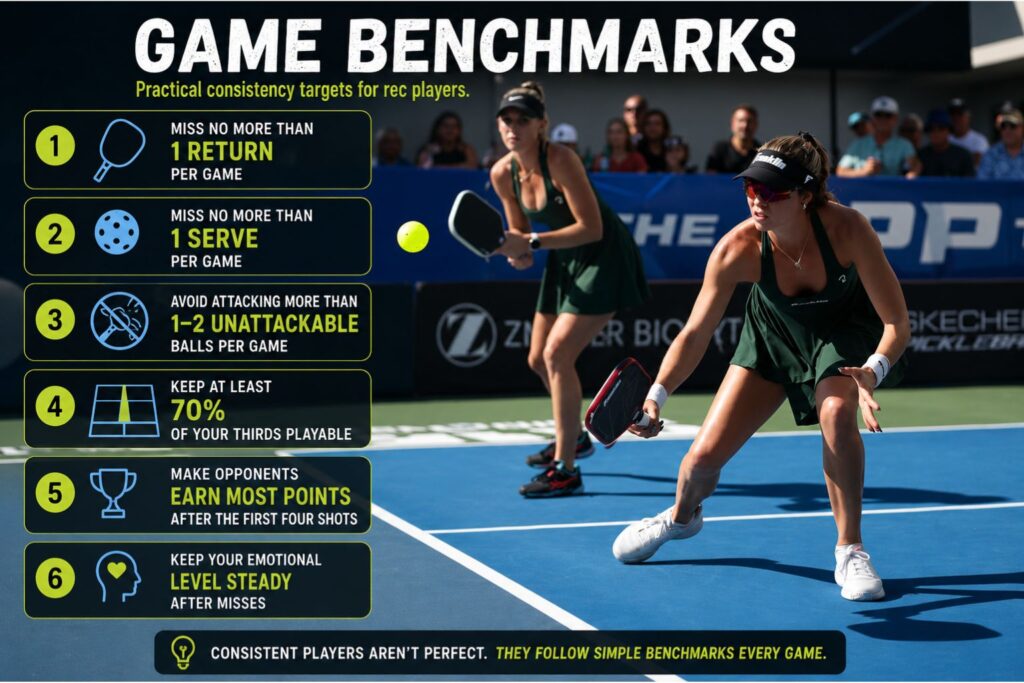
Game consistency is different because you are under pressure and making decisions. A good rec-player target:
✓ Miss no more than 1 return per game
✓ Miss no more than 1 serve per game
✓ Avoid attacking more than 1–2 clearly unattackable balls per game
✓ Keep at least 70% of your thirds playable
✓ Make opponents earn most points after the first four shots
✓ Keep your emotional level steady after misses
Again, these are practical benchmarks, not official rating standards. But they are useful.
If you can do those things, you will feel much more consistent immediately.
The “Pressure Multiplier” Test
Here is a test I like: take any drill number and ask whether you can keep 70% of it when the conditions get harder.
If you can hit 30 cooperative dinks in warmup, can you hit 20 quality dinks when your partner moves you?
If you can make 8 of 10 drops from a feed, can you make 5 or 6 of 10 after a deep return?
If you can reset well from a stationary position, can you reset while stepping back or sideways?
That is consistency.
Not your best version in a drill. Your repeatable version when the game adds pressure.
What Consistent Players Actually Do Differently
Consistent players are usually not magical. They just make fewer avoidable decisions.
✅ They use bigger targets.
✅ They clear the net by safer margins.
✅ They keep swings compact.
✅ They move before they hit.
✅ They hit fewer “maybe” attacks.
✅ They choose depth before angle.
✅ They reset when off balance.
✅ They recover emotionally faster after mistakes.
✅ They understand that a boring ball is sometimes the correct ball.
One of the biggest misconceptions in rec play is that consistency means playing timidly. It doesn’t.
It means playing with a higher floor.
Your ceiling is your best shot.
Your floor is your worst normal shot.
Consistency is raising the floor.
A Practical Consistency Scorecard
If you want to measure consistency without making your head explode, track only five things for one game. Do not track everything. That ruins the fun.
Track:
- Missed serves
- Missed returns
- Third shots into the net
- Pop-ups at the kitchen
- Bad attacks from below net height
After the game, look at the pattern.
If you had 2 missed returns, 3 third-shot errors, and 2 bad attacks, you do not have a mysterious consistency problem. You have a specific problem.
That is good news. Specific problems can be trained.
Try this for three games and ask: Where do I leak the most free points?
That is your consistency project.
The “Good Miss” Concept
Not all misses are equal. A consistent player still misses. But the miss usually makes sense.
A good miss might be:
✓ a deep return that goes six inches long
✓ a dink that clips the tape while staying low
✓ a third shot drop that barely misses because the shape was right
✓ an attack that misses after you chose the correct high ball
✓ a reset that was the right decision but slightly under-hit
A bad miss is different:
✖ a serve dumped into the net
✖ a return missed while trying for a sideline
✖ a speedup from below the net
✖ a huge swing while off balance
✖ a dink popped up because you rushed the contact
✖ a third shot drive blasted from a stretched position
Consistency is not eliminating every miss. It is shifting your misses from careless to understandable.
The Best Cues for Consistency
Here are the cues I like for rec players:
Big target, small swing.
Great for returns, resets, and defensive balls.
Make them hit one more.
Useful when you’re tempted to over-attack.
Height first, then placement.
Good for drops and dinks. Keep it unattackable before getting fancy.
Reset from trouble. Attack from strength.
Probably the best decision cue for 3.5 players.
Miss deep, not dumb.
Helpful on returns and drives. A deep miss is often a better sign than a short sitter.
Same finish, same ball.
Useful for drilling repeatable mechanics.
Breathe before the serve.
A simple pressure-control cue.
What “Consistent” Looks Like by Level
Here is a practical rec-player version.
3.0 Consistency
You can keep simple rallies going, but errors still come in bunches. Serves and returns are usually in, but depth and direction vary. Dinks are possible, but pop-ups happen often. Third shots are inconsistent.
Goal: fewer free misses.
3.5 Consistency
You can sustain rallies with similar-level players and execute basic patterns, but pressure still causes rushed attacks, missed thirds, and transition mistakes. You may look consistent in drills but less consistent in games.
Goal: make better decisions under pressure.
4.0 Consistency
You can keep the ball in with purpose. Returns are deep. Dinks are controlled. Resets are usable. You attack better balls and donate fewer points. You can recover emotionally after mistakes.
Goal: add quality without losing reliability.
4.5+ Consistency
You maintain shot quality under pressure and against pace. You can sustain patterns, adjust to opponents, and make opponents beat you rather than waiting for your error.
Goal: consistency with weapons.
So, When Can You Call Yourself a Consistent Player?
You can start calling yourself consistent when:
✓ your normal ball is playable, not random
✓ you miss fewer routine serves and returns
✓ you can dink without constant pop-ups
✓ you can reset instead of panic-swinging
✓ you choose high-percentage attacks
✓ your errors do not come in emotional clusters
✓ your partner knows what kind of ball to expect from you
✓ your game holds up reasonably well when the score gets tight
That is the real definition.