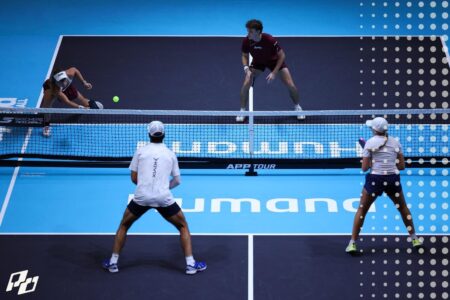


If you’ve been playing doubles for even a few weeks, you’ve probably heard it: “Split the court. Cover your half. Meet in the middle.”
It’s a tidy bit of advice. It’s also a trap.
At higher levels, nobody actually plays a strict 50/50 split. The best teams don’t divide the court evenly—they shift, tilt, and bias coverage based on ball position, forehand dominance, and partner chemistry.
If you want to stop bleeding points through the middle, it’s time to upgrade your doubles positioning.
Why the 50/50 Myth Persists
The idea of splitting the court sticks because it’s simple. Beginners need something clear to hold onto, and dividing the court down the middle feels fair.
But here’s the problem: pickleball isn’t symmetrical.
- A righty’s forehand covers more ground in the middle than their backhand.
- Partners have different strengths, reach, and mobility.
- The ball rarely comes straight down the middle—it comes at angles, and angles demand adjustments.
So while “split the court” might get you started, sticking with it too long stalls your doubles growth.
Forehand Middle Bias
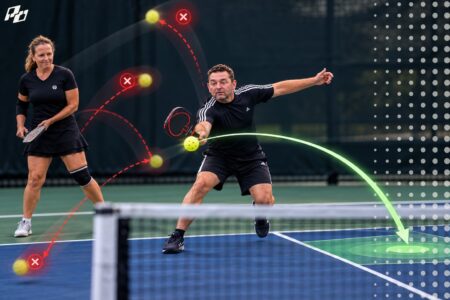
This is the first real shift players need to make: forehand middle takes it.
Why? Because the forehand gives:
- More reach — it naturally extends further into the seam.
- Better control — you can swing fluidly without jamming your wrist.
- More offense — forehand drives and counters are naturally stronger than cramped backhands.
Scenario: Two righties are at the kitchen. Ball comes straight between them. The left-side player has their forehand in the middle—that’s their ball, every time. No discussion needed.
This one adjustment will clean up half of your middle confusion.
The Lefty-Righty Advantage
Now let’s flip it. If you’re lucky enough to play in a lefty-righty pair, your team has a built-in weapon: two forehands in the middle.
That changes everything. Suddenly, the seam isn’t a weakness—it’s a wall. You can pinch tighter, close the gap more aggressively, and dare opponents to go sideline, where errors are more common.
But here’s the key: even though both players can take the middle, you still need a rule to avoid hesitation.
- Default rule: The player whose paddle is naturally closer to the ball should take it. If the ball is slightly left-center, the lefty steps in. If it’s slightly right-center, the righty takes it.
- Aggression rule: If one partner has a stronger attack (say, the righty has a huge forehand), you can agree that they get first rights on all middle balls unless the lefty clearly has an easier swing.
- No-rule = chaos. Without clarity, you risk both lunging or both freezing—two forehands in the middle isn’t an advantage if you’re unsure who swings.
It’s why so many top pro teams—like Ben and Collin Johns—love lefty-righty combinations. The geometry works, but the communication is what makes it deadly.
Practical tip: If you have a lefty-righty partnership in rec play, stack your serve/return so those forehands meet in the middle. Then, agree before the game on who takes which middle balls. That way, you maximize offense without the dreaded paddle clash.
Tilt, Don’t Split: Dynamic Ownership of the Court
The real key to elite doubles isn’t symmetry—it’s tilt.
Instead of dividing the court in half, think of it as a teeter-totter. Wherever the ball goes, your team tilts that way:
- If your partner is pulled wide, your job isn’t just to “cover your side.” It’s to slide with them and protect the T (the kitchen/centerline intersection).
- If you’re pulled wide, they slide with you, sealing the middle so you aren’t left stranded.
This fluid shifting removes seams and makes your pair feel like a single moving wall.
Coach Morgan Evans explains it well: “Don’t split the court. Split the angles.”

Common Middle Scenarios (and How to Handle Them)
1. The Hesitation Error
Ball comes through the middle. Both players think the other will take it. Neither swings. Point lost.
Fix: Forehand middle rule + early “mine” calls.
2. The Clash Error
Ball comes through the seam. Both players dive at it. Paddles collide. Point lost.
Fix: Set default rules before the game (“forehand middle,” “call early”) so there’s no panic reaction.
3. The Wide Pull
Opponent dinks your partner wide. You freeze, covering “your side.” Middle opens. They attack through the gap.
Fix: Slide with your partner. Guard the T.
4. The Lefty-Righty Overlap
Two forehands in the middle, but both players hesitate, unsure who should be aggressive.
Fix: Pre-decide who is “alpha” on middle balls. Usually, the stronger attacker or the player on their forehand-dominant side.
Communication: The Missing Ingredient
Even with forehand bias and dynamic tilts, there will still be balls that are truly 50/50. The only way to avoid chaos? Talk.
At the pro level, teams are loud. Every middle ball gets a call:
- “Mine!”
- “Yours!”
- “Switch!”
At the 3.0–3.5 level, most errors happen not because the ball was hard—but because nobody spoke up.
If you want to stop giving away points, start talking more. Yes, you’ll sound noisy. That’s what winning sounds like.
Training Smarter: How to Practice Middle Coverage
1. The Arm Reach Test
Stand side by side at the kitchen line. Reach across. If your fingertips can’t touch, you’re too far apart. Close the gap until you can.
2. Middle Drill
Have a partner feed continuous balls down the seam. Use the forehand-middle rule for every ball. Train muscle memory until it’s automatic.
3. Tilt Drill
Have a feeder dink your partner wide. Your only job? Slide to guard the T. Then switch roles. Learn to feel the tilt.
Advanced Layer: Micro-Positioning
At higher levels, doubles positioning comes down to inches.
- Half-step off the NVZ line during firefights can give you more reaction time.
- Pinching 1–2 feet tighter in the middle during a hands battle closes off your biggest vulnerability.
- Angling your body (not just your paddle) toward the ball funnels your team shape into the strongest defense.
These are the little upgrades that separate solid 3.5s from confident 4.0s.
The Bottom Line
Splitting the court evenly feels logical, but pickleball isn’t about fairness—it’s about clarity and control.
- Forehand middle rules.
- Lefty-righty pairs pinch hard.
- Dynamic tilts beat static splits.
- Communication erases hesitation.
So the next time someone tells you to “cover your half,” smile. Because you’ll know the truth: the best doubles teams don’t split the court evenly—they bend it to their advantage.