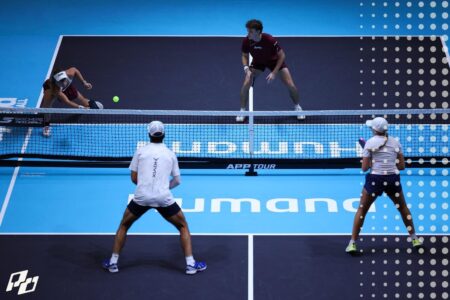
If there’s one area of the court that eats players alive, it’s the transition zone—that dreaded space between the baseline and the kitchen. At the 3.0–3.5 level especially, this is where rallies collapse and progress stalls.
We see it all the time: players charge forward recklessly, stand tall and stiff, or keep their paddle too high. The result? Popped-up balls, unforced errors, and opponents feasting on their shoelaces.
The good news? With just three adjustments, you can turn this danger zone into a stepping stone. Let’s break them down.
Tip 1: Stop Your Feet
Who it’s for: 3.0–3.5 players trying to “play up” but getting burned mid-court.
Why it’s important: Most players keep running after their third shot, leaving themselves off-balance. If you’re moving while your opponent hits, you can’t react in time.
How to put it in action: Use a split-step as your opponent makes contact. Think “Split, set, react.” This pause gives you stability and time to adjust.
Pro tip (Andre Daescu): “Stop when your opponent is about to hit—not after. Give yourself the window to react.”
Tip 2: Play Catcher, Not Sprinter
Who it’s for: Players who feel like every ball in transition targets their feet (because it does).
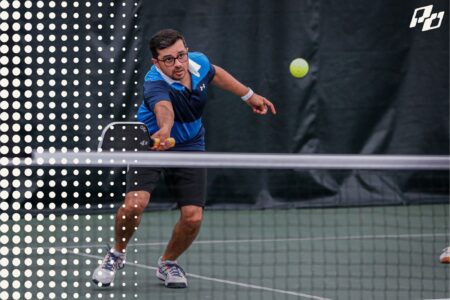
Why it’s important: If you stand tall or narrow, you can’t defend balls at your shoelaces. A wide, low stance makes you quicker and harder to jam.
How to put it in action: Picture a baseball catcher: knees bent, hips low, paddle forward. Stay wide so you can adjust laterally instead of lunging. Cue: “Sit low, stay wide.”
Tip 3: Lower the Paddle
Who it’s for: Anyone tired of popping up “easy” balls in transition.
Why it’s important: At the kitchen, your paddle guards your face. In transition, 90% of attacks aim at your shins. Starting high wastes time and guarantees errors.
How to put it in action: Keep your paddle just above knee height, angled slightly forward. Anything higher than that is probably sailing out anyway.
Pro quote (James Ignatowich): “When you’re stuck in no-man’s-land, your opponent’s best play is to tag your shoelaces. Be ready down low.”
Pro tip from Catherine Parenteau: the right paddle spot.
Why These 3 Tips Matter
If you’re an intermediate player looking to break through, these three adjustments are non-negotiable. They don’t require special shots or advanced skills—just awareness and discipline. Yet most players ignore them, sprinting forward with paddles high and bodies stiff.
Fix these first, and suddenly:
- Drops land softer.
- Drives stop eating your feet.
- You get to the kitchen more often.
That’s the foundation. Once you own these, the rest of your transition game becomes far easier.
Beyond the Basics: Elevating Your Transition Game
Now that you’ve got the three core habits, here’s how to layer in higher-level tactics.
Use Loft as a Reset
Panicking mid-court? Add air. A higher, softer reset buys you time and balance. Remember:
“Loft = lots of freaking time.”
Target Smarter
When in doubt, hit deep middle. Drives at hips or body jam swing paths and force weak replies.
Avoid low-percentage sidelines.
Partner Dynamics
Move as a team. Stay tied with an “invisible string”—if your partner stops, you stop. Cover your third of the court and share the middle.
Compact Your Swings
Transition shots need inches, not feet. Short blocks and resets keep the ball neutral and prevent giveaways.
The Transition Zone Mindset
Don’t think of the transition as a sprint; think of it as stairs. Each shot is a step closer to the NVZ. Some rallies take two steps, others take five—but if you try to leap, you’ll fall.
Decision cues:
- High ball? Drive to body/hip.
- Low ball? Reset crosscourt.
- Off-balance? Loft it high, regroup.
Patience isn’t passive—it’s the secret weapon that gets you to the line intact.
Your Transition Zone Game-Changer
The transition zone will always feel uncomfortable—that’s the point. It’s where rallies are won or lost, and where intermediate players either stall or break through.
The difference isn’t magic technique. It’s discipline: stopping your feet, staying low and wide, and keeping that paddle down. Simple shifts, but they change everything.
I’ve watched players go from looking panicked in no-man’s land to looking calm and confident just by committing to those three habits. And once you feel that calm—once you stop giving away points and start reaching the kitchen ready to rally—you’ll wonder how you ever played without it.
So the next time you push forward, don’t think “danger zone.” Think “this is where I grow.”
Because when you master the middle, the game doesn’t just get easier—it gets a whole lot more fun.