
Fear after a pickleball injury is normal, but playing scared can make you stiff, late, and less safe. Rebuild confidence with smart return-to-play rules, better balance, stronger movement patterns, safer footwork, and clear limits on risky balls, lobs, and falls.
There is a weird moment that happens after a pickleball injury.
The doctor clears you.
Your PT says you can ease back in.
The ankle, knee, calf, wrist, hip, or shoulder is technically “good enough.”
Then you put on your court shoes, walk onto the court…
And suddenly your body does not feel like yours.
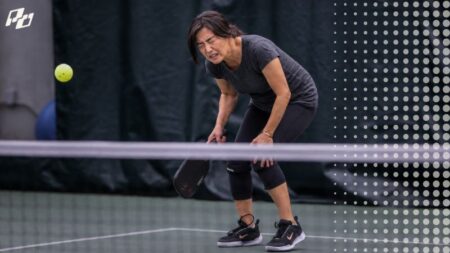
You hesitate on volleys you used to take automatically. You let balls bounce that you normally would attack. You avoid moving wide. You flinch when someone lobs. You feel your feet get careful, stiff, and slow.
And then comes the most frustrating part:
You are not just afraid of pain. You are afraid of trusting yourself.
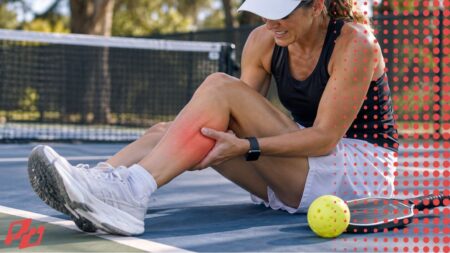
That fear is real. And for many rec players, especially players returning after a fall, ankle sprain, fracture, knee surgery, calf tear, or hard crash onto the court, it can be more limiting than the injury itself.
But here is the important part: the answer is not to “just be confident.” That is useless advice. Confidence after injury is not a personality trait. It is a physical skill you rebuild.
You rebuild it by giving your body proof that it can handle pickleball movement again — first slowly, then unpredictably, then under pressure.
That is the difference between returning to the court and actually trusting yourself on the court.
Fear Changes the Way You Move
Fear after an injury is not imaginary.
In sports medicine, fear of movement or re-injury is often discussed under terms like kinesiophobia or re-injury anxiety. In plain English, it means your brain starts treating certain movements as dangerous, even after the tissue has healed enough to begin playing again.
That protective instinct makes sense. Your brain remembers the fall, the pop, the twist, the swelling, the crutches, the brace, the missed games. It does not want to go through that again.
The problem is that fear can change your movement patterns.
- You may move with a stiffer ankle.
- You may avoid bending your knees.
- You may reach instead of taking a real step.
- You may stop split-stepping because you are afraid of landing wrong.
- You may backpedal awkwardly because you do not want to turn and run.
- You may arrive late to the ball because you hesitated, then make a bigger, more desperate movement at the last second.
That is the cruel part: playing scared can sometimes make movement less safe.
Not because caution is bad. Caution is smart. But stiff, delayed, overprotective movement is not the same as controlled movement.
The goal is not to remove all fear on day one.
The goal is to turn fear into information, then rebuild movement quality until your body stops bracing against every ball.
Pickleball Falls Are Different From “Normal” Exercise Risk
Pickleball looks friendly. It is social, accessible, and less physically intimidating than many sports.
But the movement demands are sneakier than people think. You are not just walking around and tapping a plastic ball.
You are stopping hard, shuffling laterally, reaching outside your base, lunging forward, reacting to deflections, turning for lobs, getting pulled wide, and occasionally trying to change direction while your weight is already committed.
That combination creates a very specific injury environment.
Falls often happen when a player is:
- moving backward
- reaching outside their base
- crossing one foot awkwardly behind the other
- landing from a reach or small jump
- wearing shoes that are not built for lateral movement
- fatigued late in a session
- or trying to save a ball that probably should have been let go
For older players, the stakes can be higher because bone density, reaction time, muscle power, balance reserve, vision, medication effects, and previous injury history may all matter.
That does not mean older players should be afraid of pickleball. It means the comeback plan should respect what the game actually asks of the body.
Pickleball is low barrier. It is not zero risk.
The Bad Comeback Plan: “I’ll Just Play Easy”
A lot of players return from injury with one plan: “I’ll just take it easy.”
That sounds reasonable, but it is too vague. What does “easy” mean?
No running?
No lobs?
No hard games?
No tournaments?
No bangers?
No chasing wide balls?
No sudden pivots?
No backpedaling?
If you do not define it, “easy” disappears as soon as the first competitive rally starts.
You tell yourself you will be careful. Then someone floats a ball. Your old instincts turn on. You reach, twist, plant, or chase before your brain catches up.
A better comeback plan is not based on effort. It is based on movement rules.
Instead of saying, “I’ll play easy,” say:
✓ No backpedaling for the first two weeks.
✓ No chasing lobs over my head.
✓ No running through the transition zone.
✓ No second-step lunges for balls I can only barely reach.
✓ No partners who pressure me to cover everything.
✓ No three-hour sessions just because the group needs one more.
That is not fear. That is smart load management.
The Better Angle: Rebuild Trust in Layers
Court confidence comes back in layers. You do not go from “injured” to “full-speed open play” in one jump.
You rebuild four things:
- tissue capacity
- movement confidence
- reaction confidence
- and decision confidence
Tissue capacity means the injured area can tolerate the forces of pickleball: lateral push-offs, deceleration, small hops, low positions, and repeated rallies.
Movement confidence means you can perform the movements without guarding or freezing.
Reaction confidence means you can handle unpredictability — a deflection, a lob, a ball at your feet, or a partner poaching across you.
Decision confidence means you know which balls are worth pursuing and which balls are not.
Most players only think about the first one. They ask, “Is my ankle healed?”
But pickleball asks a more complete question: Can your ankle, brain, balance, shoes, and decision-making handle the next awkward ball?
That is what we have to train.
The Return-to-Court Ladder
Here is a more useful return plan than “just start slow.” Think of your comeback in stages.
| Stage | What You Do | What You Must Prove Before Moving On |
|---|---|---|
| Stage 1: Controlled hitting | Dinks, soft volleys, cooperative rallies | No pain spike, no guarding, no fear response on simple steps |
| Stage 2: Pattern drilling | Planned side steps, forward/back movement, controlled resets | You can move both directions without stiffening or overprotecting |
| Stage 3: Reactive drilling | Random feeds, partner moves you slightly, controlled speed changes | You can react without panic steps or reaching outside your base |
| Stage 4: Modified games | Skinny singles, half-court games, no-lob games, lower-intensity doubles | You can make decisions under pressure without chasing unsafe balls |
| Stage 5: Full rec play | Normal games with clear limits | You recover between points, manage fatigue, and avoid hero movements |
| Stage 6: Competitive play | Leagues, tournaments, high-intensity sessions | You can handle speed, fatigue, and unpredictability without reverting to fear movement |
The key is not time. It is proof. You do not move up because seven days passed. You move up because your body showed you it can handle the previous level.
The 24-Hour Rule
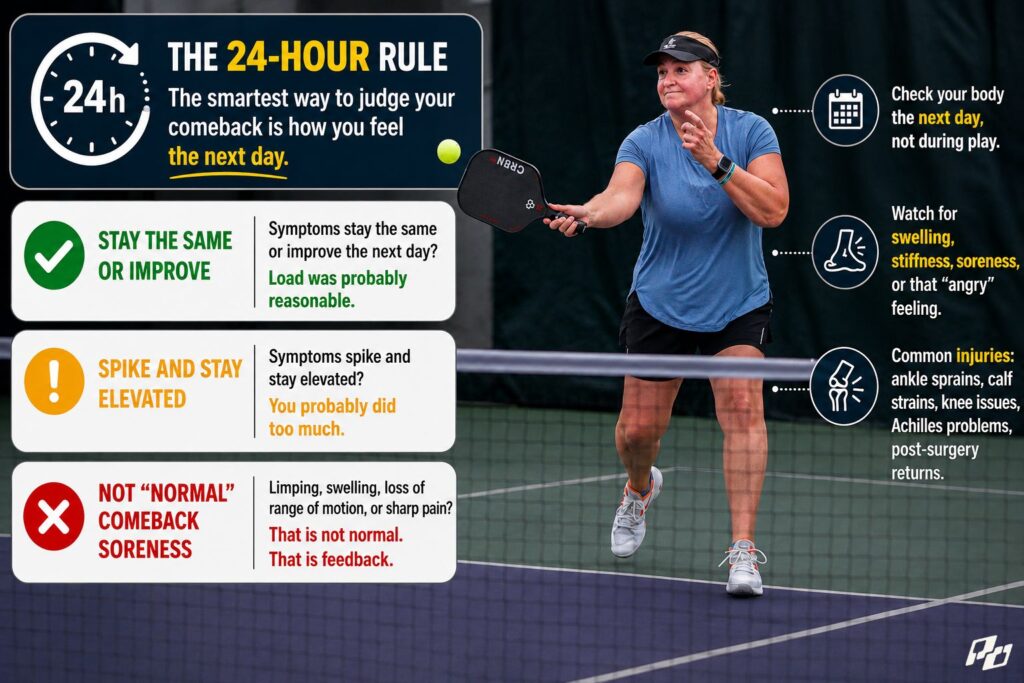
One of the smartest ways to judge your comeback is not how you feel during play. It is how you feel the next day.
During pickleball, adrenaline can hide irritation. You may feel okay in the session, then wake up the next morning with swelling, stiffness, soreness, or a sense that the injured area is angry.
Use a simple 24-hour rule:
⮕ If symptoms stay the same or improve the next day, the load was probably reasonable.
⮕ If symptoms spike and stay elevated, you probably did too much.
⮕ If you limp, swell, lose range of motion, or feel sharp pain, that is not “normal comeback soreness.”
That is feedback.
This is especially important for ankle sprains, calf strains, knee issues, Achilles problems, and post-surgery returns.
The Fear Scale: A Better Way to Know If You’re Ready
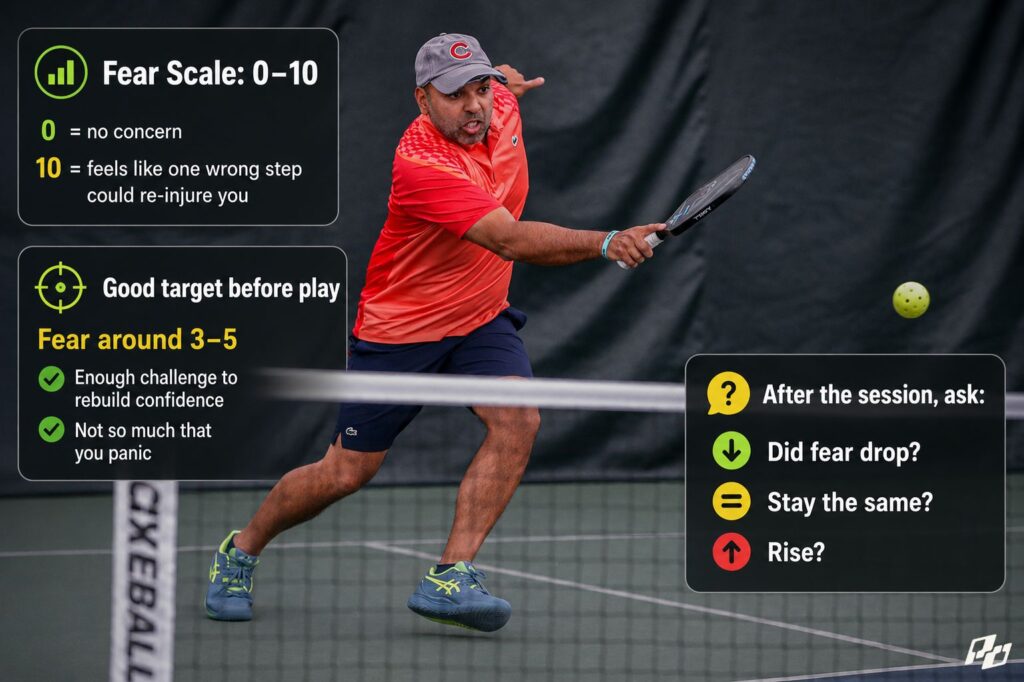
Pain is not the only thing to track. Track fear too.
Before you play, rate your fear from 0 to 10:
- 0 means no concern.
- 10 means you feel like one wrong step will injure you again.
For return-to-play, you do not need to be at zero. That is unrealistic.
But if your fear is at 7 or 8, full-speed open play is probably too big a jump. Your body will likely guard, hesitate, and stiffen.
A better target is to practice at a level where fear sits around 3 to 5. That is enough challenge to rebuild confidence, but not so much that you panic.
After the session, ask:
Did fear drop as I moved?
Did it stay the same?
Did it rise?
If fear drops during controlled drilling, that is a good sign. If fear rises during games, you may have skipped a step.
The Backpedaling Problem
If there is one movement rec players should treat with suspicion, it is backpedaling.
Backpedaling is one of the most common situations where falls happen because your feet are moving backward, your eyes are tracking the ball overhead, your center of mass may drift behind your base, and you often cannot see where you are stepping.
For players afraid of falling, lobs are not just tactical shots. They are emotional triggers.
The fix is not “never move for lobs.” The fix is to change the rule.
Do not backpedal for more than two short steps. After that, turn and run or let it go. The safest lob movement usually looks like:
- open the hips
- drop-step or pivot
- run forward toward where the ball will land
- then reset your base before hitting
If you cannot turn safely, the ball is not yours.
A practical rule: Two backpedal steps max. Then turn or concede.
That one rule can reduce a lot of fear because it gives your brain a clear boundary before panic starts.
The Reach Zone: Where Falls Begin
Many pickleball falls do not happen because players run too much. They happen because players reach from a bad base.
A safe reach usually happens when your feet are still underneath you, your chest is not falling outside your hips, and you can make contact without turning the shot into a full-body rescue mission.
A risky reach feels different.
You are leaning.
Your outside foot is stuck.
Your paddle is chasing the ball.
Your weight is drifting past your base.
And the next step feels less like movement and more like survival.
That is the danger zone.
The problem is that during a fast rally, you usually do not have time to ask, “Can I recover after this shot?” That is too much thinking. So use a simpler rule:
If the second step would be desperate, let it go.
Here’s what that means. If you can take one controlled step, hit the ball, and stay mostly balanced, the ball is probably playable.
If you need a second emergency step, a reach-lunge, a twist, or a falling swipe just to touch the ball, that ball is probably not worth it — especially when you are returning from injury or rebuilding confidence after a fall.
Think of your playable range as a bubble, not a challenge.
⮕ Inside the bubble, compete.
⮕ Outside the bubble, protect the session.
This is especially important on wide dinks, sharp angles, balls behind your hip, and shots that pull you toward the sideline while your momentum is still moving the wrong way.
A better cue: One controlled step is pickleball. Two desperate steps is trouble.
That does not mean you never stretch for a ball again. It means you stop treating every barely reachable ball like it deserves your body.
Why Court Shoes Matter More After an Injury
Shoes do not make you injury-proof. But the wrong shoes can absolutely make court movement riskier.
Running shoes are built mainly for forward motion. Many have higher stack heights, softer cushioning, and shapes that can feel unstable during lateral cuts. Pickleball requires repeated side shuffles, hard stops, pivots, and diagonal recovery steps.
Court shoes are built for lateral support, outsole grip, sidewall stability, and controlled court movement.
After an ankle injury or fall, footwear matters even more because your confidence is already fragile. If your shoe feels unstable, your brain knows it. You may start guarding before you even hit the ball.
Look for:
✓ Lateral stability
✓ Secure heel lockdown
✓ A wide enough base
✓ Court-specific outsole grip
✓ Forefoot support
✓ A fit that prevents sliding inside the shoe
Avoid shoes that feel tall, wobbly, overly soft, or unstable during side shuffles.
Braces: Crutch or Confidence Tool?
A lot of players wonder if wearing a brace means they are weak or dependent. That is the wrong question.
The better question is: Does the brace help me move better while I rebuild capacity?
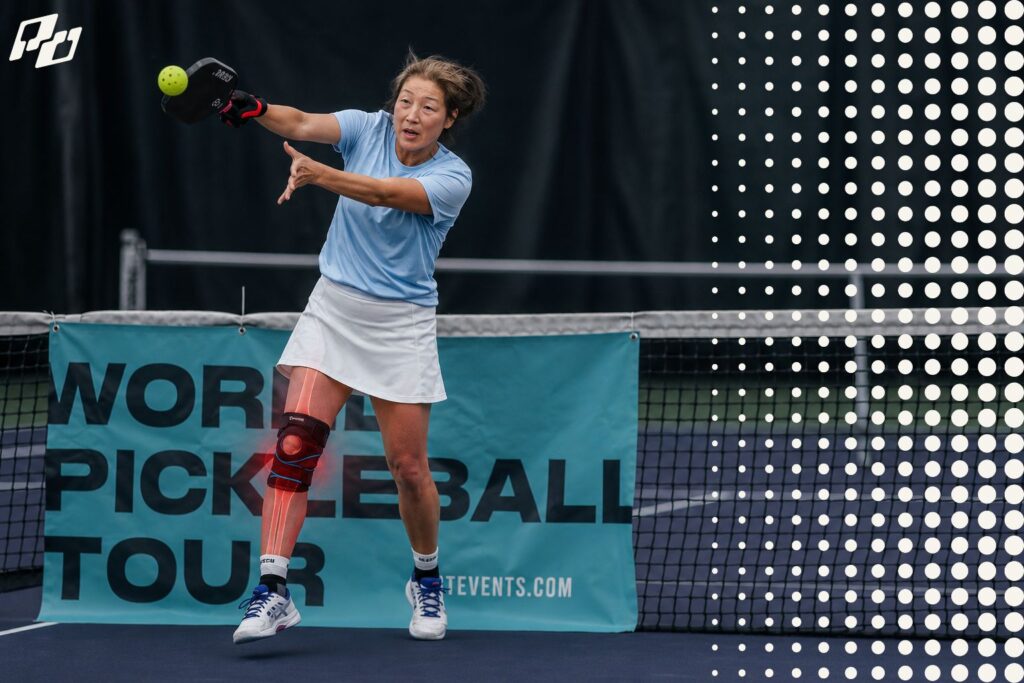
For ankles, braces can be useful during return to play, especially after sprains or instability. They may provide mechanical support, but they also provide sensory feedback — a reminder of joint position and movement.
That can matter psychologically too. If a brace reduces fear enough that you move more normally, it may be helpful.
But a brace should not replace rehab.
If you only brace and never rebuild strength, balance, calf capacity, hip control, and change-of-direction skill, you may be outsourcing confidence instead of rebuilding it.
Think of the brace as scaffolding. Useful while the building is being reinforced. Not a substitute for the building.
The Strength Work That Actually Carries Over
Generic “strengthen your legs” advice is too vague.
Pickleball asks for very specific capacities.
- You need calf strength for push-off and deceleration.
- You need ankle control for lateral stability.
- You need quad and glute strength for lunging and stopping.
- You need hip strength to keep the knee and ankle from collapsing inward.
- You need trunk control so your upper body does not pull you off balance when you reach.
For many players returning after injury or fearing falls, the biggest missing piece is not maximum strength. It is strength under control while changing direction.
Useful exercises include:
✓ Slow calf raises
✓ Single-leg balance with head turns
✓ Lateral step-downs
✓ Split squats
✓ Side lunges
✓ Banded lateral walks
✓ Farmer carries
✓ Controlled deceleration steps
But here is the real key: the exercise must eventually look a little like pickleball.
Standing on one foot in your kitchen is a start. But pickleball balance is not stillness. It is balance after movement. So progress from static balance to dynamic balance:
- stand on one leg
- then reach with the opposite foot
- then add a paddle shadow swing
- then add a partner pointing left or right
- then add a soft ball feed
Confidence comes from movement-specific proof.
The First Month Back: What to Avoid
Returning players often ask what they should do. Just as important: what should they temporarily remove?
For the first month back, consider limiting or avoiding:
✖️ Backpedaling for lobs
✖️ Ernies and ATP chases
✖️ Jumping overheads
✖️ Full-speed skinny singles
✖️ Playing with reckless partners
✖️ Playing when fatigued
✖️ Three-hour open-play marathons
✖️ Hard court sessions on consecutive days
✖️ Games where you feel pressured to chase balls you already decided to let go
This is not forever. It is a bridge.
You can return to dinking before you return to sprinting.
You can return to doubles before you return to singles.
You can return to controlled rec games before you return to tournaments.
You can return to the sport before you return to hero ball.
The Comeback Court Rules
If you are returning after injury or dealing with fear of falling, give yourself court rules before the first rally.
Not emotional rules.
Movement rules.
The reason this matters is simple: once the point starts, your competitive brain takes over. You will not always make your safest decision in the middle of a scramble.
So decide your limits before the ball is served. Try these:
⮕ No backpedaling beyond two short steps.
⮕ No chasing balls that are already behind my shoulder.
⮕ No second-step lunges for wide balls.
⮕ No twisting reach when my outside foot is planted.
⮕ No playing more than two games before checking symptoms.
⮕ No adding a third hour because I feel good in the moment.
⮕ No hiding pain to keep a game going.
⮕ No apologizing for letting a risky ball go.
The most useful rule here is the second-step rule.
One controlled step is usually fine. But when a ball requires a second desperate step, a falling reach, or a last-second twist, that is where a lot of trouble starts.
You are not trying to decide whether the ball is technically reachable. Lots of unsafe balls are technically reachable.
You are deciding whether you can play it without turning the point into a balance test. Set the rules before the point. Then obey them when the ball tempts you.
How to Talk to Your Partners Without Making It Awkward
A lot of players returning from injury worry about being a burden. They do not want partners to think they are fragile, slow, or making excuses.
But good communication actually makes the game safer and more enjoyable. Keep it short:
- “I’m easing back after an ankle injury, so I’m not chasing lobs today.”
- “I’m good for normal rallies, but I’m letting risky wide balls go.”
- “I’m rebuilding confidence, so I may play a little more controlled.”
- “I’m not 100% yet, but I’m cleared to play light games.”
You do not need a medical speech. You need a boundary.
Most reasonable partners will respect that. If someone does not, that is useful information. They are not the right partner for your comeback phase.
A Practical Four-Week Confidence Rebuild
This is not a medical rehab plan. Your doctor or PT should guide your specific return after a real injury.
But for many rec players who have been cleared to play, this kind of structure makes more sense than jumping straight into normal open play.
Week 1: Re-enter the Court
Goal: feel safe on the surface again.
Do cooperative dinks, soft volleys, easy serves and returns, and controlled footwork. Avoid games if they make you chase.
⮕ Keep sessions short.
Your win is leaving the court feeling better, not proving anything.
Week 2: Add Direction Change
Goal: rebuild side-to-side trust.
Add planned shuffles, controlled lunges, transition-zone movement, and half-court rallies.
⮕ Still avoid chaotic open play.
Track your fear level and next-day symptoms.
Week 3: Add Reaction
Goal: handle mild unpredictability.
⮕ Use random feeds, soft competitive drills, skinny court points, and modified doubles.
Still keep rules: no backpedaling, no hero lunges, no fatigue marathons.
Week 4: Return to Controlled Games
Goal: play real points with boundaries.
Choose partners and opponents wisely. Play shorter blocks. Take breaks. Keep the risky-ball rules.
⮕ If your body and confidence respond well, gradually increase intensity. If fear spikes or symptoms flare, step back one level.
That is not failure. That is training.
The “Safe Aggression” Framework
One reason returning players struggle is that they think they have only two choices: play scared, or play reckless.
There is a third option: safe aggression.
Safe aggression means you still compete, but you choose attacks and movements that keep your body organized.
You can still attack high balls.
You can still take kitchen space.
You can still pressure feet.
You can still poach within your range.
You can still play smart, tough pickleball.
But you stop treating every ball as a test of courage. A safe-aggressive player says:
✅ I will attack when balanced.
✅ I will reset when late.
✅ I will turn instead of backpedal.
✅ I will let go when the shot turns into a rescue move.
✅ I will win through positioning, not desperation.
That fourth one matters.
You do not need to avoid every stretch. Pickleball includes reaching, lunging, and reacting. But there is a difference between an athletic reach and a rescue move.
An athletic reach still has control.
A rescue move feels like your body is falling, twisting, or hoping.
That is the line.
If the shot makes you feel like you are saving the point with your joints instead of your footwork, let it go.
That is mature pickleball.
When to Stop and Get Rechecked
Some fear is normal. Some symptoms are not. Stop and get medical guidance if you notice:
- sharp pain
- new swelling
- limping
- instability or giving way
- numbness or tingling
- pain that worsens during play
- pain that is worse the next day and does not settle
- dizziness or balance changes
- or fear so strong that you cannot move normally even in controlled drills
You do not get bonus points for ignoring warning signs. The goal is to keep playing for years, not to win one Tuesday morning rally.