Feeling rushed in pickleball usually means your feet, breathing, and decisions are speeding up at the same time. The best fix is to slow down between points, exhale, loosen your grip, use simple cues, and choose safer shots like resets, higher-margin returns, and soft transition balls until you feel organized again.
Every pickleball player knows this feeling.
The rally speeds up. Your hands get tight. The ball starts feeling faster than it should. You miss one return, then one dink, then one transition ball, and suddenly you are not just playing the match anymore. You are surviving it.
Maybe you were up 8-1 and now it is 9-9.
Maybe your opponents are speeding everything up.
Maybe nothing dramatic even happened, but your body is telling you the match is out of control.
That is the moment a lot of rec players panic and try to fix the problem the wrong way. They swing harder. They rush more. They speed up the wrong balls. They stop moving their feet. They stop talking to their partner. They start playing emotionally instead of strategically.
But here is the truth: when you feel rushed, the answer usually is not to play faster.
It is to slow the match down in smart ways.
So let’s break down what recreational players should actually do when that rushed, panicked feeling shows up.
Why does pickleball suddenly feel too fast?
Because you are not just losing time. You are losing organization. That is the key distinction.
Most rec players describe the problem like this: “Everything sped up.” But the ball usually did not get that much faster. What actually happened is that your brain and body stopped syncing with the point. You got late with your split step. You stopped reading the ball early enough. You started reacting after the bounce instead of before it. You started making decisions from stress instead of from structure.
Pressure also changes how attention works. Recent research in sport psychology shows that pressure affects attentional control, which helps explain why athletes under stress get pulled away from task-relevant cues and start making worse decisions or executing worse mechanics.
Another 2024 study in precision sport found that time pressure and reward-punishment pressure can disrupt attention control processes that matter for execution.
In pickleball terms, that often looks like this:
- you stop reading paddle angle
- you start overreacting to pace
- you swing before your feet are set
- and you treat every ball like an emergency
That is why this topic is so important for rec players. Feeling rushed is not just an emotion problem. It is a decision-making and tempo problem.
What should you do first when you feel panicked?
You should lower the intensity of the moment before you try to “fix” your strokes.
That is the first move.
A lot of players do the opposite. They feel panicked, so they immediately try to think their way out of it mechanically:
- “Stay down.”
- “Watch the ball.”
- “Use my legs.”
- “Do not pop it up.”
- “Do not miss.”
- “Relax.”
That usually does not work, because the body is still in a rushed state. You cannot solve a tempo problem with twelve mechanical thoughts.
The better first step is to regulate the body a little. A towel break, tying a shoe, walking back to position more deliberately, or asking your partner to slow the between-point pace are not silly little habits. They are reset tools. They create just enough separation between rallies for you to interrupt the spiral.
And this is not just folk wisdom. Breathwork research and pickleball-specific coaching both point in the same direction: controlled breathing can help regulate arousal, improve focus, and support better motor control and concentration.
Selkirk’s breathwork guidance for pickleball emphasizes the role of breathing in staying calm and focused, while a recent meta-analysis on breathing techniques in sport found evidence for benefits in physical sport performance and concentration-related outcomes.
A very simple between-point sequence for rec players is:
- Exhale longer than you inhale.
- Let your shoulders drop.
- Loosen your hand on the paddle.
- Say one simple cue.
- Decide the next point’s one priority.
That is enough. Not magical. Just enough.
How do you slow the match down without stalling?
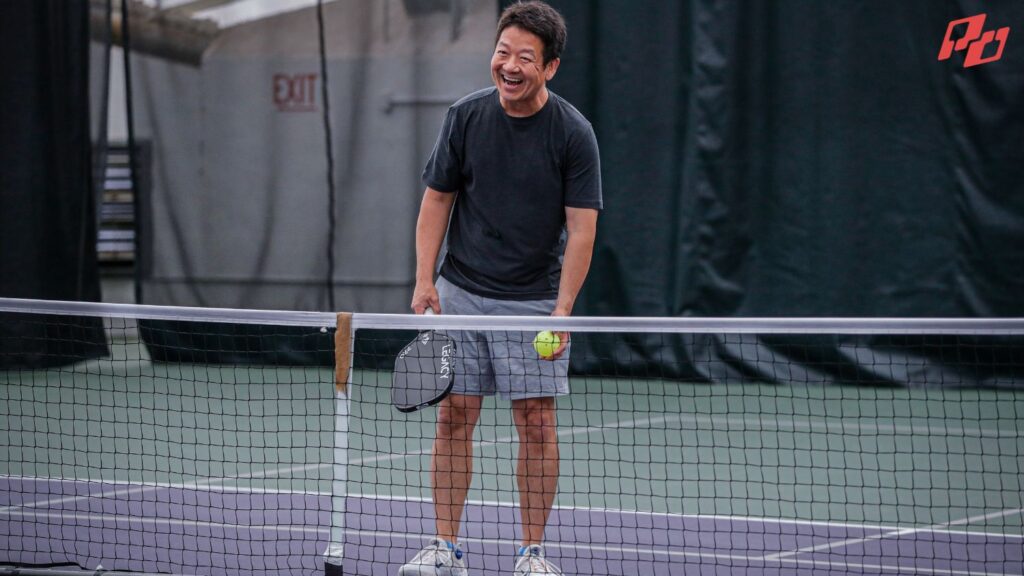
You slow your process down, not the sport itself.
That distinction matters. You are not trying to annoy opponents or drag the game out. You are trying to stop playing in a blur.
The 2026 USA Pickleball rulebook says players may quickly hydrate, towel off, and adjust equipment or apparel between rallies as long as the flow of the game is not adversely impacted. It also allows standard time-outs, with a maximum of one minute per time-out.
The server still has to serve within 10 seconds after the score call is completed, so the point is not to stretch the rules. The point is to use the legal space that already exists.
For rec players, that means you can do things like:
- walk back to position with purpose instead of hurrying into the next rally
- towel off
- turn briefly to the fence and reset your breathing
- make eye contact with your partner
- use a short partner cue like “one ball at a time” or “soft game here”
- or call a timeout before the next serve if things are unraveling
Those small pauses matter because pickleball gives you very little natural downtime compared with a sport like tennis. Better Pickleball makes this exact point in its between-points mental game advice: the short gaps between rallies can make pickleball mentally tougher because players do not automatically get much time to reset.
That is why rec players should stop thinking of between-point time as dead time. It is performance time.
What shot choices actually help when the game feels too fast?
The answer is usually: higher-margin, softer, more neutral shots.
This is where many rec players sabotage themselves. They feel rushed, so they try to hit a “confident” shot, which often means a harder shot. But when you are sped up, the smartest play is often to choose the shot that buys organization.
That is why the reset is so important. The reset is your go-to option when you are under pressure because it helps you slow the pace and recover from a tough defensive position.
That gives you a very practical rule for rec play:
When you feel rushed, stop asking, “How do I win this ball?”
Start asking, “How do I make the next ball simpler?”
Usually that means:
- reset instead of countering too hard
- lift and shape instead of punching flat from bad balance
- send a deeper, safer return instead of trying to do something fancy
- and use more arc when needed so the ball gives you time
A good panic-proof sequence is:
- block
- reset
- reclaim position
- then attack later
What technical cues help most under pressure?
The best cues are short, external, and tied to the moment.
Research and applied sport-psych work both support the value of routines, self-talk, and cue statements under pressure, especially when they keep attention directed toward the task instead of the fear. Cue statements work best when they are short and simple, not essay-length instructions.
For pickleball, I would keep the cues very practical.
If you are defending:
- Soft hands
- See ball
- Arc and breathe
- One more ball
If you are in transition:
- Set feet first
- Reset, don’t rush
- Low and through
- Balance before pace
If you are serving or returning after a mini-spiral:
- Big target
- Deep and simple
- Spin, not force
- Make them play
If your problem is emotional snowballing:
- New point
- Not that point
- Small next job
- Calm wins
The point of these cues is not motivation. It is attentional control. You are giving the mind one useful place to stand.
How should you talk to your partner when things are unraveling?
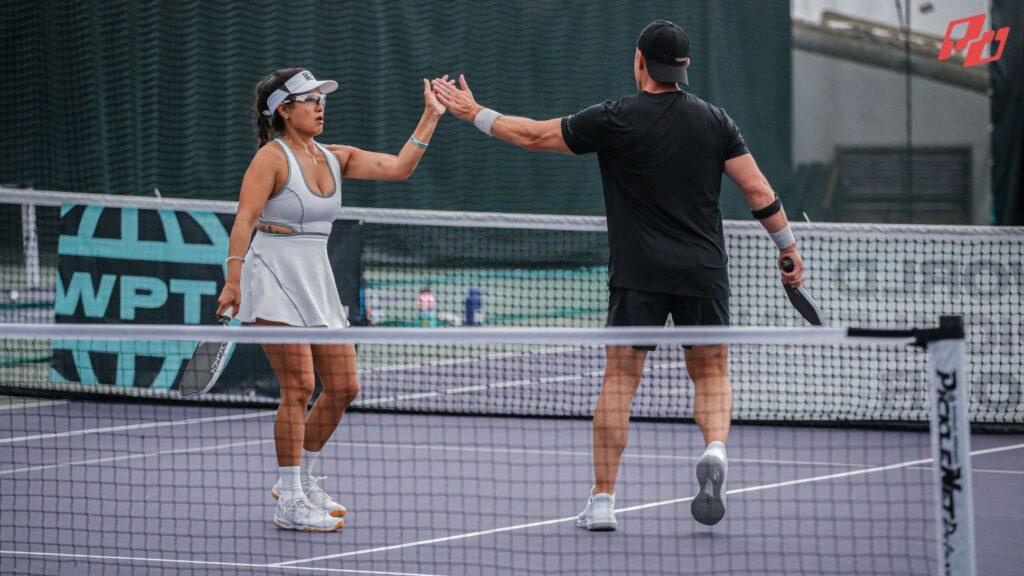
You should make the match feel smaller, not heavier. This is huge in doubles.
When both partners feel the momentum slipping, they often make it worse by over-talking, blaming, teaching, or trying to solve the whole match in one conversation. That usually adds more tension.
What works better is very short, very clear communication. In the middle of a rushed patch, try language like:
- “Let’s get one good return.”
- “Soft game for two balls.”
- “Middle is yours.”
- “Make them beat us slow.”
- “We’re fine. One point.”
That kind of language works because it simplifies the problem. It also helps both players get task-focused again, which is exactly what pressure research suggests matters.
One underrated trick is asking your partner to physically slow down between points. That is smart. If one partner rushes to the line, grabs the ball fast, and starts the next point immediately, that body language can drag the whole team into a frantic tempo.
Sometimes the best team tactic is simply: “Let’s walk slower. Breathe. Then play.”
What does “slow the game down” actually look like in a rally?
It does not mean moonballing everything or refusing to attack. It means choosing shots that reduce chaos until you are back in structure.
Usually that looks like:
- more resets from the transition zone
- fewer low-percentage speed-ups
- more crosscourt dinks if the middle is getting wild
- deeper returns instead of flashy ones
- and more acceptance that you may need to defend for a ball or two before trying to flip the rally
That gives rec players a very usable framework: when you feel rushed, your first job is not to look dangerous. Your first job is to become organized again.
That may sound less exciting, but it wins far more points than trying to “play big” from panic.
Can you train this before match day?
Yes — and you should, because panic is easier to manage when the reset routine already exists.
A few practical ways to train this in rec pickleball:
1. Play “reset-only” transition drills.
Any ball that comes hard at you in transition must be reset, not countered. This teaches you that not every fast ball requires a fast answer.
2. Practice a between-point routine in rec games.
Exhale, loosen hand, say cue, pick target. Do it even when the game is casual, so it exists when the score gets tight.
3. Run pressure games starting at 8-8 or 9-9.
That simulates the emotional texture of momentum swings, which sport-psych research suggests is useful for performance under pressure.
4. Practice partner cues.
One phrase for calming down. One phrase for returns. One phrase for soft game. Make them automatic.
So what is the real fix when you feel rushed?
The real fix is not “relax.”
It is reset your body, simplify your decisions, and choose shots that buy time instead of borrowing trouble.
The players who recover best are not necessarily the calmest by personality. They are the ones with the best reset system.
They know how to:
- use the seconds between rallies
- lower their breathing
- loosen their grip
- communicate simply
- stop trying to win the rally from panic
- and use neutralizing shots to get the match back under control
That is not soft. That is tactical. And for rec players, it may be one of the most valuable match skills to build.