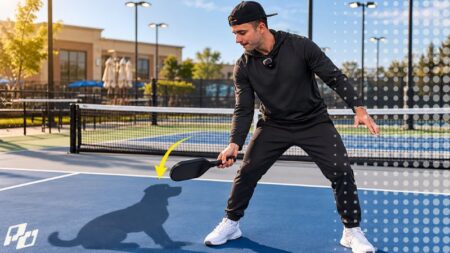

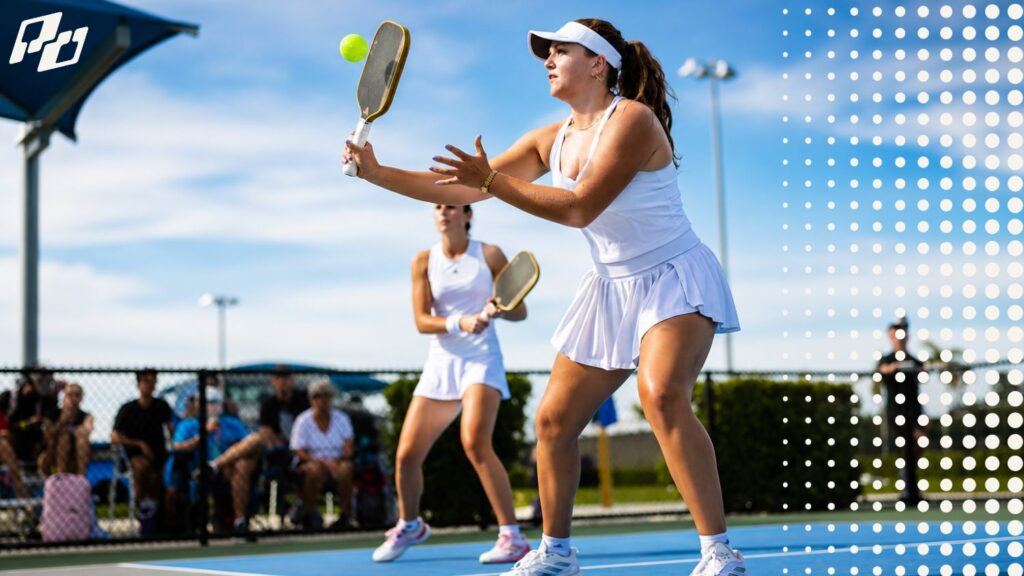
A good block volley starts with a slightly open paddle face. If the face is too vertical or closed, the ball often drops into the net. Open it just enough to absorb pace, clear the net, and land softly in the kitchen.
A lot of intermediate pickleball players think they have slow hands.
They think the problem is reaction time.
Or age.
Or hand speed.
Or that their opponents simply hit too hard.
But very often, the real problem is simpler: their paddle face is too flat on block volleys.
And that one mistake quietly destroys a huge percentage of resets, defensive volleys, transition shots, and kitchen survival exchanges.
You see it constantly at the 3.0–4.0 level.
A player gets attacked at the kitchen or transition zone. They react quickly enough. They get the paddle on the ball. But instead of softly neutralizing the speedup into the kitchen, the ball slams directly into the net.
The player thinks:
“I was there in time.”
“I blocked it.”
“Why did it still die in the net?”
Because the paddle face was too closed. That is the hidden issue.
The ball already has pace coming toward you. If your paddle face is completely vertical—or worse, slightly closed—the incoming pace drives the ball downward. The harder your opponent hits, the more brutally the ball gets forced into the net.
And once you understand this, block volleys suddenly start making a lot more sense.
Why Block Volleys Matter So Much
At intermediate level, block volleys are one of the biggest dividing lines between “solid rec player” and “hard to beat.”
Because eventually, everybody runs into speed.
You can get away with swinging at too many balls early in your pickleball journey. But once players start speeding up at the kitchen, driving harder, attacking shoulders, and pressuring the middle, pure offense stops being enough.
You need a way to survive pressure.
That is what the block volley is for.
A block volley is not a swing. It is a controlled redirection and absorption of pace. Instead of generating your own power, you use the opponent’s pace and guide the ball somewhere safer—usually low into the kitchen.
Done correctly, the block volley:
✓ slows the rally down
✓ neutralizes attacks
✓ keeps you alive during hand battles
✓ prevents pop-ups
✓ helps you reset from trouble
✓ forces opponents to hit another ball
✓ buys time for recovery and positioning
And honestly, this is where many intermediate players stall out.
They can attack.
They can drive.
They can speed up.
But they cannot absorb pressure consistently.
That is why good reset players feel so frustrating to play against. You hit a good attack… and somehow the ball keeps coming back soft and low.
The Real Problem: The Paddle Face Is Too Flat
This is the classic mistake.
A player sees a fast ball coming and instinctively tries to “block” it by sticking the paddle out stiffly with a flat or slightly downward-facing paddle face.
The elbow lifts.
The wrist locks.
The paddle stays vertical.
The player braces for impact.
And the ball goes directly into the net.
Why?
Because physics is winning.
The incoming ball already has forward and downward momentum. If your paddle face does not give the ball a slight upward rebound angle, the pace continues downward after contact.
That is why a tiny paddle-face adjustment matters so much.
Not huge.
Not exaggerated.
Just slightly open:
Enough so the ball can rebound upward, clear the net, lose speed, and fall back into the kitchen.
That tiny adjustment is the difference between:
dead net ball
and
soft neutralizing reset.
The Biggest Misunderstanding About “Blocking”
A lot of rec players hear “block volley” and imagine a hard, firm stop. But a good block volley is usually softer than players expect.
You are not punching the ball.
You are not jabbing at it.
You are not trying to win the point immediately.
You are absorbing. Think of catching an egg instead of slapping it.
The paddle face stays stable, but the body and hand soften slightly through contact so the ball loses speed instead of bouncing explosively back upward.
This is why better reset players often look calm during fast exchanges. They are not fighting the pace. They are redirecting it.
Why Intermediate Players Struggle Here
At the 3.0–4.0 level, several things happen at once:
- Players panic under speed.
- They tighten their grip.
- They raise the elbow too much.
- They stab at the ball.
- They keep the paddle face too vertical.
- They swing when they should absorb.
And they try to “win” defensive volleys instead of neutralizing them. That combination creates exactly the kind of downward rebound angle that dumps balls into the net.
A lot of intermediate players are technically quick enough to block the ball.
They just are not organizing the paddle correctly.
Why This Matters More Against Hard Hitters
The harder the incoming pace, the more important paddle angle becomes.
Against slow balls, you can get away with sloppy mechanics.
Against fast drives and speedups, you cannot.
Because the opponent is supplying the energy.
A hard speedup already carries enough pace to send the ball back. Your job is mostly angle management.
That is why high-level block volleys often look almost motionless.
Minimal swing.
Minimal stab.
Minimal effort.
Forehand vs Backhand Block Volleys
This applies to both sides—but a little differently.
Backhand Block Volley
This is usually easier for intermediate players.
Why?
Because the backhand naturally keeps the paddle more in front of the body. The structure is compact. The elbow stays relatively stable. The paddle face often stays organized more naturally.
That is why many coaches teach players to bias slightly toward the backhand during fast kitchen exchanges.
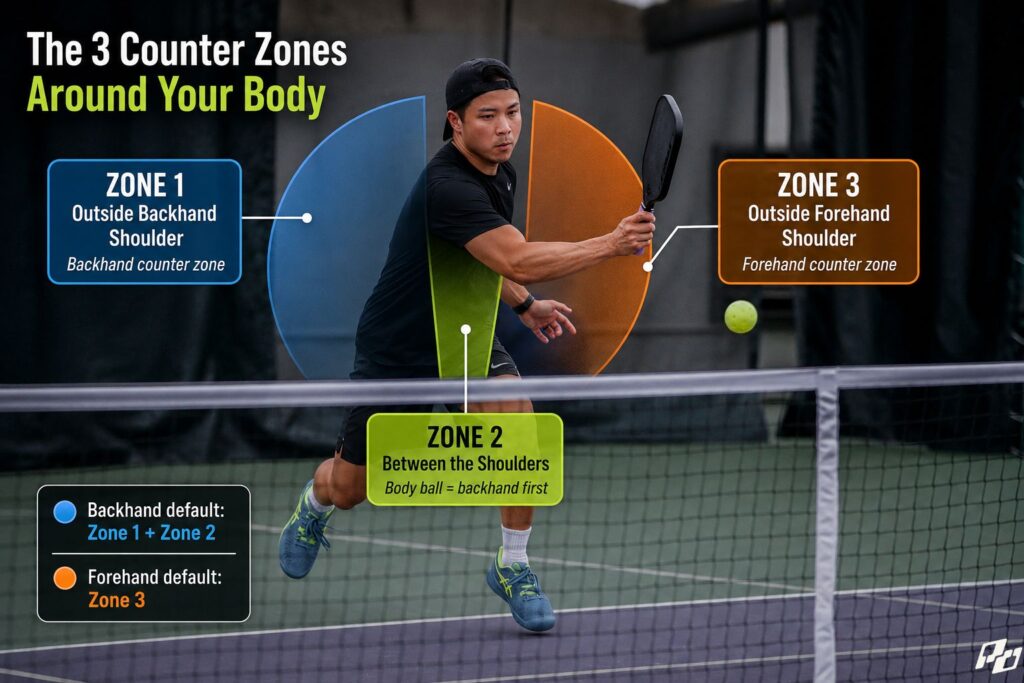
The backhand block volley is excellent for:
✓ body attacks
✓ middle speedups
✓ paddle-shoulder attacks
✓ transition resets
✓ quick counters
✓ absorbing pace compactly
The biggest mistake here is usually:
❌ too stiff
❌ too vertical
❌ too much wrist tension
The correction:
✅ slightly open face
✅ soft hands
✅ compact structure
Forehand Block Volley
The forehand side is trickier because players often over-swing or over-reach. When players panic on the forehand side, they frequently:
❌ open the elbow too far
❌ swing across the body
❌ jab downward
❌ or over-rotate
That often closes the paddle face unintentionally.
So yes, the same principle absolutely applies to forehand block volleys: the paddle face usually needs to be slightly open.
But forehand blocks also require discipline because many rec players want to counterattack every forehand volley instead of neutralizing.
Sometimes the smartest forehand volley is not offensive at all. It is just a soft reset into the kitchen.
The Grip Pressure Problem
This is huge. When players get attacked, they often squeeze the paddle too hard before contact.
That creates:
- rigid hands
- bouncy rebounds
- poor feel
- and harder resets
Good block volleys usually start with relatively relaxed hands before contact. Then the grip firms slightly during impact for stability.
Think: soft ready → firm contact → soft finish.
Not death grip from start to finish.
A useful cue: “Soft enough to absorb. Firm enough to stabilize.”
The Elbow Mistake
Another common issue: players lift the elbow too high and disconnect the paddle from the body.
That creates awkward paddle angles and poor control. You want the paddle out in front—but connected.
Not pinned to the ribs.
Not flared wildly upward.
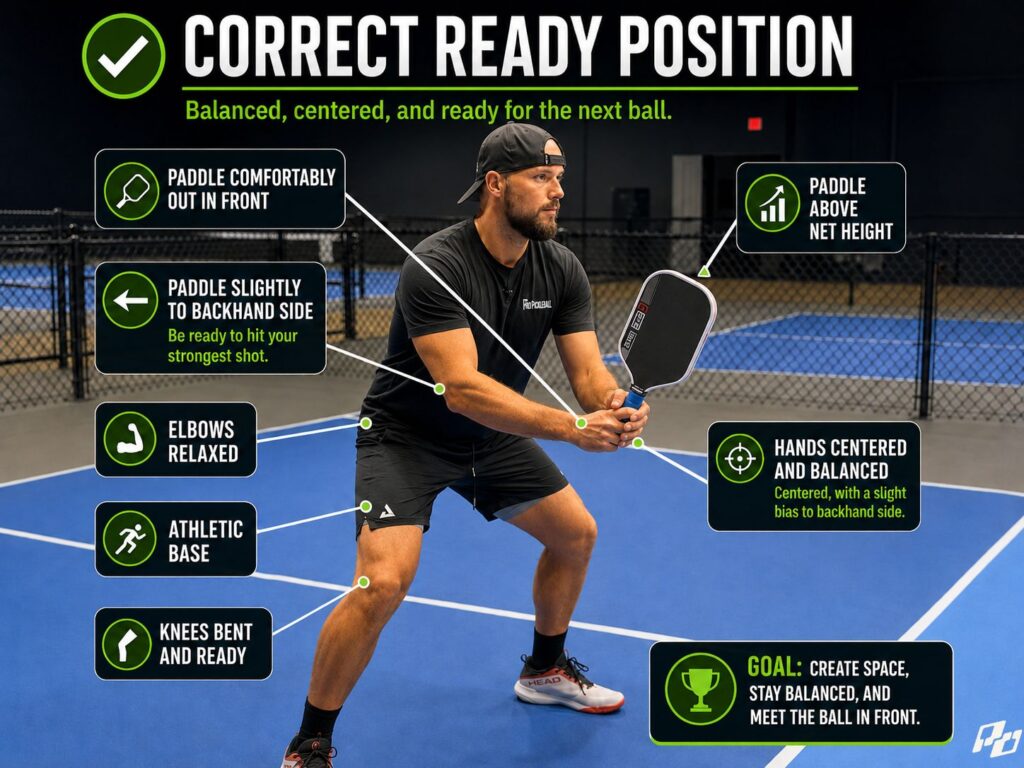
Compact and balanced. Especially on the backhand side.
Why the Ball Keeps Popping Up
Some players have the opposite problem. They over-open the paddle face and the ball floats upward.
That usually happens because:
- they absorb too little
- the paddle face opens too much
- or they lean backward during contact.
The correct block volley is not a scoop. It is a controlled rebound.
You want:
✅ slight lift
✅ low trajectory
✅ short rebound
✅ kitchen landing.
The Best Contact Height for Block Volleys
The ideal block contact is usually:
- waist to chest height
- slightly in front
- balanced posture
- stable base.
Below the net, things get harder.
At shin height, you are often resetting rather than true blocking.
At shoulder height, you may transition into a counter instead.
The classic block volley lives in that middle zone where you can absorb and redirect cleanly.
Transition Zone vs Kitchen Line
Block volleys matter in both spots, but they do not feel the same. At the kitchen, you are usually reacting to speed. In the transition zone, you are often trying to survive, soften, and reset while your body is still moving.
| Area | What the Block Volley Usually Feels Like | Main Goal | Biggest Challenge | Best Cue |
|---|---|---|---|---|
| Kitchen Line | Quick, compact, reaction-based, often against speedups | Neutralize the attack, keep the ball low, and stay in the hand battle | Reacting without stabbing or closing the paddle face | Open slightly. Absorb softly. |
| Transition Zone | More like a reset; you may be moving, stretched, or absorbing heavier pace | Lift the ball just enough to clear the net and land softly in the kitchen | Tiny paddle-angle errors become big mistakes because the ball must travel farther | Soft hands. Slight lift. Kitchen landing. |
The “Catch” Feeling
One of the best feelings for learning this shot is: catching the ball briefly on the paddle.
Not literally carrying it—just softening enough that the contact feels absorbed instead of punched.
A useful cue: “Receive the ball instead of hitting it.”
That changes players immediately.
Why Better Players Make Blocking Look Easy
Because they stop trying to “beat” the speed. That is the secret.
Intermediate players often react emotionally to pace: “They sped up—I have to hit harder back.”
Advanced players react structurally: “The ball already has speed. I just need angle and control.”
That mindset changes everything.