Better players are not obligated to teach during regular pickleball open play. They should be respectful, safe, and helpful when asked, but beginners should not expect free coaching. The best rule: ask before giving advice, offer one quick tip if invited, and keep the game moving.
Open play creates one of the weirdest social contracts in pickleball.
A beginner walks onto the court hoping to learn.
An advanced player walks onto the court hoping to play.
Both are reasonable.
Both can get annoyed.
And that is where the tension starts.
Some newer players feel like better players should help them. After all, pickleball has a reputation for being welcoming. Many people got better because someone explained scoring, showed them where to stand, or gently said, “Try getting to the kitchen after your return.”
But many stronger players feel the opposite: open play is not a free lesson. They may have limited court time, their own goals, and no desire to spend every game correcting someone’s grip, footwork, third shot, or positioning.
So who is right?
Honestly, both sides have a point.
The best answer is this: better players are not obligated to teach during open play, but they are responsible for being respectful, safe, and socially aware. Beginners are not entitled to coaching, but they are allowed to ask for help in the right way.
That distinction matters.
Open Play Is Not a Clinic
This is the first thing newer players need to understand.
Open play is usually a drop-in format where players rotate into games, often by paddle rack, queue, court level, or club structure. It is social and accessible, but it is still play. It is not automatically instruction time.
Newer players should not assume advanced players are there to coach them, and players should avoid giving tips unless asked because even well-meant advice can land like criticism.
That is the part some beginners miss.
A better player may be friendly. They may love the sport. They may even be a coach. But that does not mean every open-play game becomes their teaching shift.
Imagine showing up for a pickup basketball run and expecting the best player there to pause every possession and teach you footwork. That would feel odd. Pickleball is friendlier, yes — but it still has boundaries.
But Stronger Players Also Shape the Culture
Now the other side.
Advanced players do not have to teach, but they do influence the feel of the court. If they roll their eyes, freeze out beginners, smash every pop-up at someone’s chest, or act personally offended by lower-level mistakes, they make the game worse.
Good etiquette in mixed-level open play is not about pretending every game is equal. It is about reading the room. Uneven skill levels are common, and players should keep things fun, inclusive, and safe rather than turning every mismatch into a court-bully situation.
That is a reasonable standard.
A stronger player can play without becoming a full-time instructor. They can soften the power a little, hit more playable balls, avoid targeting the weakest player every shot, and keep the tone positive.
That is not “teaching.” That is basic court citizenship.
The Problem With Unsolicited Coaching
Here is where a lot of well-meaning players get into trouble. They think they are helping.
“Move up.”
“Bend your knees.”
“Don’t back up.”
“Third shot drop.”
“You should have let that go.”
“Try continental grip.”
The advice may be correct. The timing may still be terrible.
During open play, unsolicited coaching can feel like a public performance review. It can embarrass the player, slow the game, annoy the other team, and make the stronger player look condescending. The core idea is simple: not everyone wants feedback during play, even if the feedback is technically useful.
This is especially true when the “coach” is just another rec player.
There is a difference between: “Want one quick tip?”
and “Here’s everything wrong with your game.”
One respects consent. The other hijacks the court.
The Better Rule: Ask First, Then Keep It Tiny
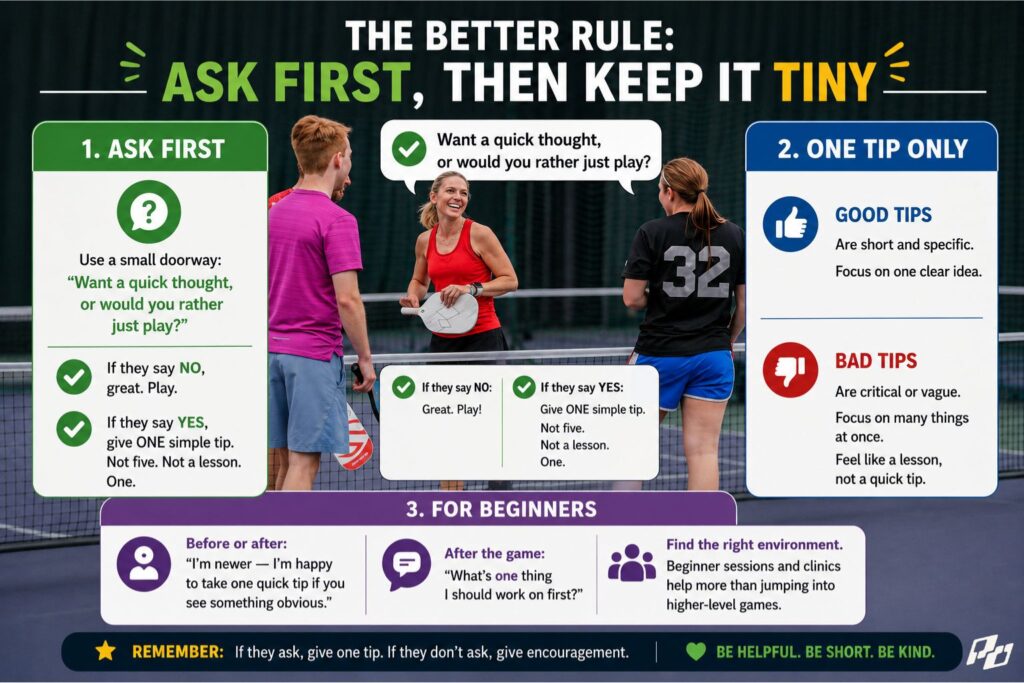
If you are the stronger player and you genuinely want to help, use the smallest possible doorway: “Want a quick thought, or would you rather just play?”
That sentence solves almost everything.
If they say no, great. Play.
If they say yes, give one simple tip. Not five. Not a full lesson. One.
Good open-play tips sound like this:
“Try getting to the kitchen after your return.”
“Aim your return deeper; it’ll buy you more time.”
“On that ball, reset instead of swinging hard.”
“Your serve is fine — just give yourself more margin.”
Bad open-play tips sound like this:
“Your whole swing is wrong.”
“You need to change your grip.”
“You’re standing in the wrong place every point.”
“No, no, no — not like that.”
If the advice cannot be explained in one sentence, it probably belongs in a lesson, not a rotating open-play game.
What Beginners Should Do Instead of Expecting Free Coaching
Beginners should absolutely ask questions. That is part of learning. But the way you ask matters.
Instead of expecting better players to teach throughout the game, try this before or after: “I’m newer — I’m happy to take one quick tip if you see something obvious.”
That gives the stronger player permission, but not pressure.
Or after the game: “What’s one thing I should work on first?”
That is much better than asking for a full breakdown mid-game while other players are waiting.
Also, beginners should look for the right environment. Many clubs now divide open play by level, offer beginner sessions, or run clinics because open play can get messy when skill levels are too mismatched.
Translation: if you are brand new, a beginner clinic or beginner open play may help you more than jumping straight into competitive intermediate games and hoping strangers coach you through it.
The “One Tip Rule” for Stronger Players
Here is my favorite standard for stronger players: if they ask, give one tip. If they don’t ask, give encouragement.
That keeps you helpful without becoming the court narrator.
For example: They miss a return.
Don’t say: “You’re taking your paddle back too far and your weight is falling backward.”
Say nothing, or say: “No worries. Next one.”
If they ask, then say: “Try a shorter backswing and aim deep middle.”
That is useful. It is specific. It does not embarrass them.
The “Don’t Ruin the Game” Standard
There is also a practical problem: too much coaching ruins the rhythm of the game.
Open play is supposed to move. People are waiting. Games rotate. Momentum matters. If every missed shot becomes a mini-clinic, the whole court gets heavier.
Open play relies on shared values and unwritten rules because there is no formal referee or structure keeping every interaction smooth.
That is why restraint matters. A good open-play helper knows when to stop.
If the beginner wants more, you can say: “Happy to show you after this game.”
That moves teaching into the right space without derailing play.
When Better Players Probably Should Help
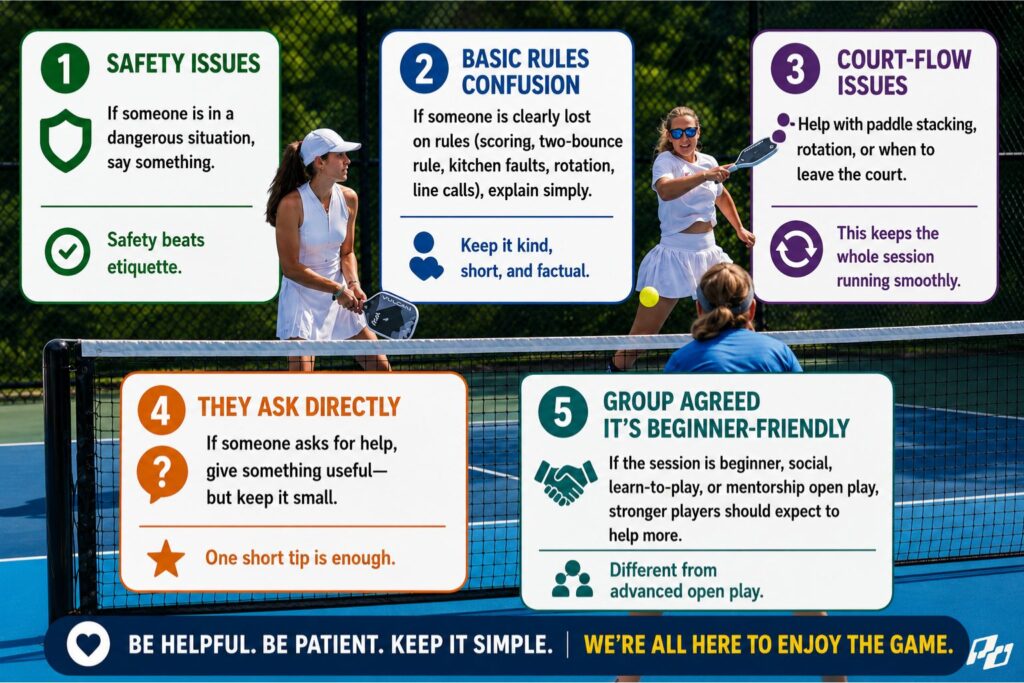
There are a few moments where a stronger player should step in, even without a formal teaching role.
1. Safety issues
If a beginner is wandering into another court, turning around while balls are live, standing too close to a swinging partner, or backing up dangerously for lobs, say something.
Safety beats etiquette.
2. Basic rules confusion
Scoring, two-bounce rule, kitchen faults, rotation, and line calls are fair game if someone is clearly lost.
Keep it kind, short, and factual.
3. Court-flow issues
If someone does not understand paddle stacking, rotation, or when to leave the court, help them. That protects the whole session.
4. They ask directly
If someone asks for help, give them something useful — but still keep it small.
5. The group has agreed it is beginner-friendly
If the session is labeled beginner, social, learn-to-play, or mentorship open play, then stronger players who join should expect to help more.
That is different from advanced open play.
When Better Players Should Not Teach
There are also moments where teaching is usually a bad idea. Do not teach when:
✓ the player did not ask
✓ the point just ended and emotions are high
✓ you are frustrated with them
✓ your “tip” is really criticism
✓ the advice is too technical for the moment
✓ other players are waiting
✓ the game is supposed to be competitive
✓ you are not actually sure your advice is correct
That last one is important. A lot of rec-player coaching is confident but wrong. If you are not a coach, keep your advice humble.
Try: “One thing that helped me was…”
not: “You need to…”
The tone changes everything.
What Advanced Players Can Do Without Teaching
This is the sweet spot. You can make the game better without giving lessons.
You can:
✓ hit more balls to playable spots
✓ avoid body-bagging beginners
✓ serve safely but deep
✓ extend rallies instead of ending every point immediately
✓ model good positioning
✓ call the score clearly
✓ compliment good choices
✓ explain rotation politely
✓ invite them to ask after the game
This is not babying them. It is giving them a chance to play actual pickleball instead of just watching balls fly past them.
A stronger player who can control the game without humiliating people is usually more respected than the player who proves they can beat beginners 11-0.
Everyone already knows you can.
What Beginners Can Do to Be Easier to Play With
Beginners have responsibilities too.
If you want stronger players to enjoy playing with you, make it easy for them.
✓ Learn the basic rules before showing up.
✓ Know the two-bounce rule.
✓ Call the score loudly.
✓ Move up after your return.
✓ Do not apologize after every miss.
✓ Do not ask for five tips during a game.
✓ Do not expect advanced players to slow everything down forever.
✓ Thank people who help.
✓ Find level-appropriate games when possible.
And here is a big one: watch.
You can learn a lot from better players without asking them to explain everything. Watch where they stand. Watch how they return. Watch how quickly they get to the kitchen. Watch what balls they do not attack.
Observation is free coaching.
The Best Script for Beginners
Use this: “I’m still learning, so no pressure to coach me. But if you see one obvious thing after the game, I’d love to hear it.”
That is perfect.
It tells better players you are open to feedback. It also tells them you respect that they came to play.
Most decent players will respond well to that.
The Best Script for Better Players
Use this: “Want one quick tip, or are we just playing?”
That is also perfect.
It gives the beginner control. It keeps the vibe light. And it prevents you from accidentally becoming annoying.
If they say yes, give one tip and move on.
If they say no, respect it.
So, Should Better Players Be Expected to Teach?
No — not by default. Better players should not be expected to give free lessons during open play.
But they should be expected to be decent.
That means no eye-rolling. No public shaming. No blasting beginners for sport. No acting like open play is your private training block if the posted format is mixed social play.
At the same time, beginners should not treat every stronger player as unpaid coaching staff.
Ask politely. Accept one tip. Watch carefully. Find beginner-friendly sessions. Take a clinic if you want structured instruction.
The healthiest open-play culture is not “advanced players must teach beginners.”
It is: everyone respects why the other person came to the court.
Some came to learn.
Some came to compete.
Some came to socialize.
Some came to sweat.
Some came to escape work for 90 minutes.
When those goals collide, good etiquette is what keeps the game fun.