A lot of rec players assume higher-level partners get annoyed by missed shots.
Not really.
Better players can live with misses when the idea was right. What tends to frustrate them is when the miss came from a bad decision that was avoidable, predictable, and costly to both players.
That is an important distinction.
Because if you are trying to level up, the question is not just: “What shots do I need?”
It is also: “What in-game habits are making my partner’s job harder?”
That is the real angle here.
At stronger levels, pickleball becomes less about whether you can hit a flashy ball and more about whether you can help your team hold good shape, choose the right speed, and protect advantage when you have it.
1. Staying back when the whole point is to get up
This is one of the most common problems better players notice. A partner hits a decent third or a workable drop, then stays back and never uses the shot for what it was supposed to do: help the team move forward and take the kitchen.
That frustrates better players because it breaks the basic structure of doubles.
The goal is to move through the transition zone and establish yourself at the kitchen line as quickly and intelligently as possible. Your chances of winning go up dramatically when you get there and can play from the non-volley zone.
- they leave their partner covering too much front court
- they create a one-up/one-back gap
- and they let opponents attack or drop into open space
That is why stronger players hate it. Not because it “looks wrong,” but because it wrecks team geometry.
What to do instead
If you return serve, work forward under your return and split step before the opponent hits. Aim deep on serve and return, get to the NVZ quickly after your return, and use the simple third-shot rule: drop low balls, drive high balls, and follow your shot in.
If you are serving, do not sprint blindly. Move in only after the return has been struck and you know what kind of third shot you are dealing with.
That leads to the next problem.
2. Drifting after the serve and making your own third harder
Lower-level players serve, start wandering forward, then the return lands deep and they have to backpedal into a bad third.
That is such a common rec mistake that it deserves a name: premature forward drift.
It feels harmless. It is not.
Even a small retreat step can wreck your balance, contact, and drop accuracy. Better players hate this because it is a self-inflicted problem.
What to do instead
Use a simple rule: Serve and stay. Return and go.
If your team is serving, do not cross the baseline just because you are excited. Wait for the return, read the ball, then choose your third and move in behind it.
And if you are unsure when to stop your feet on the way in, the answer is: split step when the opponent is about to strike.
3. Attacking balls that are not attackable
This may be the single most universal rec-player leak.
It kept coming back to the same core mistake: speeding up from bad positions, blasting shin-high balls, attacking off balance, firing crosscourt speed-ups off the bounce, or trying to win the point immediately from trouble.
This is not just a mechanics issue. It is a shot selection issue.
Pro player Connor Garnett’s instruction on common beginner-to-intermediate mistakes makes this exact point: a lot of players attack from the wrong height, wrong balance, or wrong part of the court and end up putting their partner in trouble. James Ignatowich says the same about drop errors — many come from oversized swings and off-balance footwork, not just “bad hands.”
What to do instead
Use this filter before you speed up:
- Is the ball above net height?
- Are your feet set?
- Are you balanced?
- Can you contact it out in front?
- Are you attacking into space, or into the opponent’s strike zone?
If the answer is no to most of those, it is probably not an attack ball. Reset it, dink it, or neutralize it.
A simple cue: Do not attack from discomfort.
Pickleball coach Marko Grgic has a really useful “traffic light” rule that makes it much easier to know when to attack and when to reset:
4. Driving every ball because pace feels safer than patience
Another big pattern is players who drive everything, swing full-out on every ball, and try to rip the third from any height — even when the contact is too low or the shot has almost no chance of bothering a stronger opponent.
A third-shot drive is not wrong. USA Pickleball explicitly teaches it. The key is that the drive and the drop are both transition tools — different routes to the same destination. And if you drive the third, the best follow-up is often a fifth-shot drop.
What frustrates better players is not “a drive.” It is the player who drives:
- from low contact
- from bad balance
- with no plan for the next ball
- and without moving up behind it
That is just pace without purpose.
What to do instead
Think of the drive as a setup shot, not a personality trait.
- Drive high balls.
- Drop low balls.
- Follow your shot in.
- And if the drive gets blocked back, be ready to drop the fifth.
That is modern, practical doubles pickleball.
5. Lobbing from the wrong places and for the wrong reasons
Bad lobs get criticized for a reason. In rec play, they often look more effective in memory than they really are. Players remember the one perfect lob that worked, but forget all the short ones that got crushed, the ones that sailed out, and the ones that dumped into the net.
That is what makes the lob such a misleading shot for lower-level players: the occasional success can hide a lot of low-percentage outcomes.
What frustrates better players
Not all lobs. Bad defensive lobs from deep court.
Effective lobs are usually from the kitchen or short transition zone; backcourt lobs are more often desperation or low-percentage habits.
What to do instead
Treat the lob as a specialty shot, not a stress response. Use it more when:
- you are balanced
- your opponent is leaning forward
- you can lift with shape
- and you are not simply panicking
A better default from trouble is usually a reset, not a hopeful lob. That aligns with instruction from top coaches who keep emphasizing that lower-level players attack or improvise out of discomfort instead of resetting.
6. Poaching without the skill, read, or permission to do it
This one really annoys stronger players. It usually shows up in a few forms:
- right-side backhand stab into the middle
- poaching balls you cannot finish
- and taking your partner’s forehand with your backhand while leaving a huge gap behind you
This frustrates advanced players because poaching is supposed to solve a problem, not create a bigger one.
What to do instead
Before you poach, ask:
- Am I early?
- Can I hit this stronger than my partner?
- Can I recover if they get it back?
- Am I taking a ball because it is truly mine now, or because I am impatient?
And if you are a right-side right-hander, stop assuming your backhand in the middle is always noble. Often it is just rude geometry.
Poach to finish or clearly improve the rally.
Do not poach to feel active.
7. Not moving with your partner
This is one of the quietest differences between 3.5 and 4.5 pickleball.
Lower-level players often think “I got to the kitchen, I’m done.” Then the opponent hits a wide dink, their partner shifts, and they just stand there like a lawn ornament. The middle opens. Trouble.
Players need to close coverage gaps, move with their partner, and get to the NVZ sooner as part of developing strategy. Footwork is not separate from strategy; it is strategy.
What to do instead
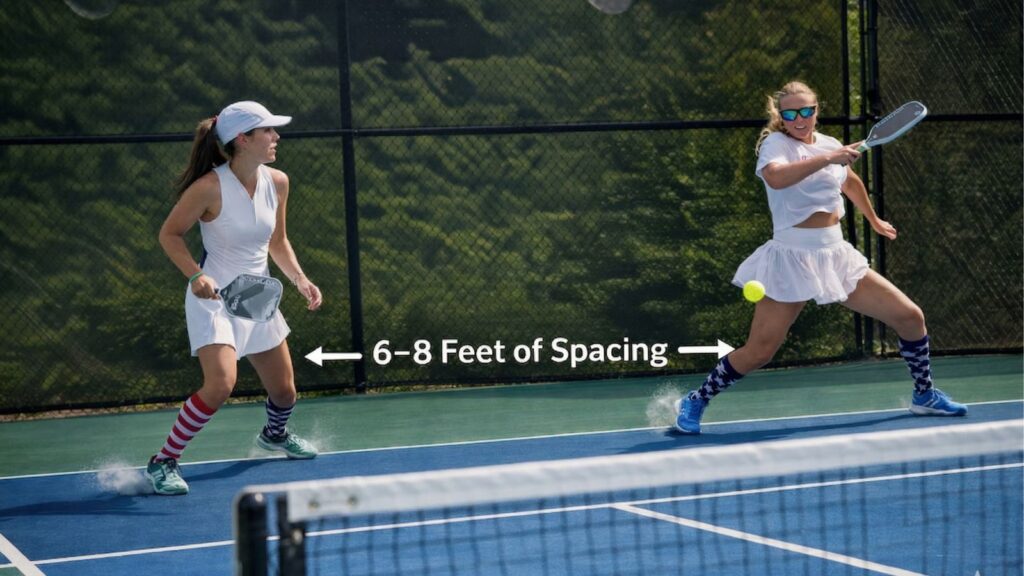
Move like you are connected by a rope, no more than 6-8 feet of spacing.
If your partner shifts left, you shift left.
If they step forward, you read that.
If they get pulled wide, you protect the middle.
A simple cue: Ball moves, we move.
That one habit alone makes you much easier to play with.
8. Giving opponents a free ride to the kitchen
Players finally have the other team pinned deep, then they hit a cute short ball, a bad drop volley, or something soft enough that the opponents stroll right up.
That is not just a miss. That is a strategic gift.
What to do instead
Ask yourself one question when the opponents are back: Am I keeping them back, or helping them forward?
That is huge.
If they are deep and uncomfortable, your default job is often:
- keep the ball deep
- keep it low
- or force them to earn their way in
A short, attackable ball that relieves pressure is often the wrong shot, even if it lands in.
9. Poor communication and bad middle-ball decisions
Another common frustration is poor communication: not calling the score, not calling balls clearly, shouting “you” too late, taking balls that are not yours, and then leaving the one that was.
This matters because better players do not need perfection from a partner. They need predictability.
What to do instead
Be early, simple, and boring. Say:
- “mine”
- “yours”
- “switch”
- “watch it”
- “out”
And say the score every time you serve. The 2026 USA Pickleball rules require the score to be called before the serve, which is why inconsistent score-calling annoys so many players.
Good communication is not extra. It is part of playing clean doubles.
10. Trying to win points instead of trying to win positions
Underneath all the specific complaints — baseline camping, panic speed-ups, reckless lobs, random poaches — the same principle keeps showing up: Lower-level players often try to win the point too early.
That is the real issue.
And that is why better players get frustrated. Not because the player is weak — but because the decision is impatient.
What to do instead
Start thinking in layers:
- Keep the ball in play.
- Improve your position.
- Keep your partner out of trouble.
- Attack only when the geometry says yes.
That is better doubles.
A simple filter better players wish 3.5s used more often
Before you hit, ask:
✔ Am I balanced?
✔ Is this ball attackable?
✔ Does this shot help us get to the kitchen or hold it?
✔ Am I protecting my partner or exposing them?
✔ If this comes back, are we still okay?
That is not passive pickleball. That is smart pickleball.