You’re toeing the kitchen line. Tap, tap—split step—then it’s a strobe-light rally: pop-pop-pop. In that blur, “fast hands” gets all the praise, but posture is the quiet hero. If you can arrive in the right shape before the ball gets to you, your paddle does less and your results do more.
Two gears run the whole show:
Arrive stacked. Decide late.
High? Lean and punch. Low? Stack and melt.
Not slogans—sequences you can feel. Let’s make them automatic.
Two Gears You Shift Between (Not One Stance You Marry)
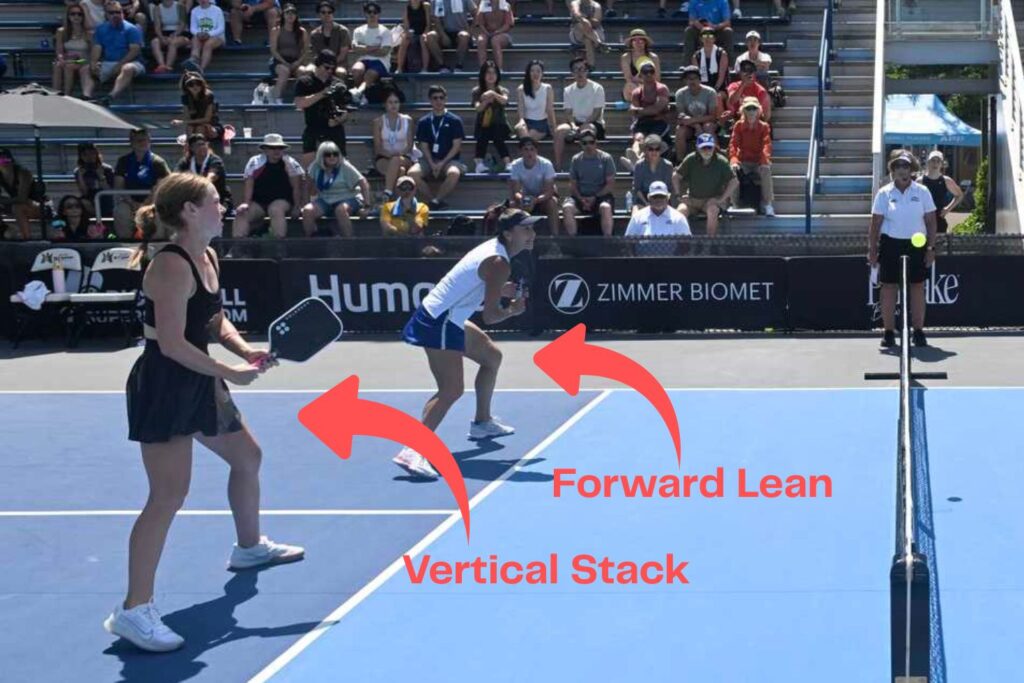
1. Forward Lean — Your Steal-Time Gear
Tiny hip hinge, nose just over the laces, heels whisper-light. Paddle sits front-center at chest height with a slight backhand bias.
Why it works: when contact is at or above your navel, an early, compact punch sends the ball back before your opponent finishes their blink. That’s not macho; it’s time theft.
Common trap: over-leaning past your toes. The second the ball dips, that over-lean flips your face and you sail it. Keep it micro.
2. Vertical Stack — your absorb-and-live gear
Ears → shoulders → hips → knees stacked over mid-foot. Athletic, not stiff. Knees soft, torso calm, paddle quiet.
Keep your elbow down, not out. Only move your paddle about an inch or maybe two inches.
Pro Coach Sarah Ansboury
Why it works: stacked posture buys stillness; stillness buys clean angles. When the ball is at your body or below the navel, a tiny, soft block resets the point and cools the firefight.
Common trap: tall and rigid. Tall makes you late; rigid makes you swing.
Which Posture Fits Which Ball?
| Situation at Contact | Best Posture | Why it Wins | Feel Cues |
|---|---|---|---|
| Ball at/above navel, in front | Forward Lean | Early contact steals time | “Nose over laces,” compact punch |
| Ball at body or below navel | Vertical Stack | Quiet face = easy reset | “Elbow down, tip up,” two-inch block |
| You feel late or off-balance | Vertical Stack | Re-neutralize with a block | “Freeze at contact,” soften grip |
| You initiated a speed-up | Forward Lean (re-stack if next ball dips) | Pressure first ball, own the second | Paddle returns front-center between shots |
The Little Mechanics That Change Everything
Big rallies are won by small details. When the kitchen heats up, you don’t need a brand-new technique; you need a cleaner version of what you already do.
Think of this as your on-court “tune-up”: a handful of tiny habits that make every contact simpler, calmer, and more reliable.
1. Balance First, Decision Second
Start by landing your split step as your opponent strikes the ball. That arrival point—wide, athletic, and stacked—is home base.
From there, you only add a micro forward hinge if the next ball sits high enough to attack. It’s not a lunge; it’s a nudge.
2. Paddle Home Base (And Why it Matters)
Between touches, park your paddle front and center at chest height with a slight backhand bias. That simple habit shortens your first move, protects your torso, and keeps you from getting jammed.
Check out Zane Navratil demonstrating pickleball ready position with chest-height, vertical paddle and stacked athletic stance.This is the starting shape for both Forward Lean and Vertical Stack.
3. Contact Rules You Can Trust
Let ball height choose the stroke. If it’s high, deliver a compact punch that finishes in front—no loop, no wraparound.
If it’s low or into your body, keep the body quiet and block with a softer grip so the ball “melts” into the face.
Have a loose grip… aim for a two or three out of ten. Don’t follow through. You should just let the ball hit your paddle.
Pro Player Catherine Parenteau
4. Tension is the Rally Killer
When hands get fast, tight muscles make slow paddles and wild misses. Stay compact, stay rhythmic, and let your posture—not your swing—do the heavy lifting.
Put it together: arrive stacked, read the height, then either micro-hinge and punch (high) or stay stacked and melt a block (low). Keep the paddle at chest level between touches, keep the grip loose when you’re resetting, and keep your moves small.
Those little mechanics are what make the kitchen feel slow—even when it isn’t.
Troubleshooting Without the Guesswork

Here’s your quick triage. Spot the symptom, check the cause, and apply the fix on the very next ball. Give it two or three reps—if it doesn’t stick, reset to your base rhythm: arrive stacked, decide late.
| Symptom | Likely Cause | Fast Fix |
|---|---|---|
| Pop-ups under pressure | Swinging; paddle drops between hits | Don’t swing; swiftly punch the ball.” |
| Always late on counters | Tall posture; heels heavy | Re-stack on the split; micro-hinge only when it’s high |
| Blocks flying long | Grip too tight; follow-through on resets | Loose grip (2–3/10)… don’t follow through. |
| Jammed by body balls | Forehand-dominant ready; paddle behind torso | Slight backhand bias, paddle front-center (chest-level, vertical). |
| Firefights unravel after 2–3 balls | Stuck in one gear | “Arrive stacked. Decide late. |
Drills You’ll Actually Do (And Feel Immediately)
Punch-Only Hands (3 minutes).
Kitchen vs. kitchen.
Rule: punch only. Start stacked; any ball ≥ navel triggers a micro-lean and a compact punch.
2. Live Fire → One-Ball Reset (5 minutes).
Trade four chest-high punches in Forward Lean, then you must drop one stacked reset to a safe crosscourt target before re-entering the firefight.
3. Body-Line Blocks (4 minutes).
Feeder aims ribs/hips from 14–18 feet.
You stay stacked, use “elbow down” and a two-inch move.
Quiet sound = good rep.
4. Ready-Position Cadence (2 minutes).
After every contact, tap the ball to your paddle to confirm you’ve returned to home base before the next one arrives.
For 50+ Players (And Cranky Knees)
You don’t need a deep squat to win the line, just cleaner, easier moves.
- Stay centered & soft: stack over your mid-foot, knees easy, heels light.
- Micro-hinge only on high balls: no deep bends; hinge at the hips to punch, otherwise stay stacked and reset.
- Arrive early: split-step a beat sooner; use short recovery steps instead of lunges.
- Paddle home at chest height: slight backhand bias protects the body and shortens your first move.
- Light hands: grip 2–3/10 for resets, 5–6/10 for counters; keep motions compact.
Easy warm-up (30–45s): a few ankle rocks, 10 micro-hinges, then 20 paddle taps at chest height while split-stepping in place.
Lean vs. Stack—One Last Look
| Attribute | Forward Lean | Vertical Stack |
|---|---|---|
| Purpose | Take time away (attack/counter) | Absorb pace (reset/neutralize) |
| Best Ball | At/above navel | At body or below navel |
| Body Feel | Nose over laces; heels light | Centered over mid-foot; soft knees |
| Paddle Action | Compact punch | Quiet block, tiny lift |
| Switch Cue | Rally stays high → keep leaning | Ball dips/jams → re-stack immediately |
The Rally Isn’t Rushing You; Your Posture Is
You don’t need faster hands, you need faster posture. Split a beat earlier, land stacked, and let the ball tell you what’s next. If it’s high, add that tiny hinge and go; if it’s low or crowding your ribs, stay calm and live to the next ball.
And when the kitchen turns into a blur, remember Brodie and Tanner’s mantra from CRBN Coaching: “The best hands players aren’t tense… stay compact.” Loosen the grip, shorten the move, and let your posture do the heavy lifting.
Give those cues ten focused minutes—seriously, just one drill block—and the kitchen won’t feel like a strobe light anymore. It’ll feel like a conversation you’re leading. See you at the line.