
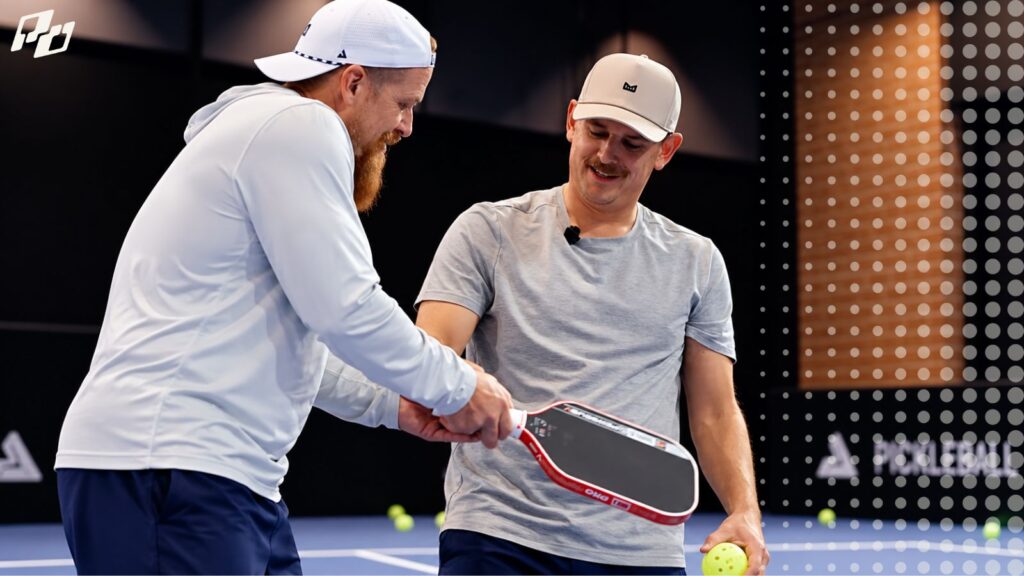
A good pickleball coach should identify the real cause of your mistakes, explain the fix clearly, give you specific drills, and help those changes transfer into games. If you’re practicing seriously but still getting generic advice, too many corrections, or no measurable progress, it may be time to find a new coach.
You take a lesson.
The coach fixes your drop.
It feels better for 15 minutes.
Three days later in rec play, you’re popping it up again.
So now comes the uncomfortable question: is the coach not helping—or are you not actually learning?
Those are very different problems. And this is where choosing a pickleball coach gets tricky. A coach can be:
- a great player but a poor teacher
- certified but generic
- uncertified but excellent
- technically knowledgeable but bad at explaining
- perfectly good while you simply aren’t practicing what they gave you
So before you fire anyone—or keep paying someone who isn’t moving your game forward—use a better test.
A good coach should change what happens between lessons.
Not just what happens during them. If every lesson feels productive but your actual game never changes, something is missing.
The job is to figure out where the breakdown is.
First: Are You Paying for Coaching—or Just a Human Ball Machine?
This is the fastest test. A useful coach should do more than feed balls and say:
- “Good.”
- “Again.”
- “Keep it lower.”
They should be able to answer three questions:
1. What is actually wrong?
Not just: “Your drop is high.”
But: “You’re contacting too close to your body, which forces the paddle face open and sends the ball up.”
2. Why does the correction work?
A good coach should connect the fix to the ball result.
3. What should you practice after the lesson?
You should leave knowing:
- what to drill
- how to drill it
- and what success looks like
That matters because deliberate practice works best when it targets a specific problem, includes feedback, and allows repeated correction rather than just accumulating court time.
If the coach is simply giving you repetitions you could get from a drilling partner or ball machine, you may be paying coaching rates for feeding.
The Best Sign of a Good Coach: They Diagnose Before They Prescribe
Suppose you’re missing backhand dinks. A weak coach sees the miss and immediately says: “Use less wrist.”
A better coach watches:
✔ Your spacing
✔ Foot position
✔ Contact point
✔ Paddle face
✔ Balance
✔ Whether the incoming ball is crowding your body
Those are different problems. And they require different fixes.
This is especially important for intermediate players because the visible error is often not the real cause.
You miss a reset.
Was your reset technique bad?
Maybe.
Or perhaps your previous shot left you in terrible transition position.
You miss a drive.
Was the swing wrong?
Or were you late because the split step never happened?
A coach worth keeping should progressively become better at identifying the cause behind the miss, not just the miss itself.
How Much Better Than You Should Your Coach Be?
This gets overcomplicated.
There is no magical rule that your coach must be exactly 1.0 DUPR higher. Playing ability and coaching ability overlap, but they are not the same skill.
A 5.5 can be a terrible teacher. A 4.5 can be excellent at diagnosing a 3.5 player’s movement, mechanics, and strategy.
That said, playing level still matters more as your goals become advanced.
⮕ If you’re a 2.5–3.0
You need someone who can teach reliable fundamentals, movement, contact, and basic strategy.
They do not need to be an elite player.
⮕ If you’re a 3.5 trying to reach 4.0
I’d want a coach with a strong understanding of 4.0+ play who can demonstrate and teach the shots and patterns you’re trying to acquire.
⮕ If you’re a 4.0–4.5 trying to compete higher
Now I’d care much more about whether the coach genuinely understands:
- advanced transition play
- counter patterns
- attack selection
- court geometry
- stacking
- partner movement
- and modern pace
At this level, someone who has competed successfully near or above your target level becomes much more valuable.
PPR’s current Level 2 certification reflects a similar distinction: it is aimed at coaches working with advanced players and requires at least a 4.0 skill level, with emphasis on technical analysis, specialty shots, and advanced tactics.
The better rule:
Your coach needs to understand the level you’re trying to reach—not necessarily dominate you in a game.
Do They Need to Be Certified?
No. But certification can be useful.
PPR is currently the official education and certification partner of USA Pickleball, and its pathway includes formal workshops and testing.
IPTPA also uses tiered credentials. Its Level I focuses on beginner/recreational instruction, while Level II is aimed at beginner-to-intermediate players and includes observed teaching, skill evaluation, shot selection, and strategy.
That’s valuable because certification tells you the instructor has at least gone through a structured teaching process.
But it does not automatically mean they are a great coach. A credential is a filter. Not a guarantee.
Even current pickleball coaching guidance recommends evaluating the individual coach rather than relying only on PPR versus IPTPA certification.
Think of certification this way:
Certified + good teacher = strong signal.
Certified + poor communicator = still a poor fit.
Uncertified + experienced + excellent teacher = potentially very good coach.
Local Pro or Certified Coach?
For many recreational players, the best coach may actually be a respected local player who teaches well. A strong local 4.5 or 5.0 may know:
✔ The styles you’ll face
✔ The mistakes common in your local games
✔ The tournament environment
✔ The practical jump you’re trying to make
That can be extremely useful. But don’t hire someone just because they’re the best player at open play. Ask:
- Can they explain what you’re doing wrong?
- Can they show you more than one solution?
- Can they simplify rather than overwhelm?
- Can they feed consistently?
- Can they correct movement, not just strokes?
- Can they explain why a strategy works?
The best player at the park is not automatically the best coach at the park.
The Best Coach Doesn’t Give You 12 Corrections
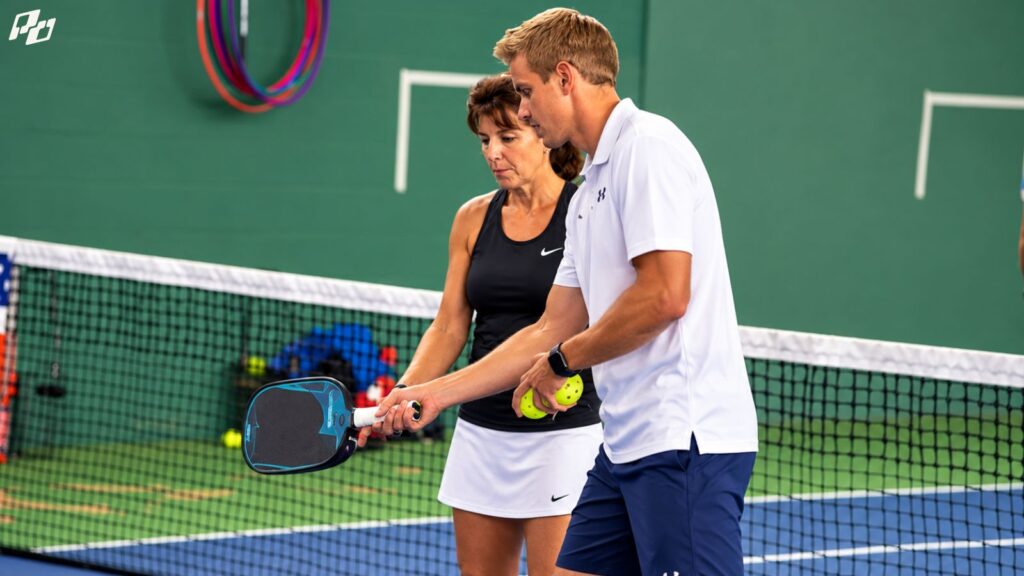
This is a major red flag. You hit one drive and hear:
- Turn more.
- Stay lower.
- Move your feet.
- Contact farther forward.
- Loosen the grip.
- Use more topspin.
- Finish higher.
Now you’re worse than before. Good coaching prioritizes. A strong lesson often sounds more like:
“We’re fixing one thing today: your spacing.”
Once that improves, the coach can layer in something else.
Motor-learning research supports the broader idea that feedback helps learning, but more feedback is not automatically better; effective practice needs feedback that is usable rather than constant information overload.
Green flag:
Your coach can tell you: “Ignore everything else for now. Fix this first.”
Are You Unhappy With the Coach—or Just Uncomfortable With the Fix?
This one matters. A correction often feels worse before it feels better.
You change your grip.
Now the ball feels strange.
You stop backing away from volleys.
Timing feels off.
You change your footwork.
Suddenly your old automatic stroke doesn’t fit.
That does not automatically mean the coach is wrong. Sometimes the correct change temporarily lowers performance because your old pattern was deeply learned.
This is why you should judge a coach over: several practice sessions, not 20 minutes.
But there is a limit. If you’ve practiced the correction seriously for weeks and:
- the explanation still doesn’t make sense
- the ball result isn’t improving
- and the coach cannot adapt the instruction
then it may be time to get another opinion.
The Player Test: Are You Doing the Homework?
Before changing coaches, ask yourself:
✔ Did I actually drill what they taught me?
Games don’t count.
✔ Did I give the change enough reps?
One lesson won’t make a new movement automatic.
✔ Did I use it in rec play — even when it cost me points?
If you instantly revert under pressure, the old habit stays.
✔ Did I come back with useful feedback?
Try: “It works on slow feeds, but I lose it when the ball jams my body.”
Now the coach has something specific to solve.
The key distinction:
Coaching identifies the change.
Drilling installs it.
When You Should Probably Leave
I’d seriously consider another coach if several of these are true.
⮕ Every student gets the same lesson.
- Same drills.
- Same cues.
- Same progression.
- Regardless of skill or goals.
⮕ They cannot explain why.
If every answer ends with: “That’s just the right way.”
That’s a problem.
⮕ They coach above your actual level.
A 3.0 who cannot control returns probably doesn’t need an hour of advanced two-handed backhand speedups.
The next skill should solve the biggest current problem.
⮕ They fix outcomes instead of causes.
“Keep it lower” isn’t enough if they can’t explain what makes it high.
⮕ You mostly pay to hit balls.
That is a drill partner with an invoice.
⮕ They resist questions.
Curiosity should improve a lesson, not threaten the coach.
⮕ They never change the plan.
A good coach should evolve as you improve.
When You Should Probably Stay
Stay with a coach who regularly does these things:
✅ They identify things you didn’t see yourself.
✅ They explain the cause clearly.
✅ Their corrections create measurable improvement when practiced.
✅ They simplify problems.
✅ They give you drills you can repeat without them.
✅ They adapt their language when you don’t understand.
✅ They understand your goals.
✅ They’re willing to say: “You don’t need another lesson yet. Go practice this.”
That last one is a particularly good sign.
A coach whose business model depends on you being permanently dependent on them is not necessarily helping you become a better learner.
How Often Should You Take Lessons?
For many rec players: less often than they think. A very effective pattern can be: Lesson → 1–3 weeks of drilling and play → reassessment.
If the coach gives you a meaningful technical change, taking another lesson two days later may simply add another layer before the first one has settled.
For beginners learning basic movement or players making a major rebuild, more frequent instruction may make sense.
But for a 3.5–4.0 player, one excellent lesson every few weeks plus serious drilling can be better value than weekly lessons filled with new information.
Private Lesson, Small Group, or Clinic?
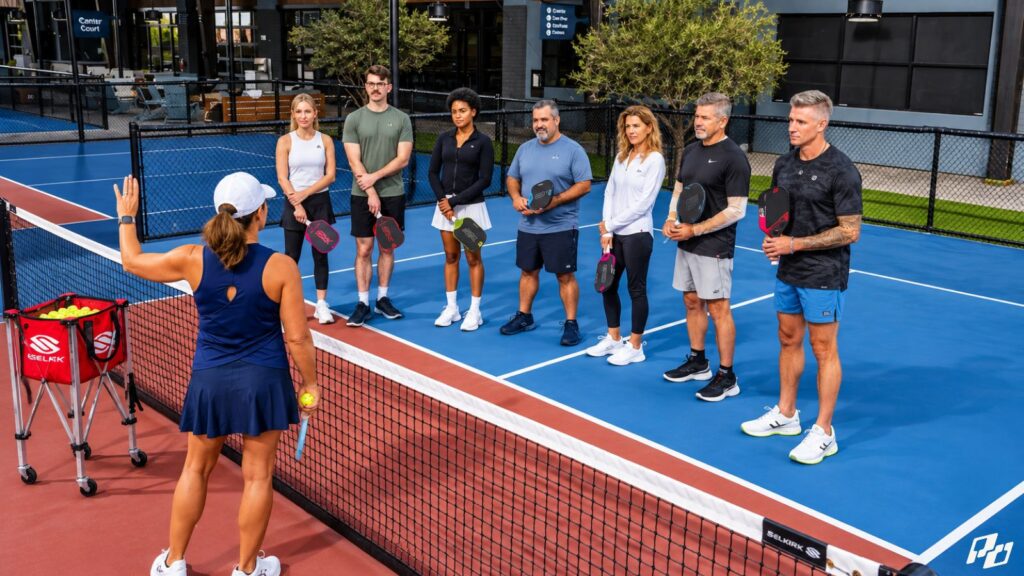
They solve different problems.
1. Private lesson
Best for:
✔ Specific diagnosis
✔ Technical correction
✔ Video review
✔ Individual progression
2. Small group
Best for:
✔ Partner movement
✔ Strategy
✔ Situational drills
✔ Live-ball patterns
✔ Lower cost
3. Clinic
Best for:
✔ Learning new concepts
✔ Structured reps
✔ Broad skill exposure
The key is matching the format to the problem.
If one stroke is breaking down, go private. If your mechanics are fine but your doubles decisions are poor, small-group live play may help more.
And if you simply need exposure to a concept, a clinic can be enough.
One of the Best Coaching Moves: Bring Video
This is wildly underused. Record a real game and bring 10–15 minutes of representative points to your coach. Now you don’t have to explain what’s going wrong. They can see it.
Your “third-shot problem” might actually be:
✔ Short returns
✔ Poor recovery
✔ Late split steps
✔ Bad third-shot selection
That changes the lesson completely.
Instead of: “Teach me something.”
You get: “Diagnose my game.”
And that’s usually far more valuable.
Video also gives the coach something objective to work from — not just how the problem felt to you in the moment.
How to Find a Coach Worth Paying
Start in three places:
PPR directory — search certified pros in your area.
IPTPA directory — check credentials and active status.
Your local competitive community — often the most useful source.
Ask 4.0–4.5 players, league captains, tournament regulars, advanced open-play organizers, or strong drilling groups. Local Facebook groups, GroupMe/WhatsApp chats, DUPR leagues, clubs, and dedicated pickleball facilities are also useful.
But ask the right question: “Who actually improved your game?”
Not: “Who gives lessons?”
Then find out:
✔ What level they coach most
✔ What they helped other players fix
✔ Whether they give drills between sessions
✔ Whether they use video or real-game analysis
✔ Whether you can watch them teach first
Certification helps, but the real test is whether the coach can spot the real problem, explain it clearly, and give you a correction that carries into actual play.
The Three Questions I’d Ask Before Booking
These will tell you more than a long résumé.
“If you watched me for 15 minutes, how would you decide what we work on first?”
You want diagnosis, not a canned curriculum.
“What should I do between lessons?”
You want a practice plan.
“How do you know when a student has actually learned something?”
You want something better than: “It looks good during the lesson.”
The Coach Scorecard
After three or four sessions, rate the relationship on five things.
Diagnosis:
Do they identify the real problem?
Explanation:
Do you understand why the correction works?
Practice:
Do you leave with drills you can repeat?
Transfer:
Is the change appearing in actual games?
Independence:
Are you becoming better at diagnosing yourself?
That final category is underrated.
The best coach isn’t just improving your shots. They’re improving your ability to understand your own game.
The Pickleball Coach Check: Stay, Question It, or Leave?
If you’re unsure whether the problem is your coach, your expectations, or your own follow-through, use this as a quick diagnostic. One red flag does not automatically mean you should leave—but patterns matter.
| What You’re Seeing | Stay or Leave? | What It Probably Means |
|---|---|---|
| The coach spots problems you did not notice yourself | Stay | You are getting real diagnostic value |
| Their explanations connect the mistake to the ball result | Stay | They understand more than surface-level technique |
| You leave with clear drills and one or two priorities | Stay | The lesson has a pathway into actual improvement |
| Your game is changing slowly but measurably after practice | Stay | The coaching is transferring |
| A correction feels awkward initially but improves with reps | Stay | Normal learning discomfort, not necessarily bad coaching |
| The coach changes cues when an explanation does not click | Stay | Good adaptability and communication |
| You are improving but still benefit from periodic reassessment | Stay | That is a healthy coaching relationship |
| You are not drilling what was taught | Don’t blame the coach yet | The breakdown is probably happening between lessons |
| You revert to your old habits as soon as a game gets competitive | Don’t blame the coach yet | The new skill has not transferred under pressure |
| You expect one lesson to permanently fix an ingrained habit | Don’t blame the coach yet | Your expectations may be unrealistic |
| Every lesson contains five or ten corrections at once | Consider leaving | The coach may be overloading rather than prioritizing |
| Every student seems to get the same drills and advice | Consider leaving | The coaching may be generic instead of diagnostic |
| They tell you what is wrong but cannot explain why | Consider leaving | Their technical understanding may be limited |
| Most of the lesson is simply feeding you balls | Consider leaving | You may be paying coaching rates for a drill partner |
| They teach advanced shots while obvious fundamentals still break down | Consider leaving | Poor prioritization |
| They cannot tell you how to practice the correction without them | Consider leaving | There is no real learning plan |
| You have practiced the correction seriously for weeks and nothing improves | Get a second opinion | The diagnosis or teaching method may be wrong for you |
| The coach becomes defensive when you ask reasonable questions | Leave | Poor coach-player relationship |
| They insist there is only one correct way to execute every shot | Leave | Good coaching should allow for individual variation |
| You are becoming more dependent on the coach instead of understanding your own game | Leave | A strong coach should gradually make you more self-sufficient |
The simplest rule is this:
If your coach can diagnose, explain, prioritize, and give you a practice path, keep working. If you are genuinely doing the homework and the same problems remain unexplained, it is probably time for another set of eyes.
So When Should You Bail?
Don’t fire a coach because:
- you missed shots immediately after a lesson
- a new movement feels awkward
- or your rating didn’t jump in three weeks
But don’t stay indefinitely because:
- they’re certified
- they’re a 5.0
- everyone at the club likes them
- or you’ve already spent money
The relationship should produce a clear cycle: diagnose → understand → practice → apply → reassess
A few green flags: the coach spots problems you missed, explains the cause clearly, prioritizes one or two changes, and gives you a specific way to practice them.
A few red flags: the advice is generic, every lesson looks the same, they overload you with corrections, or they keep telling you what went wrong without explaining how to fix it.
For a fuller breakdown, see our pickleball coach green flags and red flags checklist.
If that improvement cycle is working, stay. If you’re practicing seriously and it still isn’t working, ask the coach to change the approach.
If they can’t? Try someone else.
And if you’re not drilling, not applying the changes, and immediately reverting to old habits, the next coach probably won’t solve that either.
Sometimes you need a better coach. Sometimes your coach needs a more coachable student. Knowing which one is the problem may save you more time—and money—than any lesson you take.