In pickleball, middle-ball misses usually come from late preparation, poor spacing, oversized swings, or unclear partner responsibility—not slow reflexes. Face the hitter, keep the paddle compact and in front, move laterally when possible, communicate early in doubles, and recover toward the center of likely angles in singles.
There is a particular pickleball miss that makes absolutely no sense.
The ball comes right through the middle.
You see it.
Your paddle is right there.
And somehow the ball passes untouched—or clips the edge of the paddle while you and your partner exchange that look. It feels like a hand-eye-coordination failure. Usually, it isn’t.
The middle ball is often lost before you swing.
Your feet were pointed at the wrong player.
Your paddle drifted away from the likely ball.
You left too much space between yourself and your partner.
You tried to decide ownership after the opponent hit.
Or you saw an easy volley and suddenly took a swing three times larger than necessary.
Fix those things and the mysterious “hole in the paddle” starts disappearing.
Start Here: Face the Ball, Not the Net
This may be the most underrated middle-ball adjustment for intermediate players.
Imagine you’re at the kitchen and the opponent diagonally across from you has the ball. Many rec players remain completely square to the net. But the ball isn’t coming from the net.
It’s coming from that opponent.
Coach Jordan Briones teaches a similar concept for faster exchanges: when the action moves crosscourt, strong players slightly orient their shoulders toward where the ball is coming from instead of remaining rigidly square ahead.
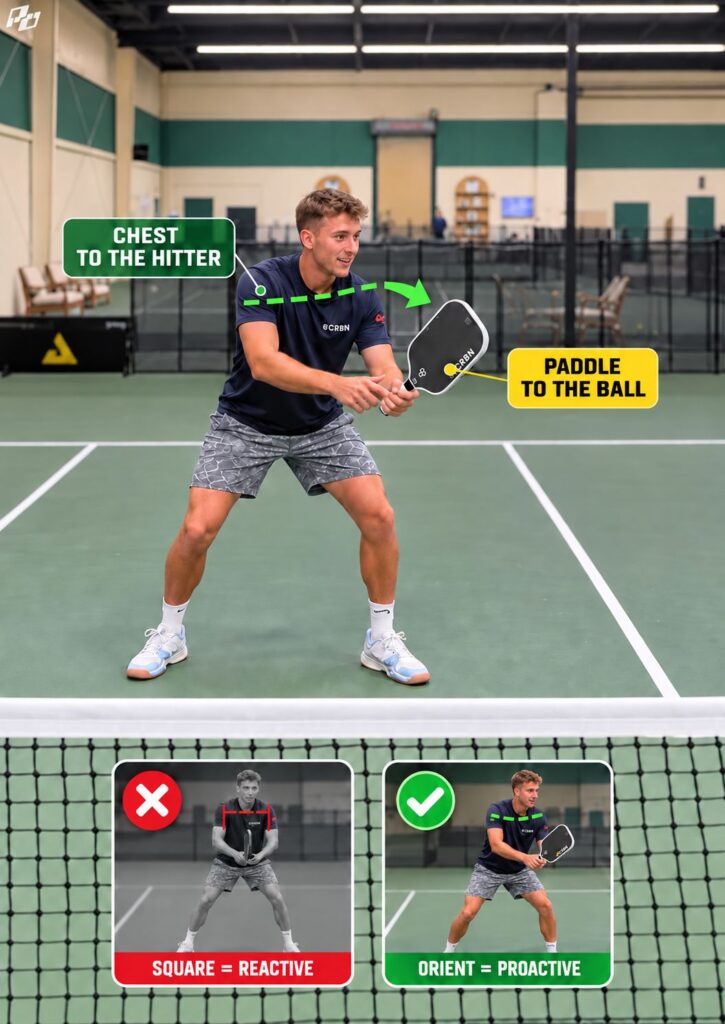
That subtle adjustment changes your coverage.
Your paddle is now more naturally connected to the ball’s flight. Your first lateral step becomes shorter. And a speed-up toward the seam no longer feels as though it appeared from nowhere.
Try this cue:
Chest to the hitter. Paddle to the ball.
Don’t dramatically rotate sideways. You’re simply adjusting your ready position toward the actual source of the next shot.
That is proactive middle coverage. Standing square and waiting to discover where the ball goes is reactive middle coverage.
At kitchen-line speeds, reactive is often too late.
The Footwork Mistake: Don’t Back Up When a Lateral Step Will Do
This needs an important distinction.
Sometimes backing up is the correct move. On a deep dink that crowds your inside foot, a small diagonal drop step can create the space you need to get the paddle comfortably in front of your body.
But that’s different from a routine middle volley. When a faster middle ball is simply a little outside your reach, many players unnecessarily step backward and sideways. Now:
- your contact gets later
- your body is moving away from the ball
- and the paddle has farther to travel
For that ball, the better first move is usually lateral along the kitchen line.
Think: slide → set → contact.
The rule isn’t: “Never back up.”
It’s: “Don’t give up depth unless depth is what you need to create space.”
Dink crowding your inside foot?
A small diagonal drop step may be perfect: create space → dink → reclaim the line.
Middle volley just outside your body?
Stay connected to the kitchen and move across: slide → contact → recover.
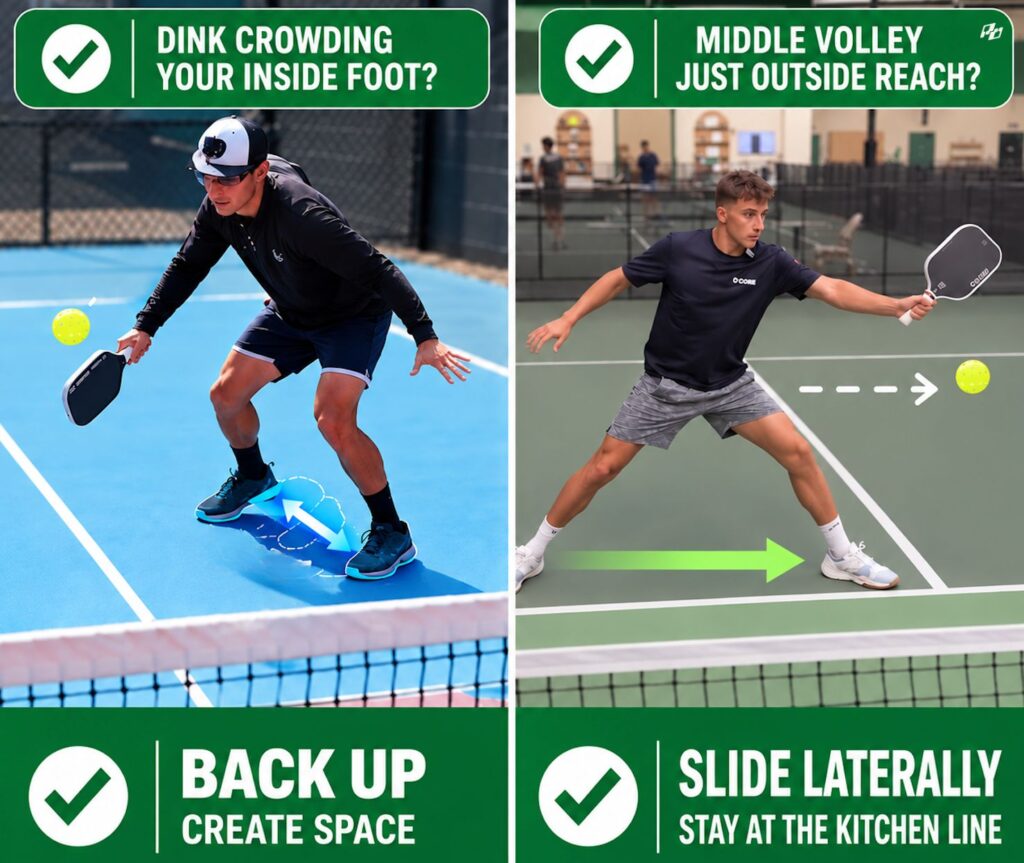
Coach John Cincola emphasizes being balanced and ready to push toward the next ball with the split step rather than continuing to move through contact.
And in doubles, that lateral movement has another benefit: it keeps you connected to your partner instead of unnecessarily opening the seam.
The key is recognizing why you’re moving. Back up to create usable contact space. Slide laterally to cover court.
Those are two different solutions to two different problems.
Your Middle Volley Should Be Smaller Than You Think
The middle ball often looks inviting. That is precisely why rec players butcher it.
They see an apparent putaway and suddenly take the paddle back. The hand disappears behind the body. The ball keeps traveling.
Now contact depends on perfectly timing a large swing against a ball that may be moving quickly.
Oversized backswings are one of the easiest ways to lose control at the kitchen. Keep the paddle compact, centered, and in front.
On volleys, think:
Minimal backswing.
Short movement.
Contact out front.
The bigger the swing, the more time you give yourself to be late. Let incoming pace do some of the work.
Your paddle should usually begin in front of you, move only enough to establish the face, meet the ball ahead of the body, then make a short controlled finish.
If you’re regularly whiffing middle volleys, film yourself.
You may discover you’re not slow at all. Your swing is simply too long for the amount of time available.
Now the Harder Question: Whose Ball Is It?
This is where “forehand takes middle” causes almost as many problems as it solves. It’s useful as a default. It is not a law.
Coach Helle Sparre has long challenged the simplistic version of that rule, teaching doubles partners to organize coverage around the ball’s location and the player connected to its trajectory rather than blindly sending the forehand player across the court.
Tony Roig teaches the related Respect the X concept: the ball’s diagonal path helps determine which player is naturally connected to the middle.
A more useful rule for intermediate players is: clean contact beats preferred wing.
Suppose your forehand is technically in the middle. But you’re:
- recovering from the sideline
- falling away
- late
- or reaching behind yourself
Meanwhile your partner has a balanced backhand directly in front. That’s probably your partner’s ball.
Forehand can break a tie. It shouldn’t create a bad shot where a clean one already existed.
The Middle Moves With the Ball
Here’s the concept many 3.5 players are missing.
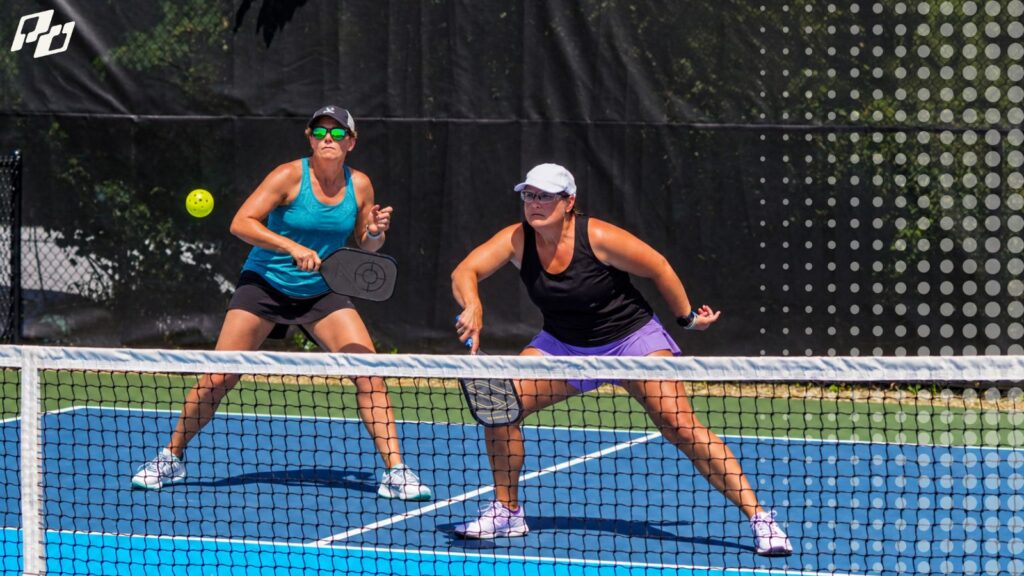
The middle isn’t permanently the painted centerline. The dangerous seam between partners moves as the rally moves.
If your partner gets pulled several feet toward the sideline and you stay where you were, the gap between you grows.
That’s the new middle.
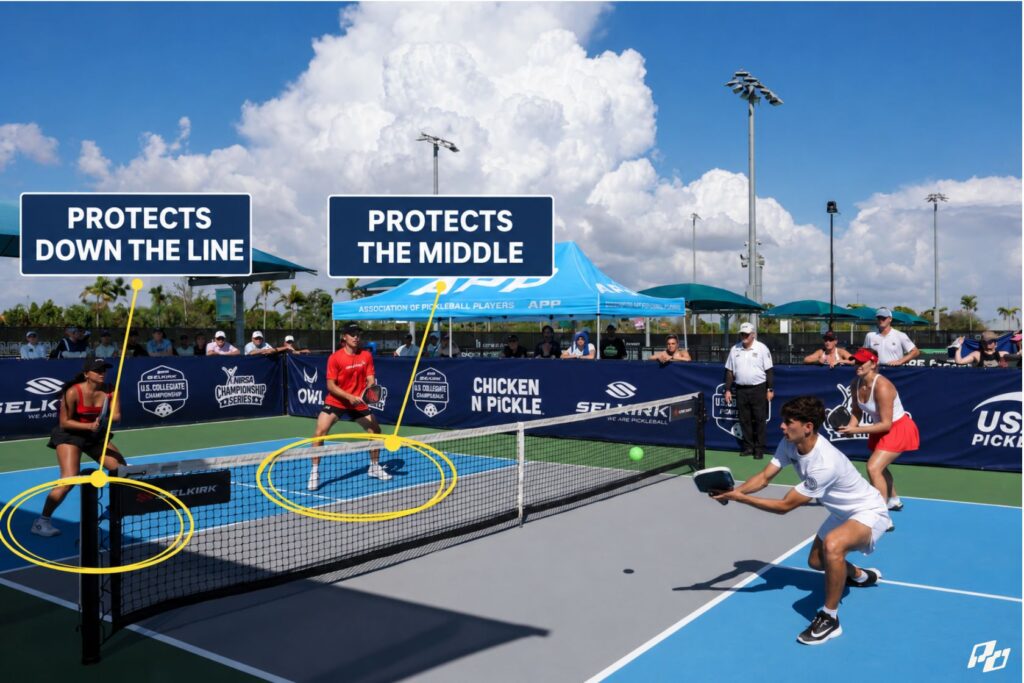
Opponents love an open middle because it’s a low-risk target, so I recommend staying closer to your partner and making opponents beat you toward the outside instead.
Think of two defenders connected by an invisible cord.
Partner slides left?
You slide left.
Partner gets pulled right?
You shade right.
Not all the way. Just enough that the seam doesn’t become a freeway.
Better cue:
Protect the gap, not the paint.
That one sentence can transform doubles court coverage.
Why Middle Is Such an Attractive Target
There is actual geometry behind this.
A regulation pickleball court is 20 feet wide, and the net is 36 inches at the sidelines but only 34 inches in the center.
So a middle ball offers several advantages:
- lower net
- more court margin
- less severe angle required
- and—against doubles teams—possible confusion about ownership
Briones also points out that middle dinks reduce the opponent’s available angles compared with wider dinks.
That explains why better opponents keep sending balls there. They’re not simply hoping you’ll argue. They’re attacking favorable geometry.
Your job is to make that safe target feel crowded.
Middle Dinks Are Different From Middle Speed-Ups
Don’t apply one ownership rule to every ball.
A slow dink gives you time.
A speed-up doesn’t.
That changes everything.
On a slow middle dink
You can communicate. You can move your feet. You can often choose the player with the cleaner attacking or dinking angle.
This is where a simple:
“Mine.” or
“Yours.” works beautifully.
Say it early. Not while both paddles are already entering the ball.
On a fast middle attack
There may be no meaningful time for conversation. The responsibility should already be understood. That means your partnership needs defaults before the rally.
For example:
“Your forehand takes neutral middle floaters.”
“I’ll take hard balls crossing into my backhand.”
“If you’re pulled wide, I’ll close behind you.”
That is much more useful than yelling “YOURS!” after the ball has passed both paddles.
The Ball at Your Inside Hip Is Where Things Get Messy
Middle balls don’t always arrive neatly between partners. Some attack your inside hip or inside foot.
For a right-handed player on the left, that’s often the right side of the body. For a right-handed player on the right, it’s often the left side.
That is deliberately awkward because the player has to decide:
Forehand?
Backhand?
Move?
Reach?
Those decisions take time. The solution isn’t a heroic last-second paddle flip. Create space early.
If the ball is slow enough, use the feet so you can contact it in front instead of allowing it to enter your body.
For a dink: read → small lateral adjustment → establish space → contact → recover.
For a fast volley: there may not be time to reorganize completely, which is why a neutral paddle position matters so much.
Briones recommends keeping the paddle roughly in front of the center of the body with a bent elbow rather than parking it aggressively on either the forehand or backhand side. That makes both directions accessible with less movement.
Stop Looking at the Target During Contact
Players often say:
“But if I watch the ball, how am I supposed to see where everyone is?”
You’re supposed to gather that information before contact.
- Watch the opponent.
- Read position.
- Choose the likely target.
Then let your visual attention return to the ball as it arrives.
What causes trouble is trying to locate the opponent again during the final fraction of the swing.
- Your head lifts.
- Your body opens.
- Your paddle path changes.
- And occasionally you completely miss.
The better sequence is: scan → decide → track → contact.
Not: track → look away → swing.
Once the ball is close enough to hit, your tactical homework should largely be finished.
Communication: “Mine” Is Better Than “Sorry”
Middle communication works best when it happens in two stages.
Before the rally
Establish defaults. Especially with a new partner.
You only need 10 seconds:
“I’ll take most forehands through the middle. If I get pulled wide, close behind me. Call anything unclear.”
Now neither player begins from zero.
During the rally
Keep language tiny.
- Mine.
- Yours.
- Switch.
That’s enough. Don’t explain strategy while the ball is moving. And call early.
The purpose of communication isn’t merely identifying ownership. It’s allowing the other player to stop moving toward the ball.
That prevents paddle collisions and lets that partner recover for the next shot.
What Changes in Singles?
Everything involving ownership disappears. But the middle becomes even more important. Now there is no partner. You own all of it.
The problem becomes: can you recover to a position from which both sides are reachable?
Coaches recommend center-oriented singles tactics, including serving toward the T to reduce the opponent’s available return angles. The important refinement is that you don’t blindly return to the painted center after every shot.
You recover toward the middle of your opponent’s likely angles.
Hit a neutral ball straight through the center?
Recover close to center.
Pull the opponent sharply toward a sideline?
Your ideal recovery point shifts slightly toward that side because the geometry of their available replies has changed.
That is why good singles players often appear to anticipate shots. Much of the time they’re simply standing where the percentages tell them the next ball is most likely to travel.
Singles cue:
Hit → recover → split → read.
The mistake is: Hit → admire → chase.
On a 20-foot-wide court, that first recovery step matters enormously.
A Better Way to Practice the Middle
Don’t practice this by having someone feed you 50 balls directly at the center. That’s too clean. Middle problems happen because you must first process where the previous ball went.
Try this instead.
Put two players at the kitchen. The feeder alternates randomly among:
- wide dink
- middle dink
- middle speed-up
- body speed-up
After every wide ball, both defenders must shift together. Then the feeder attacks the newly created seam.
Your goals are:
✔ Orient to the hitter
✔ Close the gap
✔ Stay balanced
✔ Keep the paddle compact
✔ Make ownership obvious
For singles, use the same idea with one defender.
Feed wide.
The player hits.
They must recover toward the appropriate middle and split before the next feed. Then send the next ball either behind them or to the open side.
Now you’re training the skill that actually prevents middle misses: recovery before reaction.
The Middle-Ball Checklist
When one keeps getting through, don’t immediately blame your reflexes. Ask:
✔ Was I facing the hitter?
✔ Was my paddle centered and in front?
✔ Did I move laterally or drift backward?
✔ Was my swing compact?
✔ Had my partner and I already established ownership?
✔ Did we move together after the previous shot?
✔ Was I watching the ball at contact—or already looking at my target?
Usually the answer appears quickly. And that’s the real lesson.
A middle ball rarely gets through because there is literally too much court to cover. It gets through because two players prepared for the previous ball instead of the next one.
In doubles, close the seam before your opponents find it.
In singles, recover toward the center of their options before they make you run.
And when the ball finally comes? You shouldn’t need a spectacular reaction. You should already be there.