Watching pro pickleball can improve your game if you watch with a purpose. Instead of copying highlight shots, study footwork, positioning, shot selection, recovery, patience, and how pros build points. Pick one player, one skill, and one habit to apply in your next rec game.
Yes — watching pro pickleball can make you a better player.
But only if you watch it the right way.
That’s the catch.
If you watch highlights casually, you might get inspired. You might pick up a few ideas. You might even start trying shots you have no business trying yet — hello, behind-the-back reset, fake Erne, and Ben Johns-style dead dink that immediately turns into a popup.
But if you watch with a plan, pro pickleball can absolutely improve your court IQ, shot selection, positioning, patience, footwork, and understanding of how points are built.
The key is this: don’t watch pros to copy everything they do. Watch pros to understand why they do it.
That distinction matters a lot for rec players.
A 3.5 player does not need to copy every pro speedup, poach, ATP setup, or hold-and-flick pattern. But a 3.5 player can learn a ton from watching how pros move, when they attack, when they reset, how they recover, how they communicate, and how rarely they are truly standing still.
So yes, watching pro pickleball can help. But you need to stop watching like a fan all the time.
Sometimes, you need to watch like a player.
The Problem: Most Rec Players Watch the Wrong Things
When most of us watch pro pickleball, our eyes naturally go to the fun stuff.
The speedups.
The hands battles.
The ATPs.
The Ernes.
The crazy resets.
The full-stretch counters.
The “how did they even get that back?” points.
That’s entertaining, but it’s not always the most useful thing to copy.
The problem is that pro players have skills, hands, footwork, balance, and anticipation that most rec players do not have yet. So if you only watch the highlight shot, you may miss the five boring things that made the highlight possible.
For example, you might see a pro rip a speedup off a dink and think: “I need to attack more.”
But what actually happened was:
- they moved their feet early
- they held their paddle in a threatening position
- they recognized the opponent was slightly off balance
- they attacked from a ball high enough to pressure
- they targeted the right hip/shoulder/seam
- and they recovered immediately for the counter
That is very different from “attack more.”
A lot of rec players watch the finish but miss the setup. And in pickleball, the setup is usually the lesson.
What Watching Pros Can Actually Teach You
Watching professional pickleball is useful because it gives you a clean model of what efficient pickleball looks like.
Not perfect pickleball. Pros miss too. They make errors. They choose wrong sometimes. They get sped up on. They lose hands battles. That is actually good for rec players to see because it reminds you that pickleball is not about never missing.
It is about making better decisions more often.
Here are the areas where watching pros can really help.
1. Watch Their Feet, Not Just Their Paddle
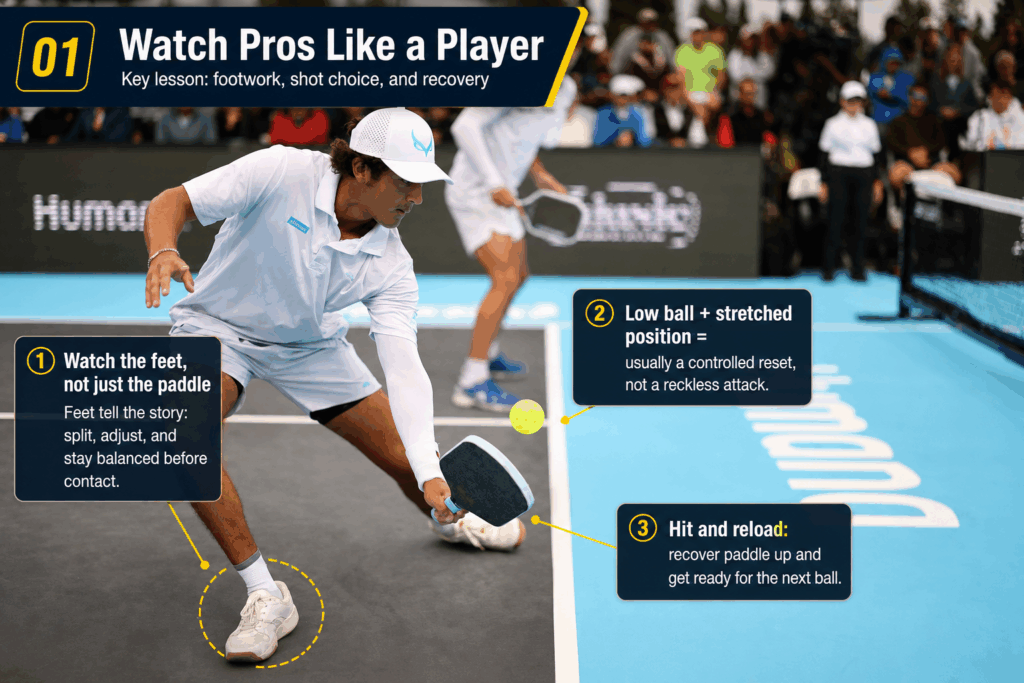
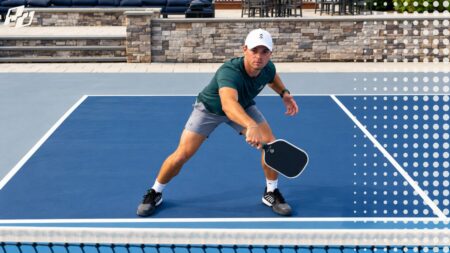
If you want one simple assignment, do this: watch one player’s feet for an entire rally.
Not the ball.
Not the winner.
Not the paddle trick.
Just the feet.
You will notice something quickly: high-level players are constantly adjusting.
They split step.
They recover.
They shade toward likely counters.
They move as their partner hits.
They take tiny adjustment steps before contact.
They get low before difficult balls.
They are rarely surprised from a dead stop.
This is one of the biggest things rec players can learn from pro matches.
Most 3.0–3.5 players are late not because they are slow, but because they are standing in the wrong place for too long.
Their feet are quiet when they should be active.
Their weight is back when it should be balanced.
Their paddle is ready, but their body is not.
Pro footwork shows you that pickleball is not just “get to the kitchen and stand there.” It is constant micro-positioning.
That matters because proper footwork makes shots easier, improves accuracy, saves energy, and reduces awkward lunging or twisting.
⮕ What to watch
Pick one player and ask:
- When do they split step?
- Do they move before or after their partner hits?
- How close are they to the kitchen line?
- When do they slide laterally?
- When do they retreat?
- When do they hold their ground?
- Are they balanced at contact?
⮕ What to copy in your game
Do not try to move like the most athletic pro on tour. Instead, copy the principle: move before you are in trouble.
At rec level, better footwork often looks simple:
✔️ recover after every shot
✔️ get your weight forward
✔️ split before the opponent contacts the ball
✔️ stop drifting after your own shot
✔️ avoid hitting while falling backward
That alone can upgrade your game.
2. Watch the “Before” Shot, Not the Winner
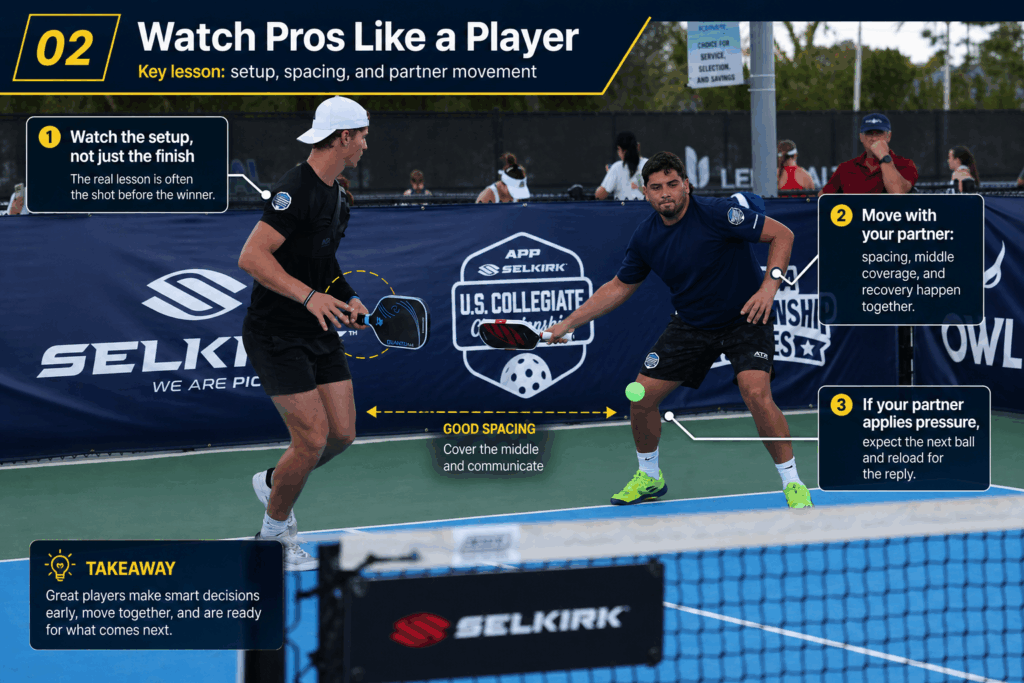
This is probably the most important viewing habit. When a pro hits a winner, rewind one or two shots. The winner is usually not the real lesson.
The setup is.
Maybe the winning speedup came after three dinks that pulled the opponent wider and wider. Maybe the pop-up came because a deep dink pushed someone off the kitchen line.
Maybe the counter winner happened because the first attack went into the body and created a predictable reply.
If you only watch the last shot, you may think pros are just hitting better winners. But most of the time, they are creating better winners.
That’s the difference.
⮕ What to watch
When a point ends, rewind and ask: what created the attackable ball?
Was it:
- depth?
- angle?
- spin?
- patience?
- body pressure?
- footwork?
- a reset?
- a dink to the outside foot?
- a speedup that forced a weak counter?
- a ball that made the opponent reach?
This is how you start seeing pickleball as a sequence, not a collection of individual shots.
⮕ What to copy in your game
Instead of trying to hit more winners, try to create more weak replies. That means:
✔️ dink to move people
✔️ reset to make them hit up
✔️ drive to set up a fifth shot
✔️ speed up to create a predictable counter
✔️ attack only when the ball gives you permission
That is much more useful than simply saying, “I need to be more aggressive.”
3. Watch Shot Selection: When Do They Drive, Drop, Reset, or Attack?
This is where pro pickleball can really sharpen your pickleball IQ. A lot of rec players know the shots. They just choose them at the wrong times.
They drive when they should drop.
They drop when they should drive.
They attack from below net height.
They reset balls they could punish.
They speed up because they are bored, not because the ball is attackable.
Pros give you a living library of decision-making. You can watch how they treat different balls:
- deep returns
- short returns
- balls at their feet
- balls they contact in front
- balls below net height
- dinks that sit up
- counters into their body
- and transition-zone pressure
This is especially useful because modern pro instruction often frames third-shot decisions as situational rather than automatic. For example, Anna Leigh Waters emphasizes adapting the third shot based on return depth and difficulty: deep returns often make drops harder, while shorter balls can change the decision entirely.
That matters for rec players because too many of us learn rules like:
“Always third shot drop.”
“Always drive the third.”
“Never speed up low.”
“Always get to the kitchen.”
The better version is: “What does this ball allow?”
⮕ What to watch
During a pro match, pick one category:
- Every third shot
- Every reset
- Every speedup
- Every dink that gets attacked
- Every ball taken out of the air
Then ask: why that shot right there?
Not whether you could execute it. Just why it made sense.
⮕ What to copy in your game
Use pro matches to build decision rules:
✔️ If I’m stretched, reset
✔️ If the ball is high and in front, attack
✔️ If the return is deep and heavy, simplify
✔️ If my drop is good, move
✔️ If my partner attacks, expect the next ball
✔️ If the opponent is balanced and loaded, don’t feed their counter
That is how watching becomes training.
4. Watch How Patient They Are — But Don’t Misread Patience as Passivity
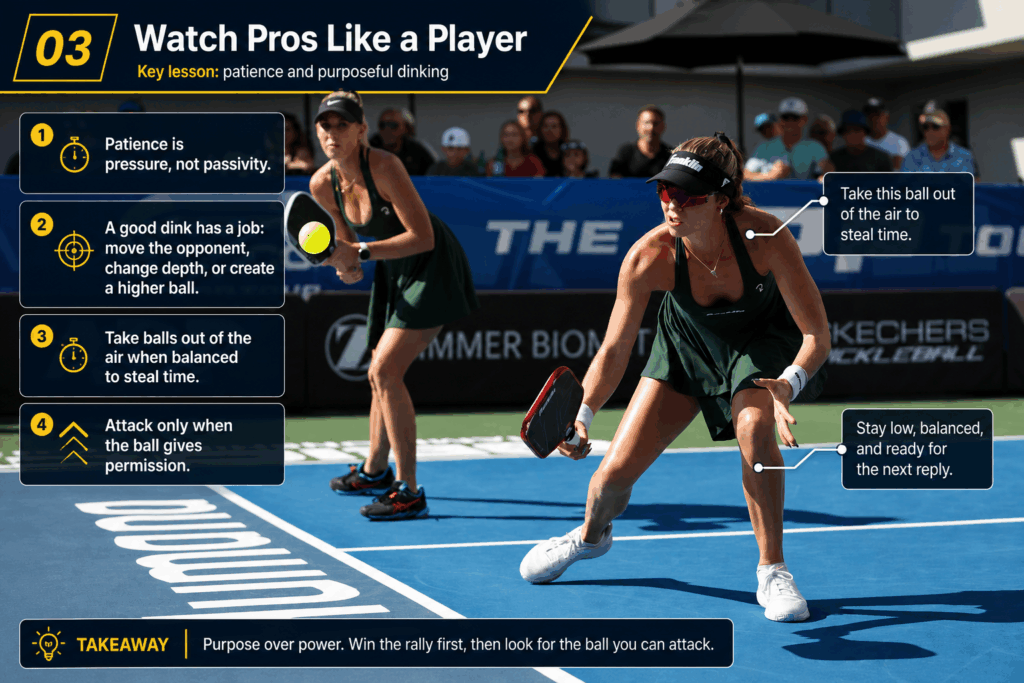
One of the biggest lessons from pro pickleball is patience. But this is also one of the easiest things to misunderstand. Patience does not mean “just dink forever.” High-level patience is not passive. It is pressure without panic.
A good pro dink is often doing something:
- moving the opponent
- changing height
- changing depth
- changing spin
- testing balance
- pulling someone wide
- creating a speedup window
- preventing the opponent from attacking first
That is very different from a dead dink straight to the opponent’s paddle.
This is why some rec players watch pro pickleball and think, “They’re just dinking forever.” But once you understand what is happening, those dink rallies become more interesting. Each ball is probing for a slightly better contact point, a slightly higher reply, a slightly worse balance position, or a slightly late recovery.
That level of patience is also why pros attack less randomly than many rec players. They respect counters. They know that if they speed up the wrong ball, the ball comes back faster.
⮕ What to watch
During dink rallies, ignore the ball for a moment and watch:
- who is being moved?
- who is reaching?
- who is taking balls out of the air?
- who is giving ground?
- who is changing depth?
- who is waiting for a high enough ball?
- who speeds up first — and why?
⮕ What to copy in your game
Do not just “dink more.” Dink with a job.
Try:
✔️ one crosscourt dink to move them
✔️ one dink toward the outside foot
✔️ one deeper dink to push them back
✔️ one soft dink that forces them to lift
✔️ one dink that sets up your next speedup
That is pro-style patience translated for rec play.
5. Watch Recovery After the Shot
This is a hidden gem. Most rec players watch the shot itself. Better players watch what happens immediately after.
After a pro speeds up, where does their paddle go?
After a dink, do they admire it or recover?
After a drive, do they crash blindly or move based on the quality of the shot?
After a reset, do they step in or stabilize?
After getting pulled wide, how fast do they reconnect with their partner?
That recovery habit is huge.
Many rec players lose points not because the first shot was terrible, but because they are late for the next one.
They hit a decent speedup and freeze.
They hit a nice drop and watch.
They dink wide and stand upright.
They counter once and let the paddle fall.
Pros are constantly reloading. That is one reason they look like they have more time.
They are not finished after contact. They are already preparing for the next ball.
⮕ What to watch
After every shot, ask:
Where does the paddle go next?
Where do the feet go next?
Does the player move with the partner?
Are they ready for the obvious reply?
⮕ What to copy in your game
Use the phrase: hit and reload.
After every shot, return to:
✔️ paddle up
✔️ balanced base
✔️ eyes forward
✔️ ready for the next likely ball
This is one of the easiest pro habits to copy because it does not require elite athleticism. It requires discipline.
6. Watch One Player Who Looks Like You
This is a big one. Do not only watch the most spectacular player. Watch someone whose game type makes sense for you.
If you are shorter, do not build your kitchen movement around a 6’3” player who can lunge halfway across the kitchen.
If you are not explosive, do not copy a player who wins by flying into every poach. If you have a two-handed backhand, watch players who build points around that pattern.
If you are left-handed, study lefties.
If you are a power player, watch how aggressive pros choose the right ball instead of attacking everything.
One of the smartest comments players often make about pro watching is that there is not one “correct” pro style. There are different workable models based on body type, mobility, strengths, weaknesses, and tactical identity.
That is exactly right.
The question is not: “What does the best player in the world do?”
The question is: “What can I realistically borrow?”
⮕ What to watch
Pick one “model player” for a month.
Watch:
- their ready position
- their favorite patterns
- how they defend
- how they attack
- how they move with a partner
- what they do under pressure
- and what they avoid doing
⮕ What to copy in your game
Choose one small habit. Not five. Examples:
✔️ their return depth
✔️ their dink posture
✔️ their paddle recovery
✔️ their third-shot patience
✔️ their transition reset shape
✔️ their communication after errors
✔️ their habit of taking dinks out of the air
Small copying works. Whole-game copying usually fails.
7. Watch Slower, Not More
If you really want to learn, slow the video down. A full-speed pro rally can be too fast to process. The footwork, paddle angle, shoulder turn, split step, and recovery all blur together.
At 0.5 speed or 0.25 speed, the game changes.
You start seeing:
- when the paddle gets set
- when the feet stop
- how early they read the ball
- how little backswing they use
- how compact the counters are
- how often they recover before the ball crosses the net
- and how much of “fast hands” is actually early preparation
This is not just a pickleball thing. In broader sport learning, video observation and visual feedback are widely used because they help athletes notice technical and tactical details that are hard to catch in real time.
⮕ How to do it
Pick one rally. Watch it three times:
- Full speed — understand the point.
- Half speed — watch positioning and decisions.
- Quarter speed — watch technique and contact.
Then take one note. Not ten.
One note you can use next time you play.
8. Don’t Let Pro Watching Make You Play Worse
This is the warning section. Watching pros can help your game, but it can also mess you up if you take the wrong lesson.
You might start:
- attacking too much
- trying shots you have not practiced
- forcing speedups from low balls
- poaching when your partner is not ready
- copying extreme footwork your body cannot handle
- trying to dink like a pro without understanding the setup
- or thinking every rec point should look like a championship final
That is not learning. That is cosplay. The goal is not to play “pro-style pickleball” at 3.5.
The goal is to make your 3.5 game more intelligent. That means translating the idea to your level.
For example:
Pro version: disguises a backhand speedup after a long dink exchange
Rec translation: wait for a ball that sits up—don’t speed up out of boredom
Pro version: drives, crashes, and wins the fifth
Rec translation: move forward only when your drive creates real pressure
Pro version: takes a dink out of the air and attacks
Rec translation: step in and take time away instead of letting everything bounce
That’s the difference between copying and actually learning.
The “One Player, One Skill” Watching Method
Here is the easiest way to turn watching into improvement. Do not watch the whole match for everything.
Pick:
One player.
One skill.
One question.
Example:
Player: Ben Johns
Skill: dink patience
Question: What ball does he finally attack?
Or:
Player: Anna Leigh Waters
Skill: transition offense
Question: When does she move from neutral to attack?
Or:
Player: Hayden Patriquin
Skill: footwork
Question: How early does he move before contact?
Or:
Player: a lefty pro
Skill: doubles positioning
Question: How does the lefty change middle coverage?
Then watch 10–15 minutes with that one question in mind. That is enough.
You will learn more from 10 focused minutes than from two hours of passive watching.
Watch Pros, Then Watch Yourself
This is where the magic really happens. Watching pros gives you the model. Watching yourself gives you the truth.
Video analysis is becoming a major part of pickleball improvement because it gives objective feedback on technique, positioning, and shot selection. Modern pickleball coaching platforms increasingly use video review because players often miss their own habits in real time.
The best loop is:
Watch pros → pick one habit → record yourself → compare honestly → drill one correction → play again.
That is how watching becomes action.
How to Apply What You Watch in Your Next Rec Game
Here is a simple system. Before you play, choose one thing you noticed from a pro match. Not a highlight shot.
A habit.
Examples:
- “I’m going to recover my paddle after every speedup.”
- “I’m going to return deep and move in.”
- “I’m going to split before my opponent hits.”
- “I’m going to attack only when the ball is high enough.”
- “I’m going to dink crosscourt with purpose.”
- “I’m going to reset instead of swinging in transition.”
- “I’m going to watch my partner’s shot quality before crashing.”
Then play the whole session with that one focus.
Afterward, ask:
Did I actually do it?
Did it help?
Where did it break down?
What should I watch next?
That is the improvement loop.
The Final Answer: Yes, But Watch With a Job
Watching pro pickleball can make you better.
Not automatically.
Not by osmosis alone.
Not if you only watch highlights and try to copy the flashiest shot
But if you watch with intention, it can absolutely upgrade the way you see the game.
For rec players, the biggest benefit is not that you suddenly hit like a pro. It is that you start thinking more like a better player.
You stop asking, “What shot do I want to hit?”
And you start asking:
“What does this ball call for?”
“Where should I be before the next shot?”
“What is my opponent likely to do?”
“What pattern am I trying to create?”
That is how watching becomes useful.