
Choose your pickleball third shot by reading the return—not by habit. Ball height, your balance, and opponent position should decide whether you drive, drop, or attack.
A lot of intermediate players decide their third shot before the return even crosses the net.
I’m a drop player.
Or: I drive thirds and drop fifths.
That makes life simple. It also means you occasionally hit exactly the wrong shot.
The better way to think about the third is not drive or drop?
It is: What did this return just give me?
Because a short sitter, a low skidding return, a deep ball that pushes you backward and a deep ball that lands high in your strike zone may all be “third shots.”
They are not remotely the same shot.
And interestingly, even high-level coaches disagree on simple rules such as “always drop a deep return.” Parris Todd recommends the drop when a deep return pushes you into a defensive position, while coach Austin Hardy and pro Liam Duffin often favor driving from deep to manufacture an easier fifth.
That disagreement tells us something useful: court depth alone isn’t enough information. You need to read the ball.
Use three questions, in this order
Forget memorizing eight scenarios. As the return approaches, read three things:
1. How high will I contact it?
2. Am I balanced or being pushed backward?
3. Have my opponents established themselves at the kitchen?
Those three answers will make most third-shot decisions for you.
The first one—contact height—is particularly valuable.
A high ball gives you room to swing forward and use topspin while still bringing the ball down. A low ball forces you to lift.
That’s why a short return isn’t automatically a drive.
If it lands short but stays ankle-high, trying to crush it can turn an advantageous return into a ball you’re desperately trying to drag over the net.
And a deep return isn’t automatically a drop.
If it sits up beautifully, you’re balanced and the returner is still moving forward, the drive may be a very sensible way to attack their transition and create something easier next.
The third shot cheat sheet
| The ball you receive | Your best default | Why |
|---|---|---|
| Deep + you’re pushed backward | Drop | You’re defensive; forcing a drive from poor balance often produces an attackable ball |
| Deep + you’re balanced + ball sits up | Drive or drive-to-drop sequence | Use pace to manufacture an easier fifth rather than demanding a perfect long drop |
| Midcourt + low | Drop | You already gained court position; don’t surrender it by attacking upward |
| Midcourt + high | Drive | You have both position and contact height |
| Short + low | Push/slice drop | Short distance gives you plenty of margin; forcing topspin or pace adds unnecessary risk |
| Short + high | Drive and crash | This is the gift ball—attack and immediately expect the next volley |
| Opponent still moving toward kitchen | Lean drive | Make them volley while moving rather than once they’re settled |
| Both opponents established and balanced at NVZ | Lean drop | A hard ball may simply give good volleyers exactly what they want |
That last column is the important part.
You’re choosing a shot because of what you want the fourth ball to look like. Not because somebody told you third shots should be drops.
A drive is often not an attack. It’s a setup.
This is where a lot of recreational players misunderstand the modern third-shot drive.
They blast the third and watch to see whether it wins. If it comes back, they think the drive failed.
The drive is often a transition shot. Most good third-shot drives will come back; the purpose is frequently to provoke a shorter or more manageable fourth ball so that your fifth is easier to drop.
That changes how hard you need to hit it.
You don’t necessarily need your biggest forehand. You need a drive that stays low enough that your opponent’s volley is uncomfortable.
Think: Drive → weak block → easier fifth → kitchen.
Not: Drive → winner.
PPA pro Riley Newman shows you exactly how the strategy works, why it gives consistent players trouble, and how to use it in your own game:
Experienced players talk about this constantly. In recent rec discussions, the common logic behind driving the third and dropping the fifth is precisely that a blocked drive often lands much shorter than the original return, shrinking the distance of the eventual drop.
That is the real payoff. You are purchasing an easier next ball.
But here’s the catch with “drive the deep ball”
This is where rules get dangerous.
Austin Hardy, head coach at Pickleball Playbook, strongly favors driving many deep returns. His reasoning is that a drop from well behind the baseline asks you to land a soft ball into a small target from a long distance, while a drive can pressure the opponents and often set up an easier fifth-shot drop.
Parris Todd gives almost the opposite default: if a deep return pushes you backward or gets on you quickly, neutralize with a drop rather than trying to muscle an aggressive ball from a defensive position.
Both can be right. The missing variable is your body.
If “deep” means: ball lands near baseline, I have time, feet are set, contact is waist-high—you may have a perfectly good drive.
If “deep” means: I’m backing up, late, jammed and contacting beside my hip— that is a completely different ball.
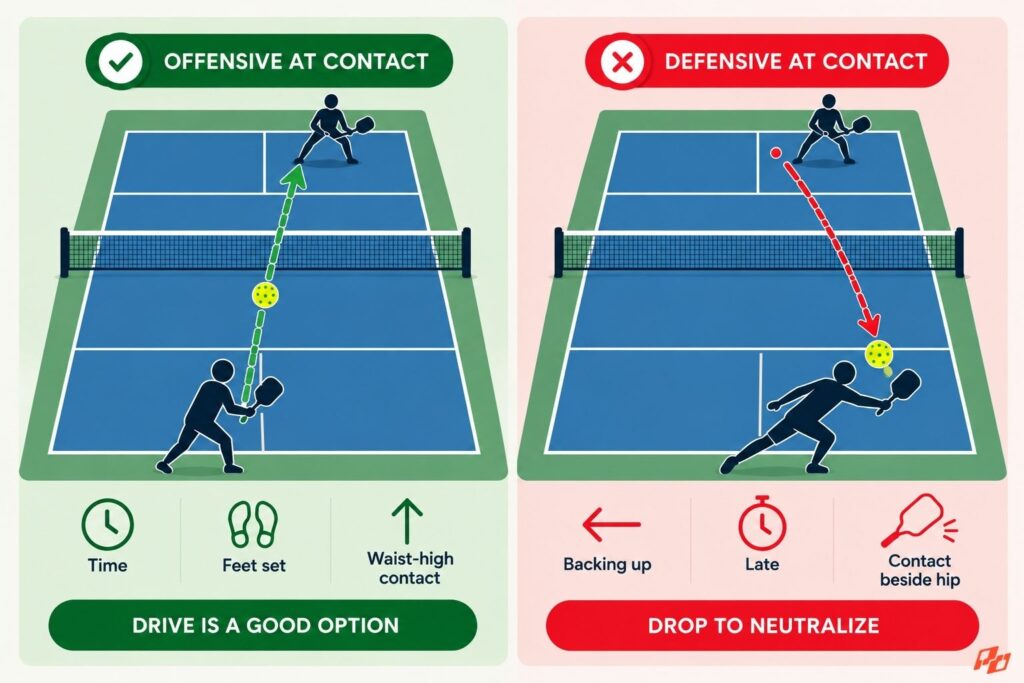
So don’t ask: Was the return deep?
Ask: Did the return leave me offensive or defensive at contact?
That’s a much better rule.
Short doesn’t necessarily mean “smash”
A short, high ball should usually make your eyes light up. But the word high matters much more than the word short.
A short return that stays below your knees gives you excellent court position but poor attacking geometry.
Don’t ruin the gift.
Use a simple push or controlled drop, continue forward and make the opponents hit their next ball upward:
@tanner.pickleball Learn The Most Consistent Drop in Pickleball, the Push Drop! 🏆 👉 Keep a loose grip on the paddle. 👉 Have no backswing and catch the ball out in front. 👉 Keep your paddle tip down to fully catch the ball. #pickleball #pickleballtips #pickleballaddict #pickleballlife #pickleballtiktok ♬ original sound – Tanner.pickleball
A short ball that bounces around waist height? Different story. Now you can contact comfortably in front, drive with topspin and follow it.
Pro pickleball player Parris Todd says the best drive opportunities usually come on a short return, with enough contact height, good balance, and room to step through the shot. That’s the green light.
Short + high + balanced = go.
Short alone doesn’t equal go.
Stop sprinting after every good drop
Another mistake happens after the shot.
You hit a pretty drop.
Your brain says: KITCHEN!
So you sprint forward even though the drop actually floated a little too high. Now the opponent volleys it at your feet while you’re moving.
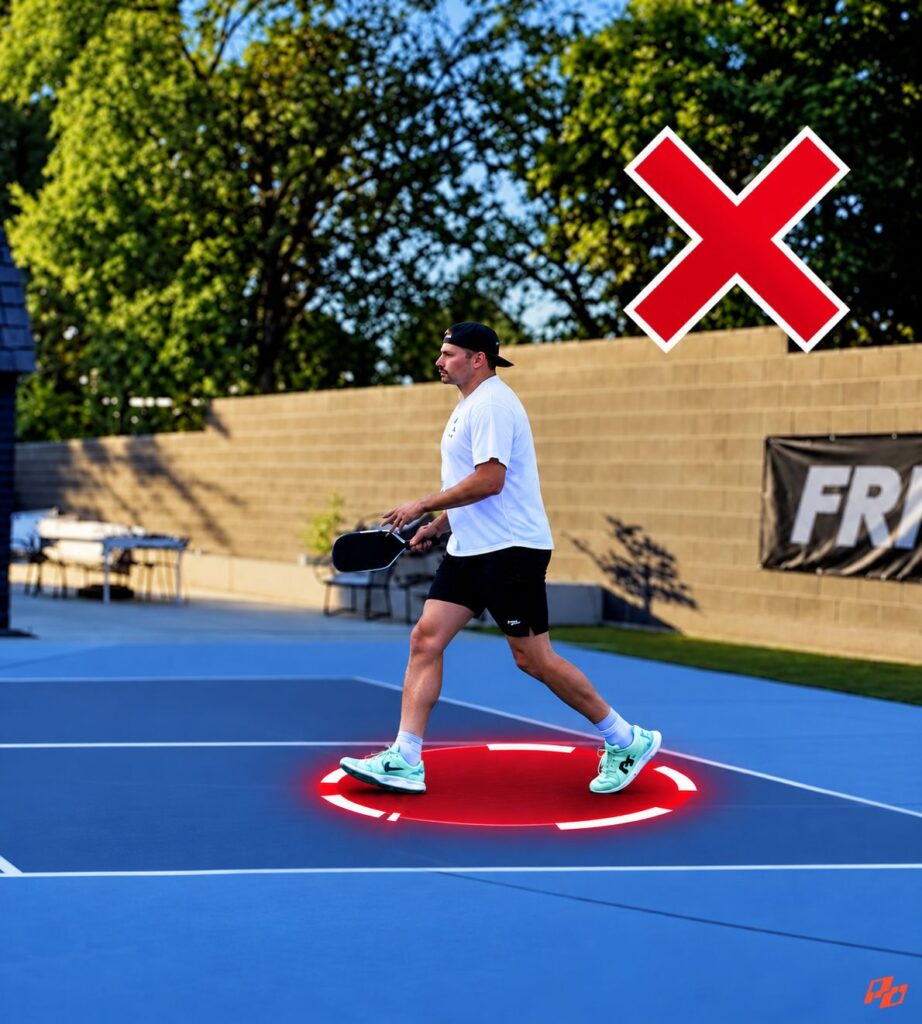
A good third shot does not automatically mean you should reach the kitchen immediately. Move forward as the ball earns it.
A great drop may let you take several steps.
A mediocre one may earn you two.
A bad one may require you to stop, split, and play another reset.
The kitchen isn’t somewhere you have to arrive on shot five. It’s somewhere you earn your way into.
Your opponents belong in the decision too
The ball matters. Your position matters. But so do the two people waiting for it.
Imagine you get the same midcourt ball twice, and both times it sits up enough to attack. In the first game, the returner is still moving forward.
Drive it. Make them handle pace while they’re on the move.
Now imagine the same ball, but this time both opponents are already settled at the kitchen, balanced and ready.
That same drive is much less attractive. They’re no longer scrambling. They’re waiting for it.
Coach Austin Hardy’s third-shot framework focuses heavily on return depth, your court position, ball height, and whether you’re moving forward or still defending. His bigger point is that a drive often works best as a setup shot, not a winner: drive the third, get a weaker fourth, then play an easier fifth.
Your opponents help tell you whether that plan is working. So pay attention to what happens after the drive.
If their fourth-shot volley keeps floating short or landing harmlessly in the transition zone, keep pressing them.
If they’re consistently blocking your drive low at your feet or countering it aggressively, that’s useful information too.
They’ve basically told you: stop feeding me this ball.
That’s when the drop starts making more sense.
The goal isn’t to decide “I’m a drive player” or “I’m a drop player.” It’s to notice what this opponent is giving you today.
Don’t copy the pros without copying the next shot
You will absolutely see elite players drive enormous numbers of thirds.
In one documented pro men’s doubles match, Ben Johns and Collin Johns drove 34 of 52 third shots—about 65%. Their opponents Christian Alshon and Quang Duong drove 39 of 57, about 68%.
It is tempting to watch that and conclude: Third-shot drops are old-school.
Not quite.
Pros aren’t just better at driving. They’re much better at what comes after the drive.
They expect the counter.
They can handle pace at their feet.
They can drop the fifth from a faster incoming ball.
They know when to stop moving.
So if your third-shot drive routinely produces a hard fourth at your ankles—and then your fifth goes into the net—the problem might not be your drive.
The problem may be that you’ve copied half of a professional pattern.
This is exactly what experienced rec players point out online: the drive/drop strategy becomes far less useful if the fourth ball you’re generating isn’t actually easier for you to handle.
Use this test: is my drive making my fifth easier?
If yes, keep it.
If no, you’re just hitting hard.
The topspin drop is useful—but don’t force it
A topspin drop from midcourt is a good option. But you don’t need to turn every midcourt drop into a mini-pro shot.
A 2025 aerodynamic study of third-shot drops found something interesting: successful drop trajectories exist inside fairly specific combinations of launch speed and angle. For example, the model estimated successful down-the-line drops at approximately 10.9–13.0 m/s, with initial angles around 15.5–22.5 degrees. Crosscourt drops tolerated somewhat different speeds and angles.
You don’t need to remember those numbers on court. The practical lesson is simpler: A drop has a window.
Adding more pace, spin and wrist action doesn’t automatically enlarge that window.
For most intermediate players, a boring push drop they can repeat is worth far more than a beautiful topspin drop they make six times out of ten.
Spin should solve a problem. Not create one.
Here’s the read I want you to make
Next time you serve, don’t decide: I’m driving this third. Watch the return. Then run this tiny sequence in your head:
High or low?
Balanced or stretched?
Settled opponent or moving opponent?
That’s it.
If it’s high + balanced + opponent moving, think attack.
If it’s low + defensive + opponents established, think neutralize.
Everything between those extremes is where your own strengths matter.
And when you’re unsure? Choose the shot that gives you the better next ball. That is the real third-shot skill.
Not having one perfect drop.
Not blasting every return.
Not religiously driving third and dropping fifth.
It’s realizing that the third shot is not really a shot at all. It’s a decision. And the ball has already given you most of the answer.