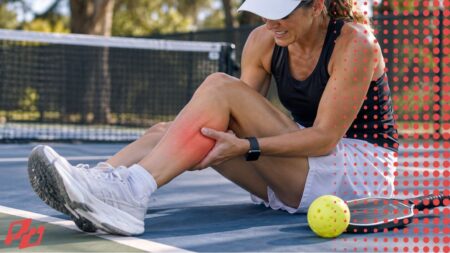

Playing through pickleball pain can turn a minor ache into a nagging injury. If pain worsens during play, changes your movement, causes swelling, or feels worse the next morning, cut back or stop. For players over 50, the 24-hour recovery test is often more useful than judging pain on the court.
There is a very specific kind of pickleball injury that almost never feels serious enough to stop you.
Your elbow is a little sore. Your knee feels stiff when you get out of the car. Your Achilles complains for the first few steps in the morning.
Then you get to the courts, warm up, play a game or two and… it feels better. So you keep playing. This is where a lot of recreational players get into trouble.
Not because they ignored some dramatic warning sign. Not because they heard a pop or collapsed in pain. Because they were still able to play.
And that turns out to be a surprisingly poor test of whether your body is actually handling the workload.
A national survey of 1,758 pickleball players found that 35.9% were currently playing with pain or an ongoing injury. Nearly 69% had experienced some kind of physical complaint over the previous year, and chronic or overuse problems were the largest category of serious injuries reported.
Players who played more frequently each week also had 45% higher odds of injury.
In other words, a lot of pickleball injuries are not one bad step. They are 40 ordinary sessions stacked on top of each other.
The dangerous sentence: “It loosens up once I start playing”
This one deserves suspicion. Because irritated tendons and joints can genuinely feel better once they are warm. That does not necessarily mean the problem has gone away.
Imagine your Achilles feels stiff when you get out of bed.
You walk around. It improves.
You play for 90 minutes. It feels surprisingly decent.
You think: Great. Apparently movement is good for it.
Then the next morning you step out of bed and the stiffness is worse. That morning is telling you something the previous day’s game did not.
For many nagging overuse problems, how you feel during pickleball is only half the story. The more useful question is: how did your body respond to that session afterward?
That is the idea I wish more recreational players used.
Call it the 24-hour test.
Your body keeps score after you leave the court
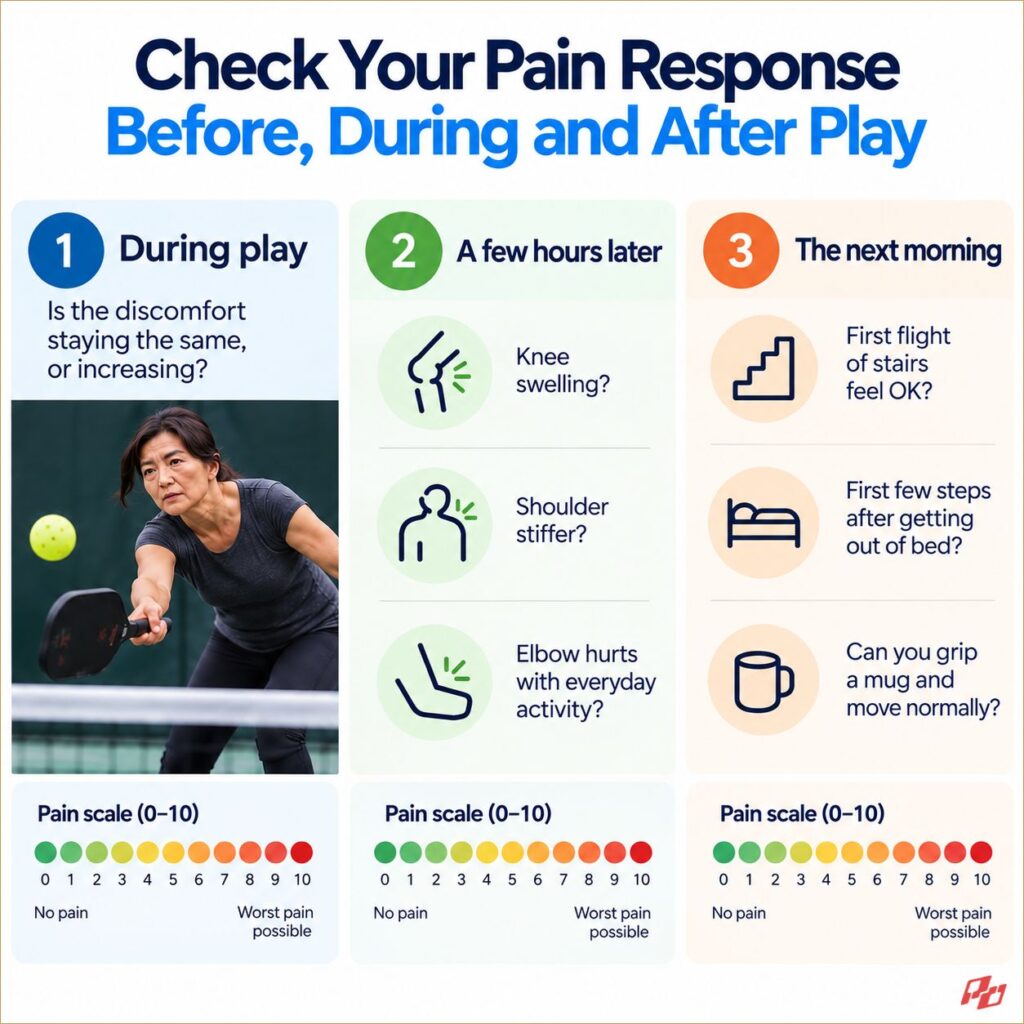
Instead of asking only, “Did it hurt while I played?”, check the same area three times.
First, during play.
Is the discomfort staying roughly the same, or is it steadily increasing?
Second, a few hours later.
Does the knee swell?
Does the shoulder suddenly feel much stiffer?
Does your elbow hurt when you pick up a pan?
And third — probably most important — check the next morning.
How does the first flight of stairs feel?
What about the first five steps after getting out of bed?
Can you grip a mug normally?
Does putting on a shirt suddenly remind you that you played yesterday?
Sports-medicine rehabilitation sometimes uses exactly this kind of symptom response to judge whether a tendon tolerated a particular amount of loading.
Mild discomfort during exercise is not automatically considered disastrous. What matters is whether symptoms settle afterward and return close to baseline by the following day rather than progressively worsening.
That does not mean, “Anything up to 5/10 pain is safe, keep playing.” It means something much more useful: the next morning gives you information.
If you were a 2/10 before playing, a 2–3 during play and back around a 2 the following morning, that session may have been manageable.
If you were a 2, played anyway and wake up at 5 with noticeably more stiffness, your body has essentially sent you the bill.
And if that bill gets larger every week, stop pretending the problem is just soreness.
The progression most players miss
A nagging injury often develops in a very predictable way.
At first, it hurts after pickleball. Then it hurts near the end of pickleball. Then it hurts at the beginning, warms up, and comes back afterward. Then everyday things start hurting.
Stairs.
Opening jars.
Getting out of a chair.
Walking the dog.
Reaching into a cupboard.
Sleeping on one shoulder.
This is an important point.
The pain getting stronger is not the only sign that things are worsening. Pain spreading into ordinary life is also progression.
A knee that only bothers you after a hard third game is one thing. A knee that now hurts every time you walk downstairs is telling a different story.
Here is the mistake: treating the symptom while keeping the same schedule
This is where pickleball players become amateur sports-medicine departments.
New brace.
Compression sleeve.
Ice.
Massage gun.
Different paddle.
Different grip.
Different shoes.
Painkiller.
Stretching routine from YouTube.
Some of those things can genuinely help symptoms. But there is a question that should come before all of them: did you change the amount of stress causing the problem?
If the answer is no, you may simply be finding better ways to tolerate the same overload.
This is particularly relevant with tendon problems. Tendons generally do not become more resilient because we protect them forever. They usually need appropriate loading to rebuild capacity.
But appropriate loading is not the same as another two-hour open-play session. That is the distinction recreational players often miss.
Rehabilitation gives tissue a controlled dose. Pickleball gives it whatever happens next.
The “pickleball is my exercise” trap
There is a line experienced players use that I think should be printed on the wall of every 50-plus rec center: you train so you can play the sport. The sport is not automatically the training that prepares you to play it.
Pickleball is excellent activity.
It is not particularly systematic strength training.
It does not necessarily strengthen your calves through a controlled full range of motion.
It does not progressively build your quads.
It does not gradually improve your ability to absorb force on one leg.
It does not guarantee stronger hips.
And it certainly does not make you practice safe deceleration before somebody drops a ball three feet in front of you.
This matters more after 50 because muscle and tendon capacity become increasingly valuable insurance.
The encouraging part is that older bodies still adapt extremely well to resistance training. And pickleball-specific research is starting to point in the same direction.
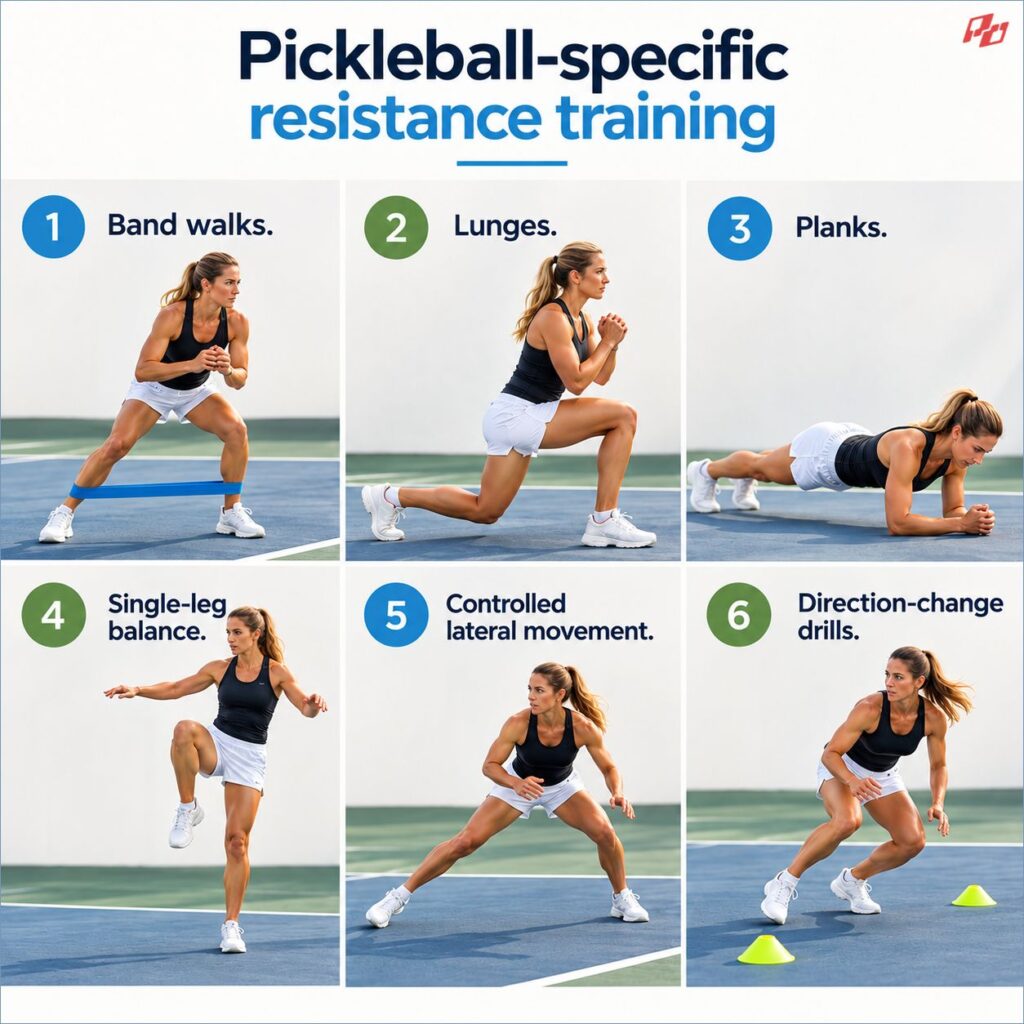
One study involving players 55 and older tested a 10-week program built around strength, balance, multidirectional lunging, lateral movement and change-of-direction training.
The exercises were not exotic.
- Bridges.
- Band walks.
- Lunges.
- Planks.
- Single-leg balance.
- Controlled lateral movement.
- Direction-change drills.
Participants improved several measures of physical performance, and the researchers highlighted hip strength, trunk strength, quadriceps strength, balance and deceleration ability as particularly relevant to pickleball.
This may be one of the more useful changes an older intermediate player can make: replace one extra playing day with a strength day.
Not because playing less is virtuous. Because stronger players often get to play more over the course of a year.
Smart players also reduce unnecessary mileage
There is another way to lower injury load that almost nobody calls injury prevention. Play better pickleball.
Watch strong senior players and you will often notice they are not trying to win every point with athleticism.
✔ They anticipate.
✔ They recover early.
✔ They use height and depth.
✔ They reset.
✔ They let certain balls go.
✔ They make opponents move.
✔ They avoid turning every slightly bad lob into an Olympic qualifying event.
This is not just smart strategy. It is economy of motion.
If you are 58 and your calf has been grumbling for two weeks, chasing a low-percentage lob backward may not be heroic. It may simply be bad shot selection.
If your knee is irritated, repeatedly sprinting into the kitchen because your return keeps landing short is not just a knee problem. It may be a return-of-serve problem.
And if your shoulder is sore because you attack every ball above net height at maximum speed, sometimes the medical breakthrough is not another resistance band. It is a reset.
One of the best things about becoming a better intermediate player is learning that good pickleball can demand less desperate movement.
That can keep you on the court longer.
So when should you actually stop?
This is where players need something more useful than “listen to your body.”
Because sometimes your body is saying, I’m a little stiff. And sometimes it is saying, Stop doing this now. Those are not the same message.
A good rule is to pay less attention to the mere presence of discomfort and more attention to what the pain is making you do differently.
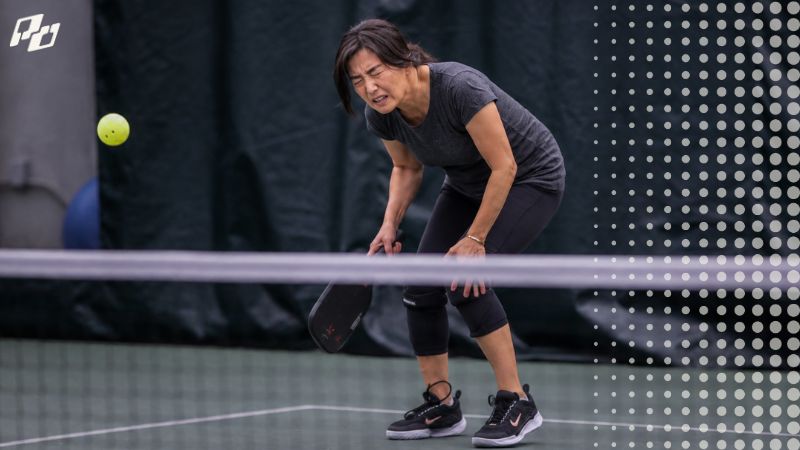
If you are limping, protecting one side, shortening your stride, avoiding rotation, changing your swing, or moving cautiously because a normal movement hurts, that is a much stronger warning sign than a mild ache that stays stable.
At that point, the body has already started compensating.
And once you are compensating, you are no longer just playing through pain. You are changing mechanics to avoid it, which can shift stress somewhere else.
Quick cheat sheet
| What you notice | What it probably means | What to do |
|---|---|---|
| Mild, familiar discomfort that stays stable and does not change your movement | Possibly manageable irritation | Finish cautiously, then check how it feels later that day and the next morning |
| Pain gradually increases during play | The current workload is probably too much | Cut the session short |
| You start limping, protecting one side, shortening your stride, or changing your swing | Your body is compensating | Stop playing |
| Sharp pain, sudden pain, or pain that makes you hesitate before moving | Possible acute injury | Stop immediately |
| Swelling develops during or soon after play | More than ordinary soreness | Stop and assess |
| A joint catches, locks, buckles, or gives way | Mechanical or stability problem | Stop and get it evaluated |
| You hear or feel a pop or snap followed by pain | Possible muscle, tendon, ligament, or joint injury | Stop immediately |
| You cannot bear weight normally | Significant injury warning sign | Stop and seek prompt medical assessment |
| The same ache returns every time you play, even after reducing volume | It is no longer behaving like ordinary soreness | Get it assessed |
| Pain starts affecting sleep, stairs, walking, gripping, dressing, or other normal activities | The problem is spilling into daily life | Get it assessed rather than continuing to manage it yourself |
| Chest pressure, unusual shortness of breath, dizziness, faintness, confusion, or a fast/irregular heartbeat | This is not a normal sports ache | Stop immediately and seek appropriate medical care |
The key distinction is this: pain that stays mild and does not change how you move is one thing. Pain that changes your movement is another.
If your knee hurts enough that you stop bending it normally, if your calf makes you take shorter steps, or if your shoulder makes you alter your swing, the session is already costing you more than it is giving you.
And there is another pattern worth respecting: repetition.
If the same ache shows up every time you play, settles down, then comes straight back the next session, do not keep resetting the clock and calling it soreness. Especially if it has started creeping into normal life.
That is usually the point where “I can still play” stops being useful information.
One final category sits outside the usual muscle-and-joint discussion. Chest pressure, unusual breathlessness, dizziness, faintness, confusion, or a fast or irregular heartbeat during play are reasons to stop immediately and seek medical attention.
Those are not symptoms to monitor for another game.
The question that changes everything
Most injured recreational players ask: “Can I play tomorrow?” Try replacing it with: “If I play tomorrow, will I be better, the same or worse 24 hours later?”
That question forces you to think like someone trying to accumulate healthy pickleball rather than someone trying to squeeze in one more session.
And that is ultimately the game.
Not Tuesday’s 11–9.
Not finishing league night because you already paid.
Not proving that your knee can tolerate one more match.
The score that really matters is how many good months of pickleball you can string together without turning one small ache into the thing that finally takes you off the court.