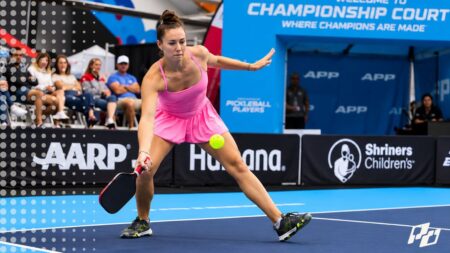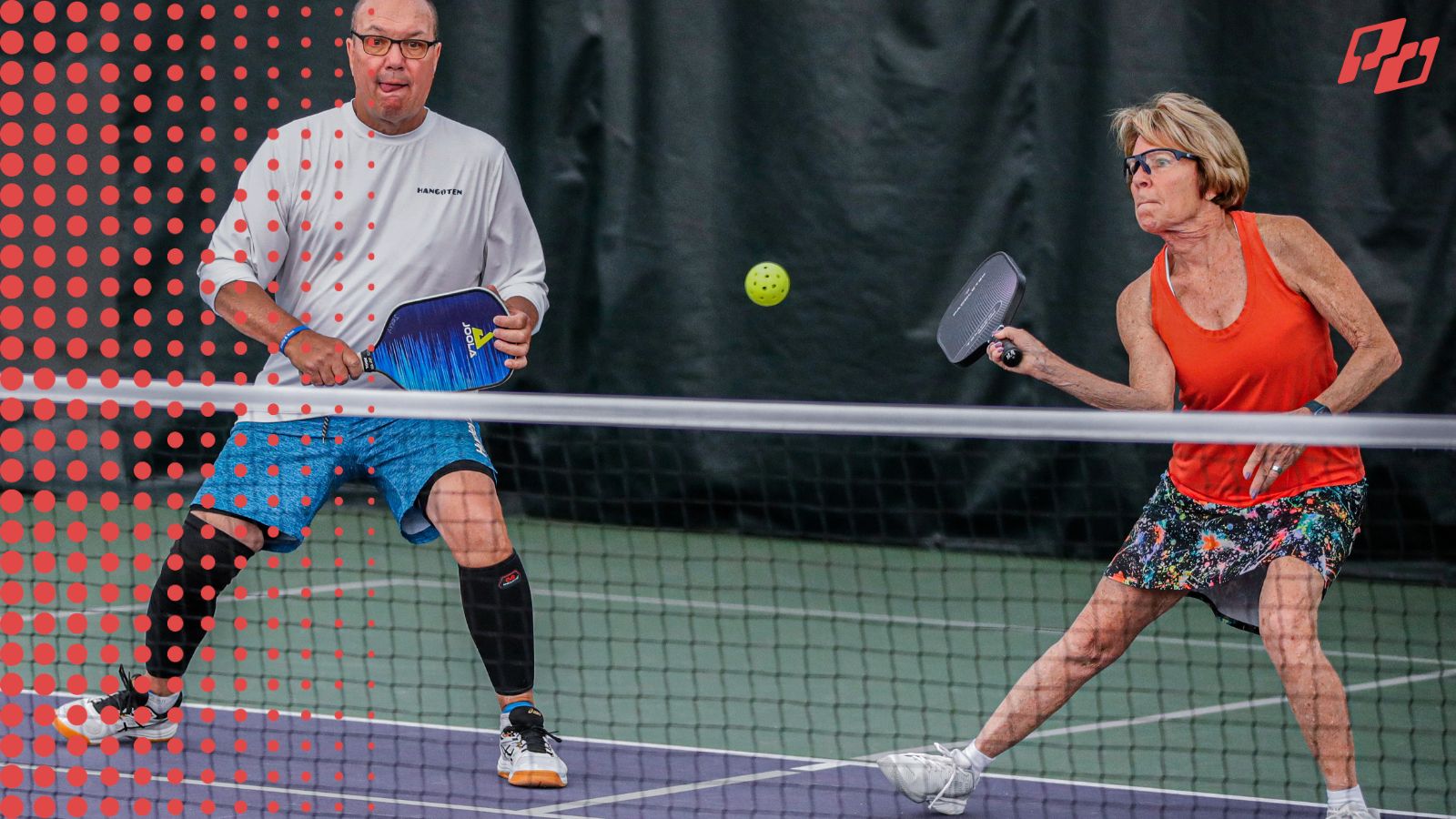
Most players miss the sweet spot because of poor contact point, not paddle quality. Late contact, reaching, or hitting while off-balance shifts impact lower or off-center on the paddle. Clean contact happens when the ball is struck slightly in front of your body with stable footwork.
Here’s the coach-y truth: a lot of “sweet spot problems” aren’t paddle problems. They’re contact point problems.
When contact is late, jammed, or reached-for, you don’t just mishit the ball—you change where the ball meets the paddle, how stable your paddle face is, and how much vibration you feel. That’s why you can own warm-ups… then feel like your paddle turns into a frying pan once points speed up.
This guide is about fixing that.
I’ll walk you through why late contact tends to hit the lower half of the paddle, how reaching shrinks your effective sweet zone, the difference between balanced contact vs emergency contact, and why pros look “effortless” (spoiler: it’s not magical hands—it’s earlier positioning and repeatable impact).
The sweet spot isn’t just a spot—it’s a “zone” your body has to earn
Most players think the sweet spot is a fixed dot in the middle of the paddle.
In reality, there’s the paddle’s “physics sweet spot” (often discussed as the center of percussion, where vibration/shock is minimized) and there’s your effective sweet zone, which depends on your posture, spacing, timing, and swing path.
So yes—paddle design matters. But your body decides whether you actually get to use that sweet spot under pressure.
1) Why late contact hits the lower half of the paddle
If you want one mental image: late contact pulls the paddle “down and back.”
Here’s what typically happens when you’re late:
- The ball gets closer to your body than you expected.
- Your elbow folds (you get “jammed”).
- Your wrist tries to save it.
- Your paddle face opens or wobbles.
- Contact happens lower on the paddle (and often closer to the handle).
That lower-half contact is common because the paddle is arriving late and descending slightly as you “catch” the ball—especially on volleys and quick exchanges.
And when you strike closer to the handle/low face:
- you tend to feel more shock,
- your directional control drops,
- your paddle face becomes less stable,
- your swing path gets shorter and “stabby.”
This matches the broader coaching point that impact/contact relative to your body is a major driver of control and outcome.
Quick self-check (you can do this tomorrow)
After a few pop-ups, ask: “Was that late—and did I feel jammed?”
If yes, it wasn’t random. You probably contacted low/near the throat.
2) How reaching changes your effective sweet zone
Reaching is sneaky because it feels like you’re doing the right thing: “I’m just getting to the ball.”
But reaching changes three things that shrink your usable sweet spot:
A) Your paddle face becomes harder to control
When your arm is fully stretched and your body isn’t supporting the hit, your paddle face becomes the steering wheel. That’s where “sprays” happen.
B) Your hit turns into a one-rail save
Instead of a stable swing, you get a poke—because you’re trying to touch the ball, not strike it cleanly.
C) You stop meeting the ball “in your window”
A lot of coaches describe your ideal contact window as out in front, where you can see the ball, control your angle, and keep your swing consistent.
When you reach sideways or behind you, your window collapses and the sweet spot becomes “luckier.”
The non-obvious cue
If you’re reaching and your shoulder creeps up toward your ear, you’re already in emergency mode. Your sweet spot odds drop immediately.
3) Balanced contact vs emergency contact (this is the whole game)
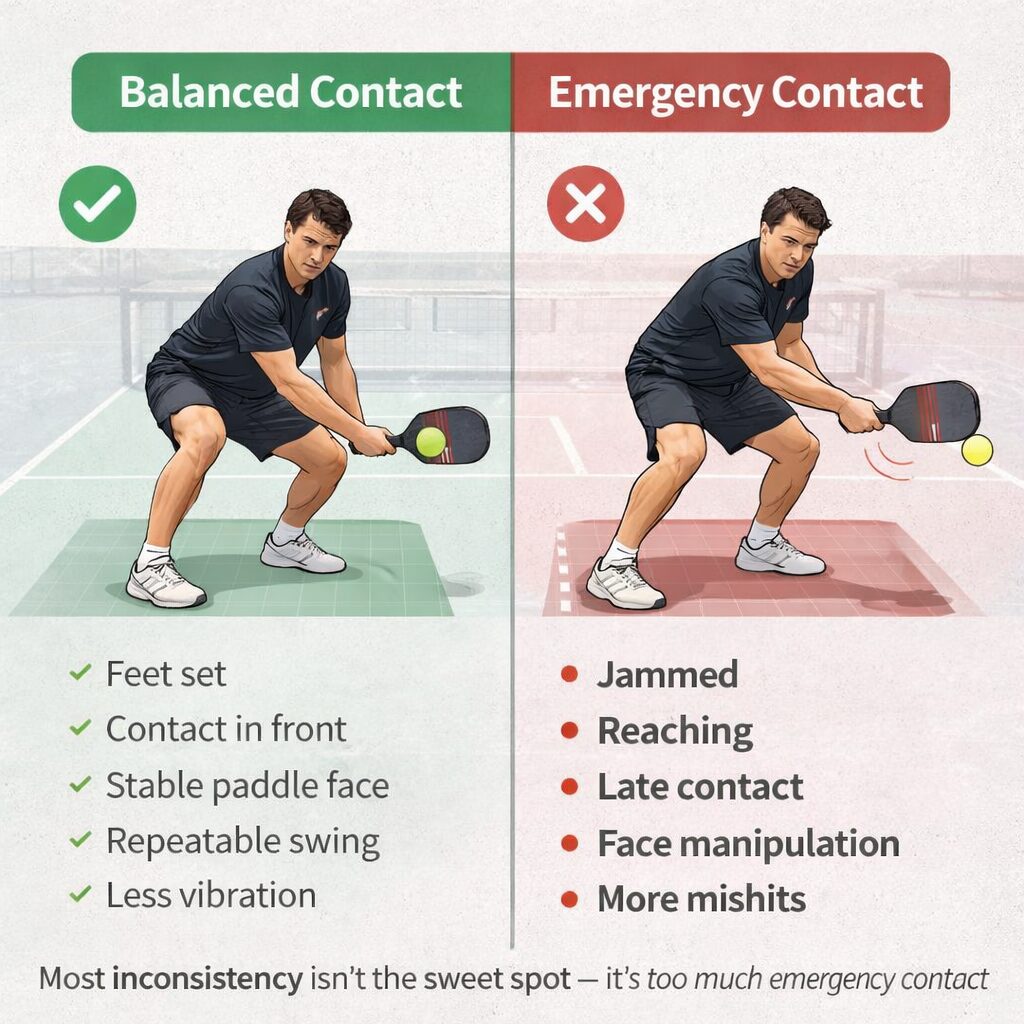
This is the most useful distinction for rec players because it stops you from asking the wrong question.
Balanced contact
Balanced contact is when:
- your feet are under you,
- your torso is quiet,
- you can hit in front,
- you can choose height and direction,
- and you can hit with a calm face and a repeatable swing.
Balanced contact lets you “find the sweet spot” without trying.
Emergency contact
Emergency contact is when:
- you’re stretched, leaning, or jammed,
- the ball is on you faster than your feet can organize,
- you’re reacting late,
- and the goal becomes: get it back.
Emergency contact forces:
- shorter swings,
- more face manipulation,
- more off-center hits,
- more vibration,
- more floaters/pop-ups.
Here’s the kicker: most “sweet spot inconsistency” is really too much emergency contact.
So instead of obsessing over where you hit it on the paddle, start tracking why you were forced into a save.
4) Why pros look “effortless” (and why it’s not just touch)
Pros look effortless because they create a world where:
- contact is almost always in front,
- spacing is consistent,
- their paddle path doesn’t change much,
- and they avoid emergency contact more than you think.
A great example: pro-level instruction often emphasizes getting contact out in front for control, power, and consistency—especially on volleys/rolls.
And when pros “make dinking look easy,” coaches commonly point to footwork and positioning that keeps them balanced (not reaching) so the ball can be met in the same window over and over.
Effortless = early.
Early = options.
Options = clean contact.
The Fix: Build a contact window you can repeat
Let’s get practical. If your contact point is sabotaging your sweet spot, you need two upgrades:
- Earlier positioning (so contact happens in front)
- A simpler swing intention (so your paddle face stays stable)
A) The “lead foot rule” for kitchen exchanges
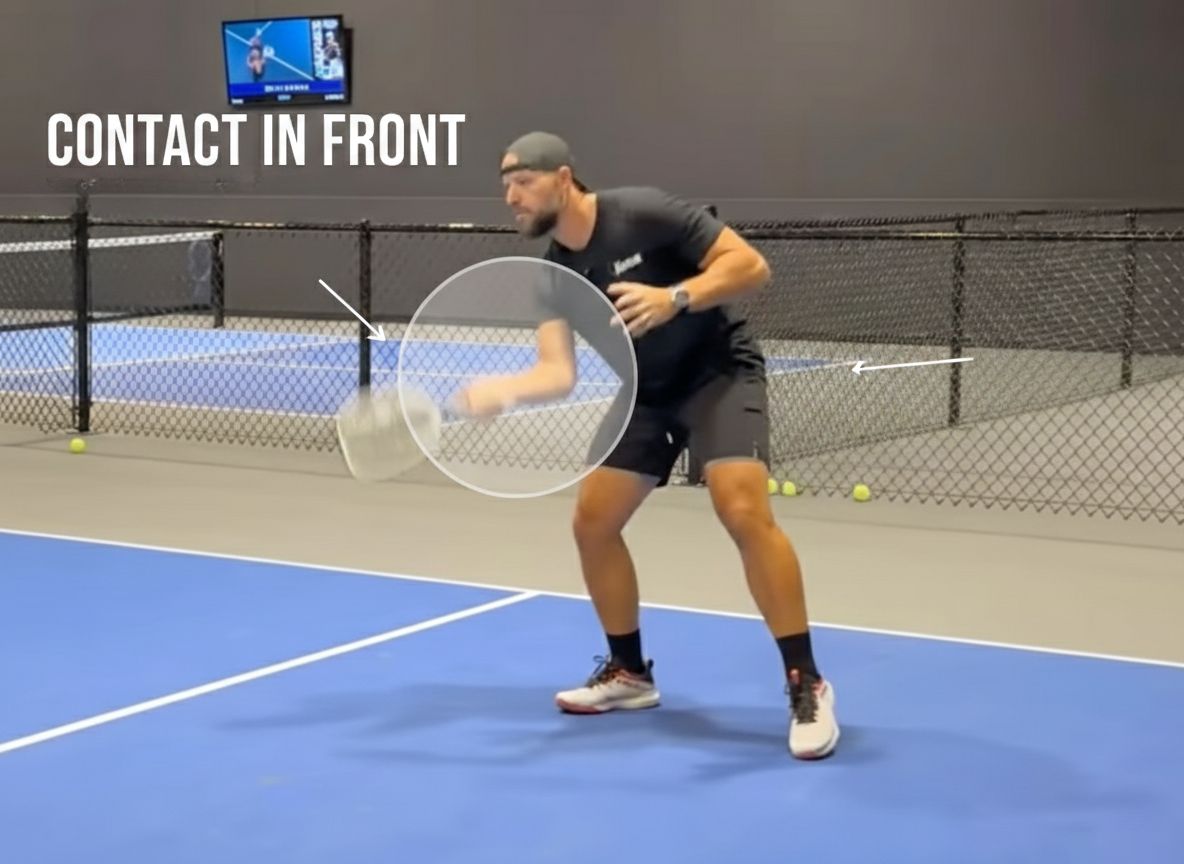
In fast dink/volley exchanges, a simple goal works well: try to meet the ball just in front of your lead foot.
Not beside your hip.
Not behind your knee.
Not “wherever it ends up.”
This cue naturally pulls contact forward and stops the late-jam pattern.
What you’ll feel when it’s right
- Less vibration in your hand
- Cleaner “thunk”
- Less need to flick/open the face
- More predictable depth
B) Stop “reaching with the arm”—start “moving the window”
Here’s the mindset change: don’t chase the ball with your arm. Move your contact window to the ball (with your feet).
That can be as small as:
- a tiny shuffle,
- a drop step,
- a half-step back to re-space,
- or a shoulder turn to clear room.
Pros are constantly doing micro-movements to avoid emergency contact—especially in soft game.
C) The difference between “late” and “rushed”
This matters because players fix the wrong thing.
- Late = you didn’t get set early enough → contact drifts back/low → mishit
- Rushed = you were set, but you panicked → swing gets big/fast → mishit
Late is a feet + readiness problem.
Rushed is a breathing + swing-size problem.
If you don’t separate these, you’ll keep “working on the sweet spot” without fixing the cause.
Real-match scenarios (where contact point quietly kills you)
Scenario 1: The dink that sits up… and you swear it was “just a little high”
Usually that’s late contact + open face.
You’re slightly jammed, you contact low on the paddle, the face opens to “help,” and the ball floats.
Fix: get contact 6–12 inches more in front. Don’t aim lower—move earlier.
Scenario 2: You’re reaching for a crosscourt dink and it keeps dying into the net
That’s often “outside-window” contact. Your paddle path can’t travel cleanly when your body is stretched sideways.
Fix: either step earlier to re-space or accept a safer neutral dink (middle/crosscourt) instead of trying to be cute from a compromised position.
Scenario 3: Hands battle, ball hits your paddle but goes nowhere
Classic emergency contact: you’re meeting it near the throat/low face with a dead, unstable hit.
Fix: shrink your swing and bring your contact window forward—your goal is stable face, not a bigger punch.
A simple way to track progress (without overthinking)
After games, don’t ask “Did I hit the sweet spot?”
Ask these three:
- Was my contact mostly in front today? (or did it drift back/low?)
- Did I reach a lot? (or did my feet carry my window?)
- Did my mishits happen under speed? (emergency contact)
If you start seeing fewer emergency contacts, your sweet spot “magically” shows up more.
The Big Takeaway
Here’s something most rec players never test: if you filmed yourself for one game, you’d probably notice you’re reacting to the ball instead of arranging the ball.
That’s the shift.
Better contact isn’t about trying to “hit cleaner.” It’s about deciding earlier where the strike will happen.
So here’s a simple experiment for your next session:
- For one game, care more about how you struck the ball than whether you won the rally.
- If you feel rushed, don’t swing harder — reset and buy yourself time.
- If you feel stretched, accept a neutral shot instead of forcing a quality strike from a bad position.
Another underrated tip: watch your non-hitting hand. If it’s flying around or dropping behind you, your body probably isn’t organized. Balanced players tend to look quiet. Quiet bodies create cleaner strikes.
And here’s the part that really changes things: stop chasing perfect shots. Chase repeatable contact.
When you prioritize repeatability over highlight winners, the sweet spot starts showing up more often — not because you’re trying to hit it, but because your body is finally arriving in the same place every time.