
You can improve at pickleball without changing your technique. Focus on higher-quality reps, stronger opponents, purposeful drilling, filming yourself, pressure practice, and understanding why points end. The biggest gains often come from better feedback and smarter practice—not simply playing more games or constantly adding new shots.
Most players trying to improve immediately start changing something.
New grip.
New drop.
New speed-up.
New paddle.
But Zane Navratil recently shared a list of ways to improve that barely touched stroke mechanics at all.
And one of his ideas is particularly uncomfortable: in rec play, hit more balls to the better player. Yes—the person you’ve probably been avoiding.
That may tell you more about how to improve than another month of comfortably beating the same players.
Zane’s larger point is worth exploring because coaches such as John Cincola, Jordan Briones and Tanner Tomassi keep arriving at the same conclusion: better practice does not always mean more practice. It means getting better information from the reps you’re already taking.
Here are 10 ways to do that.
1. Hit to the Better Player—Especially When You Don’t Need to Win
Tournament?
Exploit the weakness.
Tuesday-night rec game?
Consider doing the opposite.
Zane recommends hitting to the stronger player because stronger players provide better feedback.
That weak speed-up a 3.5 blocks back?
A 4.5 may counter it at your feet.
That slightly high dink?
Now it’s attacked.
That lazy return?
Now the serving team is immediately pressuring you.
Certified instructor Todd Jungling describes using the same approach: when a stronger player is across the net in rec play, he deliberately gives that player balls because the challenge tells him whether his game actually holds up at the next level.
That’s the hidden benefit: better opponents expose errors before they become habits.
⮕ How to use it
For one rec game, deliberately send roughly half of your neutral balls toward the strongest opponent. Don’t feed them easy putaways. Play your normal patterns—but stop avoiding them.
Then notice:
Which attacks come back?
Which dinks get pressured?
Which balls you thought were “good” suddenly aren’t?
⮕ What doesn’t work
Don’t turn this into: “I must hit every ball to the best player.”
You’re training decision-making too. The objective is to seek harder feedback, not abandon good pickleball.
2. Stop Counting Reps. Start Counting Good Reps.
The distinction between quantity and quality is huge. Two hundred third-shot drops don’t automatically beat 40 intentional ones.
John Cincola makes the same point in his current practice system: the value of training comes from intentional repetition, then progressively moving those skills into realistic point situations.
There’s a big difference between:
“Let’s dink for 20 minutes.”
and:
“For 10 minutes, every dink goes to the inside foot and I’m tracking whether it stays unattackable.”
Same court.
Same ball.
Very different practice.
⮕ Try this
Give every drill a success condition.
Instead of: 50 drops
Try: 10 drops that bounce inside the kitchen and can’t be attacked comfortably.
Instead of: Five minutes of dinking
Try: 20 consecutive dinks without giving the opponent an obvious attack.
Now your brain has something to solve.
⮕ What doesn’t work
Mindlessly continuing after your movement or concentration deteriorates. More tired repetitions of the wrong pattern are still repetitions of the wrong pattern.
3. Play the Ball, Not the Reputation
This is one of Zane’s most useful mental ideas.
You see a 4.7 across the net. Suddenly their ordinary drive looks enormous. Or you see someone you normally beat. Now you try ridiculous attacks because you think you should dominate them. Neither reaction has much to do with the ball.
Instead, read:
- height
- speed
- spin
- position
- balance
That determines the next decision—not the name or DUPR attached to the opponent.
⮕ Example
A 5.0 gives you a shoulder-high dead dink.
Attack it.
A 3.5 gives you a great dink below the net while you’re stretched.
Don’t attack it simply because they’re a 3.5.
⮕ Cue
Solve this ball.
Not: Beat this player.
⮕ What doesn’t work
Trying to convince yourself the opponent isn’t good. They might be excellent. The goal isn’t fake confidence.
It’s keeping your attention on information that actually determines the shot.
4. After the Point, Ask Why It Ended
Zane Navratil talks a lot about curiosity between points.
Not: “How did I miss that?”
Actual curiosity: “Why did that rally really end?”
Because the final miss isn’t always where the point was lost.
Say you miss a tough backhand reset. You might think: “My reset is terrible.” But rewind:
Short return.
Easy third-shot drive.
Floating fourth.
Forced backward.
Then the missed reset.
The reset ended the rally. It may not have caused the problem.
A better between-point habit: Replay the chain. Find the first mistake. Take one lesson. Move on.
That’s basically free coaching — one rally at a time.
⮕ Ask one question
What created the problem?
That’s better than: What shot did I miss?
⮕ What doesn’t work
Giving yourself a five-minute coaching lesson between every rally.
Find one cause.
Store it.
Move on.
5. Drill Because It Compresses Learning
The big advantage of drilling is simple: you get the same problem far more often.
In an hour of doubles, you might only see a handful of useful third-shot reps. In a focused drill, you can recreate that situation over and over.
But don’t just drill the stroke.
Drill the decision around it.
Instead of feeding 50 perfect balls for drops, vary the return:
Short ball? Drive.
Deep, difficult ball? Drop.
Ball pushes you backward? Create space first.
Now you’re not only training execution. You’re training recognition + choice + execution — which is much closer to real pickleball.
⮕ What doesn’t work
Only practicing cooperative feeds and assuming the skill will transfer automatically into chaotic rallies.
Eventually the drill has to become unpredictable.
6. Film Yourself—Because Feel Is a Terrible Camera
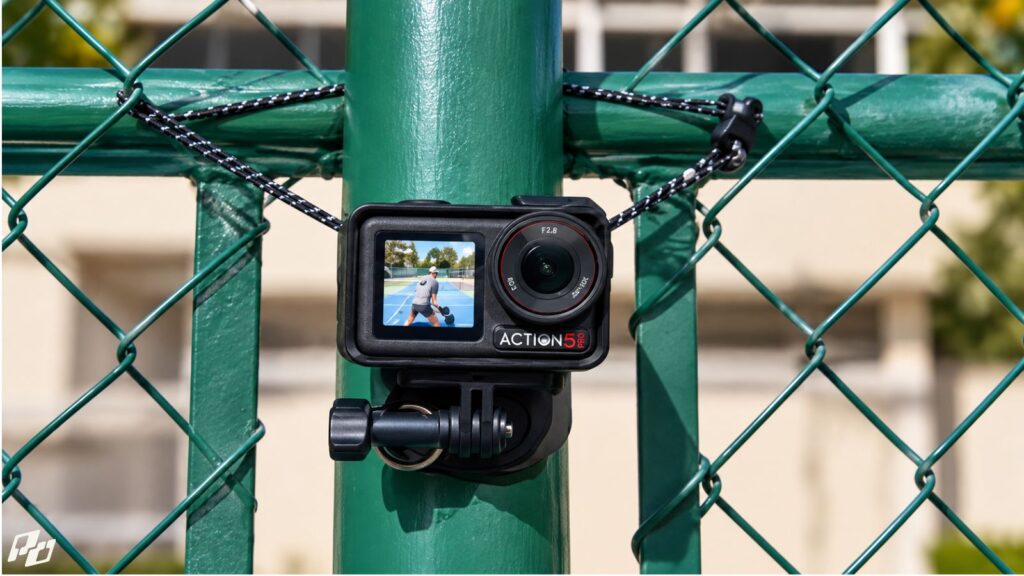
This is one of the few improvement ideas almost every serious coach seems to agree on.
Jordan Briones says filming his own play has been one of his most valuable development tools because the camera reveals things he doesn’t notice while playing—late feet, drifting paddles, repeated positional errors and predictable shot patterns.
And this is where rec players usually get surprised.
You thought you were: at the kitchen.
Video says you’re two feet behind it.
You thought: your return was deep.
Video says it lands around the service line.
You thought: you split-stepped.
You were still running through contact.
⮕ Best camera angle
Put the phone behind the baseline and reasonably high, ideally centered enough to see all four players.
That view makes positioning, spacing, shot depth and movement much easier to evaluate.
⮕ Review only three things
Don’t analyze 47 technical details. Watch:
Where were my feet when the opponent contacted?
Where did my neutral balls actually land?
What pattern produced most of my errors?
Then choose one correction.
⮕ What doesn’t work
Watching yourself like you’re judging an audition. Video is evidence, not entertainment.
7. Learn to Win—Not Just to Play Well
This one sounds strange until you’ve experienced it.
You can be excellent at drilling. Excellent in casual games. Then get to 9-9 and suddenly stop doing everything that got you there.
That’s because executing a shot and executing it while you care about the outcome are not identical skills.
Zane specifically recommends learning to win at your current level rather than constantly chasing the next rating.
Tanner Tomassi and John Cincola both use competitive constraints and pressure situations in training rather than making every drill consequence-free. Cincola, for example, recommends adding stakes such as consecutive-ball targets because they force more concentration into each repetition.
⮕ Add small consequences
Start a game at 8-8.
Play to 11.
Or try:
Make 10 drops in a row.
Miss No. 9?
Back to zero.
Or play a best-of-three with your regular drilling partner and actually track who wins.
You don’t need money or punishment. You just need enough consequence to think: “I really don’t want to miss this.”
Then practice performing anyway.
⮕ What doesn’t work
Trying to remove nervousness completely. The skill is executing with pressure present.
8. Create Space Instead of Asking Your Hands to Rescue You
This is slightly more physical than Zane’s other ideas, but it illustrates a larger learning principle brilliantly: sometimes the shot isn’t the problem. Your spacing is.
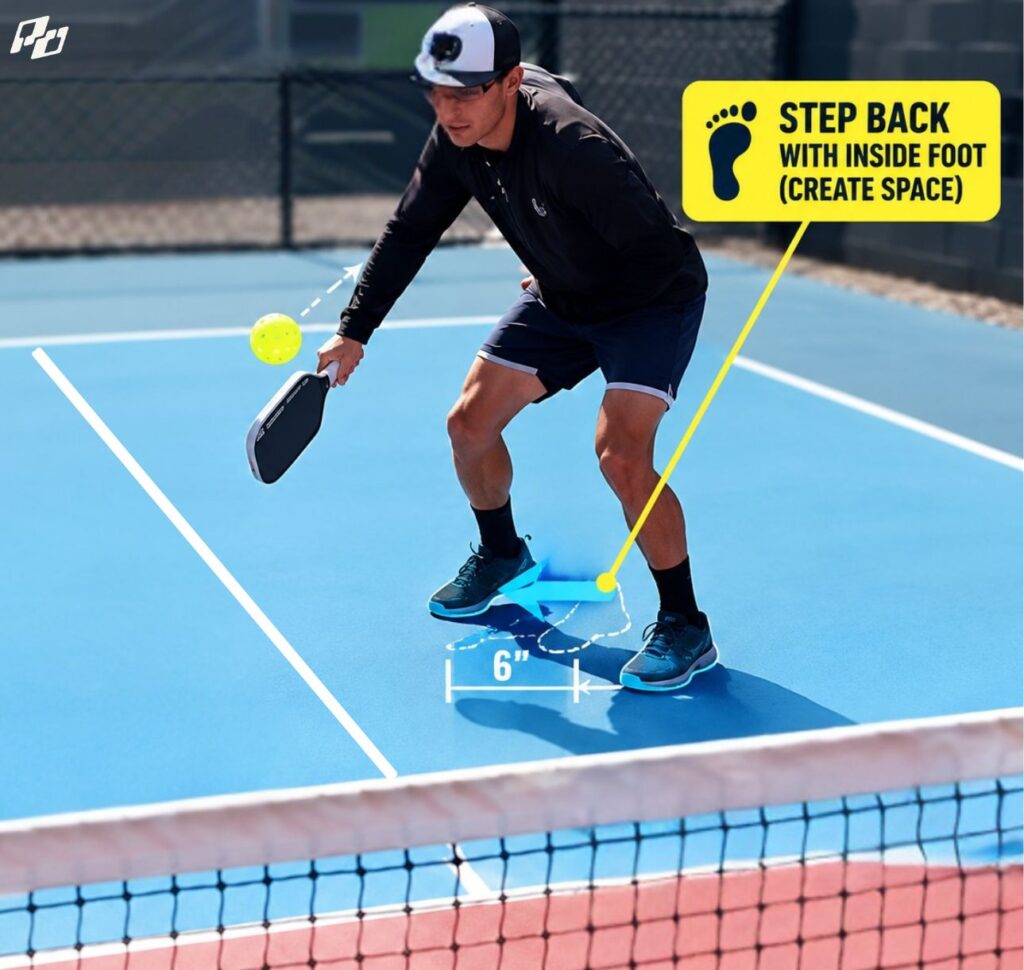
A perfect example is the deep dink that lands near your inside foot.
Intermediate players often remain glued to the kitchen line. The ball gets too close. Now the leg occupies the space where the paddle needs to travel.
So the player:
- flicks the wrist
- lifts the elbow
- leans sideways
- and concludes they need a better dink
They may actually need six inches of space.
Current Jordan Briones instruction on inside-foot dinks teaches creating room rather than freezing at the line, and other coaches similarly emphasize using the feet first on the backhand dink.
⮕ How to do it
If a deep dink is going to crowd your inside foot: read it early → take a small diagonal drop step → stabilize → dink → reclaim the line.
Think: Drop. Set. Hit. Recover.
Not: Back up and stay back.
The goal isn’t retreat. It’s restoring a comfortable contact point.
⮕ What doesn’t work
Backing two or three feet away every time someone dinks near you. You only give up enough ground to create space. Then take it back.
This is a surprisingly useful lesson beyond dinking: Before rebuilding the stroke, check whether your body was simply in the wrong place.
9. Practice the Situations You Hate
Most rec players unintentionally design practice around what they’re already comfortable doing.
Good dinkers dink.
Drivers drive.
Fast players play hands.
Then tournaments introduce something ugly and the game falls apart.
Tanner Tomassi deliberately includes uncomfortable defensive situations in his training—handling a driver who’s crashing, recovering from lobs, and working forward while under pressure—because those are the situations players need to function in when the rally stops being comfortable.
⮕ Make an “I hate this” list
Maybe yours is:
- repeated hard drives
- deep topspin serves
- inside-foot dinks
- being lobbed
- playing a lefty
- being targeted
- or resetting while moving backward
Choose one. Spend 15 minutes starting every repetition in that exact problem.
That’s much more valuable than another 15 minutes demonstrating your favorite forehand.
⮕ What doesn’t work
Practicing randomness for its own sake. “Chaos” isn’t the goal.
Repeated exposure to a specific uncomfortable situation is.
10. Stop Trying to Fix Everything at Once
This may be one of the least obvious differences between players who improve and players who stay permanently “working on their game.”
They have fewer projects.
Coach Kyle Koszuta makes this point directly: players often slow their progress by trying to improve too many things simultaneously instead of mastering a smaller number of important skills and decisions.
John Cincola has described a related problem: constant drilling and information can make players so absorbed in details that stepping away and returning to basic priorities sometimes improves their play.
That should sound familiar.
Monday: new serve.
Tuesday: new grip.
Wednesday: watched a backhand video.
Thursday: changed ready position.
Friday: new speed-up technique.
Saturday: “Why am I playing worse?”
Because your brain is running six software updates at once.
⮕ Use a two-week rule
Pick one development problem. For example: “My returns aren’t consistently deep.”
- Film it.
- Measure it.
- Drill it.
- Test it in games.
Two weeks later, reassess. Then move on.
⮕ What doesn’t work
Collecting pickleball tips.
Knowing 200 coaching cues isn’t the same as owning one new skill.
What These 10 Ideas Have in Common
Zane’s advice sounds like a collection of separate tips. It really isn’t.
Almost all of it revolves around one idea: Improve the quality of your feedback.
Hit to the stronger player?
Better feedback.
Drill instead of waiting for the shot to appear in rec?
Faster feedback.
Film yourself?
More objective feedback.
Ask why the point ended?
Smarter feedback.
Play under pressure?
More realistic feedback.
Practice uncomfortable situations?
More useful feedback.
Even creating space on that inside-foot dink follows the same principle. Instead of immediately concluding: “My backhand dink is bad,” you learn to ask: “Was I actually in position to hit a good backhand dink?”
That is what curious players do differently. They don’t merely collect more reps. They keep improving the information each rep gives them.
A Better Week for a 3.5 Trying to Reach 4.0
You don’t need to double your court time. Try changing what the existing time does.
One session: drill a weakness with measurable targets.
One session: play stronger opponents and deliberately give them balls.
One session: competitive games where the result matters.
Film one of them.
Afterward, identify one recurring reason points ended.
Then make that your next training project.
That’s a much more sophisticated development plan than:
“I just need to play more.”
Because more pickleball is fun. But the bigger lesson is that more is not automatically better.
Better feedback is better.
Better intention is better.
Better opponents are better.
And sometimes the fastest way to improve isn’t changing your technique at all. It’s finally giving your current technique a practice environment that tells you the truth.