When I first picked up a paddle, I wasn’t thinking about fitness. I just wanted to keep the ball in play, laugh with friends, and maybe win a point or two. But after a few months, I noticed something surprising: my legs weren’t as sore after long rallies, I was moving quicker at the kitchen, and even my balance felt steadier off the court.
So it got me wondering—can pickleball actually make you athletic? And if so, how long does it take?
Let’s unpack that, with research, physiology, and a dose of real talk for every age group.
What “Athletic” Really Means in Pickleball
Before we answer how long, we need to define what athletic even is. In pickleball, athleticism isn’t just six-pack abs or a vertical leap. It’s a mix of:
- Agility: Quick directional changes at the NVZ.
- Endurance: Staying sharp through that third game to 11.
- Strength & Power: Driving a ball or exploding into an overhead.
- Balance & Coordination: Controlling your body during lunges, dinks, and resets.
- Recovery: The ability to play again tomorrow without limping.
Pickleball touches all five—but in very different ways depending on your age, background, and how often you play.
The Timeline: When Players Notice Athletic Gains
Research in exercise physiology shows it takes about 6–8 weeks of consistent training for measurable changes in aerobic fitness and muscle endurance. Pickleball isn’t “training” in the strict gym sense, but it counts—especially if you’re playing 3+ times a week.
- Weeks 1–4: Neuromuscular adaptation. Your footwork, reaction time, and paddle coordination improve faster than your fitness.
- Weeks 5–8: Cardio endurance and leg strength start to show. You don’t get winded as quickly, and kitchen battles feel less exhausting.
- Weeks 9–12: Joint stability and balance improve. Your ankles, knees, and hips adapt to lateral loads, reducing soreness and injury risk.
- 3+ Months: Studies suggest recreational players can improve VO₂ max by roughly 10–15% in 3 months of regular play (4–5 hrs/week).
What the Research Says
A 2021 study in the International Journal of Research in Exercise Physiology found that older adults playing pickleball three times per week improved cardiovascular fitness, blood pressure, and cholesterol within 6 weeks.
A 2023 Mayo Clinic review highlighted pickleball as an effective moderate-intensity workout, averaging 350–450 calories burned per hour for adults, depending on body weight and pace.
Reaction time studies in racket sports show consistent neural adaptation within 4–6 weeks, meaning your brain starts firing signals to your muscles faster—even if you haven’t “hit the gym.”
Research at NC State using Fitbit monitors showed adults 65+ logged nearly 3,500 extra steps and 86 minutes of moderate-to-vigorous activity on pickleball days
Translation: You don’t need years. A couple of months of consistent play is enough to start feeling, looking, and moving more athletic.
Doubles vs. Singles: Which Builds Athleticism Faster?
This is a big one, because the physical demands of singles and doubles are very different.
| Category | Singles | Doubles |
|---|---|---|
| Cardio Demand | High — full court coverage keeps heart rate in vigorous zone (140–160 bpm). | Moderate — bursts of play raise HR but with longer pauses (110–130 bpm). |
| Calories Burned (per hour) | ~500–700 depending on pace & body weight. | ~350–450 depending on intensity & rallies. |
| What Improves Most | Endurance, lateral speed, stamina. | Reflexes, balance, hand speed, coordination. |
| Primary Stress on Body | Legs, lungs, and joints from constant movement. | Shoulders, core, and quick-twitch muscles from fast exchanges. |
| Injury Risk | Higher — more running, twisting, and potential overuse. | Lower — less ground to cover, but still shoulder/wrist strain. |
| Best For | Accelerating fitness and conditioning. | Building quickness, steadiness, and control. |
Singles Pickleball
- More like tennis in its cardio demands. You’re covering the entire court, chasing down lobs, and exploding into wide angles.
- Heart rate averages 140–160 bpm, which puts most adults in a vigorous activity zone (comparable to running or HIIT).
- Builds endurance, lateral quickness, and overall conditioning faster than doubles.
Doubles Pickleball
- More stop-and-go, with shorter bursts of speed. Rallies emphasize reflexes, balance, and coordination rather than constant running.
- Heart rate averages 110–130 bpm, placing most adults in the moderate activity zone (comparable to brisk walking or light cycling).
- Builds reaction time, hand speed, and stability at the NVZ—but not as much raw cardio fitness.
The Takeaway: If your goal is to get fit or “athletic” quicker, mix in singles. Even one singles session per week can accelerate conditioning dramatically while doubles sharpens quickness and balance.
Age Matters: Athletic Gains by Life Stage
Pickleball isn’t the same workout at 25 as it is at 65. Here’s how the timeline shifts:
Athletic Gains by Age Group in Pickleball
| Age Group | What Improves First | Main Challenge | Timeline for Athletic Gains |
|---|---|---|---|
| Under 30 | Explosiveness, agility, and shot variety | Overuse injuries (tendinitis, rolled ankles); lack of recovery discipline | 4–6 weeks for noticeable gains |
| 30–45 | Endurance and balance (fast-twitch/slow-twitch crossover) | Limited time due to work/family; inconsistent play | 6–8 weeks for cardio & mobility, 2–3 months for strength |
| 45–60 | Joint stability, coordination, and smoother footwork | Slower recovery, more soreness; need supplemental strength training | 8–12 weeks for clear athletic gains |
| 60+ | Balance, coordination, and reaction time; reduced fall risk | Slower cardio adaptation; joint protection is critical | 12+ weeks, with major quality-of-life improvements |
Younger players adapt quickly but often struggle with overuse and recovery discipline. Middle-aged players gain endurance and balance but battle time constraints. Players over 45 improve coordination and stability but need to respect recovery.
For seniors, gains come slower but the payoff is often life-changing—better balance, confidence, and energy on and off the court.
The Psychology of Feeling Athletic
Here’s the fun part: sometimes your brain notices the change before your body does.
Sports psychology calls this self-efficacy—the belief that you can perform a skill. In pickleball, that moment might be:
- Sliding into a wide dink without losing balance.
- Outlasting a 20-shot rally.
- Winning a hand battle you would’ve lost two months ago.
Each of these reinforces the identity shift from “I’m just playing pickleball” to “I’m athletic again.” That mindset drives motivation, which in turn accelerates the physical gains.
How to Speed Up the Process
Pickleball alone gets you far, but here’s how to accelerate your athletic gains:
Track progress. Use a smartwatch or fitness tracker to measure heart rate zones, calories, and recovery. Seeing improvements reinforces commitment.
Play both singles and doubles. Singles challenges your cardio; doubles hones your reflexes. Together, they round out athleticism.
Add interval play. Instead of casually rallying, push yourself: 5 minutes of high-intensity games (speed-ups, fast rallies), then rest. Mimics interval training.
Do off-court strengthening. Squats, lunges, planks, and resistance band work build the muscles pickleball stresses most. Stronger muscles = faster athletic adaptation.
Cross-train. Even one day of biking, swimming, or yoga per week speeds recovery and fills in fitness gaps.
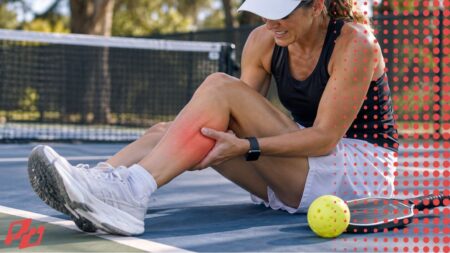
What Happens If You’re Sidelined by Injury?
Here’s the truth no one likes: athleticism fades faster than it builds. But how fast depends on age, injury severity, and whether you stay active in other ways.
- Cardio fitness: VO₂ max can decline within 2–3 weeks of inactivity. You’ll notice quicker fatigue when you return.
- Strength: Strength tends to fade slower, around 4–6 weeks, but explosive movements (like sprinting or jumping) fade faster.
- Neuromuscular coordination: Reflexes and timing degrade the fastest. After even a month off, rallies may feel “off rhythm.”
- Older players (60+): Detraining happens quicker. Balance and coordination may regress within 2–3 weeks if completely inactive.
The Good News:
- Research shows “muscle memory” is real. Even after months off, your body regains lost fitness in half the time it took to build it initially.
- If you stay active with alternate workouts (cycling, swimming, even walking), you’ll return to pickleball shape much faster.
- Focused drills when you return—footwork ladders, dink practice, controlled resets—help you rebuild coordination quickly.
So don’t panic if you’re sidelined. Yes, you’ll lose some sharpness, but you’ll bounce back quicker than you think if you’ve built a strong base.
The Bottom Line
So, how long does it take to become athletic by playing pickleball?
For most players, 6–12 weeks of regular play is enough to see real changes in cardio, agility, and balance. Younger players might feel it faster; older players might take a bit longer but often notice even bigger quality-of-life benefits.
Singles will turbocharge your fitness, doubles sharpens your reflexes, and smart off-court work speeds it all up. And if injury sidelines you, your body bounces back quicker thanks to muscle memory—provided you stay active.
The magic is that you don’t have to chase fitness in a gym. By simply showing up, hitting dinks, chasing lobs, and laughing through long rallies, you’re building athleticism disguised as fun.
And honestly? That’s the best kind of workout there is.