One of the main reasons behind pickleball’s seemingly unstoppable and endless pulling power is that it doesn’t require you to be an Olympian to excel in and relish the sport. However, Houston doctors have recently noticed a surge in pickleball-related injuries.
“An Audible Snap”
John Kelly recently underwent surgery at UTHealth Houston and Memorial Hermann to repair a torn Achilles tendon, an injury he sustained while playing pickleball.
Reflecting on the incident, he recalls, “I jumped off my back leg. That’s what tore it. You could hear it, an audible snap, like a rubber band going. I have to admit, before I retired, I was quite sedentary. I thought pickleball is a quiet sport that older people play.”
Dr. Michael Greaser, an orthopedic foot and ankle surgeon at Memorial Hermann, highlighted the rising trend of pickleball-related injuries. He noted, “Achilles injuries are at the top of that list [with] plantar fasciitis, which is pain on the bottom of the heel, and other tendonitis-type injuries.”

Abrupt Transition
However, Dr. Greaser emphasized the sport itself isn’t the issue. Instead, injuries often arise when individuals abruptly transition from minimal physical activity to regularly playing pickleball several times a week.
Kelly, despite loving pickleball, has decided to step away from the sport following his injury. He advises fellow players, saying, “Don’t let my story stop you. Just be aware, if you are playing pickleball, just like any other sport, warming up, getting your muscles loose before you do. It is the way to prevent yourself from hurting yourself.”
Dr. Jordan D. Metzl
Jordan D. Metzl, MD, is a Sports Medicine Physician at Hospital for Special Surgery in New York and Connecticut. He echoed these sentiments, saying, “I’ve seen more injuries from pickleball than walking and swimming. But don’t let that deter you from playing. The benefits — moving, having fun, building a community — far outweigh the risks.
“So what should you watch out for? In pickleball, we see repetitive-use injuries, especially in the wrist and elbow, and sudden injuries from quick ballistic movements.

“Injuries commonly occur when lunging forward for a low shot, which can cause straining to a calf or hamstring.”
Dr. Metzl provides the following insights into these injuries and more.
Calf Strain
A calf strain, also termed “tennis leg,” often manifests as a sensation akin to being kicked in the calf, commonly occurring during a forward lunge for a low shot in pickleball.
Upon experiencing this, seeking professional confirmation from a doctor to differentiate it from an Achilles rupture, which is a more severe injury, is crucial. Fortunately, calf strains typically heal without surgical intervention.
Traditionally, the RICE method (rest, ice, compression, and elevation) has been recommended for injury treatment. However, a modernized approach, MICE (movement, ice, compression, and elevation), is now advocated within the initial 24-48 hours post-injury.
While some debate surrounds the use of ice for acute injuries, it has shown efficacy in reducing pain. He often advises patients to apply ice to the affected area for five to ten minutes during the initial stages. As the injury progresses, ice might provide diminishing relief, whereas gradual movement and compression tend to be more beneficial.
The healing duration for calf strains varies based on severity, ranging from approximately one to four months. This underscores the importance of seeking proper medical guidance and following recommended treatment protocols to ensure optimal recovery.
Hamstring Strains
Similar to calf strains, hamstring strains often result from lunging forward for a low shot in pickleball. However, their healing process differs, with the recovery period for hamstring strains typically being longer.
The duration of healing hinges on the specific location of the injury within the hamstring muscle. Injuries situated at the top of the hamstring, where the tendon attaches to the ischial tuberosity (sit bone), tend to necessitate months for complete healing.
Conversely, injuries occurring in the middle of the muscle might resolve in a matter of weeks. Regardless of the location, initiating gentle movements like using a stationary bike and gradually integrating a strength-building regimen can expedite the healing process.
Wrist Injuries
In pickleball, wrist injuries often stem from the twisting motions akin to those in ping pong. Tendinitis in the wrist tends to be the most prevalent injury among players.
Initially, addressing this condition typically involves employing a wrist splint and allowing the affected wrist adequate rest for a couple of weeks. Should discomfort persist beyond this rest period, seeking professional evaluation becomes crucial.
Elbow Pain
In pickleball, elbow pain, commonly known as tennis elbow, occurs less frequently than in tennis but remains a possibility. Typically, this discomfort manifests as tendinitis on the outer part of the elbow.
The recommended approach involves refraining from playing for a week or two to allow the affected area to recover. Additionally, consulting a physical therapist for specific wrist and forearm stretches can aid in managing and alleviating this condition.
Achilles Tendor Rupture
On the other hand, an Achilles tendon rupture stands among the more serious injuries in pickleball. Given the challenging nature of tendon healing due to their limited blood supply, this injury often necessitates surgical intervention followed by structured physical therapy.
The recovery timeline for an Achilles tendon rupture can span several months to a year, underscoring the importance of comprehensive treatment and rehabilitation efforts to promote healing and restore functionality in the affected tendon.
Understand Your Limits And Warm Up!
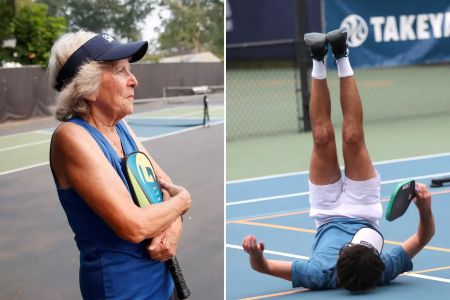
Ultimately, the consensus among experts is clear: enjoying pickleball safely involves understanding your body’s limits, preparing adequately with a properly structured stretching program, and adopting strategies like muscle conditioning and strength training to minimize the risk of injury.