Every injured pickleball player ends up asking the same question: “How long until I can play again?”
Not walk.
Not rally gently.
Actually play — move laterally, split-step, chase a late ball, and trust your body when the point breaks down.
Here’s the mistake most rec players make: they return when pain improves — not when their body is ready for pickleball again.
This guide exists to close that gap.
Below are the most common pickleball injuries, broken down in a court-realistic, rec-player way, including:
- what’s actually injured
- how long healing usually takes
- when it’s typically safe to come back
- how to return without immediately re-injuring yourself
- what changes if you’re 40+ or 50+
This isn’t medical advice. It’s practical guidance so you don’t reset the injury clock by rushing back.
Quick Reference Table: Pickleball Injuries & Return Timelines
| Injury | Modified Play | Full Play | PT? |
|---|---|---|---|
| Ankle sprain | 1–6 weeks | 4–12+ weeks | Often |
| Plantar fasciitis | 2–6+ weeks | Weeks–months | Often |
| Calf strain | 1–3 weeks | 4–8+ weeks | Sometimes |
| Achilles tendinopathy | 4–8+ weeks | 3–12 months | Yes |
| Tennis elbow | 2–6 weeks | 3–12 months | Often |
| Shoulder / rotator cuff pain | 2–8 weeks | 2–6+ months | Often |
| Wrist fracture (fall) | 8–12+ weeks | Months | Yes |
| Knee injury (non-surgical) | 2–8 weeks | 6–12+ weeks | Often |
Modified play = doubles only, shorter sessions, reduced chasing
Lower-Body Injuries
Ankle Sprains (The One Bad Lunge Injury)
Ankle sprains are the most common pickleball injury for a reason: lateral lunges, quick stops, and reaching outside your base are baked into the sport.
What’s really happening: one or more ankle ligaments are overstretched or torn. Pain and swelling often improve quickly, but balance and joint awareness lag behind.
Typical healing windows:
- Mild (Grade 1): ~1–2 weeks
- Moderate (Grade 2): ~3–6 weeks
- Severe (Grade 3): often months
When it’s usually safe to return:
- Fast walking and stairs without pain
- Single-leg balance for 30–45 seconds
- 10–15 controlled single-leg calf raises
- Side-shuffle and stop without wobble
How to return without re-spraining:
- First week back: doubles only, short sessions
- Avoid emergency lunges and late saves
- Increase movement demands before increasing games
40+/50+ note: pain often improves before balance does. Older players should add balance work and delay full-speed movement for an extra week to reduce re-sprain risk.
Plantar Fasciitis (Heel Pain That Lingers)
This usually sneaks in during volume spikes — tournaments, travel weeks, or “just one more game” sessions.
What’s really happening: the plantar fascia is overloaded faster than it can recover. This is a load-management issue, not a tear.
Typical healing windows:
- Early / mild cases: ~2–4 weeks with reduced volume, better warm-ups, and calf/foot work
- Moderate / persistent cases: ~6–12 weeks before consistent, pain-controlled play
- Long-standing or recurrent cases: 3–6+ months, especially if volume spikes continue
When it’s usually safe to return:
- Morning pain is mild and improving
- You can walk a full day without flare-ups
- Short sessions don’t worsen next-day pain
How to return safely:
- Use the “next-morning test” — tomorrow tells the truth
- Start with short, frequent sessions
- Prioritize warm-up walking before play
40+/50+ note: older players should prioritize calf stretching and avoid sudden jumps in playing time.
Calf Strains (The Sudden Grab)
Calf strains often feel minor at first — until you try to accelerate.
What’s really happening: muscle fibers are partially torn. Walking tolerance returns before sprint tolerance.
Typical healing windows:
- Mild: ~1–2 weeks for daily movement, 2–3 weeks before controlled pickleball play
- Moderate: ~3–5 weeks before modified play, 5–8+ weeks before full-speed acceleration
- Severe: 2–3+ months, depending on tear size and rehab consistency
When it’s usually safe to return:
- Normal walking speed without limp
- 20 smooth calf raises
- Light acceleration without grabbing
How to return safely:
- No chasing lobs early
- Build volume before intensity
- Stop immediately if tightness appears
40+/50+ note: older players should avoid full-speed acceleration and sudden sprints during their first few sessions back.
Achilles Tendinopathy (The Patience-Tester)
This one improves slowly and punishes impatience.
What’s really happening: the tendon’s ability to handle explosive load is reduced. Pain improves before capacity does.
Typical healing windows:
- Early symptom improvement: ~4–8 weeks with reduced load and controlled play
- Return to modified pickleball: ~8–12 weeks once morning stiffness and next-day soreness stay stable
- Full sport tolerance: 3–6 months, and sometimes 6–12 months for long-standing or recurrent cases
When it’s usually safe to return:
- Minimal morning stiffness
- 20 controlled single-leg calf raises
- Light hopping without pain
How to return safely:
- Walk-only warm-ups
- No repeated sprint starts early
- Increase intensity before increasing session length
40+/50+ note: if you rush an Achilles, it pushes back. Take extra rest days and add speed last.
Upper-Body Injuries
Tennis Elbow (Lateral Epicondylitis)
Repetition plus grip tension makes tennis elbow a classic pickleball injury.
What’s really happening: this is tendon overload, not inflammation. Tendons need graded loading, not total rest.
Typical healing windows:
- Mild / early cases: ~2–4 weeks with reduced volume, grip adjustments, and controlled play
- Moderate cases: ~6–12 weeks before consistent, pain-controlled pickleball
- Persistent or long-standing cases: 3–6 months, and sometimes 6–12 months if volume isn’t managed
When it’s usually safe to return:
- Daily tasks are tolerable
- 10 minutes of dinking doesn’t flare symptoms later
- Next-day pain is stable or improving
How to return safely:
- Dinks, drops, blocks first
- Delay drives and roll volleys
- Limit total games played
40+/50+ note: one long session a week is harder on tendons than a few shorter ones. Keep volume steady.
Shoulder / Rotator Cuff Pain
Often triggered by speed-ups, overheads, and wide reaches under fatigue.
What’s really happening: the shoulder is doing more work than it can currently tolerate.
Typical healing windows:
- Mild: ~2–4 weeks with reduced volume and controlled play
- Moderate / persistent: ~6–12 weeks with proper load management and rehab
- Long-standing or recurring: 3–6+ months, especially if play continues without adjustment
When it’s usually safe to return:
- Overhead motion without sharp pain
- Short volley sessions without warming-into pain
- No next-day symptom spike
How to return safely:
- Avoid overheads early
- Limit speed-ups
- Build reps gradually
40+/50+ note: shoulders tolerate fewer high-rep days with age. Limit long sessions, avoid back-to-back hard days, and plan at least 48 hours between higher-volume play early in recovery.
Wrist Fractures (Falls)
Very common due to forward falls.
What’s really happening: bone heals first; strength, confidence, and reaction lag behind.
Typical healing windows:
- Medical clearance to return to play: ~8–12 weeks for uncomplicated, non-displaced fractures (often longer if surgery was required)
- Functional strength and confidence: ~3–6 months, sometimes longer before the wrist feels “normal” during fast exchanges or awkward reaches
When it’s usually safe to return:
- Cleared by your provider
- Grip strength improving
- Light bracing tolerated
How to return safely:
- Short sessions
- Avoid diving or reaching falls
- Take fall prevention seriously
40+/50+ note: reaction time and bone density changes increase fall risk. Use a wrist brace early, keep sessions short, and prioritize balance and court awareness before returning to full-speed play.
Knee Injuries (Unified Section)
Pickleball stresses knees constantly: lunges, split-steps, deceleration, and awkward reaches. Most non-surgical knee issues in rec players are about load tolerance, not structural failure.
Typical healing windows:
- Overuse pain (patellofemoral pain, tendon irritation): ~2–6 weeks with reduced volume and targeted strengthening
- Meniscus irritation (non-surgical): ~4–12 weeks, depending on swelling control and load management
- Arthritis flares: ~3–14 days per flare, with tolerance rebuilding over 2–6 weeks
When it’s usually safe to return:
- Stairs and squats are tolerable
- Swelling does not increase the next day
- You can play 30–45 minutes without flare
How to return safely:
- Short sessions first
- Avoid repeated deep lunges early
- Fewer consecutive days of play
40+/50+ note: pain can lie; swelling doesn’t. Any increase in knee swelling means you did too much and need to scale back.
The Universal “Am I Ready?” Checklist
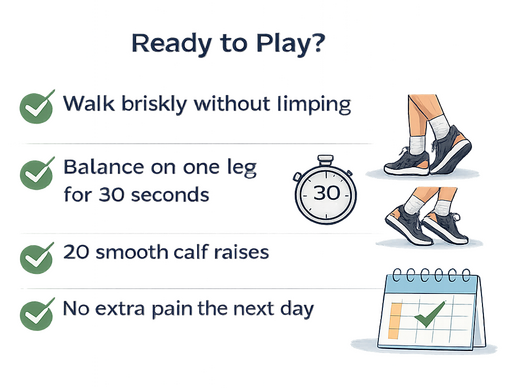
You’re usually ready to return to modified pickleball when most of these are true:
- You can walk briskly for 20–30 minutes without limping or pain increase
- You can single-leg balance for 30 seconds on the injured side
- You can perform basic strength work (calf raises, squats, band work, light gripping) without sharp pain
- You can change direction at low speed without hesitation or instability
- You can play 30–45 minutes and feel the same or better the next morning
If you fail the next-morning test, you’re close — but not quite ready yet.
Read This Before You Rush Back
Most pickleball injuries don’t end playing careers. They expose how easy it is to come back too fast.
This guide isn’t a rulebook and it isn’t a guarantee. It’s a decision framework — something to help you slow down, check yourself, and make smarter choices when adrenaline says, “I’m fine.”
A few final things worth remembering:
- Your best session back is the one where you stop early. Ending on a good note protects tomorrow.
- Recovery isn’t linear. A slightly bad day doesn’t mean failure — it means adjustment.
- Volume hurts more than intensity. Two extra games often do more damage than one hard rally.
- Listen to the next day, not the last point. Morning stiffness and swelling are better judges than how you felt on court.
- Playing less now usually means playing more later. Rushing back costs weeks; patience costs days.
Treat your return to pickleball like a ramp, not a switch. Do that, and you give your body a real chance to stay in the game — not just get back into it.