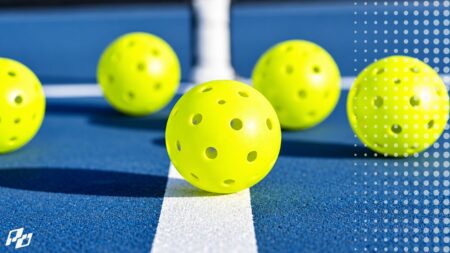
You’re mid-rally. Suddenly, a ball rolls onto your court from the next game over. Do you keep playing? Slam a winner? Or… call for a replay?
Most players know that “ball on court” or “something fell” can pause play—but what they don’t realize is this: a well-timed hinder call can be a legit tactical reset, especially when you’re on your heels.
Today we’re breaking down the replay rule, defining what counts as a hinder, and explaining when it’s to your advantage to stop play.
The Replay Rule, in Plain English
In pickleball, a “hinder” is anything external—not caused by a player—that disrupts the point. Think:
- A ball rolling onto your court
- A hat flying off
- Loud noise or sudden movement from another court
- A bug in your face mid-volley (yes, that counts!)
When this happens, you or the referee can call “Hinder!”, and the point is paused and replayed. No one wins or loses—it’s a full reset.
This is different from a distraction, which is usually player-caused (like an opponent yelling mid-shot) and can result in a fault instead of a replay.
2025 USA Pickleball Rules (Official Definitions)
Rule 3.A.16 – Hinder
“A hinder is any transient element or occurrence not caused by a player that adversely impacts play, not including permanent objects.”
USA Pickleball Rulebook
Rule 8.C – Replay Due to Hinder
“A hinder called by the referee or a player results in a dead ball. If determined valid by the referee—or simply acknowledged in non-officiated play—the rally is replayed from scratch.”
USA Pickleball Rulebook
When to Call a Replay (Yes, You Can Be Strategic)
Here’s where it gets juicy. You don’t just call a hinder to be fair—you can use it strategically. If something interrupts play and you’re at a disadvantage, a replay can bail you out.
1. Stray Ball on Court
Even if it’s in the back corner and doesn’t touch your ball—call it. It’s a safety issue and a tactical opportunity. Don’t try to win the point when you’re distracted or off-balance.
Hit the pause button and reset.
2. Something Falls (Hat, Glove, Water Bottle)
If anything flies into your field of view or lands near the court while you’re defending, call a hinder. A falling hat—even if it’s your own—qualifies.
Better to stop and replay than lose the point under unfair conditions.
3. Noise or Movement From Another Court
Let’s say someone yells “OUT!” on the next court just as you’re about to swing. If it genuinely disrupts your focus or decision-making, call it.
You don’t get to do this every time a sound happens—but if it affects the point directly, you’re within your rights.
When You Want the Replay on Purpose
There are moments in a rally when you’re desperate for a lifeline. Maybe you just barely got your paddle on a drive, or your partner’s out of position. If an external event occurs at that exact moment, calling a hinder is often smarter than trying to survive the rally.
Here’s when to make that call:
- You’re on defense and need a breather.
- Your partner is recovering and a distraction buys you time.
- The point is clearly tilting toward your opponents.
- You lost track of the score or rotation and need a reset.
Call it immediately—before the next shot—and be polite about it. “Hinder!” is all it takes. Most players (and refs) will honor it, especially if the interference is clear.
When NOT to Call a Replay
It’s important not to abuse the rule. Some situations might feel distracting but don’t meet the replay threshold:
| Situation | Replay | Why Not? |
|---|---|---|
| Partner yells “out” before the ball bounces | ❌ | That’s communication, not a hinder |
| Opponent grunts or yells mid-swing | ❌ | Possibly a distraction, not a hinder |
| Permanent object (like a fence) causes interference | ❌ | Not considered a “transient” hinder |
| You play through a hinder and then call it | ❌ | Too late—you accepted the rally continuation |
Timing and intention matter. If you call a hinder after seeing how the shot plays out, it looks suspicious. Call it immediately if it genuinely affects play.
Gray Areas and Smart Reads
What if the Other Team’s Hat Falls?
If their gear causes the distraction, it still counts. Replay the point. Same with their water bottle tipping over—no penalties, just a do-over.
What if a Bug Flies in Front of You?
If you flinch mid-swing because of a bee or gnat, that’s a legitimate hinder. Don’t be afraid to call it. You’re not expected to dink through an insect invasion.
What if the Net Structure Itself Interferes?
In temporary net systems, if a ball hits a horizontal support bar or center post and takes a strange bounce, it’s a replay—even if it technically hit the net legally.
Real-Life Example
You’re pinned at the baseline. Your opponents are pressing. You pop one up slightly, and right as they charge the net, a rogue ball rolls onto your sideline.
That’s your moment.
Call “Hinder!”—confidently and clearly. Don’t wait to see if they crush the put-away. You just bought yourself a second chance.
Replays Aren’t Just Technical—They’re Tactical
Too many players treat the hinder rule as something boring or overly formal. But smart players see it for what it really is: a momentum shifter.
It’s about control:
- Control over the tempo of a match
- Control over momentum swings
- Control over your mental reset
Knowing when to call a replay—and when to let it go—is a subtle skill that separates casual players from court tacticians. It won’t show up on a stat sheet, but it might just flip the match in your favor.