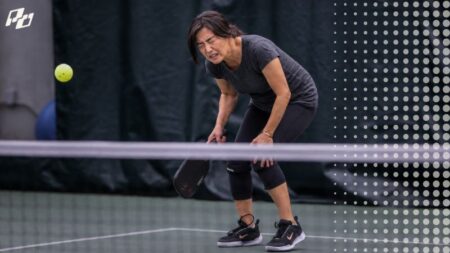


It’s 10–9, game point. Your calf’s been barking at you for the last few rallies. Not screaming, but enough that you notice. Your partner yells, “Yours!” You lunge, slap the winner down the sideline, and grin like a champ. Then you limp to the fence, telling yourself, “Eh, it’ll loosen up.”
Sound familiar?
A big survey of nearly 1,800 pickleball players found that one in three admits to playing through pain. Yep—one out of every three paddles stacked on the fence is attached to someone who’s secretly hurting.
But why do we do this? And what really happens when we keep ignoring those “little” twinges?
Let’s break down the stubbornness factor in pickleball—the love, the pride, the social pressure—and how it can either fuel us or sideline us.
Quick Stats You Should Know
- 1 in 3 pickleball players admit to playing through pain.
- 12% of lower-limb injuries in pickleball are Achilles ruptures.
- 69% of players report at least one injury each year—time-loss or not.
- Court shoes vs running shoes: mismatched footwear is a known injury trigger.
These numbers aren’t scare tactics—they’re proof that stubbornness is common, and the costs are real.
The Psychology of Stubbornness
Sports psychologists call this the athlete identity effect: we tie our self-worth to our ability to compete. Even recreational athletes—especially older ones—cling to this identity.
In pickleball, that effect is doubled because it’s so social. If you bow out, you don’t just lose the rally; you feel like you’re losing your place in the group.
This makes stubbornness feel noble—when really, it’s quietly stealing your longevity.
Why We Push Through
1. The Social Pull
Pickleball isn’t just a sport—it’s a scene. If you sit out, you feel like you’re letting down your partner or slowing down the rotation.
That little voice says, “Don’t be the weak link.” So we tape it up, stretch it out, and stay in the game.
2. The Story We’re Living
You’re finally hitting drops, moving up in ladder play, or just on a hot streak. Pain feels like an interruption to your “hero arc.”
Nobody wants to stop when they feel like they’re leveling up.
3. The “It’s Just a Twinge” Lie
Especially if you’re newer to the game, it’s easy to think, “This isn’t a real injury, just soreness.”
But surveys show that newer players are actually more at risk for injuries—because they don’t yet know what warning signs matter.
What Playing Hurt Does to Your Body
Here’s the sneaky part: when something hurts, your brain rewires how you move.
- Knee pain? You bend less, so your back takes extra load.
- Calf tightness? You push off differently, dumping stress into your Achilles tendon.
- Shoulder ache? You flick more with your wrist, overloading the elbow.
These are called compensations, and they snowball fast. What started as a “2 out of 10” ache turns into a strained tendon, or worse—a season-ending rupture.
Doctors are seeing a spike in Achilles tendon tears from pickleball. Why? Because those quick backpedal-then-sprint moves at the kitchen hammer the Achilles.
And if you’ve been ignoring that calf tightness? You’re basically playing chicken with a snap.
The Pain Translator: When That Ache Means More
We all shrug off little aches. But in pickleball, those “nagging” pains often have a story to tell. Here’s how to read them before they turn into season-ending injuries.
Morning heel pain
→ Likely plantar fasciitis brewing. That stabbing pain in the heel when you first step out of bed means the plantar fascia (the band under your foot) is irritated from repeated stop–start movements and hard-court pounding.
Calf tightness that lingers mid-match
→ Often Achilles tendon overload. If it doesn’t loosen after warming up, your Achilles is waving a red flag. Ignore it, and you risk a sudden rupture—the injury pickleball clinics are seeing all the time.
Knee ache on lunges or squats
→ Patellar tendon irritation or early cartilage wear. Hard courts + bent-knee play load the tendon under your kneecap. Over time, it can lead to jumper’s knee or accelerate arthritis.
Shoulder twinge on overheads
→ Classic rotator cuff strain. Reaching high and snapping through without enough warm-up or strength puts the small stabilizers of the shoulder at risk.
Elbow soreness after drives or flicks
→ Could be lateral epicondylitis (a.k.a. “pickleball elbow”). Similar to tennis elbow, it comes from gripping too tight or snapping through too many drives.
Wrist ache after long games
→ Usually tendonitis from over-flicking or compensating for a sore shoulder. Sometimes it’s early carpal tunnel irritation from repetitive grip pressure.
Low back stiffness post-play
→ Often poor core engagement or compensation for tight hips/hamstrings. Can also signal facet joint irritation from repeated bending and twisting at the kitchen.
Hip pinch when shuffling wide
→ Early sign of hip impingement or labral irritation. Quick lateral lunges into wide dinks stress the hip joint capsule, especially if mobility is limited.
Groin twinge on fast reaches
→ Likely adductor (inner thigh) strain. Those sudden splits to snag a wide ball are a common culprit—especially if you haven’t warmed up.
Outer ankle roll after a wide step\
→ Lateral ankle sprain. Even a mild roll stretches ligaments and increases the odds of rolling again if you don’t rehab it properly.
👉 None of these mean you’re doomed—but they do mean your body is trying to negotiate with you. Pay attention, and you can stay in the game without escalating a whisper into a shout.
Quick-Reference Cheat Sheet
⚠️ These are general patterns. Severity varies, and rest times are averages. If pain is sharp, worsening, or lingers more than a week, get checked by a healthcare pro.
| Ache / Symptom | What It Usually Means | How Serious Is It? | Typical Time Off (if managed early) |
|---|---|---|---|
| Morning heel pain | Plantar fasciitis irritation | Moderate: can worsen if ignored | 3–7 days rest + stretching; chronic cases = weeks |
| Calf tightness mid-match | Achilles tendon overload | High risk: can rupture suddenly | 5–10 days minimum; longer if sharp/persistent |
| Knee ache on lunges | Patellar tendonitis / early arthritis | Mild–moderate: nagging but worsens with play | 2–7 days lighter activity; add strengthening |
| Shoulder twinge on overheads | Rotator cuff strain | Moderate: can escalate to tear | 5–10 days avoiding overheads; longer if persists |
| Elbow soreness after drives | “Pickleball elbow” (lateral epicondylitis) | Mild early, can become chronic | 3–7 days; adjust grip/technique |
| Wrist ache after long games | Tendonitis / early carpal tunnel stress | Mild: usually short-term | 2–5 days; check grip pressure |
| Low back stiffness | Core weakness / facet irritation | Mild–moderate: improves with mobility | 1–3 days, plus stretching/mobility |
| Hip pinch on wide shuffles | Hip impingement / labral irritation | Moderate: warning sign for chronic hip issues | 3–7 days, plus hip mobility |
| Groin twinge on reaches | Adductor strain | Moderate: worsens with repeat lunges | 5–10 days, depending on severity |
| Outer ankle roll | Lateral ankle sprain | Mild to severe depending on roll | Mild: 3–7 days; severe: 2–6+ weeks |
Is This Just a Pickleball Problem?
Not really. Athletes in every sport play hurt. But pickleball adds a few twists:
- Older Players, Bigger Risks: With so many 50+ players, pain ignored today can turn into fractures, tendon ruptures, or arthritis tomorrow.
- Different Movement Pattern: Pickleball is all about short, explosive stops and starts—harder on tendons than steady-state sports like running.
- The Social Vibe: Because pickleball is so community-driven, the pressure not to “let people down” is extra strong.
How to Know When to Stop (Without Feeling Like a Quitter)
Here are some in-game hacks to help you decide if you should push or park:
- The Traffic Light Rule:
- Green = pain 0–2/10 and fades as you warm up → keep playing, but ease up.
- Yellow = 3–5/10, stays the same or creeps up → modify or sub soon.
- Red = 6+/10, sharp or changing your form → stop immediately.
- The Two-Rally Test: If pain gets worse over just two rallies, it’s not going away. Time to bow out.
- Partner Script: Instead of sheepishly saying, “I think I’m done,” use this:
“My calf’s tightening up, it’s at a 4 out of 10. I’ll finish this point and then sub so I don’t blow it up.”
Clear, confident, and nobody feels let down.
How to Outsmart Stubbornness (And Still Play More Pickleball)
1. Warm Up Like You Mean It
Do drills that mimic the exact movements you’ll use: quick backpedal-to-sprint moves, calf raises, and a few split-steps.
Five minutes is all it takes to prime the joints that keep breaking down.
2. Buy Shoes That Love You Back
Running shoes are great for… running. Court shoes are designed for lateral moves. They grip better, protect ankles, and save you from those twisty injuries.
3. Manage Your Load
Don’t jump from 3 hours a week to 12. Follow the “10% rule”: increase either time or intensity or tournaments, but not all at once.
4. Create a Group Culture of Smarts
Make a pact with your crew: first 10 minutes at 70%, no diving, no hero plays. Normalize smart pacing so no one feels weak for sitting out.
Pro Tips You Can Steal Today
- Pain Journal: After each session, jot a quick note: “Left knee 3/10 start, fine after warm-up.” Patterns show up fast.
- Recovery Ratio: For every tournament day, take two lighter days with stretching, sleep, and protein.
- Check the Tape: Film your kitchen play. If you’re standing taller when you’re tired, that’s a sign your calves are giving out—address it before it’s an injury.
The Big Takeaway
Playing through pain isn’t about weakness—it’s about love. We love the game, the people, the joy. But stubbornness can steal the very thing we’re trying to protect: more time on the court.
The smartest players aren’t the ones who grind through every ache. They’re the ones who know when to step aside, stretch, or sub—so they can keep showing up for years, not just weeks.
Protect your future self. They’ll thank you when you’re still laughing at the kitchen five seasons from now.