

Pickleball is a game of tight margins. Using proper pickleball hitting techniques—like hitting with your whole body and mastering the backhand—may be the difference between winning and losing. Read on and put these techniques into practice to propel yourself toward more wins.
Stay In the Ready Position
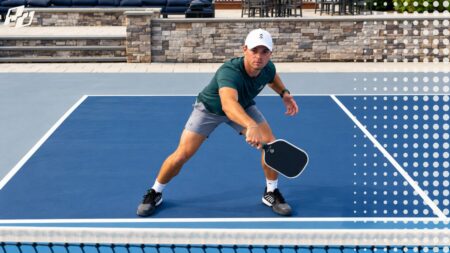
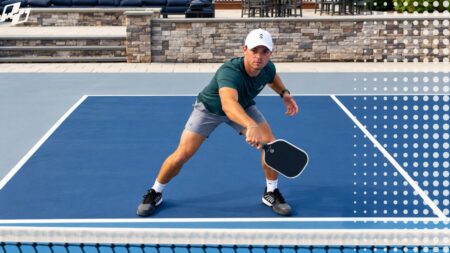
The ready position is a neutral stance you should use while waiting for the next shot to come your way. If you watch any advanced players on the pickleball court, they use this technique on every shot. This is often the difference between lower-level players and those with advanced skills.
A neutral stance enables you to adjust your body position to hit everything from basic shots to advanced shots, keeping you in a solid position throughout.
To get into the ready position:
- Place your feet shoulder-width apart, with your knees slightly bent.
- Keep your body weight forward on the balls of your feet and your toes. This will allow you to take off quickly, moving toward the ball.
- Keep your paddle in the center of your stance, allowing you to easily adjust to hitting forehand shots or backhand shots, depending on what is required.
Many lower-level players forget to reset to a neutral stance after shots, remaining with their weight in the direction of their last stroke. This makes them slower to react.
Of all the basic skills to master, the ready position is arguably the key skill for beginners.
Hit With Your Whole Body

Another indicator of skill level among pickleball players is watching how they use their body through the stroke.
A classic beginner pickleball mistake is to only use your arms to hit the ball rather than your whole body.
Using your whole body is vital if you’re attempting to play a power game. To generate faster ball speed, you need to use all the large muscles in your body: hips, shoulders, and chest. The pickleball stroke is a full-body movement, so use it, and you’ll develop much more extra pace.
One of the counterintuitive things about racquet sports is that when you use more of your body, it feels harder to control where the ball goes. Because our hands are the most dexterous part of our body, we over-rely on them. However, using your whole body won’t just deliver a powerful shot but an accurate shot too.
Perfect your Forehand
Most pickleballers are dominant forehand players. This means that they are better at hitting forehand shots than backhand shots.
This is for a number of reasons:
- For one, the ball is usually on the ‘dominant’ side of your body (the side of your stronger hand), so it feels more natural.
- Secondly, with most pickleball grips, hitting a forehand will keep your palm facing the ball rather than the knuckles.
Forehands are a much more natural movement – during the day, almost every move you make with your dominant hand will be palm-first. Picking something up, shaking someone’s hand, and opening a door are all palm-first movements.
Forehands are also classically used for power shots. Developing a strong forehand is key to getting the ball past strong defensive players.
Hitting Backhands
Most players are worse at hitting backhands. For this reason, any accomplished pickleball player is going to attempt to hit to your backhand to expose a potential chink in the armor.
If you can make your backhand a weapon rather than a weakness, you’ll gain a crucial edge in competitive pickleball games.
The key to getting in the correct backhand position is the grip. Most people play in the continental grip, where your thumb and index finger create a V on the top of the paddle grip. This is great for forehand strokes but can cause problems for backhand returns.
The correct technique for hitting a strong backhand is to use the backhand eastern grip. The easiest way to find a solid position for the backhand eastern grip is to take the continental grip and then rotate your hand about an inch to the left (if you’re left-handed, reverse this).
Volleys For Defense & Offense
Volleys are an absolutely crucial pickleball shot to master. If you have correctly positioned yourself at the edge of the non-volley zone line, the chances are that any power shots hit past you will be coming at volley height.
This makes volleys important both for offense and defense. Both types of volleys are completed by using short, sharp movements. Unlike in a ground stroke, you are not trying to hit the ball as much as simply block it using the already existing momentum of the pickleball ball to return it.
Because volleys require very little backswing and almost no follow-through, they are a great way of returning powerful shots.
Hitting Dink Shots
Dink shots are one of the most important pickleball techniques to develop in order to jump from a beginner to an intermediate skill level. So much of pickleball revolves around dominating the non-volley zone line. One of the best ways to use the non-volley zone line is to hit a dink into the kitchen, drawing your opponent into no man’s land.
Hitting a dink shot short of the non-volley line can beat them outright as they sprint forward to reach the ball before it bounces twice. Even if they get it, they are then stranded in the kitchen, unable to volley a return struck firmly past them.
Train yourself to hit dinks in practice. This is a great way of manipulating your opponent around the court. Cross-court dinks can be especially potent weapons.
Serve Deep to Your Opponent’s Backhand

To best use the third shot drop, you need to serve deep. This keeps your opponents pushed back to the baseline, allowing you to use your dinks as they run back to the kitchen line.
Most players find it harder to hit backhands than forehands. Therefore, serving to their backhand will often cause them to deliver a less powerful, less accurate return.
Though pickleball isn’t designed around powerful serves, they’re still important. Serves allow you to set the tone for the type of rally you’ll be playing.
Drop Shots
Drop shots are a soft nudge of the ball back over the net, often with some clever spin that causes the ball to bounce softly.
The third shot drop strategy is a tried and tested way of winning pickleball games and is a crucial strategy to develop.
The 3rd shot drop involves serving toward the baseline, which forces your opponent to hit a deep return. With your opponent stuck deep in the court, you can execute a drop shot close to the net.
Even if they manage to return it, their momentum will carry them forward. This allows you to hit a lob shot back over their head, hopefully winning the point!
Vary Your Shots and Speed
Pickleball, unlike tennis or squash, is not about sheer power. Due to the nature of the ball and the size of the court, you can’t simply muscle the ball past your opponent. You have to out-think them.
To win, you have to be prepared to apply a wide array of hitting techniques rather than just relying on one or two.
Pickleball is about rhythm. If you continually hit the same shot at your opponent, they can get settled, predict where you are going, and use that knowledge to beat you.
However, if you vary the shots you are hitting and the speed with which you hit them—some slower, some more powerful—you keep your opponent guessing. If they’re not sure what shot is coming at them, they can’t get ready until the ball is hit. In a game like pickleball, those milliseconds can make all the difference.
Around-The-Post Shots
Around-the-post shots are an advanced skill that only comes out in very specific conditions. These shots can be devastating if executed correctly, both mentally and in terms of winning the point.
When your opponent hits a shot with such a sharp angle that the ball bounces on the court but then travels off the sideline, normally, that would be a winner.
However, if you have the speed to get to the ball, you can then pull off the ‘around-the-post-shot.’ This is a shot that goes into your opponent’s side of the court without ever having to go over the net. Because of this, it can be hit under the net height.
A shot of this height is tough to return, and it’ll often win the point. Even better, your opponent will likely be sure that they have won the rally and so will have their guard down.
Keep the Pickleball Low
This sounds simple, but it’s actually a hard skill to master. It’s much easier to return a ball bouncing at your waist than at your knees. When the ball is low, it forces you to scoop the pickleball paddle under it, popping it up in the air. This might allow your opponent an easy chance to hit a smash back at you.
To keep control of a rally, keep the ball low. Force your opponent to hit defensive pop-ups rather than ground strokes, and you’ll find yourself with the upper hand.