
Playing pickleball with bunions? Choose court shoes with a wide, deep toe box, secure heel and midfoot support, and enough cushioning without crowding the forefoot. Pads, insoles, toe spacers, foot-strengthening exercises, and smarter footwork can reduce pressure and pain—but they won’t remove a structural bunion.
A bunion can make pickleball miserable in a very specific way.
You feel fine walking onto the court. Twenty minutes later, the joint beside your big toe is burning. An hour later, every lateral stop seems to shove the foot into the side of the shoe.
So you buy a bigger shoe.
That feels better for a week.
Then your heel starts sliding.
Here’s the problem: a bunion usually doesn’t need a longer pickleball shoe. It needs a better-shaped one.
And because pickleball involves so much lateral movement, solving the bunion without creating a stability problem somewhere else is the real trick.
First, your bunion isn’t just a bump
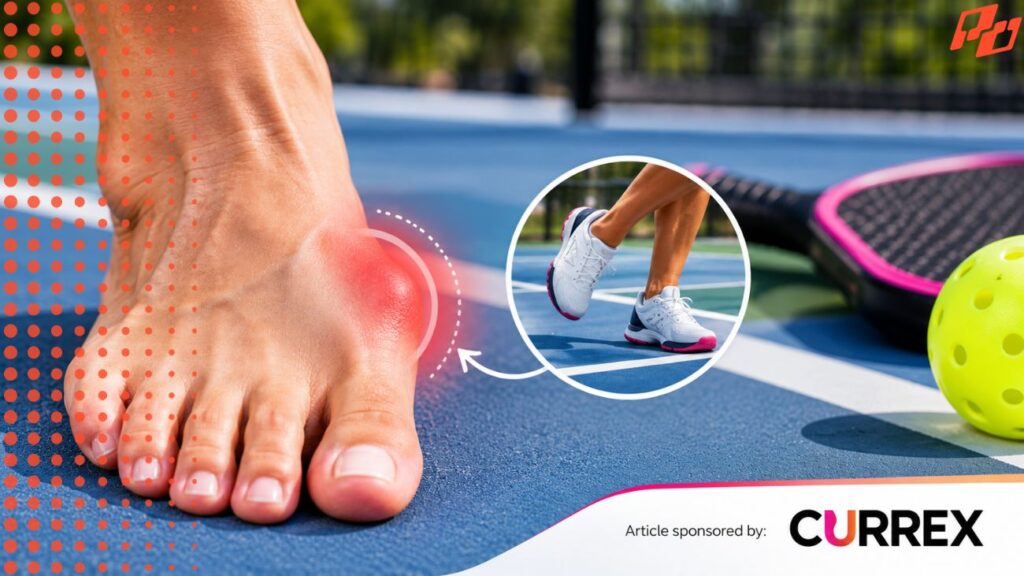
A bunion, or hallux valgus, is a change in alignment around the big-toe joint. The big toe drifts toward the other toes while the first metatarsal becomes more prominent on the inside of the foot.
That matters because you cannot simply “rub the bump away.”
Bunions are also remarkably common. A large systematic review estimated hallux valgus in about 19% of the population, with prevalence around 23.7% in women versus 11.4% in men, and approximately 22.7% among people over 60.
For the older recreational pickleball crowd, this is hardly a fringe problem. And it isn’t purely a footwear problem either.
A 2026 systematic review found hallux valgus to be multifactorial, with associations involving age, female sex, foot mechanics and footwear. But narrow-toed shoes stood out: they were associated with roughly 2.25 times the odds of hallux valgus in the pooled analysis. The researchers rated the underlying evidence as low certainty, so don’t interpret that number as proof that narrow shoes single-handedly cause bunions.
The practical conclusion is simpler: you may inherit the foot that wants to develop a bunion. You don’t have to keep squeezing it every time you play.
Why pickleball can make a tolerable bunion suddenly angry
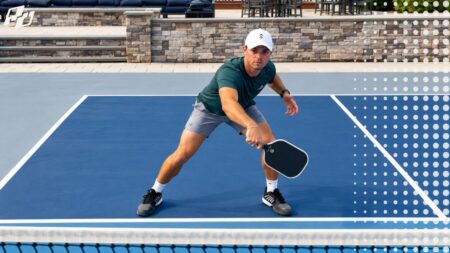
Sports-medicine physician Dr. Haris Vakil describes pickleball movement as highly lateral and diagonal, with hard pushes and sudden stops occurring constantly. He recommends short, controlled steps instead of late lunges and hard braking.
Now imagine what your foot is doing inside the shoe.
You push right.
Your forefoot pushes left against the upper.
You stop.
Your toes slide forward.
You change direction.
The prominent bunion joint meets the sidewall again.
The shoe can fit perfectly while you’re standing in the store and still become unbearable once you’re cutting on court.
The test isn’t “Does this shoe feel roomy?”
It’s: “Can my forefoot spread without my entire foot sliding around?”
That distinction changes everything.
The biggest mistake: buying “wide”
Pickleball players with bunions talk about this constantly.
Someone buys the wide version of a court shoe and discovers that the shoe is wider everywhere—but the toe still tapers. Another sizes up half a size for more space, only to create heel movement. Another finds plenty of width but discovers an internal seam positioned directly over the bunion.
In recent pickleball discussions, players repeatedly distinguish overall width from toe-box shape. One player with bunion pain described conventional tapered toe boxes as the trigger even when the shoe itself was sold as wide. Others reported particular models fitting differently despite identical width labels.
That’s anecdotal, not clinical evidence. But the basic fit principle agrees with orthopedic guidance.
AAOS recommends a toe box that is both wide and deep enough for the forefoot and specifically notes that square or rounded shapes are preferable to pointed ones for people with bunions.
So stop shopping by the little W beside the shoe size. Look at the shoe from above. Does it narrow sharply toward the big toe?
If your forefoot is naturally wide or your big-toe joint sticks out, but the shoe narrows sharply toward the toes, the bunion is still going to get compressed—even if the shoe is labeled “wide.”
But don’t solve it with running shoes
This is the other trap. You find a plush running shoe with a glorious roomy toe box.
Your bunion loves it.
Your ankles may not.
Pickleball requires lateral and diagonal stability that running shoes aren’t primarily designed to provide. Both Houston Methodist sports-medicine guidance and the American Medical Association recommend tennis or true court shoes because of their firmer lateral support and traction during cutting and pivoting.
So for pickleball, the sweet spot is: roomy forefoot + secure midfoot + secure heel + court stability.
Not merely: big shoe.
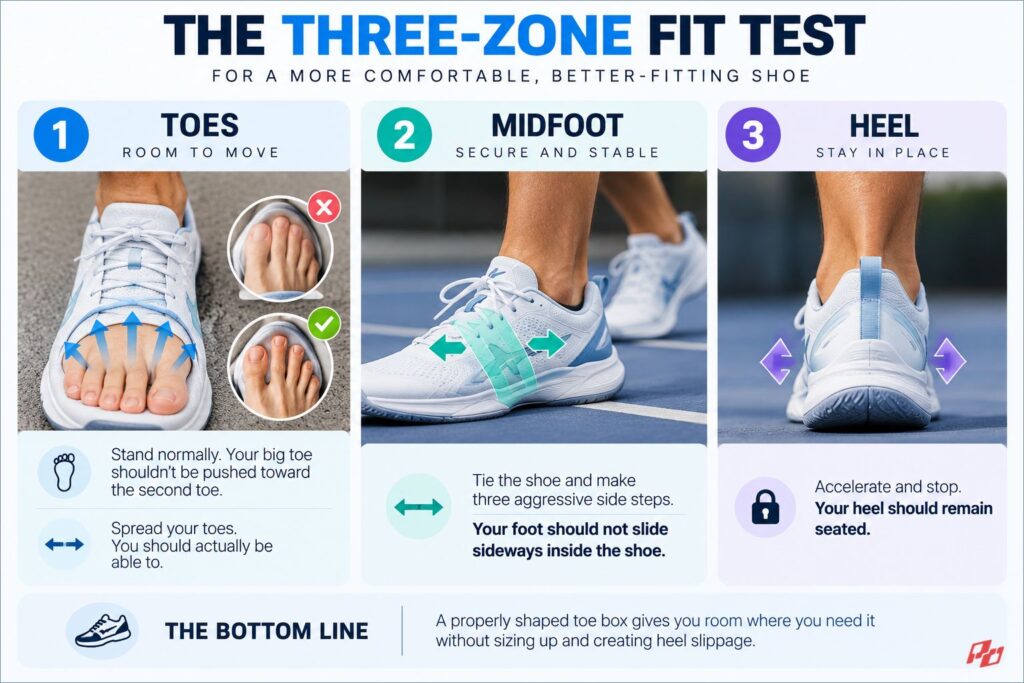
Try the three-zone fit test
When you try on your next pair, forget the size label for a moment.
Zone 1: Toes
Stand normally.
Your big toe shouldn’t already be pushed toward the second toe.
The bunion shouldn’t be pressed hard against the upper.
Now spread your toes.
You should actually be able to.
Zone 2: Midfoot
This should feel much more secure.
Tie the shoe and make three aggressive side steps.
Your whole foot should not slide sideways inside the shoe.
Zone 3: Heel
Your heel should remain seated when you accelerate and stop.
If you’re buying a much longer shoe just to make room for the bunion and your heel floats around, you’ve solved one problem by creating another.
That’s why a properly shaped toe box is usually preferable to simply sizing up.
Don’t ignore the upper
Here’s a tiny detail that can make an enormous difference: where the shoe seam sits.
You can have plenty of width and still irritate a bunion if a stiff overlay, stitching line or reinforced panel crosses directly over the joint.
One pickleball player with a tailor’s bunion specifically described a raised internal seam sitting directly over the painful area.
When you’re trying shoes, don’t just measure space. Press your fingers around the inside of the upper.
Feel for:
- seams
- hard overlays
- stiff logos
- reinforcement panels
The best upper for your particular bunion may be one that simply gives at exactly the right spot.
Can padding actually help?
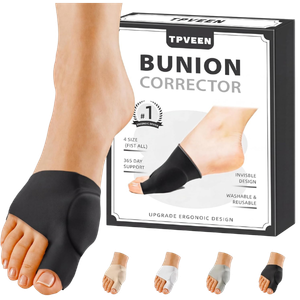
Yes—with an important qualification. A gel bunion sleeve, pad or cushion doesn’t straighten your skeleton. What it can do is create a buffer between the irritated joint and the shoe.
Mayo Clinic includes non-medicated bunion pads among conservative treatments for reducing pain and pressure. That’s potentially useful for pickleball because the irritation often comes from repeated friction and contact.
But don’t keep adding padding until your previously roomy shoe becomes tight. More material inside the shoe means less space.
A thin gel sleeve that prevents rubbing may help. A giant doughnut of padding crammed into an already narrow shoe may make things worse.
Padding should reduce pressure, not relocate it.
- Soft 3mm gel cushion
- Reduces shoe rubbing
- Breathable, stretchy fit
- Stays in place
- Washable & reusable
What about toe spacers?
This gets oversold online.
Toe spacers may make some people more comfortable, and Mayo Clinic includes them among conservative measures for bunion symptoms.
But don’t expect a $12 silicone spacer to permanently straighten a significant structural bunion.
NHS guidance is especially clear: conservative devices may help pain, but surgery is the only way to actually remove/correct the established bunion deformity.
There is some interesting middle ground, however.
A 2025 network meta-analysis of 11 randomized trials involving 401 people found that exercise combined with taping or orthoses produced better short-term improvements in pain and hallux-valgus angle than exercise alone in mild-to-moderate cases. The authors also emphasized that larger, higher-quality trials are still needed.
So: spacer for comfort? Reasonable.
Spacer marketed as a permanent bunion cure? Be skeptical.
Can insoles help?
Yes—mainly by redistributing pressure and reducing how much your foot slides inside the shoe. Orthotics won’t remove a bunion, but some research suggests they can reduce pain, especially when combined with other conservative treatments.
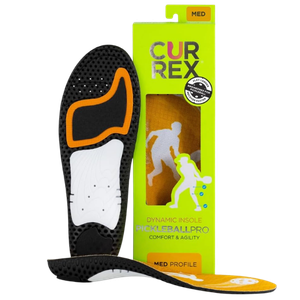
For pickleball, look for an insole with a secure heel cup, moderate arch support, some forefoot cushioning, and a thin enough front section that it doesn’t make the toe box tighter.
Pickleball-specific options such as CURREX PICKLEBALLPRO are built for lateral movement, stops, and pivots rather than straight-line running. But the label matters less than the fit: if an insole pushes your bunion harder into the side of the shoe, it’s doing the opposite of what you need.
If pain persists despite good shoes and an appropriate insert, a podiatrist can assess whether a custom orthotic would redistribute pressure more effectively.
The exercise that’s actually worth knowing
One small randomized study looked at the toe-spread-out exercise.
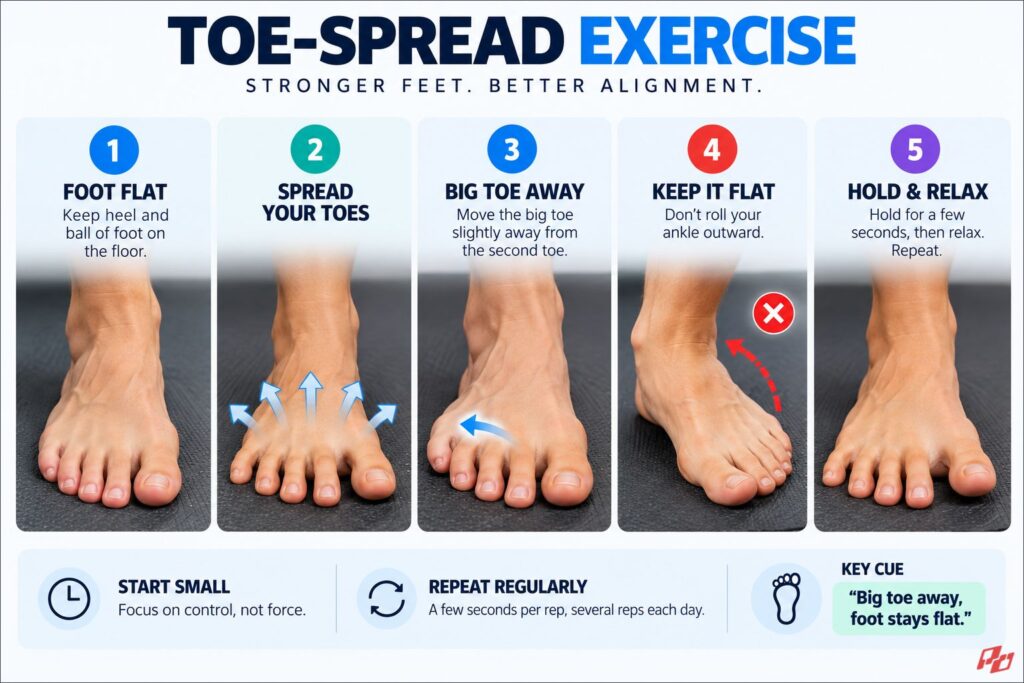
Participants practiced actively separating the big toe away from the second toe while keeping the smaller toes controlled. After eight weeks, the exercise-plus-orthosis group showed improvements in hallux-valgus angle and the size of the abductor hallucis muscle compared with orthosis alone.
There were only 24 participants, mostly young adults, so don’t turn this into miracle therapy. But it’s a sensible foot-control drill.
Try it like this
Barefoot:
- Keep the heel and ball of the foot on the floor.
- Spread the toes.
- Try to move the big toe slightly away from the second toe.
- Don’t roll the ankle outward to fake the movement.
- Hold briefly and relax.
Think: “Big toe away, foot stays flat.”
Start with control, not force.
For an older player with a stiff joint, don’t aggressively pry the toe into position. If the movement itself hurts, have the foot evaluated.
What should you do during a flare-up?
A bunion that’s mildly irritated after a long session is different from one that’s progressively limiting your movement.
Conservative measures commonly recommended by Mayo Clinic and orthopedic organizations include:
✔ Temporarily reducing the aggravating activity
✔ Roomy footwear
✔ Padding
✔ Ice for soreness/swelling
✔ Where appropriate for the individual, over-the-counter pain medicines
For pickleball, there is an even simpler tool: cut the session before your mechanics change.
If you begin limping, rolling onto the outside of the foot or avoiding normal push-off because the joint hurts, you’re no longer merely “playing with a bunion.”
You’re changing how the entire leg moves.
One 90-minute session becoming 60 minutes is usually a much cheaper compromise than turning one irritated joint into several overloaded body parts.
Can you prevent a bunion from getting worse?
Sometimes you can reduce the mechanical aggravation. You cannot control every factor.
Hallux valgus has genetic and structural contributors, and recent systematic reviews support a multifactorial rather than purely footwear-driven explanation.
But you can stop giving the deformity unnecessary help. For a pickleball player that means:
- Don’t play in a tapered toe box.
- Don’t assume a shoe will “break in.”
AAOS specifically warns against buying painful shoes and expecting them to stretch into the correct fit.
- Replace court shoes once their lateral structure collapses.
- Don’t automatically size up instead of finding the right shape.
- Don’t use a comfortable running shoe as a substitute for proper lateral court support.
And don’t wait until your bunion becomes severely painful before changing footwear.
Can you actually get rid of a bunion?
This is the part product advertising tends to blur.
- Pads can reduce rubbing.
- Toe spacers may reduce symptoms.
- Orthotics can redistribute pressure for some people.
- Exercises may improve foot function and appear promising for mild-to-moderate hallux valgus.
None of those physically removes an established structural bunion. Surgery is the definitive method of correcting the deformity.
That doesn’t mean everybody with a bunion needs surgery. Quite the opposite.
Orthopedic guidance generally reserves surgery for people whose pain persists despite conservative treatment or whose bunion meaningfully limits daily activity.
If you can comfortably play three times a week after changing shoes and managing pressure, the presence of a bump alone isn’t a reason to operate.
When it’s time to stop experimenting with shoes
Get the foot evaluated if:
- the pain keeps worsening
- the joint is repeatedly swollen
- you can no longer push off normally
- you’ve started limping
- ordinary shoes are becoming difficult to tolerate
- the big toe is becoming increasingly stiff
- or pickleball and normal daily walking are being restricted
And if you have diabetes, impaired circulation or reduced sensation in the foot, be much more cautious about self-treating rubbing, blisters or pressure areas. AAOS specifically notes that seemingly minor shoe irritation can become much more consequential in people with neuropathy or diabetes.
The bunion-friendly pickleball test
Forget whether a shoe feels luxurious while you’re sitting on the bench. Put it on and ask:
Can my toes spread?
Is anything pressing directly on the bunion?
Does my heel stay locked?
Does my midfoot stay secure?
Can I shuffle hard in both directions without sliding inside it?
Can I stop without my big toe being rammed into the sidewall?
That’s the shoe test that matters.
Because playing pickleball with bunions isn’t really about finding the softest shoe. It’s about giving the forefoot enough freedom without allowing the rest of the foot to move around inside the shoe.
That’s the balance most players miss.
Give the bunion space.
Give the foot stability.
And stop asking one bigger shoe to do both.