
Women are often targeted in pickleball mixed doubles, but it isn’t always about skill. Research shows men finish more points while unforced-error rates are nearly identical. The best response is to stay composed, reset pace, change direction, claim your space, and make targeting you stop paying off.
Let’s get one thing out of the way. This is not a women’s-rights essay disguised as pickleball strategy.
It’s a reality check.
If you’re a woman playing mixed doubles, particularly around the 3.0–4.0 recreational level, you may notice some strange things.
You get 12 balls in a row while your male partner could probably answer emails.
Your partner suddenly starts standing halfway into your kitchen box.
A man who has never seen you play asks whether you “want to stack.”
Someone drives every third shot directly at you.
Or the opposite happens: an opponent refuses to hit hard toward you because you’re a woman, and the whole match starts feeling weirdly artificial.
Are you imagining it?
Not entirely.
But the reason is more interesting than simply “men don’t respect women on pickleball courts.”
Mixed doubles really does create different tactical incentives. At the same time, recreational players often layer assumptions, ego, etiquette and bad communication on top of those tactics.
The useful skill is learning to tell the difference. Because once you do, mixed doubles becomes much easier to play.
First: yes, the game really is different
We finally have some actual numbers.
A 2025 peer-reviewed study analyzed 17 elite PPA mixed doubles matches and 1,678 rallies. Male players produced winners on 28.3% of their rally-ending shots, compared with 18.1% for women. Women had more forced errors overall: 61.2% versus 50.2%.
That sounds like confirmation of every stereotype. Until you notice another number. Unforced errors were virtually identical: 21.5% for men and 20.7% for women.
And among teams that were actually winning matches or leading on the scoreboard, much of the sex difference in error production disappeared.
That is the interesting part.
The study does not show that women simply miss more easy balls. It suggests that mixed doubles places women in different situations: defending more pressure, receiving different balls and playing a different tactical role, while men more often become the finishing player.
The researchers themselves recommended training women for pressure exchanges and deliberately redistributing finishing opportunities rather than automatically building the team around a male finisher.
There is an important caveat: this was a small study of elite PPA matches. We cannot simply paste those percentages onto Wednesday-night 3.5 open play.
But it does tell us something useful:
The difference in mixed doubles is not just in people’s heads. The ball distribution and point construction really can be different.
Why you become the target—even when you’re not the worse player
Tournament players don’t need to dislike you to hit you every ball. They just need to believe it’s their best percentage.
Senior pro and APP medalist Gina Cilento tells women to expect this. Opponents may repeatedly drive the third at the woman, speed up in her direction or force her to reset from transition because they believe that side will eventually produce the weaker ball. Her advice is not to become defensive about the targeting; expect it, get ready earlier and make the strategy stop paying.
PPA pros Mari Humberg and Ryan Fu say essentially the same thing. Humberg expects to receive a huge share of the balls in mixed and tries to use those touches to manipulate the rally rather than merely survive it. Fu has joked that his female partner might hit roughly 90% of the shots in certain mixed patterns—so naturally she will also accumulate more misses.
That last point is worth remembering. If you hit 25 balls and your partner hits six, comparing your error totals is ridiculous.
So is targeting sexist?
In competitive play? Usually it is better understood as targeting, not an insult.
Teams target weaker backhands, slower players, tired players, poor resetters and people who hate pace. In mixed, biological differences in average reach, strength and ball speed can make the woman the default first test.
But “first test” is not the same as “actual weaker player.”
And experienced women describe a funny phenomenon: opponents target them automatically, continue doing it for several points, and only later discover they chose the wrong person.
Your job is to make them discover that quickly.
The biggest mistake is trying to prove them wrong
This is where a lot of women make mixed doubles harder.
You get targeted.
You feel the message.
So when the next slightly high dink arrives, you think: Fine. You want me? Here you go.
Speedup.
Net.
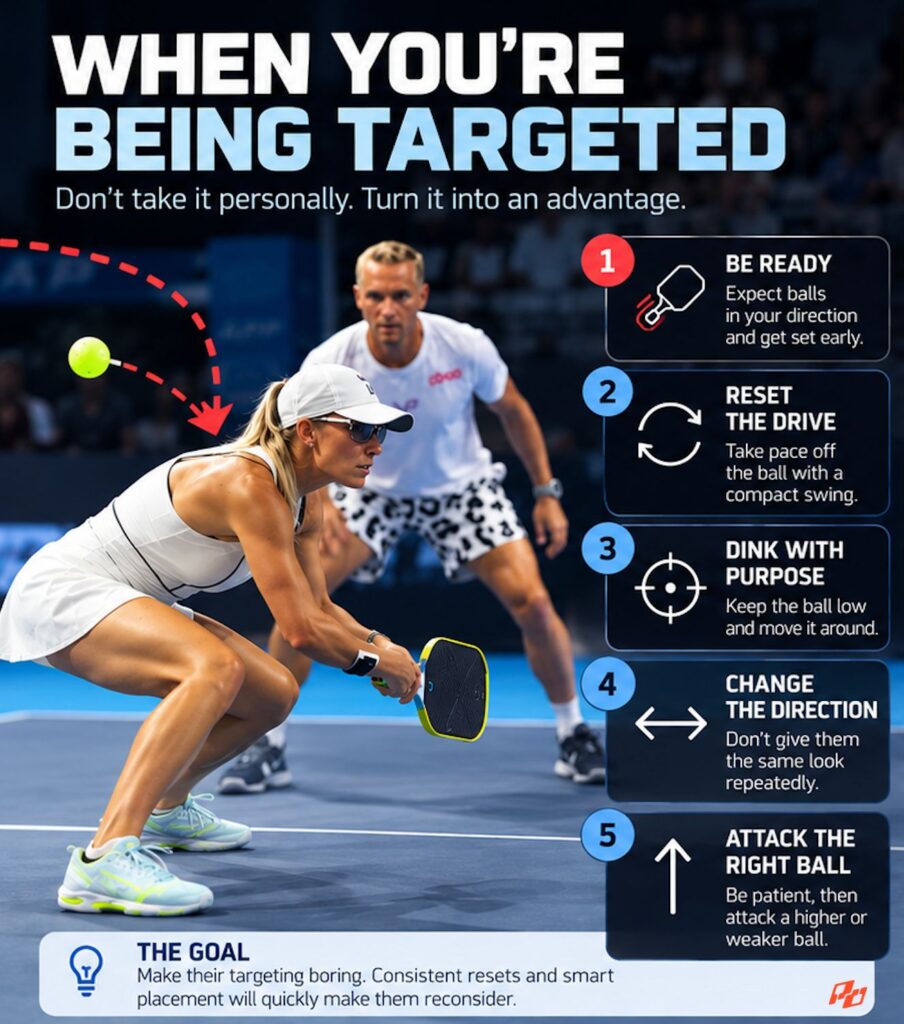
Now the targeting has worked. The better response is much less emotional. Make their targeting boring.
- Reset the drive.
- Dink with purpose.
- Move the ball.
- Give them one more difficult contact.
- Then attack the ball that actually deserves attacking.
Cilento specifically recommends a reliable reset as one of the best anti-targeting skills because taking pace off repeated attacks prevents opponents from generating easy finishing balls.
For beginners and intermediates, this may be the highest-return mixed-doubles skill you can practice.
Not hitting harder.
Receiving hard.
@jillybpickleball 99% of pickleball players can't reset the ball this consistently. Here's how I do it: Step 1.) Drink @Reign Storm to get you laser-focused & locked in. Step 2.) You go hard. I go soft. Soft grip pressure lets me absorb the ball. Step 3.) You swing big, I swing small. Don’t “hit a hit” if you want to reset it. The secret isn't power — it's precision. P.S. In reality I’d probably counter the ball through her chest! 😇🤣 Love you, sis. #ReignStorm #Pickleball #CleanEnergy #pickleballtok #pickleballtips ♬ son original – ELNOSMILE
Your goal is not to survive 20 balls. Change the conversation.
Humberg teaches women something smarter than simply becoming a human backboard.
If you stay trapped in the same crosscourt dink exchange, opponents can comfortably keep you there. So change the pattern.
Humberg and Fu teach a simple sequence: crosscourt → middle → behind.
The middle ball makes the opponents reorganize. The ball behind someone attacks their recovery. Most importantly, changing direction can bring your partner back into the rally rather than allowing your opponents to isolate you indefinitely.
That is a much better interpretation of aggression. Aggression isn’t always hitting harder.
Sometimes aggression is saying: “You don’t get to decide who plays this rally.”
And yes, hit the man sometimes
This sounds almost comically obvious.
But recreational mixed players sometimes become so conditioned to the “hit to the woman” pattern that women themselves stop using the male opponent as a target.
Humberg advises varying the dink between both opponents. Going middle or behind the man can force movement, open your partner’s forehand and change who receives the next ball. A better way to think about it is “controlling the narrative” instead of simply reacting to the targeting.
That’s excellent language for rec players.
Don’t think: How do I survive being targeted?
Think: How do I control where ball four goes?
That’s a totally different mindset.
Now let’s talk about your partner taking your court
This one is more complicated.
In high-level mixed doubles, the stronger attacking player often covers more court. That’s real strategy.
It does not mean the man automatically owns everything between the sidelines.
Anna Bright, one of the top professional women’s doubles and mixed players, puts partner selection in a much more sensible way: women need to understand how much court they are comfortable having their male partner take, because different partnerships work with very different distributions.
That’s the key word: partnership.
If your partner takes a neutral ball from the middle and puts it away, lovely. If he lunges across your forehand to float a neutral dink, leaves an entire sideline open and then tells you to “stay ready,” that is not advanced mixed doubles.
That’s freelance pickleball.
Experienced players make the same distinction: poaching is valuable when it creates pressure; stealing a ball just to send back another neutral ball often puts the entire team in a worse position.
Use one sentence before the game
You don’t need a relationship summit.
Try: “Take the middle aggressively if you can attack it, but leave my comfortable forehand.” Or: “If you’re crossing, call it early and I’ll cover behind you.”
That’s enough.
A huge amount of mixed-doubles irritation is just two players silently operating with different maps of the court.
Don’t automatically surrender the middle because you’re the woman
This happens constantly. A woman gets used to male partners covering middle.
Then she starts standing wider.
Now she gets fewer forehands.
The male partner sees more available space and covers even more court.
Soon the formation itself is telling both players: his ball.
Current coaching guidance is more useful than that. Decide middle coverage based on forehand position, balance and who can actually attack the ball, not gender alone.
If your forehand is in the middle and the ball is comfortably yours: take it. Don’t glance sideways for permission first.
That hesitation is incredibly common in beginner and intermediate mixed doubles.
The other awkward issue: men sometimes play too softly
Women talk about being targeted. Men talk about something different.
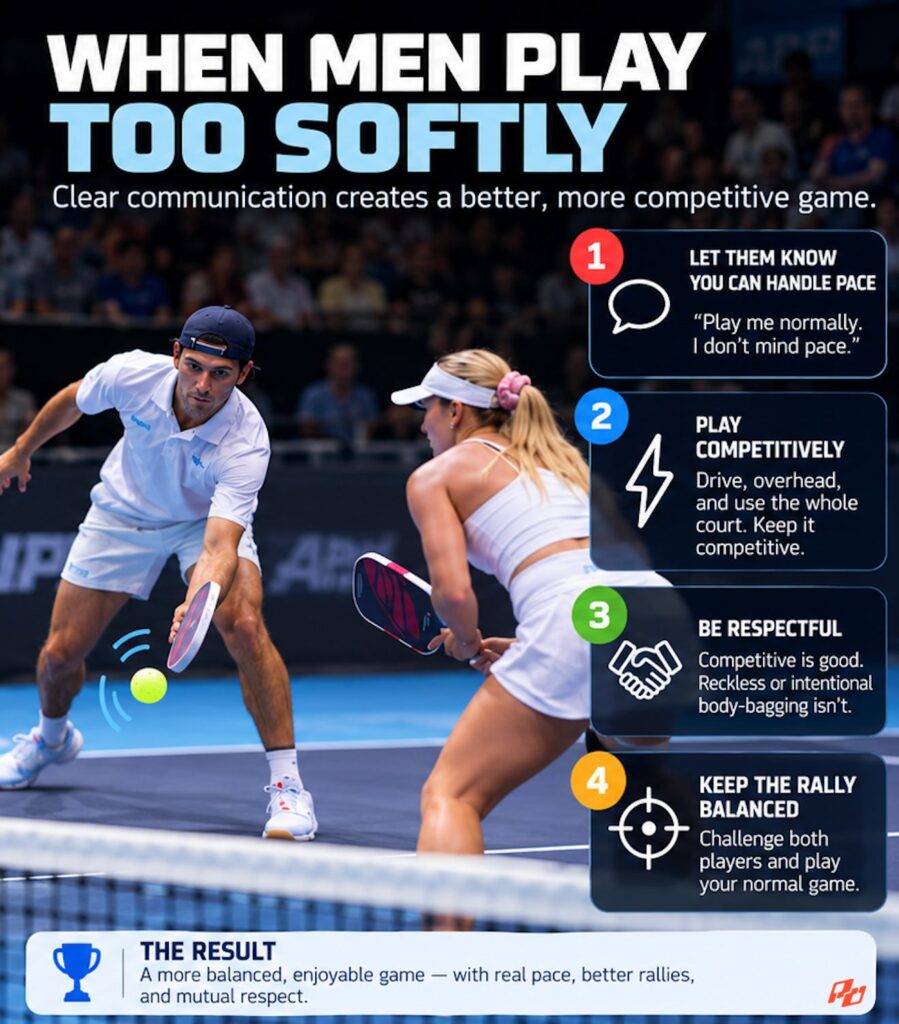
A number of male rec players say they hesitate to drive, overhead or body-target women because they worry it will be interpreted as rude. Some say they’ve received negative reactions after hitting perfectly legitimate hard shots at female opponents, so they start second-guessing how aggressively they’re “allowed” to play.
This produces a bizarre game.
One player wants to be taken seriously.
The other player is trying to be courteous.
Neither says anything.
Then both leave annoyed.
If you’re comfortable receiving normal competitive pace, there is nothing wrong with establishing that early: “Play me normally. I don’t mind pace.”
That sentence can remove ten minutes of weirdness.
Obviously, recreational etiquette still matters. Nobody needs to body-bag a beginner at maximum speed just because the rules allow it.
But being competitive and being reckless are different things.
Rec play is not a tournament
In a tournament, relentlessly targeting the player producing weaker balls is strategy.
At social open play, sending 40 consecutive balls to one person while the other person barely participates may technically help you win 11–6.
Congratulations.
You have optimized Tuesday morning.
Cilento explicitly distinguishes competitive targeting from recreational play and argues that rec games should remain more inclusive.
Some players accept hard targeting in DUPR leagues and tournaments but view extreme icing-out or refusing to participate normally in open play as poor etiquette.
Read the room.
There is nothing wrong with wanting a hard game. There is also nothing impressive about treating a social rotation like Championship Sunday.
What if men won’t play with you—or don’t try when they do?
This part is harder because there isn’t a tactical fix for every personality.
Women sometimes encounter partners who assume they’re weaker before seeing them play, poach too aggressively, offer unsolicited coaching, or even avoid partnering with them altogether.
That’s important.
Both experiences can be true. There is no evidence that every unpleasant mixed interaction is gender bias.
Skill snobbery exists.
Open-play cliques exist.
Somebody may simply be having a terrible game. And yes, gender assumptions also exist. Don’t spend six games performing a psychological autopsy on a stranger.
Use a more useful test: is this person giving me a normal competitive chance to play?
If yes, play.
If not, find better games.
Sometimes the best move isn’t fighting for acceptance—it’s finding a better format. A structured ladder with automatic partner rotation can make the games feel more equitable and more enjoyable.
That’s actually excellent advice.
Your pickleball ecosystem matters.
For older women, don’t try to win the power contest
Older women can get a double assumption: woman + age = target.
A 70-year-old player can still handle younger opponents without trying to overpower them.
Anticipation and placement can matter more than matching raw pace.
If you’re 55, 65 or 70, building your mixed game around matching a younger man’s drive speed is usually the wrong competition.
Build these instead:
✅ Compact block. Paddle out front, minimal swing.
✅ Reset. Make hard balls arrive soft.
✅ Depth. Especially on returns.
✅ Early positioning. Arrive before you need athletic rescue.
✅ Counter selection. Counter balls you can contact in front; reset the ones that jam you.
Power decreases in importance when the opponent’s power stops producing an advantage. That is how you become an irritating target.
Your mixed-doubles reality check
When you get hit 10 balls in a row, don’t ask: “Why are they picking on me?”
Ask: “What are they getting from this?”
A pop-up?
A weak backhand?
A rushed counter?
A predictable crosscourt dink?
Frustration?
Take that reward away. And when your partner starts covering too much court, don’t silently shrink. Clarify the geometry.
When somebody plays suspiciously soft against you, tell them they can play normally.
When somebody gives unsolicited coaching between every rally, you are allowed to say: “Thanks—I play better if we just talk strategy.”
And when an open-play environment repeatedly makes you miserable?
Find another one.
Because the most useful lesson from the research is not that women need to play more like men.
Quite the opposite.
The elite data showed almost identical unforced-error rates between women and men despite very different finishing profiles.
The better question is: how do you make the mixed-doubles structure work for your game rather than quietly accepting the role everybody expects you to play?
Sometimes that means resetting eight drives.
Sometimes it means owning the middle.
Sometimes it means letting your partner poach.
And sometimes it means taking the high forehand yourself and ending the point before he gets the chance.
That’s not making a statement. That’s just good mixed doubles.