Let’s be honest — pickleball stances have become the new paddle debate. Closed vs. open. Step vs. no step.
One looks powerful, the other looks relaxed, and both have their die-hard fans. But behind all the opinions, there’s a deeper story: how your stance actually changes what your serve can do — and how it sets up everything that comes after.
For intermediate rec players, this isn’t about reinventing your serve. It’s about understanding how a subtle change in foot position can affect timing, spin, depth, and consistency — and when it’s worth switching to (or from) an open stance.
The Old School Closed Stance: Power and Flow
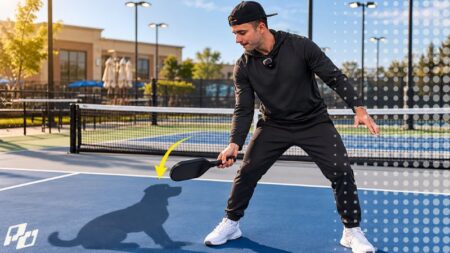
If you learned pickleball before 2023, chances are you started with a closed stance — that traditional step-forward motion, front foot pointed toward your target, back foot behind. You drop the ball, step into it, and drive through the contact.
It feels natural because it borrows from tennis and other rotational sports — the step gives you rhythm, weight transfer, and a bit of “oomph” through the ball.
For many players, especially those who value rhythm and smooth acceleration, the closed stance just feels right. You load your back hip, release your kinetic chain, and flow naturally into your recovery.
But it comes with one big tradeoff: time.
Why the Pros Started Opening Up
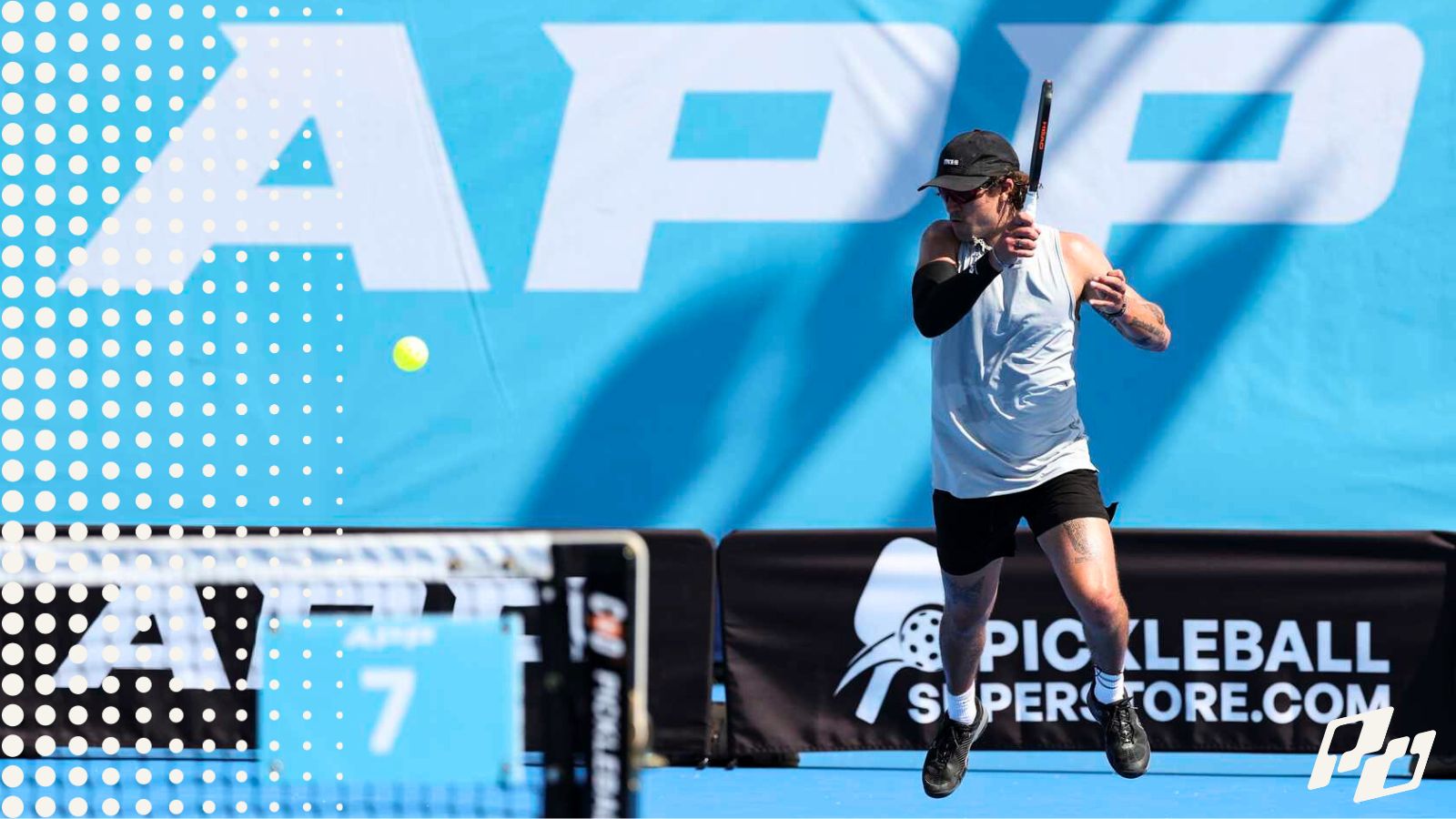
Enter the open stance serve — feet squared to the baseline, no step forward, body already facing the court.
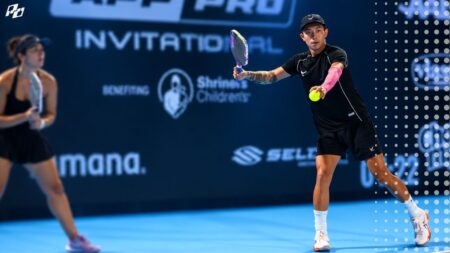
Ben and Collin Johns were among the first pros to openly switch to it, and not just because of style. The change came from necessity. With the new PPA rule requiring the ball to be dropped (not tossed) from hip height, players have less time to execute a full serve motion.
Collin Johns explained it perfectly: “Because of the new rule, you have to strike the ball relatively quickly.”
The open stance helps by pre-loading your hip rotation — instead of stepping, you’re already coiled. You don’t have to move your body forward; you just unwind. That fraction of a second saved makes the difference between hitting the ball at its peak and catching it too late.
What You Gain — and Lose — by Going Open
Here’s the surprising part: the open stance doesn’t necessarily mean less power. You can still generate pace if you know how to use your body. It just changes how you do it.
You gain:
- Speed of setup. You can serve faster, which matters under time-limited rules.
- Consistency. With fewer moving parts (no step), there’s less timing to mess up.
- Accuracy. Facing the target reduces directional errors.
- Immediate readiness. You finish your motion already balanced for the next shot — ideal for faster-paced doubles.
You lose:
- Some hip range and power potential. Without that forward step, you rely more on hip coil, shoulder rotation, and leg drive.
- Natural rhythm. The serve can feel rushed or “stiff” at first.
Collin Johns put it best: “You have to be a little more disciplined.” You can’t fake power with momentum; you have to build it from the ground up.
How to Actually Build Power in an Open Stance
Think of your serve as a mini jump shot — it’s all about energy transfer.
Instead of stepping, your legs and core do the work:
- Load the back hip by coiling slightly away from the target.
- Press into the ground with your outside leg (right leg for righties).
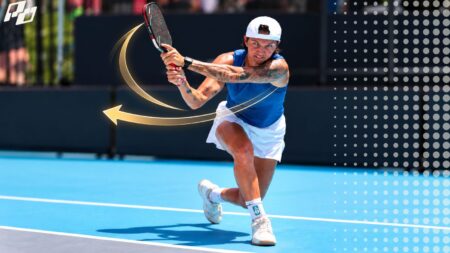
- Unwind through the hips first, then the shoulders, then the arm.
Your power doesn’t come from the swing — it comes from how well you sequence that energy.
One great analogy from coach Tyler Strife: “Push down on your outside leg, then explode off it — like you’re jumping, not stepping.”
That’s how you stay grounded yet explosive — especially when you add wrist motion and topspin.
@pickleballwithtyler 13 AMAZING Open Stance Pickleball Serve Tips🥒
♬ original sound – pickleballwithtyler
The Spin Advantage
Many players report they can create more topspin with the open stance — not because the stance itself magically adds spin, but because it forces better paddle path mechanics.
When you start square, you’re more likely to rotate through your torso and finish across your body. That motion naturally brushes up on the ball, creating a dipping, heavy serve that still lands deep.
A loose wrist helps even more. Tight grip = flat serve. Relaxed wrist = whip and lift.
One pro tip from the same lesson: “Show your butt cap.” When your paddle’s handle (the butt cap) points toward the target during the backswing, you’re setting up a perfect upward brush.
Control vs. Chaos
If you struggle with short serves or directional control, the open stance might actually save your serve.
With no step and your torso already squared, your motion simplifies — fewer moving parts, less variance. Your misses become consistent misses, which means they’re fixable.
It’s also a great confidence builder for anyone fighting the “yips.” You don’t have to coordinate a drop, a step, and a swing — just a drop and a hit.
The open stance is your “safety mode” when you need to reset your mechanics.
But Don’t Abandon the Closed Stance Yet
Here’s where nuance matters.
The open stance isn’t automatically better — it’s situationally better.
If your serve relies on rhythm, if you like to use your legs and flow through your shot, the closed stance still has huge value. That forward weight transfer lets you naturally hit deeper serves with less conscious effort.
And for older or less flexible players, it often feels more natural on the hips.
The real takeaway isn’t to switch camps — it’s to understand what each stance gives you.
Open = simplicity and speed.
Closed = rhythm and power.
A Personal Note: What Happened When I Tried It
When I switched to an open stance for a month, my first few sessions were ugly. I lost rhythm, felt robotic, and half my serves dropped short. But then something clicked: my accuracy jumped, and I could hit deep, heavy serves without overthinking.
It also made me more efficient — no wasted motion, no mistimed steps. I started feeling ready for the third shot sooner, balanced and centered.
It’s like tightening the focus on a camera lens. Less noise, more clarity.
Pro Takeaways for Intermediate Players
- Try the open stance if you struggle with timing. It simplifies the motion.
- Focus on hip coil and wrist looseness. That’s where your power and spin come from now.
- Alternate in drills. Hit 10 serves open, 10 closed. Track your accuracy and consistency.
- Commit to depth first. A deep, slow serve is more valuable than a flashy short one.
- Practice under match pressure. Real improvement comes when the score’s tight and your mechanics hold up.
It’s Not About Style — It’s About Sequence
The open stance isn’t a revolution — it’s an evolution. It’s about efficiency, timing, and being ready faster in today’s faster game.
Whether you step into your serve or stay square, the truth stays the same: the best stance is the one that lets you hit deep, with spin, and ready to dominate the rally that follows.
If you’ve plateaued with your serve, maybe it’s time to open things up — literally.