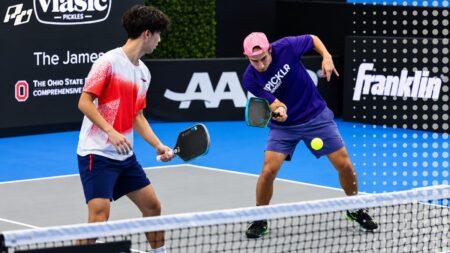
Walk into any open play and you’ll hear it: “He just bangs everything.” or “She refuses to dink.” Beneath the chatter lies a bigger issue for intermediates (3.0–4.0): not mechanics, but decision-making—choosing the right shot in real time.
What we’ve seen and heard on the courts is revealing. Players share what works, when it stops working, and how they’ve had to adapt.
The lessons are clear—and we can shape them into a practical, technical game plan you can put into play tomorrow.
The Pattern Everyone Eventually Discovers
“The natural progression here is: Beat people with drives → play better people → realize they can handle your drives and start to develop your soft game.” — 4.0 player
“Drive away. At some point that won’t work. Then adapt. Or adapt early because it will happen.” — 4.5 player
That’s the journey in two quotes. Power carries you early; soft skills carry you higher. But the point isn’t to pick a new religion—it’s to blend. As one poster distilled it:
“Drive if you can, dink if you must.”
This isn’t philosophy; it’s a conditional. The ball and your position decide.
A Clear, On-Court Rule: Let the Ball Call the Shot
Here’s the recognition model that aligns with what players keep saying (“placement over power,” “set up the 5th,” “don’t fight low balls”):
1) Ball Height
- High/attackable (waist–shoulder above net): Drive or punch to the feet, seam, or outside shoulder.
- Neutral (around net height): Roll with margin or place deep; look to create a pop-up.
- Low/at your feet: Reset or drop. Don’t fight gravity.
2) Your Position
- Set at NVZ: Punch or control-dink; finish on the kitchen line.
- In transition: Favor drops/resets; big swings are low percentage here.
- Pulled wide: Neutralize first. Regain center. Then choose.
3) Opponent’s State
- Rushed/off-balance: Apply pressure (drive/punch).
- Set/stable: Soften and move them. Force the miss or the sitter.
“You should really only dink if they force you to… But the aggression still needs to be there.” — Commenter responding to over-dinking at lower levels
“Placement over power on drives. High drives are either out or get smacked down at your feet.” — 5.0 player
The “5th-Ball Economy”: Why Your Third Shot Isn’t the Point
Multiple players described the third shot drive not as an end, but as a setup:
“You definitely need both. At higher levels you realize the drive is meant to set up an easier 5th… also placement over power.” — 5.0 player
Translation into practice:
- If the return sits up → 3rd shot drive at outside hip or backhand hip.
- Expect a block → 5th ball becomes your drop, roll, or put-away into the open hole.
- If the return is deep/low → 3rd shot drop; treat your first “win” as gaining the line, not hitting a winner.
Your third shot is a bid for time or pressure. Judge its success by what it creates next, not whether it ends the rally.
Technical Keys (That Scale Under Pressure)
Drives (when the ball earns it)
- Contact window: chest to low-shoulder; ball above net tape.
- Trajectory: chest-high rope into hip seam or feet; keep it out of strike-zone comfort.
- Feet under you: drive from a stable base; if you’re still moving forward, take 10% off.
Check out Coach Marko Grgić’s excellent tips for making your drives both consistent and aggressively effective:
Drops/Resets (when gravity wins)
- Paddle face: slightly open; shoulder-driven, quiet wrist.
- Contact on the decline of the bounce; don’t “help” a rising ball.
- Depth > fancy: a boring, net-high arc that lands short-middle beats a pretty miss.
Dinks (when everyone’s home)
- Purposeful patterns: pull them wide twice, then middle on 3; or middle-middle-outside. You’re choreographing a speed-up you can read.
- Height discipline: net-high with margin. Pop-ups come from footwork + patience, not razor-thin nets.
“Pickleball strategy is full of plateaus… Eventually you find an opponent where drives are neutralized (or counterproductive). You need to adapt.”
Identity Traps (Quotes You Can Feel)
“There’s an older generation taught PB was ‘all dinks’… and converts from tennis who think it’s all drives.
“Both matter. At higher levels, being able to handle power matters more than creating it.”
“Play what wins—until it doesn’t. Then add what’s missing.”
That’s the antidote to plateau: stop being a type and start being a problem-solver.
The challenge isn’t just individual—it’s magnified in doubles. Too many rallies collapse because partners aren’t on the same page about when to attack, when to soften, and when to reset. That’s where communication systems matter…
Partnership: Turning Two Different Styles into One Plan
- Declare roles by rally phase. Server partner owns third ball choice (drive/drop). Returner’s partner owns fourth ball positioning cue (“hold/close”).
- Pre-agree on speed-up triggers. Example: “If we lift them wide on the backhand, I’ll speed up at the shoulder on the next dink.”
- Language for transitions: “Green” (attackable), “Yellow” (build), “Red” (reset). One word beats a lecture mid-rally.
“It’s not winning or dinking. It’s setting up for the next shot.”
Pickleball Union’s Coach Marko Grgić shares a video breaking down one of the most underutilized tools in a player’s tactical toolbox: the Traffic Light Spectrum. It’s more than just a catchy idea—it’s a decision-making framework that helps you stop guessing and start choosing the right shot based on green, yellow, or red zones:
Drills That Map to Game Situations
1) Green-Yellow-Red Live Feed
Feeder varies height and depth randomly. Hitter must call the color before contact, then execute (drive/punch for green; roll/depth for yellow; drop/reset for red).
Goal: Recognition first, execution second.
2) 3→5 Progression (Drive-to-Drop)
Return feed sits up on 3rd → drive at outside hip → feeder blocks → hitter plays a 5th ball drop.
Goal: Treat the drive as a setup. Score the rep on the quality of the 5th.
3) Transition Box
Start two steps behind NVZ. Feeder lasers at shoelaces. Player must reset forward (not backward) three balls in a row before releasing a controlled punch.
Goal: Forward balance and low-ball compliance.
4) Patterned Dink to Read
Dink wide-wide-middle; on the middle, feeder gives either a float (green) or a dig (red). Hitter must speed up to shoulder on float or reset on dig.
Goal: Build a predictable read from your own pattern.
5) Film the First Contact
Record two games. Later, freeze every first touch of the ball on your side and label the right choice vs. the one you made. Count mismatches.
Goal: Reduce decision errors, not just stroke errors.
Measurement: How You’ll Know It’s Working
- Decision Error Rate: wrong shot for the ball (aimed high drive from a low feed, etc.). Track per game; aim to reduce by 30% over two weeks.
- 5th-Ball Quality: after an attacking 3rd, how often do you earn a neutral/defensive reply on the 5th? Target >60%.
- Neutral Win %: in dink rallies of ≥6 contacts, how often do you finish on top? Improving here usually correlates with rating jumps.
Stories That Mirror the Climb
“I was winning at 3.5 driving everything. At 4.0, people blocked me like crazy. When I started dropping thirds and punching fifths, the game slowed down—and I started winning again.”
“I hated dinking. Then someone said, ‘Drive if you can, dink if you must.’ Giving myself permission to attack when earned made learning the soft stuff tolerable—and effective.”
These examples capture the turning point every intermediate reaches. Power works—until it doesn’t.
Soft play feels tedious—until you realize it creates openings. The real leap isn’t picking a side—it’s weaving both into a toolkit you can trust under pressure.
A Few Non-Obvious Tips You’ll Use Tomorrow
- Aim drives down the outside hip of a two-hander. Their short lever struggles there.
- Speed up off your own pattern, not theirs. If your wide dink draws a reach, you already know where the next ball is going—pre-aim the punch.
- Switch to “depth mode” when you’re gassed. Tired players over-swing. Deep, boring balls buy oxygen and errors.
- Read the bounce, not the paddle. If the ball’s still rising, don’t force offense; if it’s falling in your window, now you can go.
My Closing Take
I’ll be honest—my game stalled for months at the 3.5 level because I thought I had to pick a side. Either I was a “driver” or I was a “dinker.” And each time I lost, I blamed the style instead of the choices.
The breakthrough came when I stopped labeling myself and started asking one simple question every rally: What’s the ball telling me to do? Some days that meant driving more, some days it meant resetting endlessly—but it always meant adapting.
That shift didn’t just win me more points, it made the game more fun. You stop feeling like you’re failing a “pickleball test” and start playing chess with a paddle. And once you do, rallies slow down, frustration fades, and you realize—you’re finally in control of the point.