If you’re a beginner, here’s the uncomfortable truth: Most missed serves aren’t about nerves.
They’re about mechanics you don’t realize you’re doing.
The good news? The serve is the one shot in pickleball you control completely before your opponent touches the ball.
No opponent. No pressure. Just you and the ball.
➡️ Let’s make it automatic.
Before we dive in, here’s something beginners often misunderstand: The serve in pickleball doesn’t need to be aggressive to be effective. At lower levels, consistency wins more points than power ever will.
A serve that goes in 95% of the time will beat a flashy serve that misses 30% of the time — every single match.
First: Why Your Serves Go Long
If your serves keep sailing out, here’s the most common reason:
👉 Your paddle face is open at contact. An open paddle face means it’s tilted upward.
Upward face = upward launch = long ball.
Most beginners don’t consciously “open” the face. It happens because the wrist relaxes backward or the player tries to lift the ball instead of driving through it.
Simple Fix:
Before contact, slightly tilt your paddle face down.
Not dramatically. Just enough so it’s not facing the sky.
When the face is slightly closed:
- You can brush up for topspin
- The ball dips instead of floats
- Long misses drop dramatically
Coaching cue: If your serve floats high and deep, check your paddle angle before anything else.
Extra clarification: If the ball is clearing the net by several feet, you’re not hitting too hard — you’re launching too high. Lower the launch angle first. Power adjustments come later.
The Rhythm Problem Most Beginners Don’t See
Another huge issue? Players hit the ball straight out of their hand. It looks rushed. It feels rushed. And it sprays everywhere.
When you contact the ball immediately after release:
- You have no rhythm
- Your backswing is cramped
- Timing becomes inconsistent
Beginners often think faster equals smoother. It doesn’t. Fast without structure equals chaotic.
Instead:
Release the ball slightly in front of you.
Let it drop.
Then swing through it smoothly.
Think: Release → drop → swing.
Not: Release → panic → slap.
Record yourself once. You’ll immediately see the difference.
Additional context: The serve is a timing sequence. If the ball drop varies, your contact varies. If your contact varies, your depth varies. Rhythm creates repeatability.
Your Contact Point Controls Everything
If you’re contacting the ball beside your hip or behind your body, you’re fighting physics.
Bad contact point = bad direction + no power.
When contact drifts backward:
- The paddle face opens
- You lose forward momentum
- The serve often floats or sails
The fix is simple:
Release the ball slightly in front of your lead foot (not directly beside or behind you).
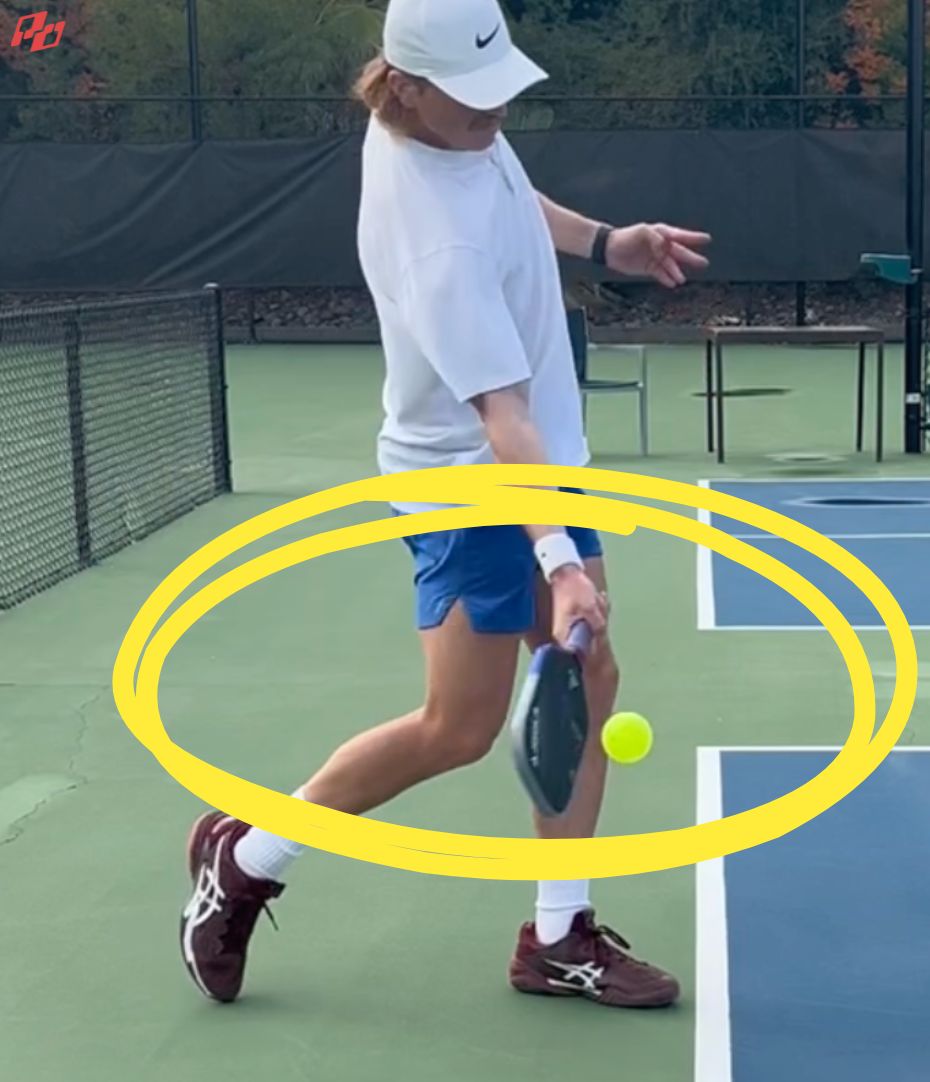
If you’re right-handed:
- Ball releases near your left foot
- Contact happens in front of your body
- Shoulders rotate naturally
When you hit in front:
- You’re stable
- You’re balanced
- You’re consistent
Beginner mistake: Standing sideways but contacting next to your body.
Upgrade: Move the release forward. Contact forward. Every time.
Clarification: Forward contact doesn’t mean lunging. It means your body weight is slightly moving toward the court at impact, not falling backward.
Stop Serving With Just Your Arm
This is huge. If your shoulders don’t rotate and your chest doesn’t face the target at the end of your serve…
You’re arm-serving. And arm-serving leads to:
- Tension
- Inconsistency
- Fatigue
- Yips
Many beginners confuse “swing harder” with “use more arm.” That’s backwards.
Real power comes from:
- Bent knees
- Back leg driving forward
- Hips rotating
- Chest finishing toward target
Watch good servers: They start sideways. They finish facing the court.
Power doesn’t come from swinging harder. It comes from rotating better.
Additional insight: When you rotate properly, your arm feels lighter. When you don’t rotate, your arm feels heavy and rushed. That’s a sign you’re forcing it.
The 10–20% Trick: Develop a Routine
Want an immediate boost in consistency? Create a serve routine. Every pro has one.
It might be:
- 2 bounces
- Paddle touch to ball
- Deep breath
- Same stance setup
But it’s the same every time.
👉 Why this matters: When you rush, you miss. Routine slows you down just enough to stay consistent.
Added perspective: Your routine isn’t superstition — it’s neurological preparation. It tells your brain, “We’ve done this before.” That reduces tension immediately.
Alignment: The “Sniper Scope” Trick
Where your lead foot points is where the ball wants to go.
If your foot is pointing crosscourt but you swing down the line… You’re fighting your own body.
Fix:
Point your lead toe exactly where you want the serve to land. Your:
- Hips align
- Shoulders align
- Swing path simplifies
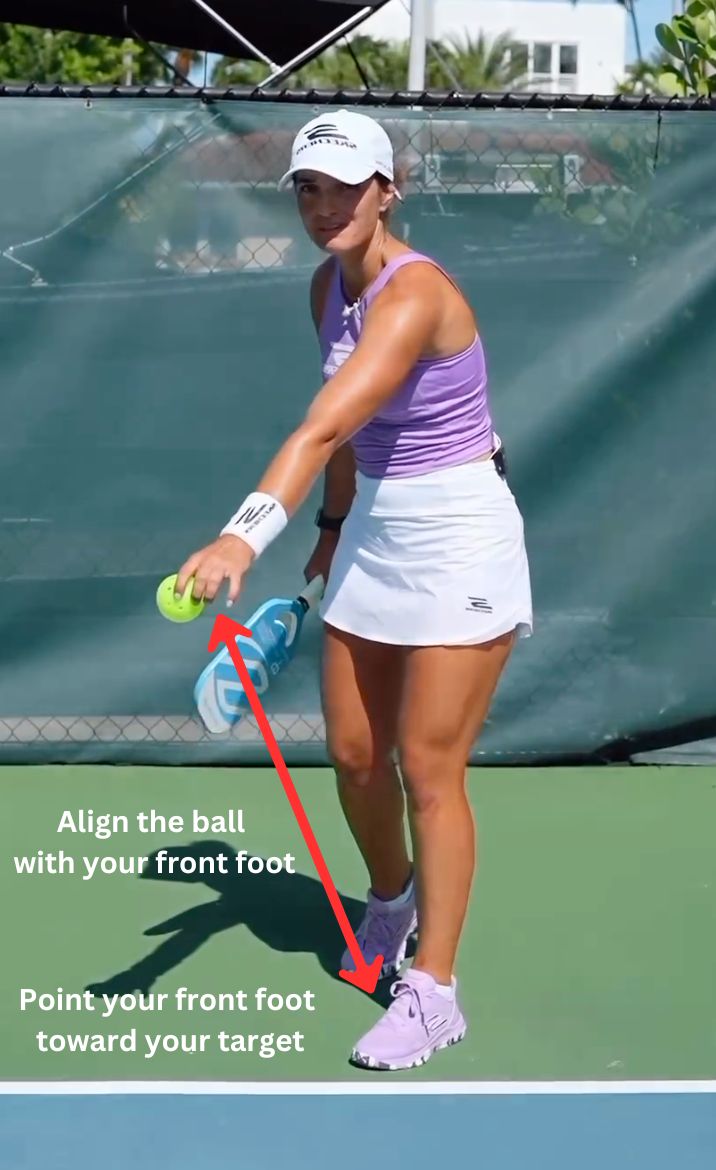
Direction becomes natural instead of forced.
Extra clarification: Alignment mistakes are subtle. Even a slight outward foot angle can cause consistent wide misses. Small adjustments here make big differences.
The “Hook” Mistake (Why Your Serve Keeps Going Wide)
Here’s what happens to a lot of beginners:
➡️ You set up correctly.
➡️ Your feet are aligned.
➡️ Your target is clear.
But then…
Instead of swinging straight back and straight through the ball, your paddle wraps around your body in a curved path.
It starts behind you… then comes around your hip in a loop. That curved swing path is the “hook.”
And here’s what it causes:
- Accidental side spin
- Balls drifting wide (especially crosscourt)
- Different contact points every serve
- Inconsistent direction
You may not even feel it happening — but the ball does.
What should happen instead?
Your paddle path should be simple and direct:
Back → Forward
Not around.
Think of your swing like it’s moving down a narrow hallway. If it swings in a circle, it’s hitting the walls.
Simple Fix
Keep the motion compact and linear:
- Paddle goes back on a straight line
- Paddle comes forward on that same line
- Finish toward your target
No wrap. No loop. No flair.
When you get nervous, your body wants to “do more.” That’s when extra motion sneaks in.
Depth Over Angles (This Is Big)
Beginners love trying to:
- Paint sidelines
- Hit extreme crosscourt
- Go for surprise angles
And they miss wide. Here’s the smarter priority:
1️⃣ Depth first
2️⃣ Direction second
If you aim deep middle:
- You can’t miss wide
- You pressure your opponent
- You play higher percentage pickleball
Depth alone wins points at beginner level.
Additional clarity: A deep serve forces your opponent to hit on the move or from a defensive position. A short serve invites aggression.
Here are some great tips on how to hit a deep serve:
The Recovery Nobody Talks About
You hit the serve. Now what?
Many beginners:
- Step into the court
- Watch the ball
- Forget to get back
If you drive forward with your serve (good), you must immediately recover behind the baseline.
Otherwise: You’re backpedaling on the return.
Simple rule: Serve → land → recover behind the baseline immediately.
If that’s too hard? Start serving slightly farther back.
Extra insight: The serve isn’t finished when you hit it. It’s finished when you’re ready for the return.
The Beginner Serve Blueprint (Save This)
Before every serve, check:
✔ Paddle face slightly closed
✔ Ball released in front
✔ Contact in front
✔ Knees bent
✔ Lead foot aimed at target
✔ Smooth rhythm
✔ Finish facing target
✔ Recover behind line
Misses drop dramatically when these are consistent.
Build a Serve You Can Trust
You don’t need more power. You need more control over the pieces that actually matter.
Most beginners miss and immediately think, “I need to hit it better.” What they really need is to hit it cleaner.
Here’s a bonus tip most beginners overlook:
Watch your contact point — not the ball flight.
If your eyes stay locked on where the paddle meets the ball, your consistency jumps immediately. Players who look up early to “see if it’s going in” often lift or pull the serve wide.
Think of your serve like a free throw in basketball:
👉 Same routine. Same rhythm. Same motion.
Once you build that repeatable pattern, you stop hoping the ball lands in. You expect it to. And that quiet confidence? That’s when your entire game starts to settle down.