
There are few feelings in rec doubles worse than this:
You hit what felt like a controlled reset…and somehow it floats just high enough for your opponent to crush it.
➡️ You weren’t trying to attack.
➡️ You weren’t swinging big.
➡️ And yet — there it is.
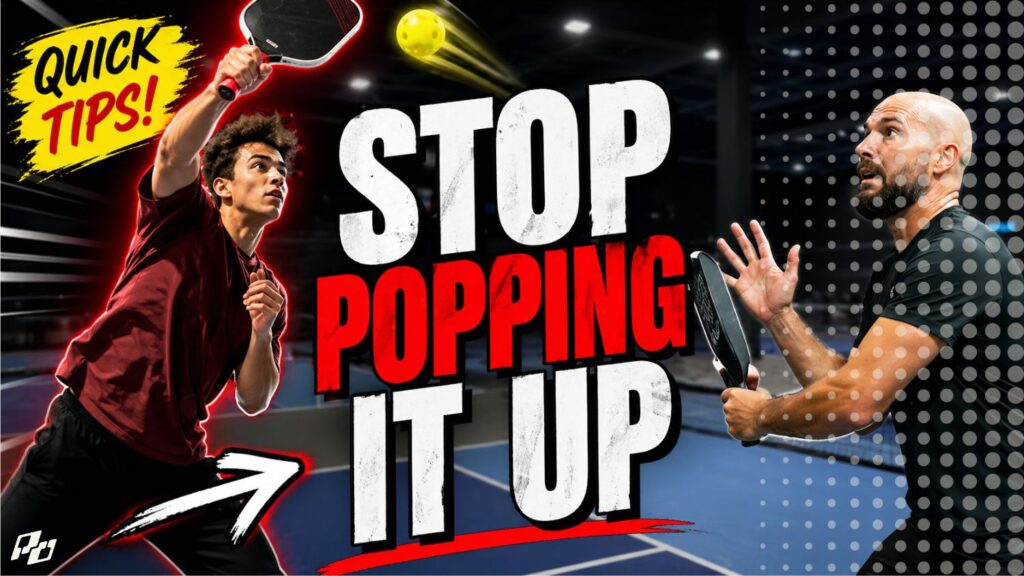
We recently filmed a session with our coach Marko Grgic on preventing pop-ups, and what stood out wasn’t a secret technique. It was how small mechanical leaks — the kind most rec players don’t notice — quietly turn neutral balls into attackable ones.
Pop-ups aren’t random. They show up when balance, grip, and timing drift just slightly off.
Let’s break down what’s really happening — and how to clean it up in real rec doubles.
Watch the Full Breakdown with Coach Marko Grgic
Before we go deeper, here’s the full video where Marko walks through the three core fixes that immediately reduce pop-ups:
In the video, he covers:
- Why contact location matters more than you think
- How grip pressure quietly adds lift
- Why early paddle prep buys you time
- And why drop shots should never have a backswing
Now let’s expand on those ideas and show you how to apply them in real doubles play.
1️⃣ Contact Between Your Feet — Why Reaching Lifts the Ball
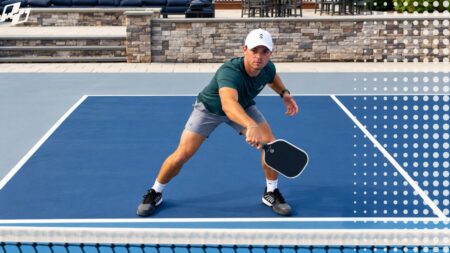
When Marko says, “Make contact between your feet,” he’s solving the most common pop-up trigger: reaching.
Think about when your resets float.
- It’s rarely when you’re perfectly set.
- It’s when the ball pulls you a little wide.
- Or jams your hip.
- Or dips just as you’re moving forward.
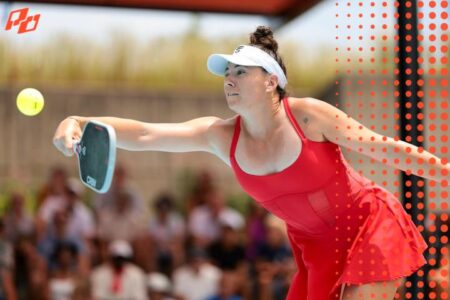
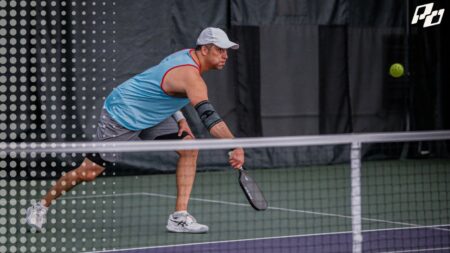
Instead of adjusting, most rec players freeze their feet and try to handle the ball with just their upper body. The problem is that when you reach, your shoulders tilt, your paddle face opens slightly, your weight shifts backward, and your swing path starts moving upward.
That small chain reaction is more than enough to send the ball a few inches higher — and a few inches is all your opponent needs.
When contact happens between your feet:
- Your head stays still.
- Your paddle face stays neutral.
- Your weight stays centered.
- Your swing path stays forward.
And forward is what keeps the ball down.
In real doubles, this shows up most in the transition zone. A six-inch adjustment step can be the difference between a clean reset and a shoulder-high putaway.
If you’re reaching, you’re probably lifting.
2️⃣ Grip Pressure — The Silent Multiplier
This one is sneaky. When rallies speed up, your grip tightens automatically. You don’t choose it. Your nervous system does.
And when grip tightens:
- The paddle rebounds more.
- The ball comes off hotter and less controlled.
- You lose absorption.
- And higher rebound speed often means higher launch.
Two identical swings with different grip pressure can produce completely different trajectories. That’s why the “confident handshake” cue works.
➡️ Not loose.
➡️ Not death grip.
➡️ Stable and calm.
If your forearm feels tense after a rally, your grip probably spiked — and that spike likely added loft.
In doubles, especially on resets, your job isn’t to hit the ball. It’s to absorb it.
3️⃣ You’re Not Rushed — You’re Late Preparing
Many rec players say they don’t have time. Usually, they have time — they just prepare too late. Watch what happens:
Opponent hits →
You track the ball →
You wait →
Then you move.
That delay creates panic. Instead, the moment the ball leaves their paddle:
- Set your paddle early.
- Decide forehand or backhand.
- Start adjusting your feet immediately.
Early preparation removes last-second jabs — and last-second jabs cause lift.
When you’re early, you guide. When you’re late, you scoop.
4️⃣ The Overswing Problem
Big swings create big variables. Especially on soft shots. On drops and resets, the paddle should live in front of your body. Forward and slightly up — not back and around.
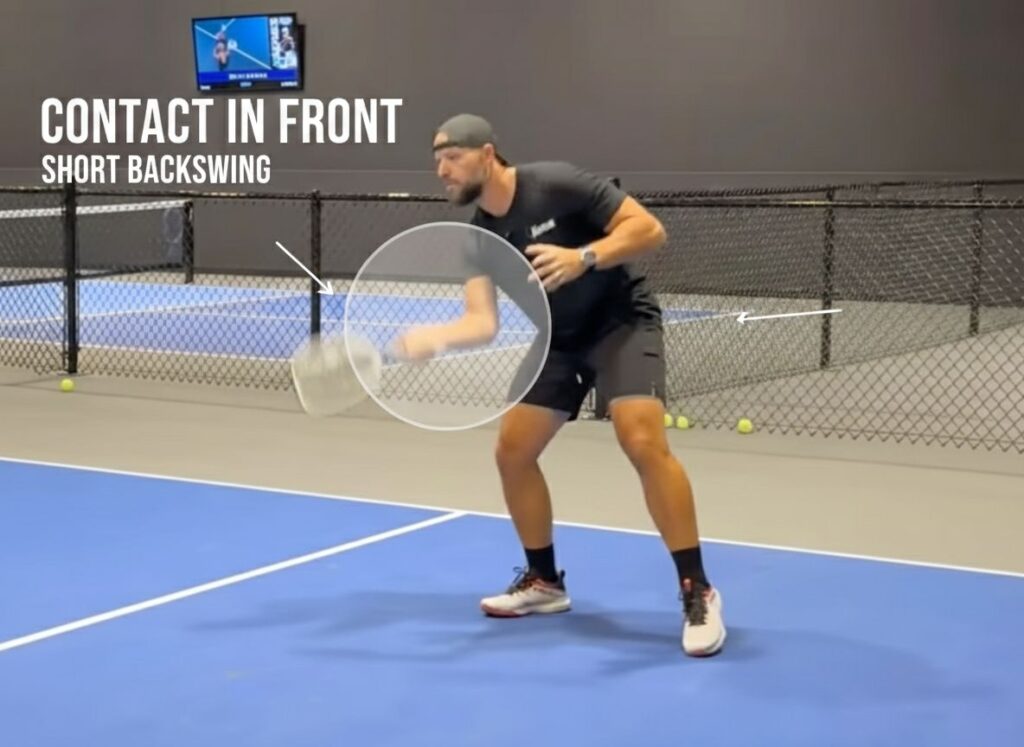
If your paddle travels behind your hip before coming forward, you’ve already increased launch angle.
💡A simple test: stand at the net and practice soft resets. If your paddle would hit the net during your swing path, it’s too big.
Compact swings protect trajectory. Large swings gamble it.
5️⃣ The Transition Zone Is the Danger Zone
Most pop-ups don’t happen at the kitchen line. They happen 3–7 feet behind it. Why? Because you’re:
- Moving.
- Unsure whether to drive or reset.
- Not fully balanced.
- Slightly tense.
Here’s a clean rule for rec doubles:
➡️ If you’re still moving forward or sideways, reset.
➡️ If you’re fully balanced and stopped, then decide.
Trying to attack while moving forward is one of the fastest ways to feed a putaway.
Pop-Up Patterns (Game Awareness Layer)
Let’s zoom out. Pop-ups aren’t evenly distributed. They happen in predictable patterns. Most common rec doubles pop-up scenarios:
- Resetting while drifting sideways.
- Dinking while backpedaling.
- Blocking a speed-up without paddle set.
- Changing direction while off-balance.
- Driving from mid-court while still moving forward.
Notice the theme?
Movement + indecision + tension.
When you recognize these patterns, you stop being surprised by them. Instead of thinking, “Why did I pop that up?” You think, “Ah — I was still moving.”
That awareness alone reduces errors.
A Different Way to Think About Pop-Ups
Here’s something most rec players don’t consider: pop-ups aren’t just technical errors. They’re emotional ones.
They usually happen when you feel pressure to do something — hit better, hit firmer, fix the rally, help your partner, stop the attack.
But doubles isn’t about solving the rally in one swing. It’s about extending it safely until the other team makes the mistake first. That’s a completely different mindset.
Instead of asking, “How do I hit a better shot here?”
Ask, “How do I make this ball unattackable?”
That small shift changes everything.