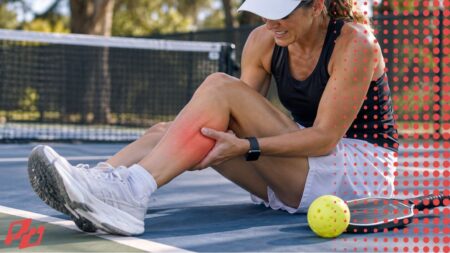
Pickleball players should choose drinks based on session length, heat, sweat, and energy needs. Water is usually enough for short play. Electrolyte powders help replace sodium without much sugar. Sports drinks make more sense for long, hot, or tournament sessions when players need both hydration and carbohydrate fuel.
Most pickleball players do not think about hydration until they are already cooked.
Game one feels fine.
Game two still feels normal.
Then somewhere around game four, the feet get heavier, the paddle feels a little slower, the patience disappears, and suddenly every third-shot drop looks like a personal attack.
So what do most rec players do? They grab whatever is in the bag, cooler, or pro shop fridge.
Sometimes it is water.
Sometimes it is a sports drink.
Sometimes it is an electrolyte powder.
Sometimes it is an energy drink pretending to be a hydration strategy.
And this is where things get confusing, because “hydration drink” has become a giant marketing bucket. A zero-sugar electrolyte packet, a full-sugar sports drink, coconut water, a caffeinated energy drink, and plain water are not doing the same job.
For pickleball players, especially rec players who play long open-play sessions, hot outdoor games, ladder leagues, or tournaments, the question is: What problem am I trying to solve today?
⮕ If you are mainly losing sodium and fluid through sweat, an electrolyte powder may make more sense.
⮕ If you are also running low on fuel during a long session, a sports drink may make more sense.
⮕ If you are playing a short indoor session and barely sweating, water may be plenty.
That is the practical difference.
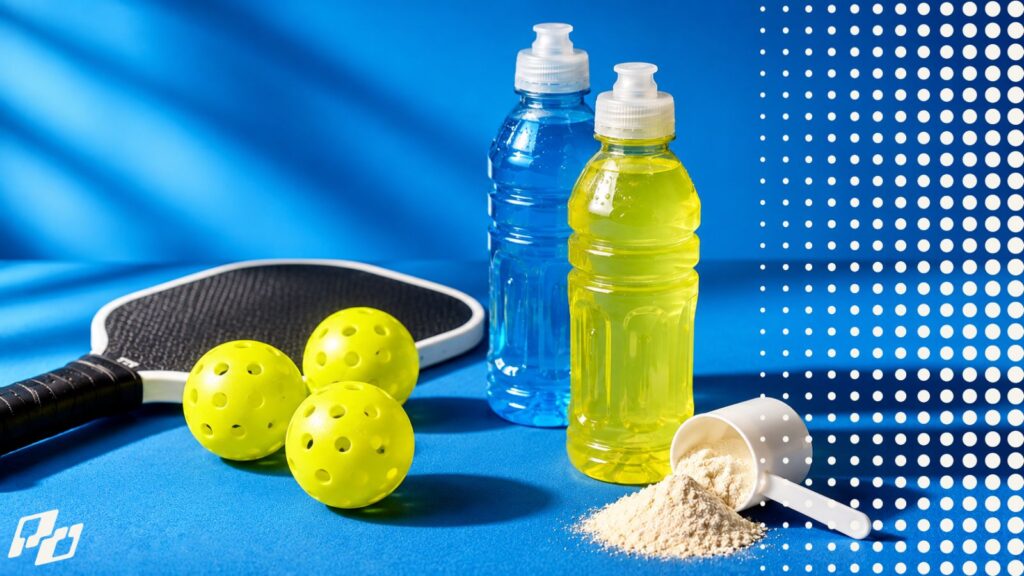
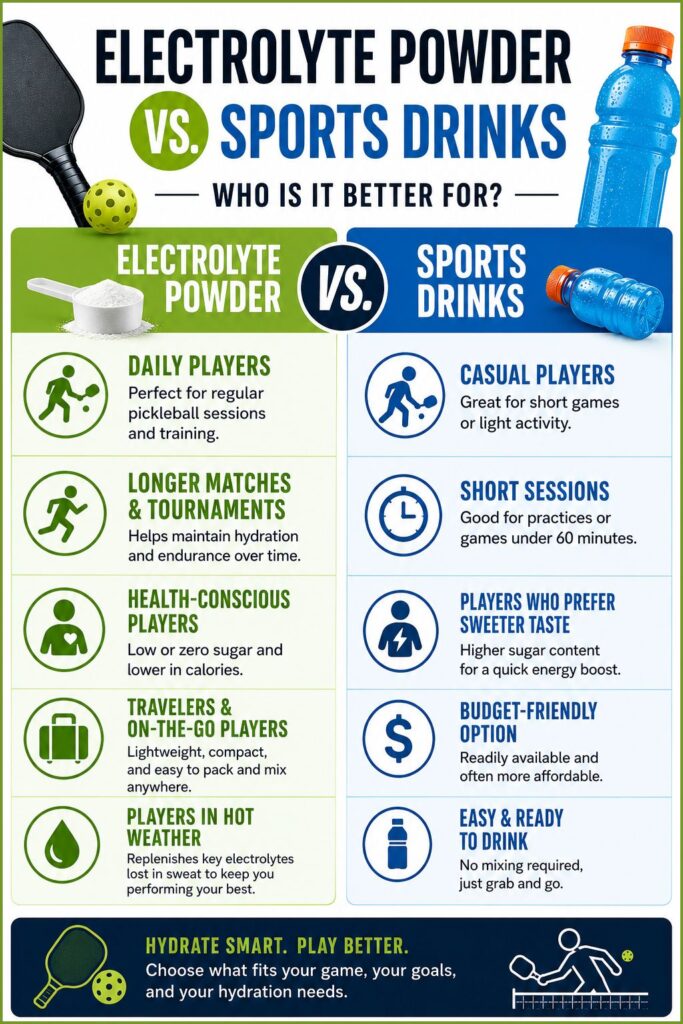
Electrolyte powders are usually about replacing minerals, especially sodium, without much sugar. Sports drinks are usually about replacing fluid, electrolytes, and carbohydrate at the same time.
Both can be useful. Both can be overused.
And neither one automatically makes you play better unless it matches the actual demands of your session.
Why Pickleball Hydration Is Sneakier Than People Think
Pickleball does not always feel like a “fueling sport” the way running, cycling, soccer, or tennis can.
You are not continuously moving for 90 minutes. You play a point, stop, retrieve the ball, talk, rotate courts, wait, then explode again.
That stop-start rhythm fools players.
Because the game has pauses, you may not realize how much total work you are doing. But a real open-play or tournament session can include dozens of short accelerations, lunges, split steps, lateral shuffles, hard stops, overheads, recovery steps, and kitchen exchanges.
And if you are playing outdoors in heat, the hydration cost can build quietly.
That is especially true for players who:
- play two or more hours
- play multiple days in a row
- play in humidity
- sweat heavily
- finish with salt marks on their shirt or hat
- cramp late in sessions
- get headaches after play
- feel sharp early but flat later
- or drink plenty of water and still feel depleted
That last one is important. Sometimes the problem is not simply “I need more water.”
Sometimes the problem is: I lost water and sodium, but only replaced the water.
Other times the problem is: I kept drinking electrolytes, but never gave my body enough carbohydrate to keep producing energy.
That is why the sports drink vs. electrolyte powder question matters. They are not interchangeable.
The Simple Difference: Electrolytes Replace, Sports Drinks Fuel
Here is the cleanest way to think about it.
Electrolyte powders help replace what you lose in sweat.
Most formulas include some combination of sodium, potassium, magnesium, calcium, and chloride. For pickleball, sodium is usually the big one because it is the main electrolyte lost in sweat and it helps your body hold onto fluid.
Sports drinks help replace what you lose in sweat and provide carbohydrate for energy.
That carbohydrate is usually sugar. That is not automatically bad. In the right situation, sugar is not just “empty calories.” During longer play, it can be fast fuel.
The mistake is treating sugar as always bad or always good. For a 45-minute casual indoor session, a sugary sports drink may be more than you need.
For a three-hour summer round robin, a full-sugar or moderate-carb sports drink may be exactly what keeps you from fading late.
That is the real difference.
⮕ Electrolyte powder is more like: keep fluid balance working.
⮕ Sports drink is more like: keep fluid balance and energy supply working.
Why Sodium Matters More Than Most Rec Players Realize
When people hear “electrolytes,” they often think of potassium or magnesium because those get marketed heavily. But for exercise hydration, sodium often matters most.
Sodium helps maintain fluid balance. It also helps with thirst, fluid retention, and replacing what you lose through sweat.
That does not mean everyone needs a massive sodium drink for every pickleball session. But it does mean heavy sweaters and hot-weather players should pay attention.
- A player who sweats lightly during a one-hour indoor game may do fine with water and normal meals.
- A player who sweats through shirts during two hours outdoors may need more sodium than they realize.
- A player who ends every session with white salt streaks on dark clothing is probably not in the same hydration category as someone who barely sweats.
This is where generic advice fails. Two players can play the same two-hour session and have very different needs.
⮕ One needs water.
⮕ One needs electrolytes.
⮕ One needs both electrolytes and carbs.
And one probably needs to stop chugging giant bottles and actually eat something.
The Sugar Question: Friend, Enemy, or Tool?
A lot of rec players look at sports drinks and immediately think: too much sugar. Sometimes they are right.
If you are sipping a full-sugar sports drink during a short, easy session, you may be adding calories you do not really need.
But sugar also has a purpose during longer or harder play.
Carbohydrate is the body’s preferred high-intensity fuel. Pickleball is not a marathon, but it does include repeated quick bursts. Those bursts depend partly on stored carbohydrate. Over long sessions, especially if you did not eat much before playing, energy availability can become a real issue.
That is when a sports drink can make sense.
Not because it is magical. Because it gives you fluid, sodium, and usable carbohydrate in one easy package.
The problem is that many rec players choose the drink based on taste or habit instead of session demand.
A better way to decide:
If you need hydration without much fuel, lean electrolyte powder.
If you need hydration plus fuel, lean sports drink.
That one distinction clears up a lot.
When Water Is Still Enough
Let’s not overcomplicate this. Water is still the best default for many pickleball sessions.
If you are playing indoors for an hour, not sweating much, and you ate normally before play, you probably do not need a specialized drink.
If you are playing a light social session with plenty of breaks, water may be enough.
If your total time on court is short and your shirt is barely damp, you probably do not need to turn hydration into a science project.
In those cases, the bigger issue is often not which drink you use. It is whether you showed up already hydrated and whether you are sipping consistently instead of ignoring your bottle until you feel awful.
But once the session gets longer, hotter, sweatier, or more competitive, the equation changes.
When Electrolyte Powders Make More Sense
Electrolyte powders are usually the better choice when your main issue is sweat loss, not fuel.
They make sense when you are playing in heat, sweating heavily, or doing a long but not necessarily exhausting session where you still plan to eat before or after.
They are also useful when you want sodium without a lot of sugar.
For many older rec players, this can be a sweet spot. You may not want a sugary drink every time you play, but you may still need more than plain water if you are sweating for two hours.
Electrolyte powders can also be easier to customize. You can mix them stronger or weaker depending on heat, sweat rate, and session length. You can carry packets in your bag. You can use one bottle with electrolytes and one bottle with plain water.
That flexibility is useful.
But there is a trap: some electrolyte powders are basically flavored water with tiny amounts of minerals. Others are much higher in sodium. The label matters.
For pickleball, a useful label target is roughly 300–700 mg of sodium per liter of fluid during longer, hotter, sweatier sessions. If you are mixing one packet into a standard 16–20 oz bottle, that usually means looking for about 150–350 mg of sodium per bottle as a practical starting range.
Light sweaters may be fine on the lower end. Heavy or salty sweaters — the players who finish with white salt marks on shirts, hats, or skin — may need the higher end, especially during long outdoor sessions.
If a product only has 50–100 mg of sodium per serving, it may taste good and still help you drink more, but it may not do much for serious sweat replacement.
Do not just look for the word “electrolytes.” Look at the actual sodium.
When Sports Drinks Make More Sense
Sports drinks make more sense when your session is long enough or intense enough that you need carbohydrate along with fluid and electrolytes.
That usually means:
- long open-play sessions
- tournaments
- back-to-back matches
- hot outdoor play
- very little time between games
- or sessions where you notice a late energy crash
The advantage of a sports drink is convenience. You do not have to separately manage water, sodium, and carbs. It gives you all three in one bottle.
That can be useful during tournament play, where you may not want to chew food between matches or risk stomach discomfort.
It can also help players who struggle to eat before morning play. If you show up under-fueled, a drink with carbohydrate may help more than a zero-sugar electrolyte packet.
But sports drinks are not automatically better.
They can be unnecessary for shorter sessions. They can add sugar you do not need. Some players also get stomach discomfort if they drink too much too quickly.
So read the label the same way you would with electrolyte powders.
For longer pickleball sessions, a useful sports drink target is roughly 300–700 mg of sodium per liter of fluid, similar to electrolyte guidance. For a typical 16–20 oz bottle, that often works out to about 150–350 mg of sodium as a practical starting range.
Then look at carbohydrates. Many traditional sports drinks land around 20–40 grams of carbs per bottle, depending on serving size. That can be useful during longer sessions or tournaments, but it may be more than you need for a short indoor game.
For players who only need light fuel, a lower-carb sports drink may be enough. For players in long, hot, back-to-back play, a regular sports drink with both sodium and carbs may make more sense.
Also check caffeine. Some drinks look like sports drinks but include caffeine or other stimulants. That changes the category. If it has caffeine, treat it as both a hydration/fuel choice and a stimulant choice.
The best use is targeted, not automatic.
Think of sports drinks as a tool for longer or harder play, not a default beverage for every casual game.
The Pickleball Session-Length Test
The easiest way to choose between water, electrolytes, and sports drinks is to start with one simple question:
How long — and how sweaty — is this session going to be?
A short indoor drill session and a three-hour outdoor round robin do not create the same hydration problem. So your drink strategy should change with the length, heat, intensity, and how much you personally sweat.
| Session Type | Best Starting Choice | Why |
|---|---|---|
| Under 60 minutes | Water | Usually enough for most players, especially indoors or in mild weather. |
| 60–90 minutes | Water or electrolytes | Water may be fine for light sweat. Electrolytes make more sense in heat, humidity, competitive play, or if you are a salty sweater. |
| 90 minutes–2 hours | Electrolytes, possibly plus carbs | Electrolytes help more as sweat loss builds. If your energy starts fading, add a sports drink or easy carb snack. |
| 2+ hours / tournament play | Fluid + sodium + carbs | Think in terms of a full system: water, electrolytes, and fuel. That could mean a sports drink or electrolyte powder plus food. |
The “Two-Bottle” Strategy I Like for Rec Players
For serious rec players, especially those playing outdoors, the simplest setup is often two bottles.
- Bottle one: plain water.
- Bottle two: electrolytes or sports drink, depending on the day.
This gives you options without overcommitting.
⮕ If the session is short, you mostly drink water.
⮕ If it gets hotter, you use more of the electrolyte bottle.
⮕ If you are in a long tournament or you know you tend to fade late, the second bottle can be a sports drink instead.
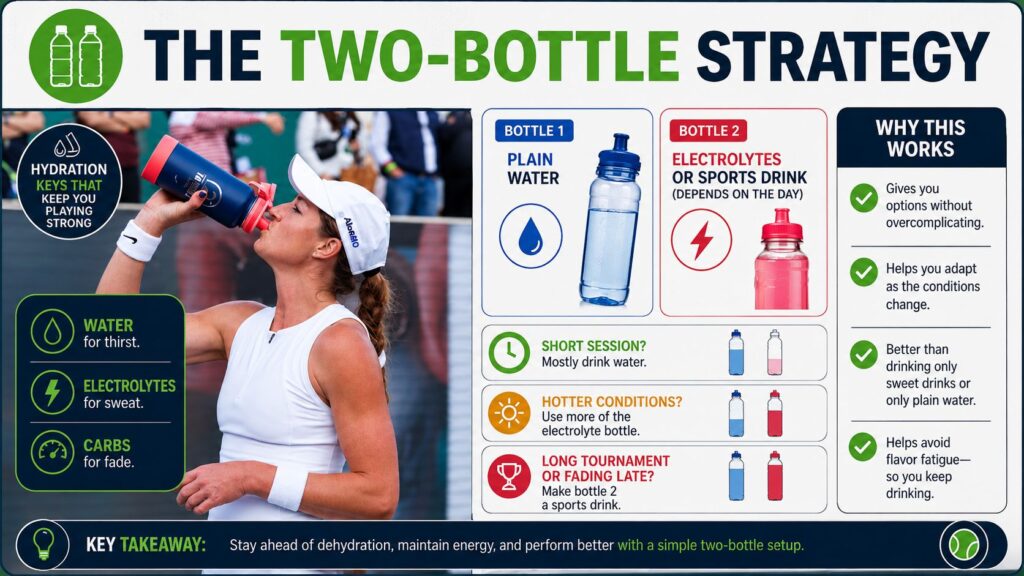
This is better than forcing yourself to drink only a sweet sports drink all session or only plain water when you are clearly sweating heavily.
It also helps avoid flavor fatigue. Some players drink less simply because they get tired of the taste. Having plain water available keeps you drinking.
A good cue: Water for thirst. Electrolytes for sweat. Carbs for fade.
That is simple, but it is not simplistic.
Electrolyte Powders vs. Sports Drinks: The Real Pickleball Comparison
| Situation | Better Choice | Why |
|---|---|---|
| Short indoor session | Water | Usually enough if you are not sweating heavily |
| Hot outdoor open play | Electrolyte powder | Replaces sodium without forcing extra sugar |
| Long tournament day | Sports drink or electrolytes plus carbs | You likely need both sodium and fuel |
| Heavy sweater with salt marks | Higher-sodium electrolyte powder | Sodium replacement matters more here |
| Player who crashes late | Sports drink or carb snack plus electrolytes | The issue may be fuel, not just hydration |
| Player watching sugar intake | Electrolyte powder | Easier to get sodium without much sugar |
| Player who struggles to eat before play | Sports drink | Convenient fluid, sodium, and carbohydrate |
| Casual social games | Water | No need to over-supplement |
| Back-to-back matches in heat | Sports drink or two-bottle strategy | Fluid, sodium, and carbs may all matter |
| Very hot/sweaty player | Electrolyte powder plus water | Allows more control over sodium and fluid |
What About Coconut Water?
Coconut water gets marketed as a natural sports drink, and it can be useful in some situations. It contains fluid and potassium, and some players like it because it feels lighter than a standard sports drink.
But for pickleball sweat replacement, coconut water may not be the complete answer because it is often lower in sodium than many sports-focused electrolyte products.
That matters because sodium is usually the electrolyte you lose most through sweat.
So coconut water can be fine as part of your routine, especially if you like it and tolerate it well. But if you are a salty sweater playing in heat, do not assume coconut water automatically replaces what you lost.
Natural does not always mean complete.
What About Energy Drinks?
Energy drinks are a different category. They are not the same as sports drinks, even though people often use them before play.
⮕ A sports drink is usually built around fluid, electrolytes, and carbohydrate.
⮕ An energy drink is usually built around caffeine and other stimulants.
That does not mean caffeine is useless. Some players feel sharper with a moderate amount of caffeine before play. But caffeine does not replace sodium. It does not replace sweat loss. It does not magically solve hydration.
And too much caffeine can be a problem in pickleball because the game requires touch, patience, soft hands, and decision-making under speed. If your “energy” drink makes you jittery, rushed, or tense at the kitchen, it may hurt more than it helps.
Energy drinks can also create issues for players sensitive to caffeine, players with blood pressure or heart concerns, and players who play later in the day and care about sleep.
So if you use caffeine, be honest about the effect.
- Did you play sharper?
- Or did you just play faster and dumber?
That is a real pickleball question.
The Older Rec Player Factor
Pickleball has a lot of players in their 50s, 60s, 70s, and beyond. That matters for hydration strategy.
As players age, heat tolerance, thirst cues, recovery, medications, and sweat response can all become more important. Some players do not feel thirsty until they are already behind. Others are on medications where fluid and electrolyte balance should be handled more carefully.
That does not mean every older player needs electrolyte powder every match. It means older players should be more intentional.
⮕ Do not wait until you feel depleted.
⮕ Do not experiment with a new drink on tournament day.
⮕ Do not assume what worked indoors in March will work outdoors in July.
And if you have kidney disease, heart disease, blood pressure issues, diabetes, or take medications that affect fluid balance, ask a healthcare professional before making high-sodium drinks or frequent electrolyte supplementation a habit.
That is not fearmongering. It is common sense.
The “Crash” Test: Hydration Problem or Fuel Problem?
One of the most useful distinctions for pickleball players is the difference between feeling thirsty and feeling flat.
If your mouth is dry, your sweat rate is high, your shirt is soaked, and you feel overheated, hydration and electrolytes may be the issue.
If your legs feel empty, your focus drops, your reactions slow, and you feel like you have no pop late in the session, fuel may also be part of the issue.
This is where zero-sugar electrolyte powders can be both helpful and incomplete. They may help you retain fluid and replace sodium, but they do not provide much energy.
If you play for three hours and only consume water plus zero-sugar electrolytes, you may still fade because you did not take in carbohydrate.
That does not mean you need a sports drink every time. You could use electrolyte powder plus food.
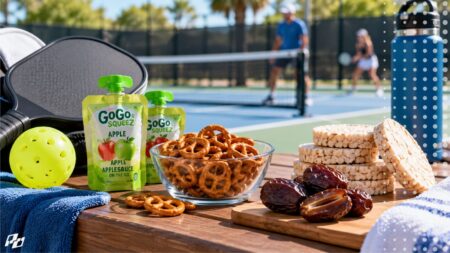
- A banana.
- A small granola bar.
- Pretzels.
- A few dates.
- Crackers.
- A simple carb snack between games.
The body does not care whether the carbohydrate came from a bottle or a snack. The practical question is what you tolerate and what fits the session.
A Smarter Tournament-Day Plan
Tournament days are where drink strategy matters most because you are dealing with heat, nerves, unpredictable match timing, and repeated bursts of effort.
The worst plan is to show up under-hydrated, drink nothing until you feel bad, then slam a random sports drink and hope it fixes everything.
A better plan starts earlier.
Before play, show up already hydrated and fed. You should not be trying to catch up during warmups.
During early matches, sip consistently. Do not wait until you are thirsty. If conditions are mild, water may be enough early. If it is hot or you are sweating heavily, include electrolytes sooner.
Between matches, decide what you need based on how you feel and how much you are sweating. If your energy is fine but you are sweating hard, electrolytes may be enough. If your legs feel flat and you have more matches coming, add carbs through a sports drink or snack.
After play, rehydrate and eat. Recovery is not just stretching and complaining about your partner’s missed returns. Replace fluid, sodium, and food so your body is not playing catch-up for the rest of the day.
Sip early. Salt when sweaty. Fuel before the fade.
The Biggest Mistakes Rec Players Make
The first mistake is using sports drinks for every session. If you are playing a short indoor game and barely sweating, you probably do not need the extra sugar.
The second mistake is using zero-sugar electrolytes for long sessions and ignoring fuel. Electrolytes may help hydration, but they do not replace carbohydrate.
The third mistake is choosing low-sodium products for high-sweat conditions. If sodium is the main electrolyte you are trying to replace, make sure the drink actually contains a meaningful amount.
The fourth mistake is drinking too much plain water during long, hot sessions without sodium. More water is not always better. The goal is balanced replacement.
The fifth mistake is copying someone else’s bottle. Your doubles partner may sweat differently, eat differently, tolerate caffeine differently, and play a different number of games.
The sixth mistake is trying something new on tournament day. Your stomach does not care that the label looked promising.
So Which One Makes More Sense?
For most rec players, the answer is not one or the other. It is situation-based.
Choose water when the session is short, mild, and low sweat.
Choose electrolyte powder when you are sweating enough that sodium replacement matters, but you do not need much extra fuel.
Choose a sports drink when the session is long, hot, intense, or tournament-style and you need carbohydrate along with fluid and electrolytes.
Choose electrolytes plus food when you want sodium replacement but prefer to get your carbs from snacks instead of a sugary drink.
Be careful with energy drinks because they are mainly a caffeine/stimulant tool, not a hydration strategy.
That is the real answer.
Not “sports drinks are bad.”
Not “electrolyte powders are better.”
Not “water fixes everything.”
The best pickleball drink is the one that matches the session.