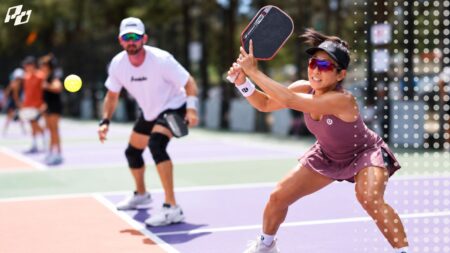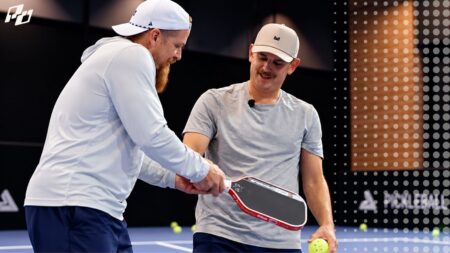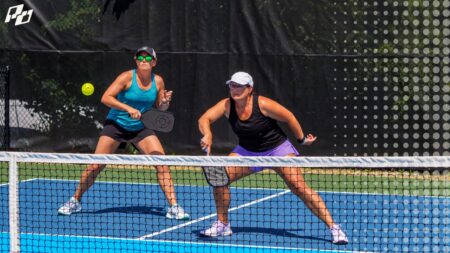

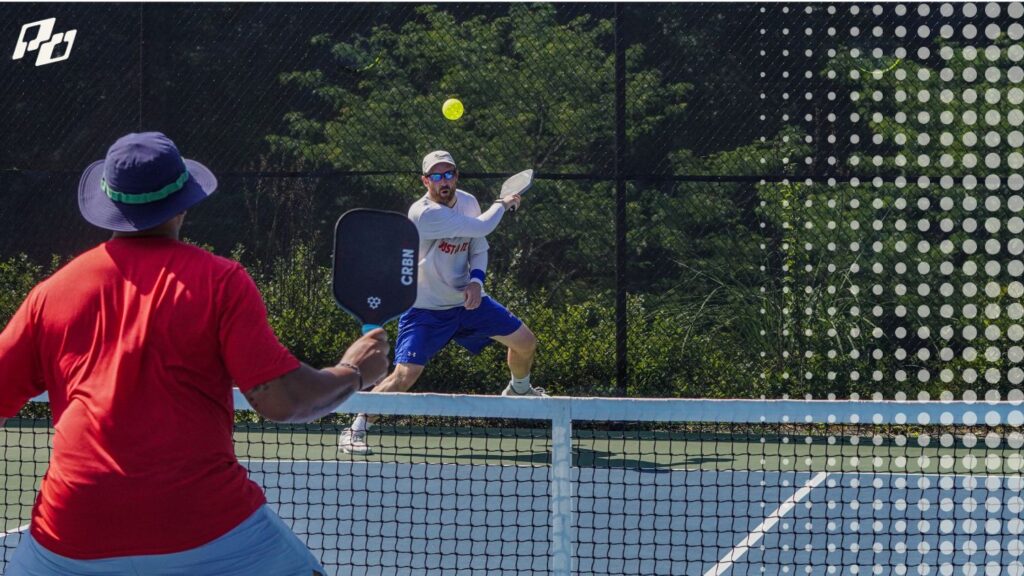
Forehand drives usually sail long because the paddle face is too open, contact is late, or the swing lifts without enough topspin. Create more space, meet the ball in front, swing forward and slightly upward, and aim several feet inside the baseline. Control the ball’s shape before adding more power.
A forehand drive that keeps flying past the baseline can feel like a power problem: Maybe I’m swinging too hard.
Sometimes you are. More often, though, the ball is going long because the paddle is sending too much energy forward and upward without enough spin, face control, or margin.
That distinction matters. Simply slowing down may put more balls in the court, but it can also leave you with a soft, attackable drive. The better solution is to keep useful speed while improving the shape of the ball.
A regulation pickleball court is only 44 feet long, and the net is 34 inches high at the center. From the baseline, a hard drive must clear the net and then come down within roughly 22 feet. That is a narrow flight window, which is why paddle angle, contact position and topspin matter so much.
Here are five keys that give your forehand drive pace without turning every aggressive swing into a baseline donation.
Key 1: Control the paddle face before adding more spin
When a drive goes long, players are often told to “brush up more.” That can help—but only if the paddle face is stable.
A paddle that is several degrees too open at contact launches the ball higher. Adding a steeper upward swing to that open face may produce some topspin, but it can also send the ball even farther before the spin has time to pull it down.
Think of ball flight as the result of two separate variables:
| Variable | What it mainly controls |
|---|---|
| Paddle-face angle | Initial launch direction |
| Swing path | Pace and spin direction |
Your paddle face does not need to point downward. It should feel nearly vertical or slightly closed, depending on your grip, incoming ball and contact height. The goal is to send the ball forward first, then let topspin bring it down.
How to find the correct face
Start with drives at about 60% pace. Aim three to five feet inside the baseline rather than at the line.
If the ball repeatedly flies long with little curve, close the face slightly. Make a small grip or wrist adjustment—not a dramatic downward chop.
If it dives into the net, do not immediately open the face. First check whether you are contacting too late or beginning the swing above the ball.
A useful cue is:
Show the paddle face to the target through contact—not to the sky.
Paddle angle is the direction the face points at the instant of contact, so a small change there can alter launch much more than a large, late follow-through adjustment.
Key 2: Create space so contact happens in front—not beside you
Many drives that sail long are actually spacing errors.
When the ball crowds your hip, your arm cannot travel freely through the hitting zone. You compensate by leaning back, opening the paddle face or flicking the wrist. All three can raise the launch angle.
Contacting too late creates a similar problem. Once the ball reaches the side of your body, it becomes difficult to send the paddle forward with a stable face. You often pull across the ball or push upward underneath it.
What “out in front” actually means
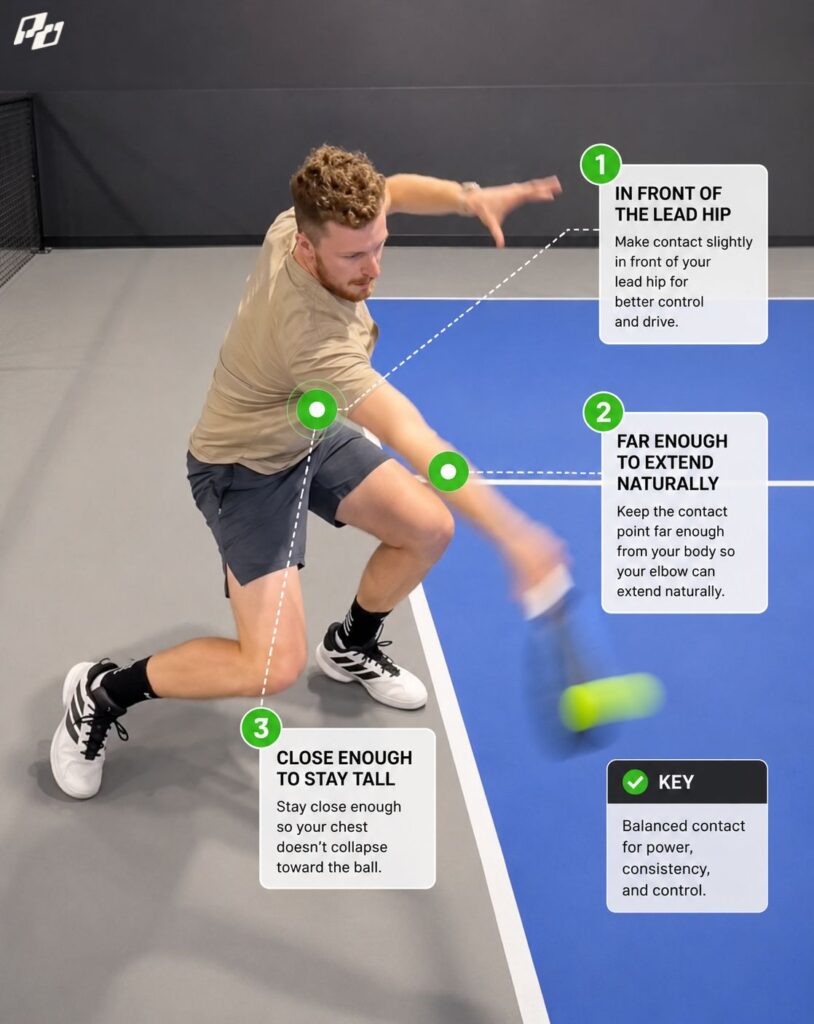
It does not mean reaching as far forward as possible. For a right-handed player, ideal contact is generally:
- in front of the lead hip;
- far enough from the body for the elbow to extend naturally;
- close enough that the chest does not collapse toward the ball.
You should feel as though there is room to swing through the contact point, rather than merely reach it.
Use your feet to create that room. On a ball moving toward your body, take a small adjustment step away from its path instead of trying to manufacture space with your arm.
Clear cue
Move your body away from the ball before moving the paddle toward it.
That cue is especially useful on deep returns that jam your forehand. Better spacing lets you maintain the intended face angle without last-second wrist corrections.
Key 3: Build a forward-and-upward swing—not an upward-only swing
Topspin is essential because it lets you send the ball with pace while still helping it dip back down into the court. The basic idea is simple: swing from low to high, use your legs to get beneath the ball, and let the paddle tip drop before contact so you can brush up through it.
But don’t learn it at full blast.
Start around 50–60% power so you can feel the spin-producing motion first. Once the shape is reliable, then add speed.
The common misunderstanding is that “low to high” means lifting steeply toward the sky.
That produces plenty of height but not necessarily a heavy drive. For an effective forehand, the paddle must also travel forward through the ball.
Picture the swing as a ramp, not an elevator:
| Swing shape | Typical result |
|---|---|
| Mostly upward | High, loopy ball that may sail |
| Mostly forward and flat | Fast ball with little dip |
| Forward with a moderate rise | Pace, net clearance and topspin |
The exact angle changes with ball height. A low contact requires more upward path. A waist-high ball allows more forward extension. A higher ball can be driven flatter because you already have clearance over the net.
Prepare below the ball, accelerate through contact and use a low-to-high component to create topspin rather than simply pushing the ball flat.
The feel to look for
Do not try to “wipe” only the back of the ball. That can create thin contact with spin but little penetration.
Instead, imagine hitting through the lower-middle portion of the ball and then continuing upward. You want solid compression plus brush.
@enhancepickleball Explanation ⬇️ To hit with heavy spin in pickleball, it’s not just about brushing the ball — you also need forward acceleration. The key is setting your wrist back and positioning your paddle at around a 45° angle. From there, your swing path should be upward and forward at the same time. Your wrist and elbow stay relaxed but stable — it’s your shoulder that drives the motion. That’s what creates the whip-like action needed to generate topspin with control. But technique isn’t the only factor. If you want effortless spin, your paddle surface matters too. The best paddles use a gritty T700 carbon fiber face that grips the ball like glue — and that’s what ours are made with. Use Code WHEEL for $20 off — same high-performance materials, way less expensive. #pickleball ♬ original sound – Enhance Pickleball
A helpful cue is:
Drive through three balls in a row, then finish over the fourth.
That image keeps the stroke moving toward the target while preserving the upward component needed for spin.
Key 4: Generate speed from rotation, not a late arm slap
When players try to keep a hard drive in, they often alternate between two bad solutions:
- swinging harder with the arm;
- steering the paddle slowly through contact.
The arm-heavy swing produces inconsistent face angles. The guided swing decelerates and makes timing harder. Neither gives you reliable control.
A better forehand uses a kinetic sequence: the legs stabilize, the hips and torso rotate, and the arm and paddle follow. Coaches describing advanced drives consistently emphasize balanced positioning, shoulder rotation and coordinated force rather than muscling the ball with the hand.
You do not need a huge body turn. Pickleball preparation should remain compact because the court is short and the ball arrives quickly. But you should feel your chest rotate from partly sideways toward the target.
Why this keeps the ball in
Body rotation gives you pace without forcing the paddle face to flip at the last moment. It also makes your contact window longer: the paddle travels on a repeatable path rather than being thrown abruptly at the ball.
Try this sequence:
Turn → load → contact → finish.
- Turn: Rotate the shoulders as you read the bounce.
- Load: Settle into the outside leg with your head level.
- Contact: Rotate through a stable base.
- Finish: Let the paddle decelerate naturally; do not force a dramatic wrap.
Your swing should feel smooth at first and fast at contact—not frantic from the beginning.
A useful speed limit
Train the drive at 60–70% until you can repeatedly land it inside a deep target zone. Then increase speed gradually.
Key 5: Aim with depth margin instead of trying to paint the baseline
A forehand drive does not need to land six inches from the baseline to be effective.
From the baseline, your opponents already have limited reaction time. A fast, dipping ball that lands three or four feet inside the court can still jam the body, force a low volley or create a short fourth shot.
Aiming directly at the baseline creates almost no tolerance for changes in:
- incoming depth;
- wind;
- ball temperature;
- paddle response;
- contact timing;
- the amount of topspin you produce on that particular swing.
Instead, give the shot a landing window.
Practical target zones
| Situation | Safer target |
|---|---|
| Crosscourt drive | Three to five feet inside the baseline |
| Down-the-line drive | Four to six feet inside the baseline |
| Return sits high and short | Attack through the body with extra depth margin |
| Return is deep or low | Reduce pace or choose a drop instead |
Crosscourt gives you more court length than down the line, but it also travels toward an opponent’s outside angle. The safer choice depends on your balance, contact height and target—not just the extra distance.
The tactical purpose of a third-shot drive is usually to pressure the receiving team and create a manageable next ball, not to hit a clean winner.
A drive that lands deep enough to force a defensive volley has done its job.
Diagnose the miss before changing everything
Use the flight of the ball as feedback:
| Ball flight | Likely cause | First adjustment |
|---|---|---|
| High and long with little dip | Open face or late contact | Create space and close the face slightly |
| Fast, flat and barely long | Too little topspin or target too deep | Add a modest upward path and more margin |
| Loopy and long | Too much lift, not enough forward extension | Swing more through the ball |
| Pulled wide and long | Contact crowded or too far behind | Adjust with the feet and meet it earlier |
| Alternates between net and long | Face angle changing through contact | Reduce wrist action and swing at 60% |
| Dips sharply into the net | Excessively closed face or thin brush | Contact more solidly through the ball |
Change one variable at a time. If you simultaneously alter your grip, stance, swing path and follow-through, you will not know what fixed—or damaged—the shot.
A compact drill that exposes the real problem
Place two markers three feet inside the baseline, creating a deep landing zone. Have a partner feed 20 forehands from the opposite baseline.
Hit the first five at 50%, the next five at 60%, then 70% and 80%.
Track two numbers at each speed:
- how many balls land in the target zone;
- how many clear the net by roughly two to four feet.
That second number matters. A drive that barely clears the tape may stay in during a cooperative drill but break down under pressure.
When your accuracy drops sharply at a certain speed, you have found your current technical limit. Train just below that speed until the ball shape remains stable, then build upward.
My Favorite Check: Watch the Ball After It Leaves Your Paddle
When I’m trying to fix a forehand drive, I don’t start by changing the swing. I start by watching the first half of the ball’s flight.
That tells you more than the final result.
If the ball launches high and stays high, the paddle face is probably too open. If it leaves low and flat but carries long, you may need more spin or a shorter target. If it starts on a good line and then suddenly dives, you may be brushing too much and driving through the ball too little.
That gives you a much better practice habit than simply saying, “I hit it long.”
On your next drilling session, call out the miss before the ball lands: High launch. Flat carry. Late contact. Too much lift.
That small habit forces you to read the ball instead of guessing at the cause. Over time, you will start correcting the drive during the session rather than waiting for someone else to tell you what went wrong.
That is when the forehand really becomes reliable: not when you stop missing entirely, but when you understand the miss quickly enough to fix the next ball.