A backhand attack down the line in pickleball can be a drive from the baseline or a speed-up at the kitchen. The shot works best when an opponent cheats toward the middle, is off balance, or leaves the outside lane open. Aim at least 2 feet inside the sideline, stay compact, and attack with purpose—not just power.
A good backhand attack down the line can change an entire doubles rally.
From the baseline or transition zone, it can punish a player who is crowding the middle and force a weak volley. From the kitchen, it can turn a neutral dink exchange into an immediate hands battle.
But those are not the same shot.
A backhand drive down the line is a groundstroke, usually hit from deeper in the court with a fuller swing.
A backhand speed-up down the line is a compact attack from the kitchen, usually taken off a dink or short bounce.
They share the same general direction, but the timing, technique, risk and tactical purpose are different.
The most important lesson is this:
“Down the line” is not one shot. It is an attacking lane you can use from different parts of the court.
What “Down the Line” Should Actually Mean
Many recreational players hear “down the line” and aim directly at the sideline. That is usually too aggressive.
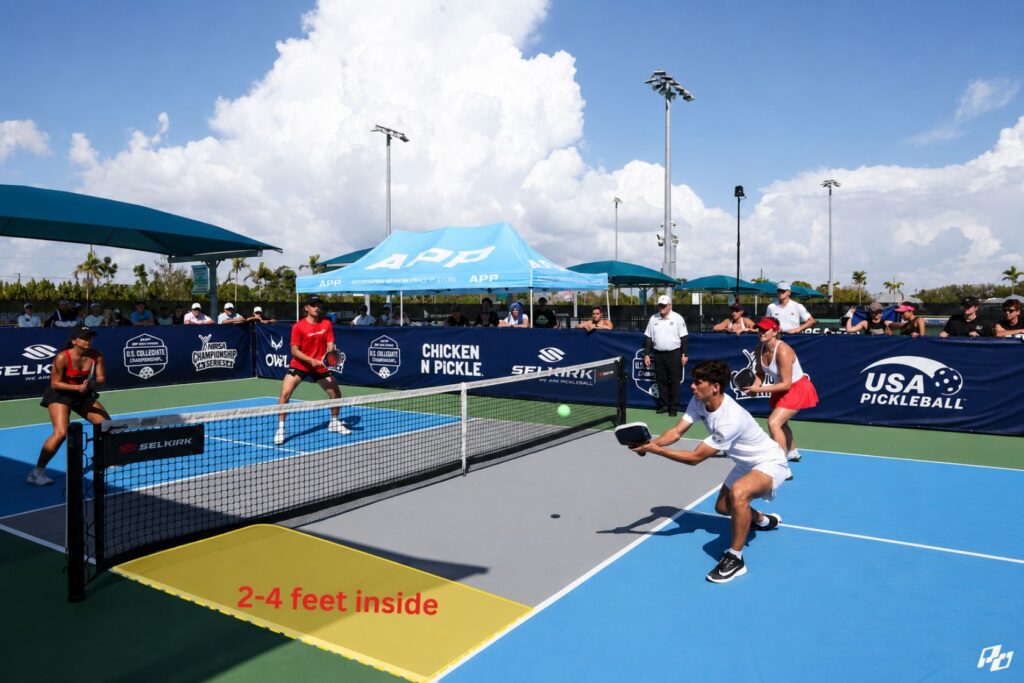
In doubles, your practical target should often be two to four feet inside the line. That still forces the opponent across from you to defend the outside lane, but it leaves margin for a slightly mistimed swing.
The same principle applies to both drives and speed-ups.
You are not trying to paint the line.
You are trying to attack the space between the opponent and the sideline, or jam the opponent on the outside hip.
Think:
Attack the lane, not the paint.
First, Know Which Backhand Attack You Are Hitting
Before discussing technique, separate the two shots.
⮕ The backhand drive down the line
This is usually hit:
- from the baseline;
- from the transition zone;
- on a third, fifth or neutral groundstroke;
- with a fuller swing and more forward momentum.
The goal is often to pressure the opponent, create a difficult volley or earn a more attackable next ball.
⮕ The backhand speed-up down the line
This is usually hit:
- from the kitchen line;
- during a dink exchange;
- off a ball that is slightly high, slow or predictable;
- with a short, deceptive motion.
The goal is to surprise the opponent, jam their paddle position or start a hands battle on favorable terms.
A drive uses more space and swing length.
A speed-up uses disguise, timing and compact acceleration.
Confusing the two often leads to poor mechanics. Players use a long baseline swing at the kitchen, or they poke at a baseline drive with no body involvement.
Why the Down-the-Line Lane Matters
Crosscourt remains the higher-margin direction in many situations. It offers more court, more net clearance and often a better recovery position.
The line, however, creates a different type of pressure.
It can:
✅ punish an opponent who is cheating toward the middle
✅ attack a weaker outside-side backhand
✅ stop an aggressive poacher
✅ surprise a player expecting a crosscourt ball
✅ force the opponent to defend without help from their partner
The value is not always in winning the rally immediately.
Sometimes the shot simply makes the opponent respect the sideline. Once that happens, the middle becomes easier to use.
When to Hit the Backhand Drive Down the Line
The drive is best when the ball and the opponent’s position create a natural lane.
1. When the opponent cheats toward the middle
This is the clearest opportunity.
If the player across from you is leaning toward the center or looking to poach, the outside lane may be open before you swing.
You do not need to hit a clean winner. A firm ball through the vacated space may be enough to stop that player from crowding the middle in future rallies.
2. When the ball pulls you wide
A ball that bounces toward your backhand sideline naturally creates a straighter path down the line.
From that position, you can drive through the outside lane without sharply changing the ball’s direction.
A useful cue is:
Wide ball, straight lane.
By contrast, a ball near the middle often makes the down-the-line backhand more difficult. You may have to pull the ball across your body, contact it late or aim too close to the sideline.
3. When the defender is still moving forward
A drive becomes more effective when the opponent across from you is not fully established at the kitchen.
A dipping ball at their feet can force a volley while moving or from below net height.
That is much more useful than blasting a waist-high ball at a balanced opponent who is already waiting.
4. When you can hit through a clear contact window
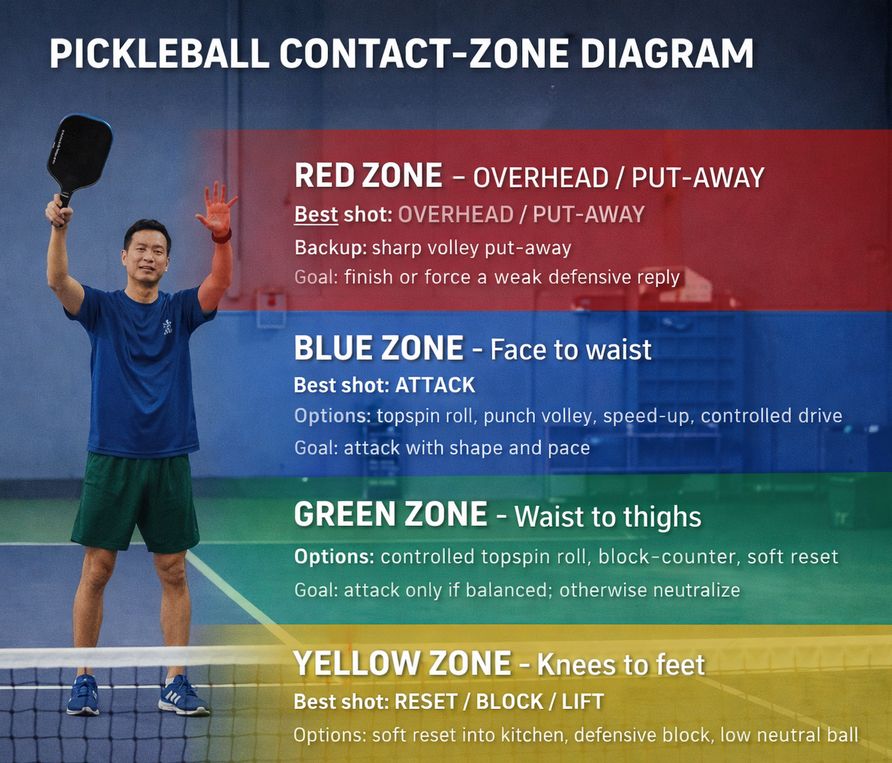
The best drive opportunities usually come from a ball at roughly knee-to-waist height with enough time to establish spacing.
If the ball is too low, too close to the body or behind you, forcing the line is rarely worth the risk.
How to Hit the Backhand Drive Down the Line
The drive requires space, early preparation and a swing path that travels through the target lane.
Create room before the bounce
Many backhand errors begin because the player gets too close to the ball.
When the bounce crowds your body, your paddle has nowhere to accelerate. You are forced to swipe across the ball or open the face late.
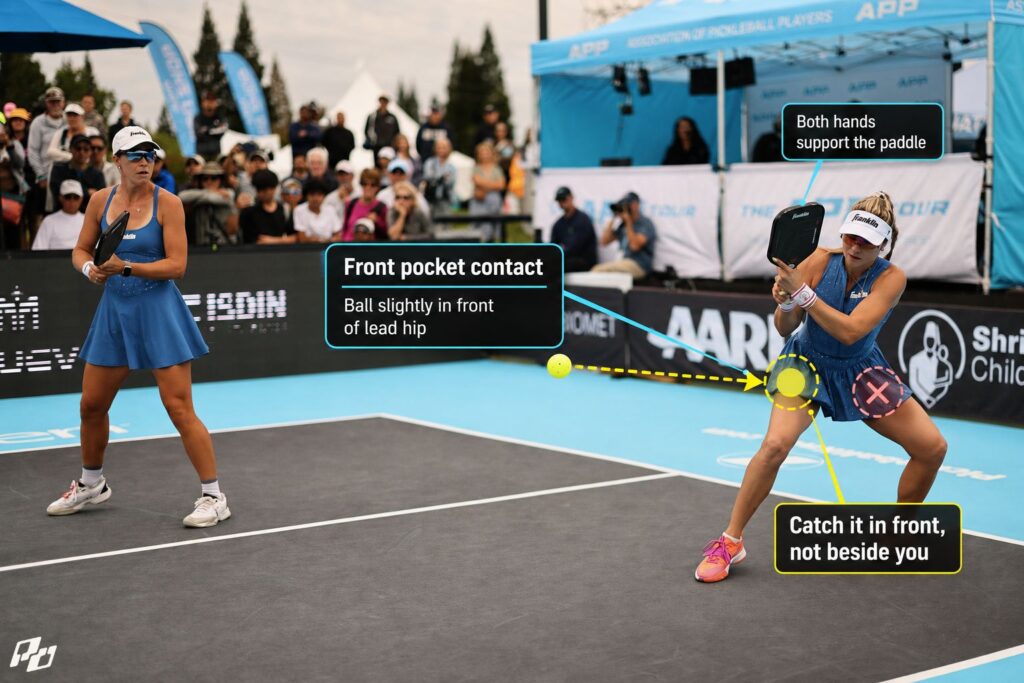
Turn early and adjust your feet so the contact point sits comfortably in front of your lead hip.
Your spacing cue is:
Give the paddle room to travel forward.
Contact in front
Late contact is especially costly down the line.
When the ball reaches your side or gets behind you, the paddle often opens and the swing starts moving across the body. The ball then floats wide or gets pulled into the middle.
Meet the ball before it reaches your hip.
Send the swing through a corridor
Do not steer the paddle toward the sideline at the final moment.
Imagine a corridor running from your contact point toward a target several feet inside the opponent’s sideline. Let the paddle travel through that corridor before finishing upward.
This keeps the direction more stable and reduces last-second wrist manipulation:
Drive forward, then add topspin
A useful drive needs penetration and shape.
Too much upward brushing produces a spinny ball that sits up. Too much flat forward force produces a ball with little margin over the net.
The feeling should be:
Forward through the ball, then up.
Topspin helps the ball clear the net and dip toward the opponent’s feet, but it should not replace forward extension.
One hand or two?
Both can work.
A two-handed backhand often provides more paddle stability, easier topspin and better control for players who can establish clean spacing.
A one-handed backhand provides more reach and may be useful when the ball pulls you wide.
For a right-handed two-hander, the left hand should provide much of the acceleration. The right hand supports and guides the paddle rather than dominating the swing.
❌ When Not to Hit the Backhand Drive Down the Line
Avoid forcing the drive when:
- you are falling backward
- the ball is below your knees
- contact will occur beside or behind your body
- the opponent in front of you is balanced and waiting
- the middle is open and provides a safer target
- your partner is out of position to cover the likely counter
A technically solid drive can still be a poor tactical choice.
If the opponent is set at the kitchen and your ball will arrive above net height, you may simply be giving them an easy counterattack.
When to Hit the Backhand Speed-Up Down the Line
The kitchen speed-up is more deceptive and more dependent on the opponent’s paddle position.
You should not speed up merely because the ball is on your backhand side.
You should speed up because the ball, the opponent and your contact position give you an advantage.
1. When the opponent’s paddle is protecting the middle
Many players at the kitchen hold their paddle toward the center because they expect a middle attack or crosscourt continuation.
That can leave the outside shoulder or hip exposed.
A compact backhand speed-up down the line can attack that gap before the opponent reorganizes.
2. When the dink sits slightly high
The ball does not need to be extremely high.
It does, however, need to be high enough that you can attack without lifting it steeply over the net.
A ball around net height or slightly above is the clearest opportunity. A lower ball can still be attacked with a roll, but the margin becomes smaller.
3. When the opponent is leaning or recovering
A speed-up becomes more effective when the player across from you is moving toward the middle, recovering from a wide dink or shifting their weight in the wrong direction.
You are attacking balance as much as open space.
4. When you have shown several crosscourt dinks
The down-the-line speed-up works best when it resembles your normal dink preparation.
If every ball from your backhand side goes crosscourt, the opponent starts leaning into that pattern.
The line attack becomes more dangerous because the same setup now produces a different outcome.
How to Hit the Backhand Speed-Up Down the Line
The kitchen speed-up must be compact. A large backswing gives away the attack and creates timing problems at close range.
Use the same preparation as your dink
This is one of the biggest keys.
Your paddle and body should initially look as though you are about to play another controlled backhand dink.
If you suddenly pull the paddle far behind your body, the opponent sees the attack early. Keep the preparation quiet. The acceleration should happen late.
Our friend and pickleball coach Will East shares a great tip on how to disguise your backhand speed-up down the line in this super-short video:
Keep the paddle in front
The paddle should stay in front of your body rather than wrapping around your hip. This keeps the contact compact and gives you a better chance of recovering for the next ball.
Remember, a good speed-up does not always end the rally. It often starts a hands exchange.
Your paddle needs to be ready again immediately.
Contact slightly in front
As with the drive, late contact tends to send the ball wide or across the middle.
Meet the ball in front of your body and let the paddle face control the direction.
Use a short forward-and-up motion
The speed-up is not a miniature full swing. The motion is shorter, with a compact push, roll or flick depending on the height of the ball.
From a lower contact point, use more upward shape to make the ball dip.
From a higher contact point, you can hit more directly through the target.
The cue is:
Short swing, late acceleration.
Aim at the body more often than the sideline
The clean sideline winner is tempting, but the opponent’s outside hip or backhand shoulder is usually a better target.
These body targets reduce your margin for error and can jam the opponent’s paddle.
In a fast kitchen exchange, creating an awkward contact is often more valuable than trying to pass the player completely.
The Difference in Swing Size
This is where many intermediate players get into trouble.
The drive uses:
- a larger shoulder turn;
- more weight transfer;
- more swing length;
- more time to generate speed.
The speed-up uses:
- little or no visible backswing;
- compact acceleration;
- disguise;
- immediate paddle recovery.
A useful comparison:
The drive builds speed over distance. The speed-up creates speed in a small space.
Trying to hit a speed-up with drive mechanics makes the attack obvious and slow to recover from.
Trying to hit a drive with speed-up mechanics usually produces a weak push.
Where to Aim With Each Shot
The best target depends on which attack you are using.
Drive targets
A drive is often most effective toward:
- the outside foot
- the backhand hip
- the open lane behind a poaching player
- the feet of a player moving through transition
The ideal drive usually dips, stretches or jams.
Speed-up targets
A speed-up is often best toward:
- the outside hip
- the paddle-side shoulder if the paddle is low
- the gap between the arm and torso
- the open sideline when the opponent is clearly leaning middle
At kitchen distance, attacking the body is often safer than chasing a clean passing lane.
Your Partner Must Read the Attack
Your partner’s role changes depending on which shot you hit.
After a drive, both players may have time to shift, stop and prepare for the next volley. The team should move forward only if the drive creates a weak or low reply.
After a speed-up, the next ball may arrive almost immediately. Your partner should already expect a counter through the middle or toward their body.
This is especially important when you speed up down the line. The opponent across from you may block or counter diagonally toward your partner.
A planned attack is much stronger than a surprise attack that also surprises your own teammate.
Common Drive Mistakes
⮕ The ball goes wide
This usually comes from late contact, an open paddle face, too much torso rotation, or aiming too close to the sideline.
Fix: Contact the ball farther in front and aim several feet inside the line.
⮕ The ball sits up
This often happens when you brush up too much, hit too softly, or leave the paddle face open.
Fix: Drive through the ball first, then let the paddle finish up.
⮕ The counter comes back harder
This may not be a swing problem. It may be a decision problem. You may have attacked a balanced opponent who could contact the ball above net height.
Fix: Use the drive when you can force low contact, attack movement, or hit into open space.
Common Speed-Up Mistakes
⮕ The opponent sees it early
This usually comes from a big backswing, a sudden grip change, or obvious body tension.
Fix: Make the setup look like a dink, then accelerate late.
⮕ The ball flies long
This often means the paddle face is too open, the contact point is too low, or the swing is too big.
Fix: Shorten the motion and use controlled forward-and-up acceleration.
⮕ The ball goes straight to their forehand
This is usually a targeting problem. You may be attacking the nearest part of the court instead of the weakest part of the opponent.
Fix: Aim for the outside hip, shoulder, or exposed lane.
⮕ You lose the hands battle
The speed-up may have been fine. The recovery wasn’t.
Fix: Keep the paddle in front and expect the ball to come back.
A Drill for Both Backhand Attacks
Use one drill with two starting positions.
Part 1: The drive
Place a target two to four feet inside the sideline and a few feet beyond the kitchen line. Have a partner feed backhands from the opposite side.
Hit three types of drives:
- controlled drive at 60 percent pace;
- topspin drive at 70 percent;
- firmer attack only on a higher ball.
Score the shot only if it lands in the outside lane and would force contact below waist height.
Part 2: The speed-up
Move both players to the kitchen. Begin with crosscourt backhand dinks.
The feeder occasionally sends a slightly higher ball or leans toward the middle. Attack only when you recognize one of those cues.
Aim first at the outside hip, not the sideline. After the speed-up, continue the rally so you are forced to recover for the counter.
This is essential. The shot is not complete until you are ready for the next ball.
The Final Decision
Before hitting either backhand attack down the line, ask three questions:
Is the lane available?
Is the ball attackable?
Am I prepared for the next shot?
From deeper in the court, use the drive when you have balance, spacing and a chance to pressure a moving or poorly positioned defender.
At the kitchen, use the speed-up when you can disguise the attack, exploit paddle position and recover quickly for the counter.
The direction may be the same.
The shot is not.
The best players understand which version the rally is asking for—and they do not force either one when the conditions are wrong.