
Aim a pickleball backhand flick based on the opponent’s ready position. If they sit backhand, target the outside forehand side. If they sit forehand, attack across the body toward the backhand hip. Against a scorpion-ready player, change pace, height, or spin and target below the prepared paddle.
A good backhand flick is not just a faster dink.
It is a pressure shot designed to make the opponent defend from an uncomfortable paddle position.
That distinction matters because many recreational players choose their flick target based only on open court. Better players also read the defender’s paddle. They look at which counter the opponent is preparing, then attack a zone that forces the paddle to move, flip, or change timing.
The simplest principle is:
Do not flick directly into the paddle position your opponent has already prepared.
If the opponent is sitting backhand, look outside that backhand preparation. If they are sitting forehand, make them bring the paddle back across the body. If they are sitting scorpion, avoid feeding the high body ball they are expecting.
The paddle position is a clue, not a command. Ball height, balance, spacing and partner coverage still determine whether you should speed up at all.
What Does “Sitting” on a Shot Mean?
When a player is “sitting” on a particular counter, they are shading their paddle and body toward the shot they expect.
They are not necessarily making a dramatic move. The adjustment may be only a few inches.
A right-handed opponent sitting backhand will often hold the paddle slightly toward their left side, with the backhand face ready to punch forward.
A player sitting forehand will shade the paddle toward their right side, preparing to counter with the forehand face.
A player sitting scorpion will usually lower their body and prepare a forehand-oriented paddle face high and in front, expecting a speed-up toward the chest, shoulders or face.
Each position protects one area while making another movement slower.
Your goal is to attack the movement the opponent has not prepared.
When the Opponent Sits Backhand: Flick Toward the Outside Forehand Side
For a right-handed opponent, a backhand-ready position usually places the paddle slightly left of center.
That is a strong position for handling balls through the middle, chest or backhand hip. If you flick directly into that zone, you may be giving the opponent the counter they want.
A better option is often a backhand flick down the line toward the opponent’s outside forehand hip or shoulder.
This forces the defender to move the paddle away from the loaded backhand position. They may need to:
- flip from the backhand face to the forehand face
- move the hand farther outside the body
- open the elbow
- defend closer to the sideline
The tactical advantage does not come only from the direction. It comes from making the opponent change paddle positions while the ball is already moving toward them.
⮕ What the hitter’s paddle should do
When you hit the backhand flick down the line, the swing should remain compact. Do not pull the paddle sharply across your body. That usually sends the ball crosscourt or creates a late, wristy contact.
Instead:
- create space between your elbow and torso
- keep the paddle head below or slightly behind the ball
- brush up and forward
- direct the paddle path more toward the line
- finish compactly rather than wrapping across the body
For many players, down-the-line direction comes from a slightly later contact point and a more forward paddle path.
Not late enough to become jammed—just slightly later than the contact used to send the ball sharply crosscourt.
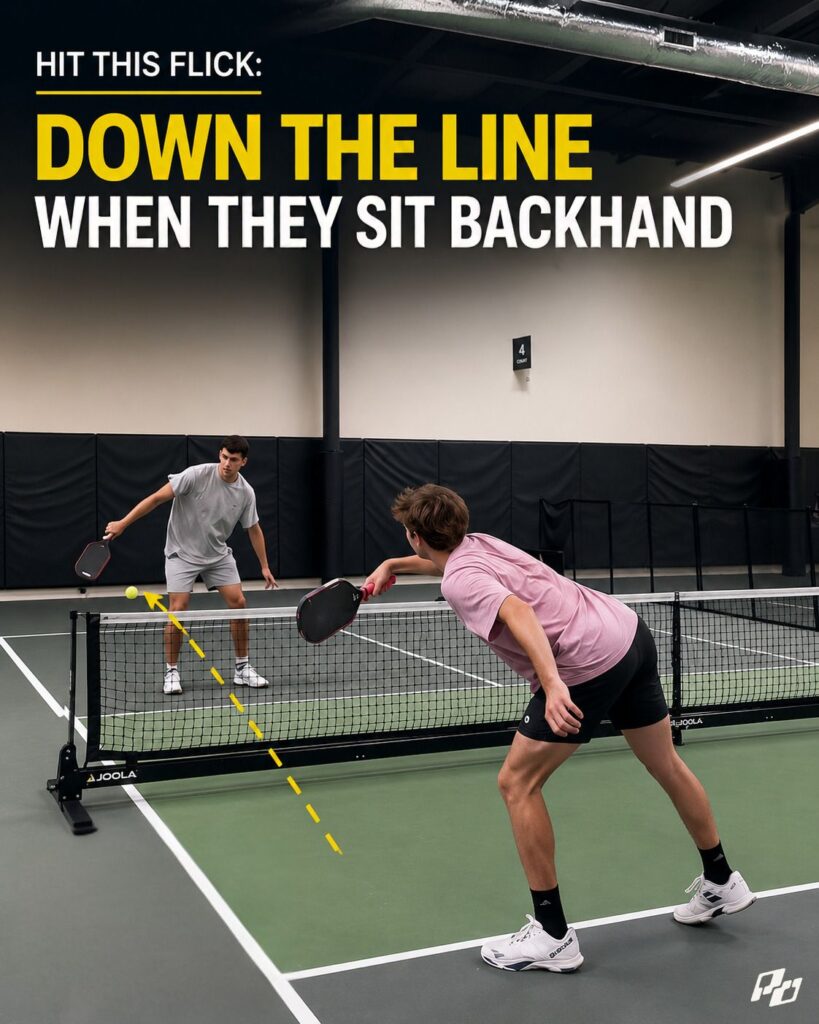
A useful cue is:
Backhand loaded, flick outside.
Do not aim for the sideline itself. Aim through the outside hip or a foot or two inside the line. That gives you margin while still forcing the forehand-side movement.
When the Opponent Sits Forehand: Attack Across the Body
A right-handed opponent sitting forehand will usually shade the paddle toward their right side.
If you flick directly toward that prepared forehand face, they may be able to counter aggressively without changing their paddle position.
The more useful target is often the backhand-side hip, rib area or shoulder seam. This forces the opponent to bring the paddle back across the torso or make a late switch to the backhand.
That is what “crossbody” should mean in this context.
It does not always mean hitting sharply crosscourt. It means sending the ball across the defender’s body, away from the paddle face they have already loaded.
Depending on your court position, that ball may travel diagonally, through the middle, or almost straight ahead.
The target is defined by the opponent’s body—not simply by the court.
⮕ What the hitter’s paddle should do
To send a backhand flick across the opponent’s body, the paddle path will usually travel slightly more across your own body than it would on a down-the-line flick.
However, the movement should still be compact. Avoid rolling the wrist or making a large sideways sweep.
Instead:
- contact the ball slightly farther in front
- brush up the back and outside of the ball
- let the paddle travel forward and slightly across
- keep the shoulders quiet
- recover the paddle immediately after contact
Earlier contact generally makes it easier to send the ball on a sharper crossbody angle.
Later contact generally favors the down-the-line path.
The difference should be subtle. If the swings look completely different, the opponent will read the target too early.
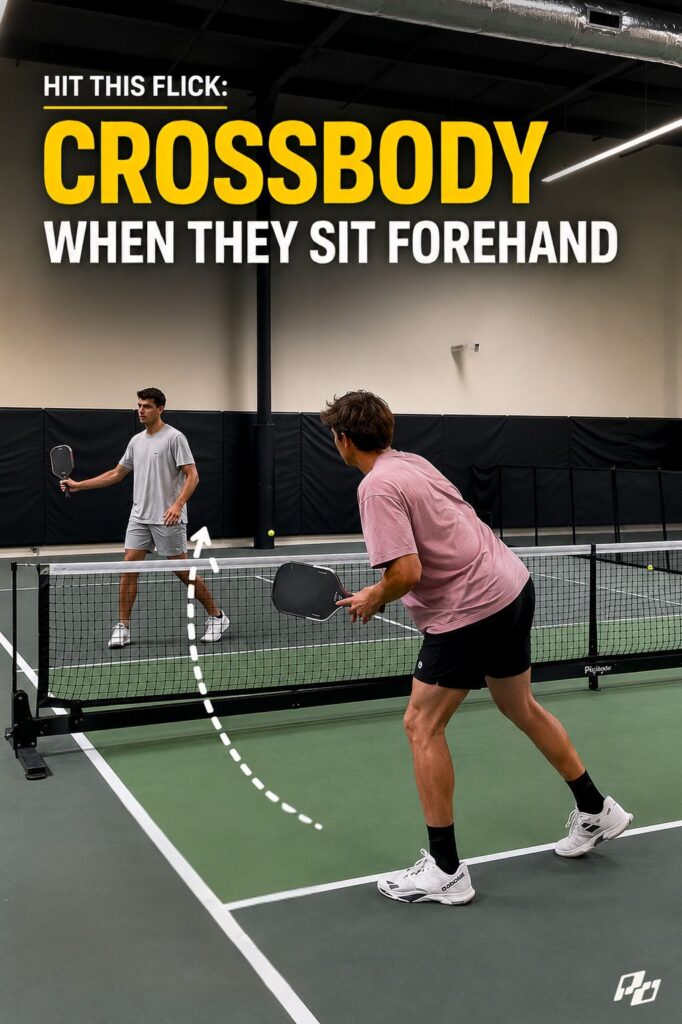
A useful cue is:
Forehand loaded, make it cross the body.
The best target is often the seam between the opponent’s forehand and backhand, not the center of either stroke.
That seam creates indecision. The defender may start with the forehand, realize the ball is crossing too far, and then attempt a late backhand.
When the Opponent Sits Scorpion: Change Pace, Height or Spin
A player sitting scorpion is preparing for a high body speed-up. They usually lower their stance and position the paddle high and in front, often with the forehand face ready to punch downward.
This setup can be very effective against attacks toward the chest, shoulders and face. That means a hard, flat flick into the upper body may be exactly what the opponent wants.
A better response is often to change one of three things:
- pace
- height
- spin
An off-pace topspin flick can be effective because it arrives differently from the hard body attack the defender is timing.
The goal is not to hit a weak ball.
It is to make the ball dip below the scorpion strike zone or arrive without enough incoming pace for the opponent to redirect easily.
Useful targets include:
- the paddle-side hip
- the outside knee
- the forehand foot
- the lower body below the prepared paddle
Think of hitting at roughly 60 to 75 percent pace with shape rather than hitting flat at maximum speed.
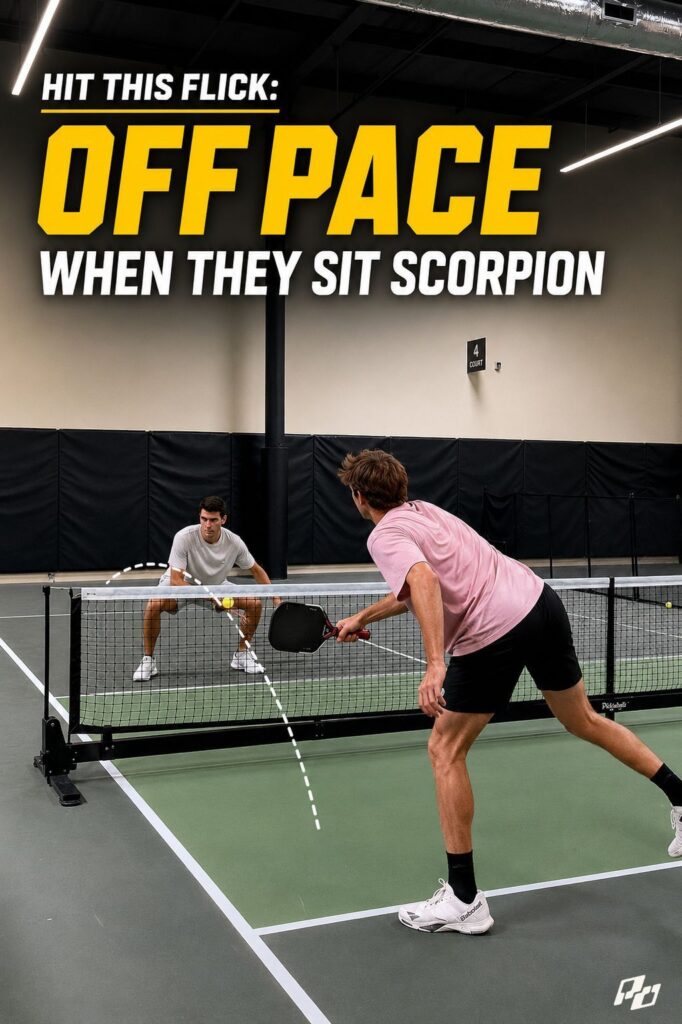
A useful cue is:
Scorpion high, make the ball dip low.
Taking pace off is not the only answer. A well-placed hard ball can still beat the scorpion. But changing the speed, shape or contact height prevents the defender from timing the exact ball they are expecting.
Read the Paddle, Elbow and Body Together
The paddle alone can be misleading. Good players disguise their ready position or bait opponents into a preferred target. The elbow and torso often reveal more.
A backhand-ready player may show:
- the backhand face slightly forward
- the paddle shaded left of center
- the backhand elbow free to punch
- a forehand side that requires a flip
A forehand-ready player may show:
- the forehand face presented
- the paddle shaded toward the forehand hip
- the elbow positioned for a punch or roll
- a crowded backhand side
A scorpion-ready player may show:
- a noticeably lower stance
- paddle near the face or high center
- forehand face prepared
- body language that invites a chest-high attack
Make this read while the dink is traveling toward you. Once the ball reaches the bounce, your attention must return to contact.
Ball Quality Still Comes First
Reading the opponent correctly does not make every ball attackable. A good backhand flick usually requires:
✅ stable balance
✅ enough space from the body
✅ comfortable contact in front or in your ideal contact window
✅ a ball high enough to brush and shape
✅ a compact swing
✅ readiness for the counter
If you are reaching, crowded, off balance or contacting below a safe attacking height, dink the ball. A smart target cannot rescue a poor attack ball.
The order should be:
- Is the ball attackable?
- What counter is the opponent preparing?
- Where can I force a paddle change?
- Am I ready for the next shot?
That final question matters because the flick is often not the winner. Its purpose is frequently to create a predictable counter.
Expect the Counter
A down-the-line flick commonly produces a straight-ahead counter.
A crossbody flick may produce a diagonal counter or involve the opponent’s partner.
An off-pace flick may generate a soft block or a ball that sits up.
After every flick:
- return the paddle to center
- keep the elbow in front
- stay balanced at the kitchen
- expect the ball to come back quickly
Do not watch your shot.
The player who wins the exchange is often not the one who hits the first aggressive ball. It is the one who is ready for the next one.
Use this cue:
Read, flick, reload.
A Simple Targeting System
Against a right-handed opponent:
If they sit backhand:
Use the backhand flick down the line or toward the outside forehand hip.
If they sit forehand:
Use the backhand flick across the body toward the backhand hip or paddle seam.
If they sit scorpion:
Change pace, add shape and target below the high-body counter zone.
This is not a rigid formula.
Some opponents have unusually strong forehand counters. Others disguise their paddle position. Some players deliberately leave a target open because they want you to attack it.
Treat the first flick as information.
Watch which paddle face they use, where the counter goes and whether they were actually uncomfortable.
Then adjust.
Drill the Read, Not Just the Flick
Have a partner feed dinks to your backhand while rotating among three ready positions:
- Backhand-ready.
- Forehand-ready.
- Scorpion-ready.
The feeder should not announce the position. Before the ball bounces, identify the setup. Then choose the corresponding target:
- down the line;
- across the body;
- off pace and dipping.
Play out the rally after every flick.
That is essential. It teaches you whether the chosen target produced the counter you expected and whether you recovered quickly enough to handle it.
Start with cooperative counters. Then increase the pace and unpredictability.
The Real Goal of the Backhand Flick
The best backhand flick does not win simply because it is fast. It wins because it forces the opponent to:
- change paddle faces
- move the paddle across the body
- defend from an awkward contact point
- alter the timing they prepared
That is the real targeting principle.
Do not attack the paddle that is already waiting. Attack the movement required to reach the ball.
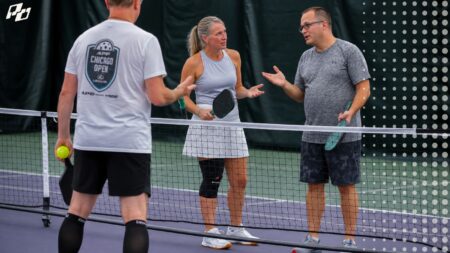
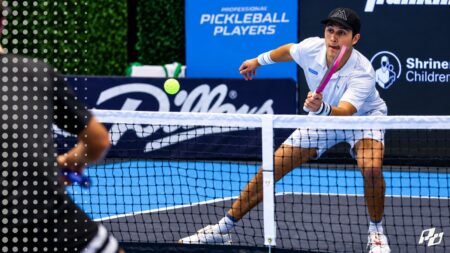
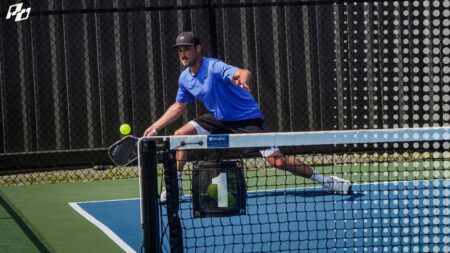
The three images in this article were created using a video shared by @elitepickleballcoaching on Instagram.