Pickleball players generally benefit from strength training at least twice per week. Focus on legs, calves, hips, trunk, upper back, and shoulders, then adjust the workload by age, playing frequency, and recovery. Older players should also prioritize balance and power so strength translates into safer, quicker movement on court.
A lot of recreational pickleball players treat court time as their entire fitness program. That works—until it doesn’t.
Pickleball gives you movement, coordination, quick reactions, and plenty of aerobic work. But it does not reliably build enough strength in the calves, hips, quads, shoulders, and trunk to prepare your body for every lunge, stop, push-off, overhead, and awkward recovery step the sport demands.
That is where strength training earns its place.
The latest American College of Sports Medicine position stand, published in 2026 after reviewing 137 systematic reviews involving more than 30,000 participants, concluded that resistance training improves strength, muscle mass, power, balance, gait speed, and physical function. The broad recommendation is simple: train all major muscle groups at least twice per week.
For pickleball players, though, the useful question is not:
“Should I lift?”
It is:
“What kind of strength do I need at my age, how much is enough, and how do I fit it around playing?”
That answer changes a little as you get older.
Why Pickleball Alone Isn’t Enough
A long doubles session can leave you wiped out, but being tired is not the same as getting stronger.
Pickleball asks your body to stop hard, push sideways, recover from lunges, brace through the shoulder, rotate through the trunk, and repeatedly load the calves and Achilles. Those are real physical demands, but playing alone does not necessarily build enough strength to handle them better over time.
That is why sports-medicine guidance for pickleball often includes exercises like squats, lunges, rows, bridges, calf raises, and rotator-cuff work.
The simplest way to think about it is: Pickleball exposes your weak links. Strength training helps fix them.
The Big Rule: Two Good Sessions Beat Five Random Ones
Most recreational players do not need a bodybuilding program.
For healthy adults, ACSM’s 2026 guidance emphasizes that consistency matters more than complicated programming. Two or more weekly sessions that train the major muscle groups can produce meaningful gains, and bodyweight, bands, machines, or free weights can all work.
For most pickleball players, I would start with:
- 2 strength sessions per week
- 30–45 minutes each
- 5–7 exercises
- 2–3 sets per exercise
That is enough to build a useful base without turning strength work into another sport.
What Changes by Age?
Chronological age does not tell me everything.
A strong 68-year-old who has lifted for 30 years may tolerate more training than a sedentary 42-year-old who started pickleball six months ago.
But age does change what I would emphasize.
| Age | Main Priority | Strength Frequency | What I’d Emphasize |
|---|---|---|---|
| Under 40 | Performance + durability | 2–3x/week | Heavy strength, lateral power, deceleration, shoulder durability |
| 40–54 | Maintain strength + protect tendons | 2x/week | Legs, calves, hips, trunk, pulling strength, shoulder stability |
| 55–64 | Strength + power preservation | 2x/week | Single-leg strength, calf/Achilles work, balance, controlled power |
| 65–74 | Preserve strength, power and balance | 2x/week | Full-body strength, balance, faster but controlled concentric work |
| 75+ | Function, fall resistance, independence | 2x/week if tolerated | Sit-to-stand, step-ups, calf strength, pulling, carries, balance |
The CDC recommends that adults 65 and older perform muscle-strengthening exercise on at least two days per week, along with aerobic and balance activities.
And importantly, ACSM explicitly says there is no age at which strength training becomes inherently inappropriate; older adults can still benefit from moderate-to-heavy resistance and power-oriented work when it is properly scaled.
Under 40: Build the Engine, Not Just the Skills
If you’re under 40 and already play a lot of pickleball, your strength training should help you move better and hit harder without wearing you down.
Prioritize:
- squats or trap-bar deadlifts for leg strength
- split squats and lateral lunges for court movement
- calf raises for push-off and deceleration
- rows and presses for upper-body strength
- trunk rotation and anti-rotation for stability
- a small amount of jumping, hopping, or medicine-ball work for power
If you play pickleball 3–5 days per week, two strength sessions are usually plenty. Add a third only if your court schedule is lighter and recovery is good.
The key is total workload.
Hard pickleball counts as training. If your legs are constantly sore, your footwork is getting slower, or your strength sessions are hurting your court play, you’re probably doing too much.
Ages 40–54: Tendon Capacity Starts Mattering More
This is the group where a lot of players suddenly discover that enthusiasm can outpace tissue adaptation. You still need strength.
But I would emphasize:
- calves and soleus
- glutes and hamstrings
- quads
- adductors
- upper back
- rotator cuff
- forearm strength
Why?
Because pickleball injuries commonly affect the knee, Achilles, calf, shoulder, elbow, and lower back, and clinicians repeatedly identify poor strength and abrupt increases in court volume as relevant contributors.
This is also the age where players often add more pickleball but remove strength training because “pickleball is my workout.”
That is usually backwards. The more often you play, the more useful your support work becomes.
Ages 55–64: Don’t Just Train Strength—Keep Some Speed
At this age, your program should still be built around regular strength exercises—squats, split squats, calf raises, rows, presses, and similar movements.
But once you have that strength base, it is worth making a small part of your strength training faster.
For example:
- regular squat with challenging resistance = strength
- lighter squat where you stand up quickly = power
- controlled step-up = strength
- lighter step-up performed quickly on the way up = power
That matters for pickleball because you don’t just need strong legs. You need to use that strength quickly when pushing toward a short ball, recovering from a wide dink, or changing direction.
ACSM recommends moderate resistance—roughly 30–70% of your one-rep maximum—moved quickly during the lifting phase when power is the goal.
The practical approach: Keep most of your program focused on strength, then add a few controlled, faster reps rather than replacing strength work with jumps and explosive drills.
Ages 65–74: Strength Training Becomes More Important, Not Less
Once you’re in your mid-60s and beyond, strength training shouldn’t disappear from your routine. In many ways, it becomes more valuable for staying capable on the court.
For pickleball, focus on the areas you actually rely on:
- Squats or sit-to-stands for getting low and recovering from dinks
- Split squats or step-ups for single-leg strength and lunges
- Calf raises for pushing off, stopping, and supporting the ankle/Achilles
- Rows for upper-back and shoulder support
- Presses or appropriate shoulder work for upper-body strength
- Balance or carries for stability and control
You don’t need dozens of exercises. Two full-body sessions per week with 5–6 well-chosen movements can cover a lot.
And don’t automatically make everything extremely light because you’re over 65. The resistance should still be challenging enough to build or maintain strength, provided you can perform it safely and with good form.
The goal isn’t to train “like an older player.” It’s to preserve the strength that lets you keep moving like a pickleball player.
Ages 75+: Make Strength Training Look Like Pickleball Life
At 75+, strength training should focus on maintaining the physical abilities you actually need on the court: getting low, getting back up, stepping quickly, staying balanced, and controlling your body when you stop.
You don’t need complicated exercises. A practical program might include:
- Sit-to-stands or chair squats for leg strength
- Supported split squats or step-ups for lunging and recovering
- Calf raises for push-off and lower-leg strength
- Rows for upper-back and shoulder support
- Wall or machine presses for upper-body strength
- Carries and balance work for stability
The NSCA recommends progressive resistance training for older adults 2–3 times per week, with the difficulty adjusted to the individual.
At 75+, the key is not automatically making everything lighter. It is choosing resistance and movements that match your strength, mobility, experience, and ability to perform them safely.
Think about a simple sit-to-stand: stronger legs make it easier to rise from a chair, but that same capacity also helps you get low for a dink and recover back into position.
The goal isn’t lifting heavy for the sake of it. It’s maintaining enough strength to keep doing the things pickleball asks of you.
The Core Exercises I’d Give Most Recreational Players
You do not need 18 exercises. These six cover many of the basic strength and stability demands of pickleball.
1. Squat or Sit-to-Stand
Builds quads, hips, and general lower-body strength.
- 2–3 sets of 8–12
2. Split Squat or Reverse Lunge
Trains one-leg strength and the split stance you constantly use around the kitchen.
- 2–3 sets of 6–10 each side
3. Calf Raise
Easy to overlook, extremely relevant. Use both straight-knee and slightly bent-knee versions if tolerated to train the calf complex.
- 2–3 sets of 10–15
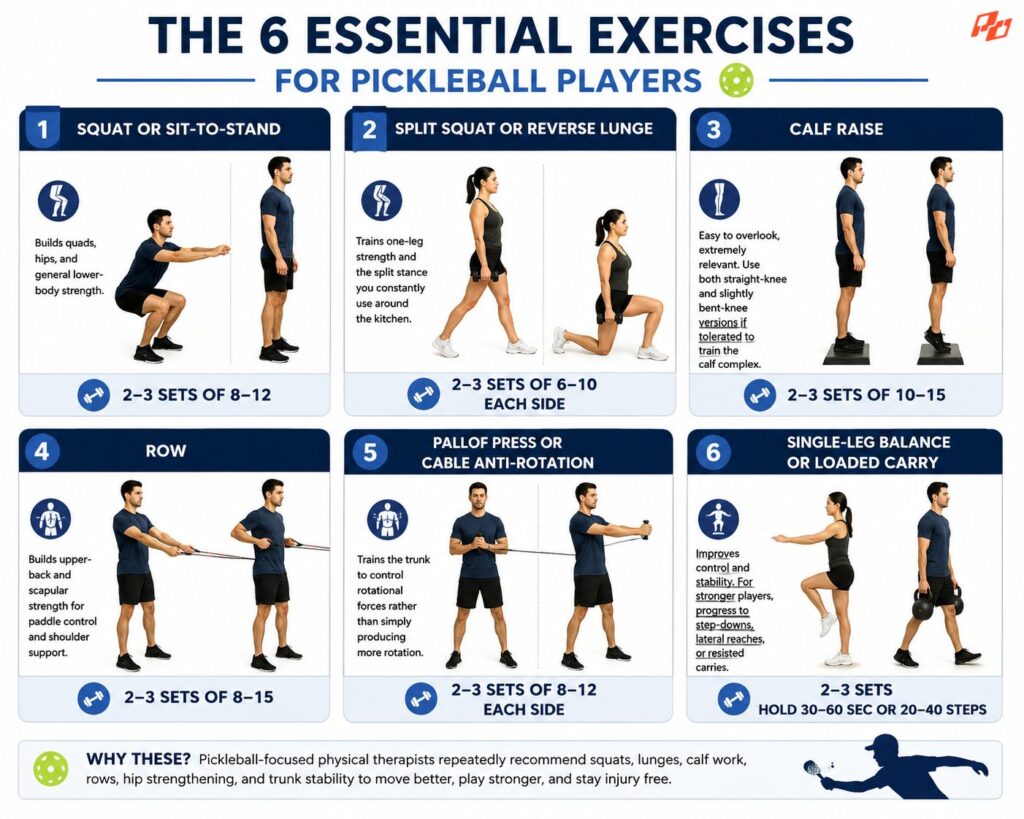
4. Row
Builds upper-back and scapular strength for paddle control and shoulder support.
- 2–3 sets of 8–15
5. Pallof Press or Cable Anti-Rotation
Trains the trunk to control rotational forces rather than simply producing more rotation.
- 2–3 sets of 8–12 each side
6. Single-Leg Balance or Loaded Carry
Improves control and stability. For stronger players, progress to step-downs, lateral reaches, or resisted carries.
Pickleball-focused physical therapists repeatedly recommend squats, lunges, calf work, rows, hip strengthening, and trunk control because they map directly onto common court demands.
How Heavy Should You Lift?
You do not need to calculate your exact one-rep max. For most recreational players, use this simpler test:
Finish the set feeling like you could perform about 2–3 more good repetitions.
If you could do another 10, it is probably too light for meaningful strength work. If your form collapses before you finish the set, it is too heavy.
For building strength, moderately heavy resistance works well.
ACSM’s newest analysis found that heavier loads—around 80% 1RM or higher—produce greater maximal-strength gains, although substantial improvements still occur across many loading ranges.
A rec player does not need to chase maximum strength. You need enough resistance that your body has a reason to adapt.
When Should You Strength Train Around Pickleball?
This is where good programs often fall apart.
If Tuesday night is your hardest league session, I would not do heavy split squats Tuesday afternoon.
Try to keep demanding lower-body lifting at least a day away from your most important pickleball session when possible.
A simple schedule:
| Day | Training |
|---|---|
| Monday | Strength |
| Tuesday | Pickleball |
| Wednesday | Easy play / recovery |
| Thursday | Strength |
| Friday | Rest or light drilling |
| Saturday | Competitive pickleball |
| Sunday | Rest / easy movement |
If you must lift and play on the same day, decide which one matters more. Do the priority activity first. And do not make both sessions maximal.
Should You Lift Before or After Pickleball?
Before casual drilling? A short strength session may be fine.
Before a tournament, league match, or intense open play? I would avoid a demanding lower-body workout beforehand.
Fatigued legs change:
- footwork
- stopping mechanics
- reaction speed
- balance
That defeats part of the reason you are strength training in the first place.
If you combine them:
pickleball priority day → play first
strength priority day → lift first
Simple.
Do You Need a Separate Leg Day?
Probably not.
Recreational players often do better with two full-body sessions rather than splitting the body across four gym days. That gives every major area repeated exposure without requiring you to live in the gym.
A practical 35-minute session:
| Exercise | Sets × Reps |
|---|---|
| Squat | 3 × 8 |
| Reverse lunge | 2 × 8/side |
| Calf raise | 3 × 12 |
| Row | 3 × 10 |
| Press | 2 × 10 |
| Pallof press | 2 × 10/side |
| Single-leg balance | 2 × 20–30 sec |
Done. Add resistance gradually when the sets become comfortable.
What About Plyometrics?
Useful—but not mandatory.
For younger, experienced players, jumps, hops, bounds, and lateral power drills can help prepare for the fast elastic demands of pickleball.
For older players, power training still matters, but it does not need to mean jumping.
Don’t Confuse Soreness With Progress
A good strength session does not need to make stairs miserable for two days. If lifting repeatedly ruins your next pickleball session, the dose is wrong.
Reduce:
- total sets
- load
- exercise novelty
- proximity to hard play
Strength training should increase your court capacity over time. It should not constantly compete with it.
If You Already Play Four or Five Days a Week
This is where I would actually become more conservative with gym volume, not abandon strength entirely.
Two shorter sessions may be better than three big ones. For example:
Day A: squat, row, calf raise, trunk
Day B: split squat, press, hip hinge, balance
Thirty minutes each.
The biggest mistake would be adding a high-volume strength program on top of a high-volume pickleball schedule and assuming more is automatically better.
Your muscles need training. Your tendons also need recovery.
If You’re New to Strength Training
Start easier than you think.
Week 1–2: 1–2 sets per exercise
Week 3–4: 2 sets
Week 5+: 2–3 sets
Then gradually increase resistance.
The biggest jump in benefit comes from going from no resistance training to some resistance training. You do not need advanced methods, failure training, complicated periodization, or expensive equipment to start getting stronger.
What I’d Tell a 60-Year-Old Who Plays Three Times a Week
Do not try to become a weightlifter. Become stronger at being a pickleball player.
Train twice per week.
Keep one squat pattern.
One lunge.
One calf exercise.
One pull.
One push.
One trunk or balance movement.
Make those movements gradually harder. Then add a small amount of controlled speed once your strength base is solid.
That is enough for most recreational players.
The bigger mistake is assuming your court time covers everything. Pickleball practices pickleball. Strength training builds the body that has to survive it.
And as you get older, that distinction becomes more important—not less.