
In pickleball doubles, don’t automatically speed the ball up where the dink came from. Read how the dink shifted the defense, then attack the exposed hip, seam, or open lane. The best target depends on balance and paddle position—and advanced players also anticipate where the counter is likely to come back.
Anna Leigh Waters recently shared a deceptively simple kitchen-line idea: don’t automatically speed the ball up toward the same side it came from. Look at the opposite side.
At first, that sounds almost too simple.
Opponent dinks crosscourt to your forehand.
You get an attackable bounce.
Instead of automatically speeding up back toward the player who sent the dink, Waters wants you to check the other defender and the space created by the defensive shift.
Why?
Because the dink that just arrived didn’t only move the ball. It may have moved both defenders. And that’s the part recreational players often miss.
A good speed-up is not just about whether the ball is high enough. It’s about what the previous shot did to the defense.
Freeze the Rally One Frame Before You Attack
Picture four right-handed players at the kitchen.
You’re on the right. The opponent diagonally across from you sends a crosscourt dink toward your forehand.
You slide wide to receive it.
At the same time, their team naturally shades toward the ball. The diagonal opponent is recovering from the dink. Their partner may be pinching toward the middle to protect the most likely return.
Then your ball sits up.
Most rec players immediately fire it back at the player who just hit it. That’s logical. It’s also often where the defense is already strongest.
Waters’ idea asks you to notice the other half of the court.
What changed because of that dink?
- Did the opposite player shift middle?
- Did their paddle move toward the ball?
- Is one hip exposed?
- Is the line available?
- Is someone still moving?
That’s when the redirect becomes interesting.
The principle isn’t really: Ball came from left → attack right.
It’s: Make the defense move one way, then attack what that movement exposed.
That’s much better pickleball.
Why the Opposite Side Can Be Vulnerable
Good doubles teams move with the ball. When a dink travels toward one side, defenders generally shade in that direction to protect the most dangerous angles.
Coaches describe this defensive movement very simply: when you or your partner dink in one direction, shift in that direction so your paddle is already protecting the likely speed-up lane. That’s correct defense.
But every shift has a tradeoff.
Protect more court here… and you necessarily protect a little less somewhere else. That’s the opening you’re looking for.
For example, if the opposite-side defender:
- slides toward the middle
- turns the paddle to protect a backhand counter
- begins leaning toward the expected crosscourt continuation
- or is still recovering from the previous shot
a redirect toward the newly exposed side can arrive before they reorganize. That is why this strategy is really about movement and anticipation, not simply direction.
Waters herself teaches that opponents who are moving or off balance are particularly good candidates for an attack.
So the sequence becomes: dink moves defense → defense shifts → ball sits up → attack the newly weak lane.
But Don’t Attack “Opposite” Just Because It’s Opposite
This is where this particular advice needs context.
Suppose the dink came from the crosscourt opponent. But the opposite player is:
- perfectly balanced
- paddle centered
- sitting on the exact lane you want
- and expecting your speed-up
Meanwhile the player who hit the dink is still recovering wide. Attacking opposite simply because that’s “the rule” would be poor strategy.
The better priority is:
- Who is moving?
- Where are the paddles?
- What lane did the previous dink open?
- Can I attack this ball from balance?
Direction comes after those questions.
Strong attacks come from recognizing a slightly high dink, an opponent reaching or moving, or a ball sitting comfortably in front—not from deciding beforehand that every dink must be attacked.
First, Read What the Dink Changed
Waters’ idea is useful because rec players often speed the ball up right back toward the player who just dinked it.
But the better question is: What did that dink make the defense do?
Did one player shift middle?
Did someone lean?
Did a paddle start favoring one side?
If the dink moved the defense one way, the opposite side may now be less protected.
So don’t think: “Crosscourt dink = opposite attack.”
Think: “The dink moved them. What did it expose?”
Example: Crosscourt Dink → Opposite Hip
You’re on the right side. A crosscourt dink comes into your forehand and sits up around net height. The defender who did not hit the dink has pinched slightly toward the middle.
Instead of automatically attacking back crosscourt, you redirect toward that player’s inside hip or body seam. Now they may be caught between forehand and backhand while their weight is still shifting.
What makes the attack work isn’t maximum pace.
It’s: Timing + balance + paddle position + target.
Then Think One Shot Ahead
Once you’ve chosen the speed-up target, ask another question:
Where is the counter likely to come back?
That’s where the Triangle Rule becomes useful. It doesn’t tell you who to attack. It helps you anticipate the likely counter after you speed up.
So the sequence is: Read the shift → attack the opening → expect the counter.
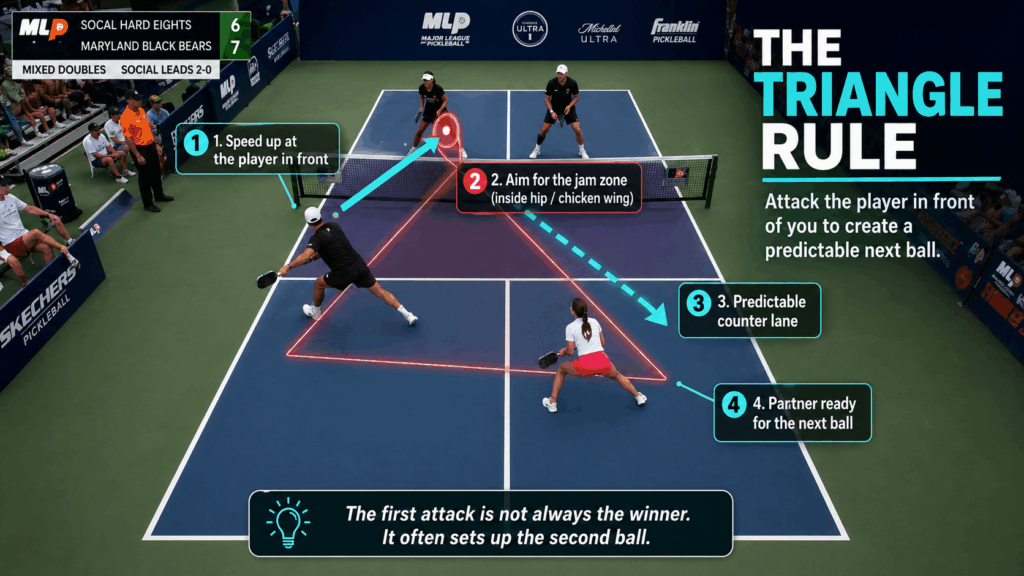
Anna Leigh Waters shows this perfectly from the left side in the video below. She and her partner speed up a backhand through the middle, then immediately shift and prepare for the forehand.
Why?
From that position near the sideline, the opponent has a tougher time redirecting the counter sharply crosscourt. The more likely reply stays through the middle, so they’re already moving to cover the next ball.
PPA pro Ava Ignatowich teaches this broader idea: the first speed-up does not necessarily need to finish the point. It can be used to force a weaker or more predictable response that you’re already prepared to attack.
That’s the bigger leap from rec pickleball to advanced pickleball.
Rec player: “Where can I hit a winner?”
Better player: “What ball am I trying to get back?”
Don’t Aim for Open Court First
This sounds counterintuitive. If you’ve created an opening on the opposite side, shouldn’t you just hit the empty space?
Sometimes.
But at kitchen distance, a speed-up into completely open court can require a much smaller target and can easily travel wide.
Often the more reliable target is the body bordering the opening.
Think:
- inside hip
- paddle-side shoulder
- or the seam between the players
A body speed-up reduces the defender’s ability to make a clean stroke and often produces exactly what you really want: a weak counter.
Deception and placement matter more here than trying to paint a sideline.
The Opposite-Side Attack Works Best After You Establish the Dink
Here’s where you can make the tactic much harder to read. Don’t redirect immediately every time.
First, make the normal ball believable.
Crosscourt dink.
Crosscourt dink.
Maybe another crosscourt dink.
Now the opponents begin organizing around that pattern. Then a slightly higher ball arrives.
Same preparation.
Same body position.
But this time: opposite-side speed-up.
Coaches specifically teach keeping speed-up preparation similar to a dink—short backswing, paddle in front, and delayed acceleration—so the opponent receives the directional information later.
That is far more dangerous than simply swinging harder.
Useful cue:
Show dink. Find opposite.
Coach Jordan Briones shares a few great tips for making your speed-up look exactly like a dink:
How Hard Should You Hit It?
Not as hard as you think.
Leigh Waters has taught attacking high dinks at roughly 50–60% pace, emphasizing control, balance, and margin rather than trying to blast every attack.
That’s particularly important with a directional redirect. You’re already asking the paddle to:
- change direction
- control height
- clear the net
- and find a smaller lane
Trying to add 100% pace on top of that usually lowers your margin.
For a 3.5–4.0 player: Think rush them, not crush them.
Enough acceleration to force a reaction. Not enough that you’re gambling the point on your own swing.
Here’s When I Would Use the Waters Pattern
Imagine a simple traffic-light system.
GREEN: Redirect
The dink sits up.
You’re balanced.
One defender is still recovering or shifting.
Their partner has shifted toward the ball or middle.
You can see a hip, seam, or line opening.
Go.
YELLOW: Read Again
The ball is attackable, but both players appear balanced. Now target paddle position rather than automatically choosing opposite.
- Who is sitting heavily backhand?
- Who is leaning?
- Who has the weaker counter?
Attack that problem.
RED: Keep Dinking
The ball is below net height.
You’re reaching.
You’re moving backward.
Your contact is late.
Or the opposite opponent is already loaded and waiting for exactly that speed-up.
Don’t manufacture offense just because you learned a new pattern. Anna Leigh Waters’ own attack advice is very clear on this point: if you have to step backward to create the speed-up, the incoming dink was probably too good to attack.
Where Rec Players Usually Get This Wrong
The first mistake is attacking every opposite-side ball. Then the opponent simply starts sitting on it.
The second mistake is changing the setup too early.
Big backswing.
Shoulders suddenly turn.
Paddle drops.
Everyone knows what’s coming.
The third mistake is watching the first speed-up.
You hit the redirect and admire it. Meanwhile the counter is already coming back.
This matters because advanced players frequently expect the speed-up to start a firefight rather than finish the point.
The triangle concept explicitly teaches preparing the paddle for the likely counter as part of the speed-up follow-through.
Your speed-up isn’t finished at contact.
Your job is: attack → recover paddle → expect counter.
Try the “Same Side / Opposite Side” Drill
This is the fastest way to understand whether the strategy actually works for you.
Four players at the kitchen. Start a cooperative crosscourt dink rally. Whenever the feeder gives an attackable ball, the hitter has two choices:
A — speed up back toward the source
B — redirect toward the opposite defender
Play the point out.
After 20 attempts, don’t count only winners. Track three things:
✔ Did the opponent counter cleanly?
✔ Did you force a weak reply?
✔ Did you lose the point immediately?
That tells you much more.
You may discover that opposite-side attacks don’t produce many outright winners—but produce a lot of balls your team finishes one shot later.
That’s a successful speed-up.
Then Make the Drill Smarter
Once you’re comfortable, let the defenders move naturally. Now the hitter cannot simply choose “opposite.” Before attacking, identify:
MOVING
PADDLE
SPACE
in your head.
If one opponent is moving, attack their instability.
If one paddle is badly positioned, attack that.
If both are stable but the dink has opened a lane, attack the space or body edge.
Now you’re no longer practicing a trick. You’re practicing reading the defense.
The Rule I Would Actually Teach a 3.5 Player
Anna Leigh Waters’ idea is useful precisely because it interrupts a habit most players don’t realize they have: they send the attack back where the ball came from.
That’s often the easiest direction mechanically. It can also be the most prepared part of the defense.
So yes—look opposite. But don’t make “opposite” your new automatic target.
Use this instead: follow the dink with your eyes. Then attack what the dink moved.
Sometimes that’s the opposite player.
Sometimes it’s the middle.
Sometimes it’s behind the moving player.
Sometimes the best decision is another dink.
And once you choose the speed-up, don’t stop thinking. Ask: What counter am I likely to get back?
That’s the difference between memorizing a pro tip and actually understanding it.
The speed-up isn’t dangerous merely because it travels fast. It’s dangerous because the previous shot made somebody prepare for the wrong thing—and because you’re already ready for what happens next.