
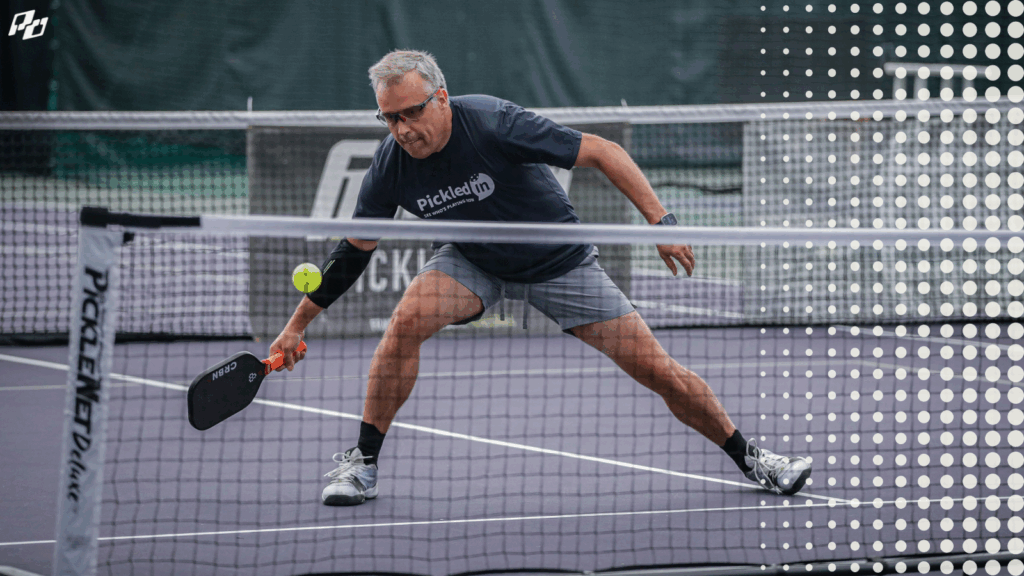
A dead dink is your chance to turn neutral pickleball into offense—but only if you’re balanced and set. First ask: can I take it out of the air? If not, is it dead? Then decide whether to attack, hold, or dink again. The best speed-ups come from good footwork, smart targets, and expecting the counter.
There’s a moment in a good dink rally when the ball stops being dangerous.
It isn’t necessarily high.
It isn’t necessarily a popup.
It just arrives with less pressure. Less spin. Less angle. Enough time for you to get organized.
That’s the ball Jill Braverman — pro pickleball player, coach, two-time USA Pickleball National Champion, and former CEO of DUPR — wants you to notice.
In a recently published video, Braverman breaks the decision down to two questions: Can I take it out of the air? If not, is the ball dead? If the second answer is yes, she wants the feet moving so you can get behind the ball, shift your weight forward, and look to initiate.
We couldn’t agree more with the idea behind it: a dead dink is often your first real chance to turn a neutral rally into offense.
First: What Is a “Dead” Dink, Really?
Players use dead dink pretty loosely. Usually, they mean a dink with relatively little pace or pressure that gives the receiver time to set up.
But “dead” does not automatically mean “high.”
You can receive a slow ball that stays ankle-high. You can receive a soft net-cord ball that dies completely. You can receive a shallow dink that gives you plenty of time but still sits below your ideal attacking window.
Those are all relatively dead balls. They are not all good speed-ups. That distinction shows up repeatedly in high-level coaching.
So I’d define a useful dead ball this way:
A ball that gives you enough time and space to establish your feet and make a choice.
Notice what’s missing. Nothing there says you have to attack it.
Jill’s Two Questions Need a Third
Braverman’s first two questions are excellent:
1. Can I take it out of the air?
If yes, you may be able to remove time from your opponent and apply pressure without waiting for the bounce.
If no:
2. Is it dead?
If no, you’re probably dealing with a pressuring dink. Respect it.
If yes, add one more question:
3. Am I actually in position to attack it?
That’s the intermediate-player filter.
A dead ball becomes much more attractive when:
- you can get behind it rather than reach for it
- contact stays in front of your body
- your weight can move slightly forward
- you aren’t falling sideways or backward
- the bounce gives you enough room to work under or through the ball
- your opponent isn’t already sitting perfectly on the speed-up
We have covered this same balance requirement in our guide to the off-the-bounce topspin speed-up: the most reliable dead dinks are the ones that let you remain stable at the kitchen instead of pulling you backward or outside your base.
That is where the feet become the real story.
The Ball May Be Dead. Your Feet Can Still Kill the Attack.
This is what I think rec players miss most.
They recognize a slow dink. Then they attack from exactly where they’re standing.
Bad idea.
A better cue is to move your feet to get behind the ball before attacking off the bounce, rather than reaching and trying to manufacture topspin from an awkward contact point.
Try this cue: Dead ball → move first → decide second.
Not: Dead ball → swing harder.
If the ball is slightly to your forehand side, create enough room for the paddle to work.
If it gets into your hip, move your feet instead of folding your arm around your body.
If you have to reach, lean backward, or contact beside your leg, the opportunity has probably deteriorated.
The attack didn’t disappear because the ball suddenly became better. Your position got worse.
This is where Jill Braverman’s cue really comes to life—watch how she recognizes the dead ball, gets her feet organized, and turns that extra time into an attacking opportunity:
Don’t Confuse “Dead” With “Easy”
Here’s a great example from Tanner Tomassi, a professional pickleball player and coach known for his tactical breakdowns and instructional content.
Tomassi specifically warns players not to automatically attack a dink that clips the net and dies short.
That ball has almost no pace. Sounds dead, right?
But because it loses momentum and can stay extremely low, he recommends using it to regain control with an aggressive dink rather than forcing a speed-up.
That gives us a useful clarification: A dead ball can give you time without giving you leverage.
If the ball is:
- very low
- dying close to the net
- forcing you to reach down
- or making you lift dramatically
use the extra time to hit a better dink.
That can be more offensive than trying to manufacture a hero speed-up.
Think of the Dead Ball as a Free Decision Window
A pressured dink forces a response. A dead dink gives you options.
That’s powerful.
Tanner Tomassi teaches players to use the extra time on a dead dink to hold the paddle underneath the ball and read the opponent.
Does the defender shade toward a backhand counter?
Do they move their paddle toward the body?
Do they lean forward expecting another dink?
The hold itself can create information and disguise. That means your choices become:
- Attack now.
- Show attack and dink.
- Move them with an aggressive dink.
- Hold and read their paddle.
- Attack the next similar ball after you’ve learned what they protect.
That is much more sophisticated than “dead ball = speed-up.” And it’s much closer to how better players create offense.
The Modern Speed-Up Is Usually the First Shot, Not the Last
This is probably the biggest shift intermediate players need to make.
You accelerate the dead ball and expect a winner.
Your opponent blocks it.
You think the speed-up failed.
Roscoe Bellamy, a professional pickleball player known for his aggressive attacking game and instructional content, would argue the opposite.
He describes the modern off-the-bounce attack as a combo starter. The first acceleration creates the ball you actually want to finish.
Experienced players say much the same thing: speed up with a compact swing, expect the counter, and be ready for the next ball rather than admiring the first attack.
That changes your objective.
Instead of asking:
“Can I hit this past them?”
Ask:
“Can I make their next contact uncomfortable?”
- Now a 65–75% attack into the hip can be excellent.
- A ball into the paddle-side shoulder can be excellent.
- A speed-up into the seam that produces a floating block can be excellent.
The point may end one shot later. That first attack still did its job.
We’ve explored this idea in more detail in our guide to opposite-side speed-up targeting: the better attack is often the one that produces the weak counter you expected rather than the most spectacular first ball.
My Green / Yellow / Red Test for Intermediate Players
Forget trying to classify every dink perfectly. Use this instead.
🟢 GREEN: Attack
✔ The ball gives you time.
✔ You’re balanced.
✔ You can get behind the bounce.
✔ Contact will be comfortably in front.
The opponent is moving, leaning, protecting one side, or holding the paddle somewhere exploitable.
You already know what counter you’re expecting.
⮕ Go.
🟡 YELLOW: Use the Dead Ball to Create Something
The ball is comfortable, but not quite attackable.
Maybe it’s low.
Maybe your opponent is perfectly set.
Maybe you’d have to lift too much.
This is where better players resist the temptation to force offense.
✔ Use the time.
✔ Hold the ball.
✔ Move the opponent with a sharper dink.
✔ Change direction.
✔ Create a ball you can attack next.
Tomassi’s dead-ball deception and Bellamy’s aggressive-dink patterns both live here.
🔴 RED: Dink
✖ You’re reaching.
✖ You’re moving backward.
✖ Contact is late.
✖ The bounce stays extremely low.
✖ You’re jammed.
Or the opponent is perfectly balanced with their paddle sitting exactly where you want to attack.
Don’t donate the firefight.
Where Should You Speed It Up?
Once you’ve earned the attack, open court isn’t always the best answer. At kitchen distance, body pressure can be much harder to handle.
Useful targets include:
- Paddle-side hip: jams the stroke and can force an awkward elbow position.
- Chicken wing / paddle-side shoulder: creates indecision between forehand and backhand.
- Middle seam: especially useful if both opponents hesitate over ownership.
And importantly: Your target should change with your contact height.
A lower attack gives you less margin over the net, so body targets often make more sense than ambitious sidelines. A higher ball gives you more downward angle and more freedom.
We recently broke down that relationship in our guide to pickleball body speed-up targets.
Why Initiation Is Becoming More Important
Bellamy says the modern game increasingly revolves around combination attacks rather than single-shot winners. James Ignatowich, one of the top professional pickleball players on the PPA Tour and a former college tennis player, has argued that today’s equipment and faster game make off-the-bounce attacks increasingly viable, while also emphasizing disguise and anticipating the counter.
There is still disagreement.
Some coaches remain much more conservative about off-the-bounce speed-ups because the defender has time to recognize them.
That disagreement is useful.
It tells you the shot itself isn’t automatically good or bad. The quality of the initiation matters.
The Cue to Take Into Your Next Game
You don’t need seven thoughts during a dink rally.
Use three:
Air? Dead? Set?
Air?
Can I take it before the bounce?
Dead?
If I let it bounce, is it giving me time rather than pressure?
Set?
Can I get my feet behind it and attack from balance?
⮕ If all three lead you toward offense, initiate.
⮕ If the ball is dead but you aren’t set, use the gift differently.
That’s the real value of the dead ball.