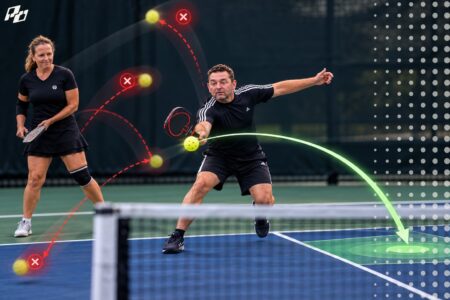


Your forehand speed-up should win you points — not hand your opponent counters on a platter.
If you watch pros fire off forehand speed-ups, it looks effortless. A tiny motion, a quick flick, and boom — they’re in control of the point.
But at the intermediate level? Forehand speed-ups fail a lot.
And here’s the part nobody talks about:
The biggest mistake isn’t bad aim. It’s not swinging too soft. It’s not “not enough spin.” It’s the backswing.
Yep — the single most common thing that kills the forehand speed-up is the big, obvious, telegraphed backswing.
Let’s break down why that ruins everything… and then build the forehand speed-up you actually need to win kitchen exchanges.
The #1 Killer of the Forehand Speed-Up: The Big Backswing
Intermediate players love taking a full forehand cut at the ball — especially when they’re excited to attack. The problem?
A big backswing ruins the speed-up in three ways:
1. You lose disguise
A giant loop announces your plan three seconds early. Your opponent loads their counter…and you basically hand them the perfect ball to attack.
Rob Nunnery says it perfectly: your speed-up must look exactly like a dink until the final moment.
2. You lose timing
Speed-ups happen on balls near net height. A long swing forces you to contact too late — usually waist-high or lower — which means:
- you pop the ball up
- you hit into the net
- you hit long with no topspin support
3. You lose your ready position
If your follow-through pulls your arm across your body or back behind you, you can’t counter their counter.
Speed-ups are not winners. They’re setups.
If your follow-through isn’t finishing in front — paddle up and ready — you’re toast on the next ball.
A great speed-up should leave you balanced, forward, and counter-ready. A big swing leaves you off-balance, open-chested, and late.
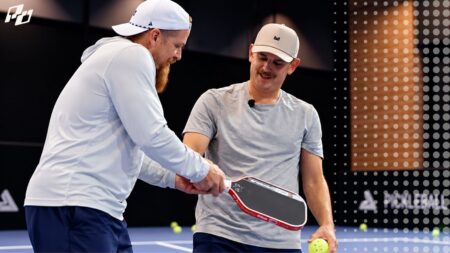
This short video sums it up perfectly:
What a Correct Forehand Speed-Up Should Actually Look Like
Here’s the clean, pro-level version:
- Follow-through ends forward — never across
- Short backswing
- Looks like a dink until the last moment
- Paddle stays in front
That tiny, compact motion is the foundation. Now let’s expand everything you need to build around it.
Step One: Choose the Right Ball (Most Intermediate Players Don’t)
A forehand speed-up is a shot of opportunity, not desire. You don’t “decide” to speed up — the ball decides for you.
Two balls that unlock the speed-up:
- Dead dinks — floaty, mid-to-upper thigh height, sitting long enough to hit outward or downward.
- Slice dinks — skidding at net height but bouncing upward from backspin, giving topspin margin.
Step Two: Grip Choice = Everything
Grip determines how much spin and control you get.
Continental
- great stability
- great backhand counter – limited aggressive angles
Semi-Eastern (gold standard)
- best topspin
- best inside-out angles
- still strong for backhand counters — the preferred grip for Hayden Patriquin, Andre Deescu, and modern attackers
Eastern
- easy spin – weakens backhand defense; better for players who attack more than counter
If you want the most versatility — choose semi-Eastern. It naturally creates the closed paddle face needed for spin while still allowing defensive stability.
Step Three: Build a Deceptive Setup
Rob Nunnery drills this constantly:
“Hold. Hold. Release.”
The longer you show a dink, the more the opponent falls asleep or shifts their weight.
Here’s how to disguise:
1. Keep paddle down and neutral
Tip of paddle dropped → opponent can’t see if you’re rolling or flicking. But don’t drop it below your knees — keep it between thigh and waist for fastest acceleration.
2. Use the same setup motion for everything
If your roll, dink, and flick all look identical for the first 80% of the swing, the opponent has to guess.
3. Release late
You accelerate only in the final 2–3 inches of contact.
Our coach Marko Grgić recently shared three excellent extra tips on how to better disguise your speed-ups:
Step Four: Master the Mechanics (Compact + Wrist Dominant)
Pros aren’t muscling speed-ups. They’re brushing.
Key mechanical points:
- Paddle never disappears behind you
- Low-to-high swing path creating topspin
- Forearm pronation, like the “windshield wiper” motion
- Minimal arm push — wrist and forearm drive the shot
The goal: speed + spin + disguise — not power.
A 10 mph ball to the right shoulder beats a 40 mph ball to the paddle any day.
Step Five: Pick the Right Targets
Here’s the hierarchy, from best to worst:
1. Right hip of the opponent in front of you (elite option)
Creates jam. Reduces time. Sets up your backhand counter.
2. Middle (riskier)
Draws in all four players — requires communication and trust with your partner.
3. Crosscourt (rare, very situational)
Only when they cheat middle. Hard to hit. Easy to miss.
4. Body bag (use sparingly, ethically)
Effective but socially dangerous. Use 1–2 times per match, not per game.
Step Six: Plan for the Next Shot (The One-Two Pattern)
The forehand speed-up is not the finishing shot. It’s the start of your offensive pattern.
The highest-percentage pattern in pickleball is:
Forehand speed-up → backhand counter
Your follow-through should naturally bring your paddle to your backhand side, ready for the counter.
Pros don’t finish points with the speed-up. They finish points with the ball the speed-up produces.
Step Seven: Use Off-Pace Speed-Ups to Beat Elite Counters
A rarely talked about technique — but brutally effective:
Off-pace speed-ups.
Against a great counter puncher, pace helps them. Take away the pace, and you steal their timing.
Use these when:
- they’re crowding the line
- they’re jumping early
- they’re over-anticipating your flick
- you’ve been speeding up too predictably
Slow speed-ups cause mishits, late swings, and floaty counters:
Step Eight: Stop Attacking Off the Bounce When You Don’t Have To
Speed-ups out of the air are vastly better.
Off the bounce → lower contact → worse angles → less topspin → more errors.
When possible:
- step in
- take the ball early
- keep the attack high
If you must attack off the bounce, be sure the ball rises above net height first OR has slice you can convert to topspin.
Step Nine: When to Absolutely NOT Speed Up
Don’t speed up when:
- your contact point is behind you
- the ball is dropping
- your feet aren’t set
- your opponent’s paddle is out front
- your opponent is already leaning forehand
- you’re off balance
- you haven’t disguised anything
In these situations, the speed-up becomes a volley feed — not an attack.
Step Ten: The Mental Side — Patience = Power
The forehand speed-up requires discipline and rhythm.
Here’s how pros think:
- “Earn your speed-up.” You don’t attack until the right ball appears.
- “Deceive first, accelerate second.” Show dink, then attack.
- “Compact = control.” Big swings lose rallies.
At the intermediate level, most players lose patience and try to force attacks — which turns a great opportunity into a cheap miss.
Your mantra: If you haven’t earned it, you’re guessing. And guessing gets punished.
Your Forehand Speed-Up Isn’t a Weapon Until It’s a System
Most players treat the forehand speed-up like a hammer: “Ball’s high — hit hard.”
But that’s not how pros play this shot.
Your speed-up becomes lethal when it’s:
- disguised
- compact
- well-timed
- spun
- targeted
- followed up
Master these layers, and suddenly you’re controlling rallies…not feeding your opponent free counters.
Play it smart.
Play it small.
Play it disguised.
And when you finally pull the trigger? Make it clean, compact, unreadable — and ready for the next ball.