
A better forehand speed-up starts before contact. A small grip adjustment, contact out in front, forward momentum, and a compact brushing motion can add spin and pace without forcing the shot. The key is to attack with control, then recover your grip immediately for the counter.
We love watching Gabe Tardio speed up a forehand. It looks almost unfairly casual.
There is no giant backswing. No violent slap. Sometimes it barely looks like an attack until the ball is already on somebody.
So we wanted to break down what is actually happening.
And Tardio is a pretty good player to study. The 21-year-old Bolivian is currently No. 3 in the PPA men’s world rankings, with 30 career PPA titles, including 26 in men’s doubles. He has become one of the defining attacking players of the modern pro game.
His explanation of the forehand speed-up comes down to a few deceptively simple ideas:
slightly adjust the grip, make contact in front, move through the ball, create spin with a compact circular path, and let your body position help choose the direction.
But the interesting part is how those pieces connect. Because this is not really a swing. It is a setup sequence.
The speed-up starts with the grip—not the arm
Tardio begins near a Continental grip and makes a small forehand-oriented adjustment.
For a right-handed player, think of that as rotating slightly toward Eastern, rather than dramatically turning all the way into an extreme forehand grip.
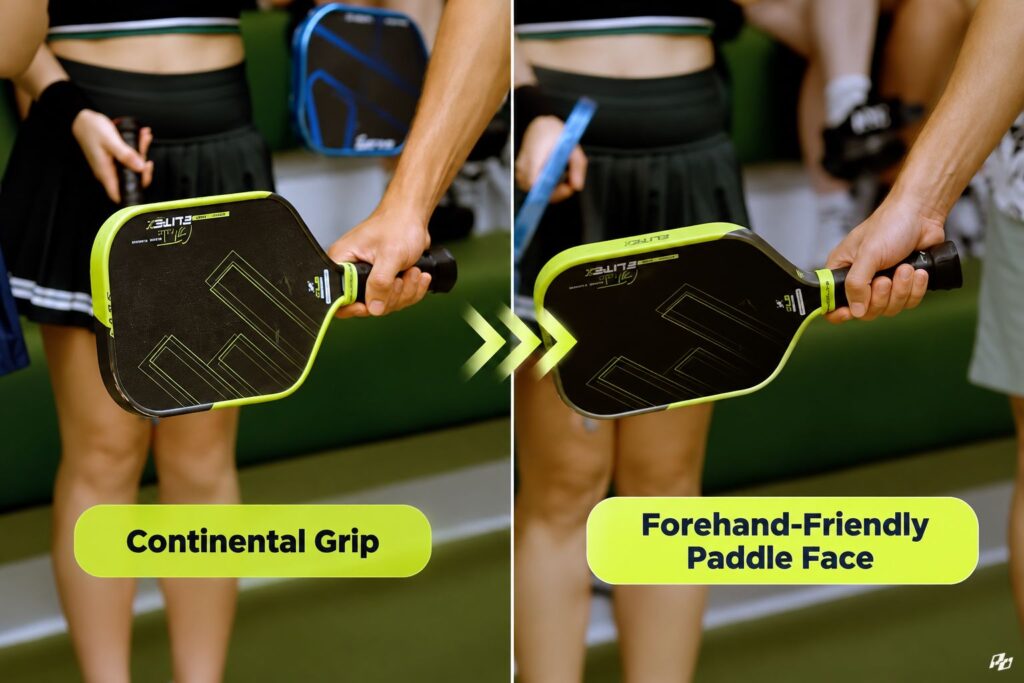
That distinction matters.
Continental is valuable at the kitchen because the paddle face stays relatively neutral and you can defend both forehand and backhand quickly. More forehand-biased grips make it easier to close the face and generate topspin, but they also make some backhand counters less natural. Coaching guidance consistently describes this tradeoff.
So Tardio is not saying: “Play the kitchen in a huge forehand grip.”
He is creating just enough bias to make his forehand attack easier.
Think: Continental → tiny forehand turn → attack.
Not: Continental → completely rebuild your hand → swing.
And grip terminology gets messy between coaches, so the hand position matters more than the label. You are looking for a slightly more closed, forehand-friendly paddle face—not a dramatic frying-pan grip.
But how do you actually change grips that quickly?
This is where intermediate players usually get stuck. They imagine releasing the paddle, looking down, rotating the handle, and grabbing it again.
That would be hopeless in a kitchen exchange. The change should be tiny. Keep the hand relaxed enough that the paddle can rotate inside the fingers.
From your neutral kitchen grip:
- Slightly loosen the middle, ring, and little fingers.
- Let the thumb and index finger guide a small rotation of the handle.
- Reclose the fingers once the paddle face reaches your preferred forehand position.
You are moving the paddle a fraction of a turn, not re-gripping from scratch. And do it while you have time.
That is the key experienced players repeatedly mention when discussing grip changes at the kitchen: if you are initiating the attack, you know the speed-up is coming before your opponent does. That gives you a preparation window—and, after contact, a tiny window to move back toward neutral before the counter arrives.
The advanced sequence becomes: neutral → forehand bias → speed-up → neutral again.
Make that loop automatic.
Your grip should be back before their counter is
This might be the most important part of Tardio’s idea for rec players. Do not admire the speed-up.
If you attack using a forehand-biased grip and simply leave your hand there, your opponent’s counter may arrive at your backhand before you are ready.
So make the return-to-neutral grip part of the shot itself.
Speed up.
Finish compact.
Immediately let the handle rotate back toward Continental as the paddle returns to ready position.
Experienced players discussing this exact problem describe the same logic: when you initiate a forehand speed-up, you usually have enough time to make the offensive grip adjustment and then return toward a more neutral grip because you control the timing of the attack.
That is much easier than trying to change grips after your opponent surprises you.
A useful cue: Attack grip in. Neutral grip out.
Tardio’s “little circle” is not a giant wrist roll
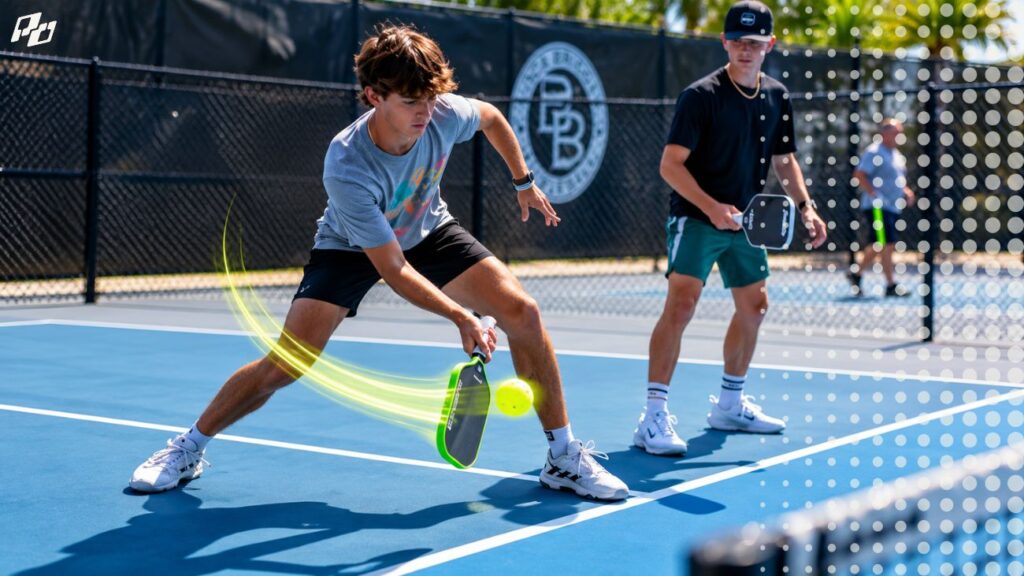
Now we get to the part people copy badly. Tardio describes making a small circular motion instead of hitting completely flat. That circle helps create spin.
But do not turn that into: huge windshield-wiper swing + violent wrist flip.
The useful motion is compact.
The paddle gets underneath or slightly around the back of the ball, accelerates forward and upward, and brushes enough to create shape.
John Cincola, a longtime professional pickleball player, coach, and former Division I tennis player who has won more than 20 pro medals, teaches a very similar concept for advanced forehand speed-ups. He emphasizes getting behind the ball, keeping the paddle tip down, making contact in front, and using a compact push-and-brush motion rather than a full groundstroke. Cincola also stresses that the common 3.5–4.0 mistake is usually not a lack of power—it is trying to speed up a ball before the setup is there.
That matches Tardio’s warning: don’t force it.
The spin should allow you to accelerate without sending the ball long. It is not permission to swing harder.
Here’s the man himself, showing the correct grip and how to create spin with a quick, almost circular motion:
Contact in front changes everything
Tardio repeatedly emphasizes hitting the ball in front.
That sounds basic until you try to attack a dink while the ball is beside your hip. Now the paddle has very little room to accelerate forward.
You compensate.
The wrist flips.
The elbow flies.
The ball either sails or gets buried in the net.
Contact in front gives you something more valuable than power: space. Space lets the paddle travel forward while still brushing upward.
Ashley Griffith, a professional pickleball player, coach, and former collegiate tennis player known for his technical instruction, makes the same point when teaching forehand power: meeting the ball out in front allows the arm to extend and lets the body contribute to the shot instead of forcing the arm to manufacture everything.
At the kitchen, the swing is smaller, but the principle survives.
A good advanced speed-up feels like you are meeting the ball on your way through it, not waiting until it reaches your body and rescuing it.
Forward momentum does not mean lunging
Tardio’s second major requirement is momentum moving forward. This can be misunderstood.
You do not want your head and chest collapsing toward the kitchen while you swing. Think pressure forward, not body falling forward.
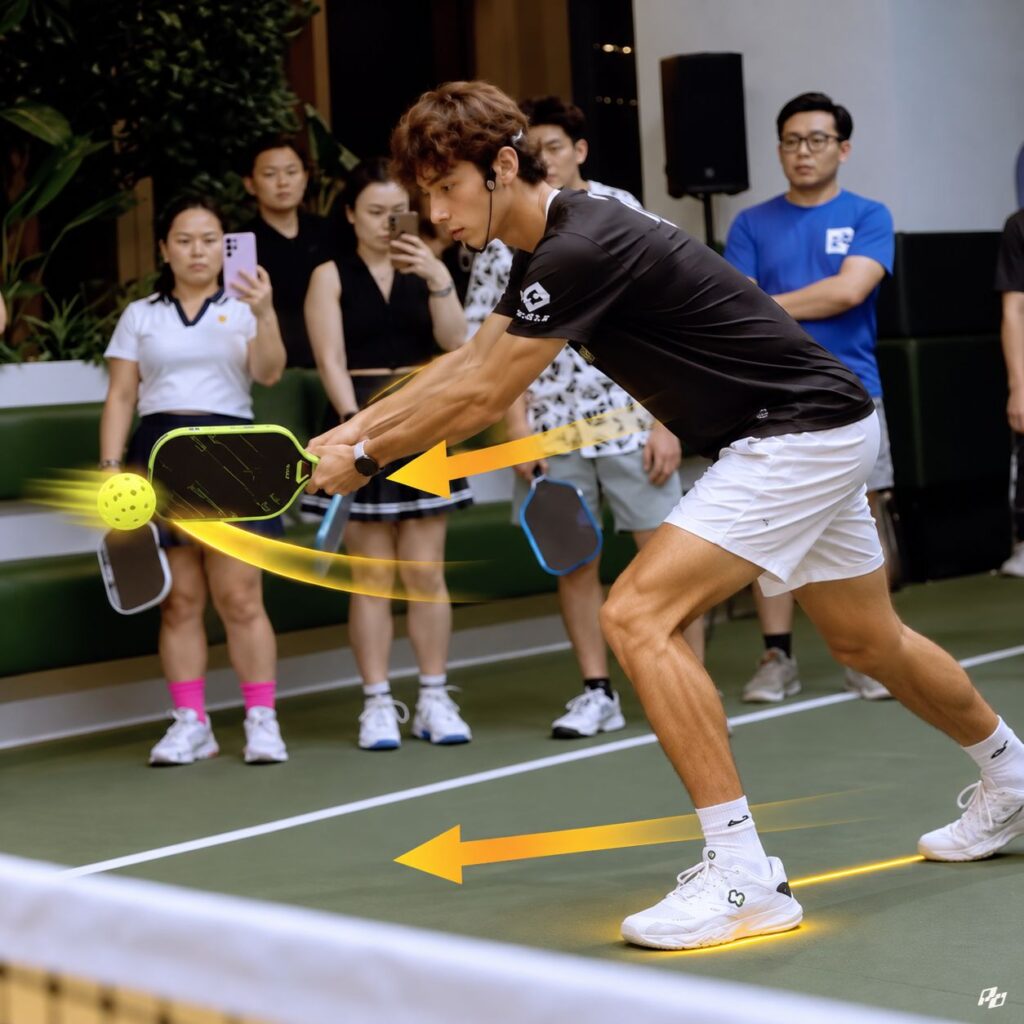
Your weight can shift from the back/outside leg into the shot while your base remains stable enough to defend the next ball.
That forward component is important because without it, players often make the swing too vertical. Then they get spin—but no penetration.
The ideal combination is: forward enough to pressure the opponent, upward enough to create dip.
That is why Tardio’s forehand looks heavy without looking violent.
Your body position quietly chooses the target
This is one of Tardio’s more advanced tips. For the crosscourt speed-up, he describes positioning the body slightly more diagonally, facing more toward the middle.
For the down-the-line ball, he becomes more closed.
This is not about dramatically announcing your target. It is about giving your arm a clean pathway.
If your hips and shoulders are organized for one direction and you suddenly force the paddle toward another, you often lose either control or spin.
The body gives the stroke its lane.
The paddle makes the final adjustment.
That gives you a useful rule: Do not aim only with your wrist. Build the direction with your body first.
At higher levels, you can disguise the target by using similar preparation and changing the paddle face late. But you still need enough body organization that the swing is not fighting your own position.
Try the “speed-up loop” instead of drilling winners
Here is the drill I would use for a 3.75–4.5 player.
Start crosscourt at the kitchen.
Dink three or four balls.
On an attackable forehand:
1. Preload
Make the small grip change before the ball reaches you.
2. Attack
Contact in front, move slightly forward, and use the compact circular brush.
3. Recover
Return the grip toward Continental and put the paddle back in front.
Your partner’s job is to counter the speed-up—not let you admire it. Play out only the next two balls.
You are training: speed-up → counter readiness
rather than: speed-up → hope.
After you can do that reliably, alternate targets.
Crosscourt.
Then line.
Try to keep the preparation as similar as possible while changing body orientation and final paddle direction.
One warning for Eastern-grip players
If you already live in a strong Eastern forehand grip at the kitchen, do not automatically copy Tardio’s grip change.
There is no universal professional grip.
Some advanced players stay forehand-biased because their counters and two-handed backhands work from there. Others prefer Continental as home base and make temporary adjustments for forehand rolls and attacks. Current high-level player discussions make clear that both approaches exist.
So copy the function, not necessarily the exact label.
Tardio wants:
- a face that supports spin
- without sacrificing control
- and enough time to recover for the next ball
If your current grip already gives you those things, do not change it just because a pro did.
What to steal from Gabe
Not the violence.
Not the speed.
And definitely not a giant wrist roll.
Steal the order.
- Grip first.
- Body second.
- Contact in front.
- Brush through.
- Recover immediately.
That is why Tardio’s forehand speed-up looks so smooth. He is not suddenly becoming aggressive at contact.
The attack was already organized before the ball got there.