

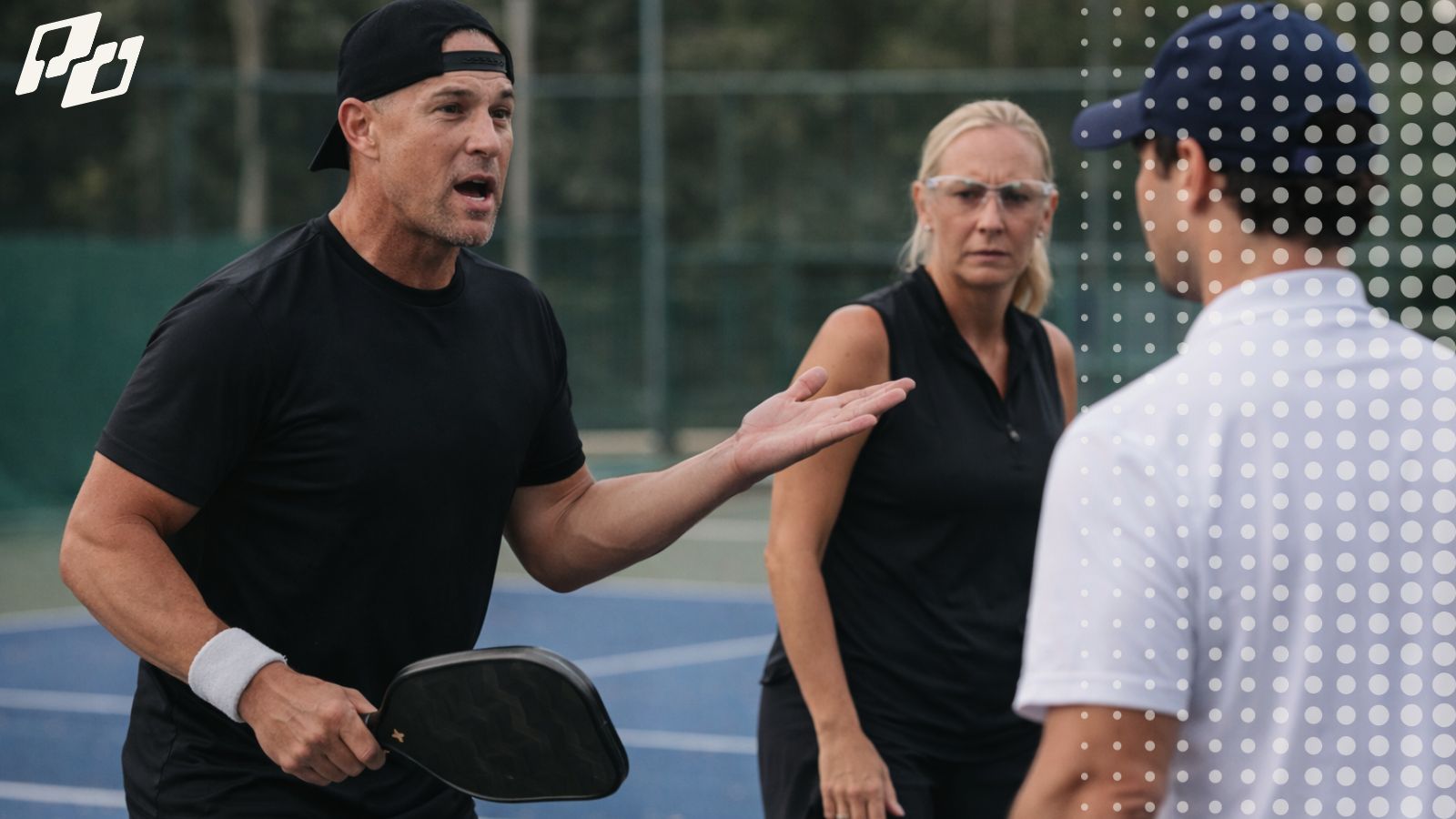
One of the weirdest things about pickleball is that it can be both incredibly welcoming and weirdly triggering.
For a lot of people, rec pickleball is supposed to be the fun part of adult life. It is exercise, community, routine, laughter, a little competition, and maybe one of the few places left where you can show up in the middle of the week and just be around people. So when one obnoxious, aggressive, or mean-spirited player starts poisoning that environment, it does not just annoy you. It gets under your skin.
And honestly, that reaction is normal.
Because the problem is not only that someone is rude. The problem is that rude players bring a certain old social ugliness with them. They can make the courts feel like middle school. They can make beginners feel humiliated. They can make kind people go quiet. And they can make perfectly capable adults suddenly feel frozen, overreactive, embarrassed, or angry in ways that do not feel like “them.”
If that has happened to you, you are not weak, dramatic, or too sensitive. You are reacting to a real social threat: someone who is trying to dominate the mood of the court through aggression, contempt, intimidation, or chaos.
The good news is that there are ways to handle it without turning into the same kind of person. Not every situation should be handled the same way, though. That is the first thing to understand.
So the goal is to learn how to read the situation, protect yourself and others, and respond in a way that preserves both your safety and your self-respect.
Start with this: not every conflict is a “you need to toughen up” moment
A lot of bad advice in rec sports comes from people who confuse emotional numbness with maturity. You do not have to pretend something is fine when it is clearly not. If someone is:
- yelling at partners,
- humiliating beginners,
- arguing every line call,
- blasting reckless balls at people with no control,
- touching people or their stuff,
- manipulating paddle stacks or court rotation,
- or creating an atmosphere where people visibly dread playing,
that is not “just competition.” That is a behavior problem. That distinction matters because it helps you avoid gaslighting yourself.
You are not trying to control every little annoyance. You are responding to behavior that makes the environment feel unsafe, hostile, or degrading. There is a big difference between normal competitive play and behavior that crosses the line into recklessness, humiliation, or repeated antagonism — especially in beginner or rec settings.
The first rule: deal with it earlier than you want to
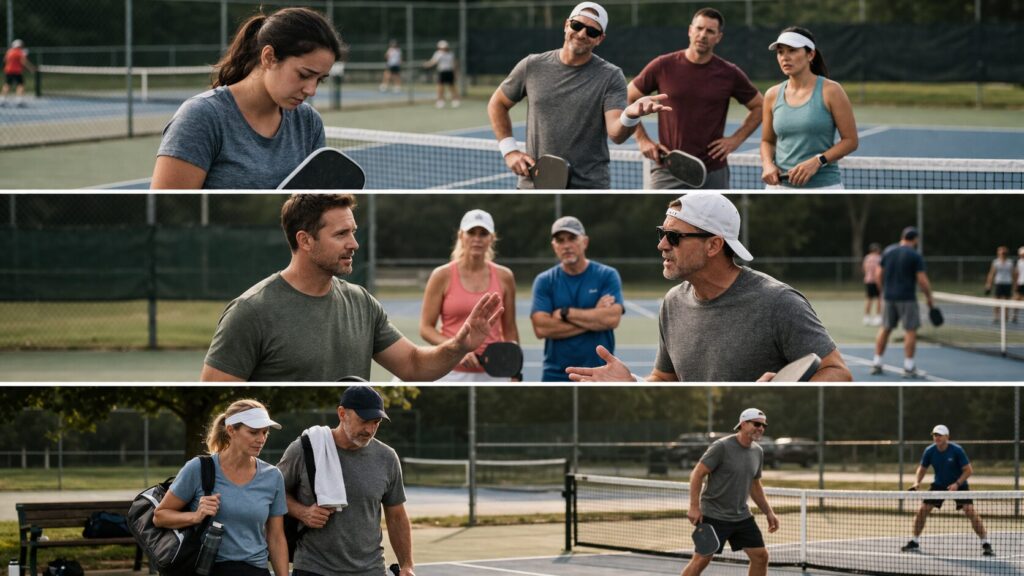
This is probably the most important practical lesson: say something earlier.
⮕ Not after six weeks.
⮕ Not after the person has alienated half the park.
⮕ Not after you have built up so much resentment that your voice is shaking.
Earlier.
Why? Because obnoxious players learn from silence.
If they hit recklessly, sneer at people, bark at partners, or argue every call and nobody says anything, they read that as permission. Not because they are right, but because that is how bullies and boundary-pushers work. They test the edges of a group, then keep expanding until somebody stops them.
That does not mean you need to explode at the first offense.
It means when something crosses a line, address the line before the whole situation becomes emotionally loaded.
What to say in the moment
Most people struggle here because they think their options are either:
- say nothing, or
- go nuclear.
There is a huge middle ground. The most effective responses are usually:
- short,
- calm,
- specific,
- public enough to set a boundary,
- but not so emotional that the other person gets to drag you into a spiral.
Here are the kinds of phrases that work well.
If someone is yelling at a partner:
“Hey, we’re not doing that here.”
“Talk to your partner with respect.”
“Cut the commentary. It’s rec play.”
If someone humiliates a weaker player:
“That’s not okay.”
“We’re not talking about people like that.”
“If you don’t want to partner with someone, say it respectfully or sit out.”
If someone keeps arguing line calls:
“It’s our call.”
“I made the call. Let’s move on.”
“If there’s doubt, I’ll give it to you. If I called it out, I saw it out.”
If someone is hitting recklessly in beginner-level games:
“You need to control that shot.”
“This is getting unsafe.”
“If you can’t hit hard without spraying people, ease up.”
If someone grabs your clothing, paddle, or body:
“Do not touch me.”
“Don’t do that again.”
“That is not okay.”
Notice what these all have in common: they do not ramble. They do not diagnose. They do not beg. They do not try to win a debate.
They simply mark the boundary.
That is important psychologically. The more you explain, the more room the other person has to argue. Assholes love loopholes. They love turning your discomfort into a courtroom. Do not hand them the microphone.
What not to say
There are a few kinds of responses that feel satisfying in your head but usually make things worse in real life.
The first is the revenge fantasy response: “Do that again and I’ll make you regret it.”
The second is the courtroom monologue: “Let me explain, in detail, why what you are doing reflects deep insecurity and poor emotional regulation…”
The third is the sarcastic performance: “Wow, big man. You beat up a beginner. Incredible.”
The fourth is the ego duel: “Try that with me and see what happens.”
All of these have one thing in common: they shift the interaction from boundary setting to status battle.
That is exactly where many obnoxious players are most comfortable. They want conflict. They want energy. For certain personalities, confrontation becomes fuel, and going through staff or organizers is often more effective than trying to “teach them a lesson” yourself.
That does not mean never speak up. It means do not let them pick the format.
The big decision: direct confrontation, quiet boundary, or organizer escalation?
This is where judgment matters.
Use direct confrontation when:
The behavior is clear, the person is annoying but not truly volatile, the boundary needs to be set in front of others, and you still feel physically safe doing so.
This is best for things like:
- constant coaching or criticism,
- rude comments,
- line-call pestering,
- queue manipulation,
- a humiliating remark toward a beginner,
- or general court bullying.
Use a quiet boundary when:
The person is more obnoxious than dangerous, you don’t want to create a public spectacle, and you’re simply trying to protect your peace.
This looks like:
- declining to play with them,
- pulling your paddle,
- saying “I’m sitting this one out,”
- or walking away after the game with no extra energy.
A lot of the time, one of the strongest tools you have is simply not playing with them again. In many rec environments, social access is the real currency. When enough people stop rewarding bad behavior with court time, the message usually lands.
Go to staff, organizers, instructors, or venue management when:
- the behavior is repeated,
- the person is humiliating beginners or targeting specific players,
- the hitting is reckless and unsafe,
- there is touching, intimidation, or harassment,
- or you think direct confrontation could escalate things.
This is often the right time to go to the instructor, facility manager, league organizer, or whoever runs the space, especially if the behavior is repeated or already forming a pattern. That is not overreacting or “running to authority over nothing.” It is using the structure that exists to keep the environment playable and safe.
And if you do go higher up, be factual:
- what happened,
- when it happened,
- who saw it,
- whether it has happened before,
- and what effect it is having.
Do not lead with “he’s a psycho.” Lead with “He has repeatedly yelled at partners, publicly mocked a new player, and hit uncontrolled balls at chest and face height in beginner games.”
Specific behavior is easier to act on than emotional labels.
The beginner-bully problem: one of the ugliest versions
There is something especially gross about people who bully beginners.
Not because beginners are fragile, but because beginners are the least socially armored. They do not know the norms yet. They do not know who is respected. They do not know whether what just happened is “normal.” So when a rude or aggressive player humiliates them, there is a good chance they will assume the entire culture is like that.
That dynamic shows up a lot with newer players who are mocked or made to feel like the unwanted partner. One of the strongest responses is often the simplest: partner with the beginner, include them normally, and make the bully’s behavior look as out of place as it really is.
That is one of the most underrated conflict tools in rec pickleball:
⮕ Sometimes you do not defeat a bully by debating them.
⮕ Sometimes you defeat them by refusing their social framing.
They want the beginner to feel ashamed.
✔ You act like partnering with the beginner is the most normal thing in the world.
They want everyone frozen.
✔ You behave like the bully is the weird one.
That matters more than people realize.
The reckless hitter: when it’s not just rude, it’s unsafe
This one needs nuance.
Body shots exist in pickleball. Speed-ups exist. Targeting the body can be strategic. Not every hard ball is malicious.
But there is an important distinction here: a controlled, legitimate attack is not the same as a player with poor control repeatedly firing dangerous balls at people in lower-level or beginner settings. Skilled offensive play is one thing. Swinging recklessly with no real concern for where the ball ends up is another.
If someone has poor control and keeps bruising people, hitting near faces, or creating a pattern of dangerous play in rec settings, the issue is not “competitive spirit.” The issue is that they are not safe enough for the environment they are in.
What do you say?
In the moment:
“You need to control that.”
“That’s too reckless for this group.”
“If you can’t place it safely, don’t hit it that hard.”
After the game:
“You may not be trying to hurt people, but this is getting unsafe.”
“In this group, that shot needs more control.”
“You can play aggressively without putting beginners at risk.”
And if it keeps happening, that is one of the clearest situations for organizer involvement.
The chronic arguer
These players are exhausting because they turn every point into a referendum. The trick here is not to get pulled into their preferred sport, which is no longer pickleball. It is argument.
The most grounded approach here is not to escalate or try to win the argument point by point. It is to make the call clearly, keep it brief, and move on. It also helps to know the rules and norms well enough that you can stay calm, certain, and unemotional.
Good phrases:
“It’s our call.”
“I saw it out.”
“If I’m unsure, I’ll call it in.”
“We’re not doing a debate every point.”
If the person keeps pushing:
“I’m done discussing it.”
“Let’s finish the game.”
“After this one, I’m not playing with you again.”
Notice how boring that is. Boring is good. Arguers feed on escalation. Calm repetition starves them.
The obnoxious partner
This is a special kind of unpleasant because now you are stuck beside the person.
Maybe they coach every ball.
Maybe they roll their eyes.
Maybe they sigh dramatically.
Maybe they poach everything and then blame you.
Maybe they act as if your mistakes are an offense against their bloodline.
You do not have to be endlessly nice to this person.
Try one clean in-game line:
“Encouragement only.”
“Stop coaching me during points.”
“Talk to me respectfully.”
“Let’s keep this constructive.”
If it continues, the strongest move is often after the game:
“I’m not playing together again if that’s how you act with a partner.”
or
“I’m here to enjoy rec play, not get talked to like that.”
Then actually mean it.
A lot of adults stay stuck around difficult people because they think setting a limit requires a massive confrontation. It often does not. Sometimes it is just a calm refusal to keep re-entering the same dynamic.
Group psychology: why nobody says anything
This matters because if you have ever frozen while someone acted horribly, you may later beat yourself up for it.
But freezing is common.
Sometimes bystanders are not really being complicit so much as getting caught off guard or not knowing how to respond in the moment. That matters because it means you should not build your whole strategy around expecting instant heroics from strangers.
Instead, think in terms of scripts. When people have a sentence ready, they are much more likely to use it.
A few good bystander lines:
“That’s not okay.”
“We’re not doing that.”
“I’ll play with her.”
“Leave the line call alone.”
“Cut it out.”
“Don’t touch people.”
Simple sentences help groups act faster.
When the best move is collective freeze-out
This is not the answer to every problem. But for some recurring public-court menaces, it may be the only thing that works.
In some communities, the only thing that eventually works is people refusing to play with a disruptive person, pulling paddles, avoiding games, or socially freezing them out until the behavior changes or the person stops showing up.
This works best when:
- the behavior is known,
- lots of players feel the same way,
- the person is not responsive to direct feedback,
- and there is no strong formal authority structure.
The danger is that freeze-outs can become petty or cruel if they are used casually.
So the standard should be high: there needs to be repeated bad behavior, a clear pattern, little to no response to feedback, and some level of impact on the broader community.
Used carefully, though, social boundaries are not mean. They are how communities protect themselves.
When someone may be unstable, impaired, or dealing with something bigger
This part requires empathy and realism at the same time.
Sometimes a disruptive player is not just arrogant. They may be intoxicated, mentally unwell, neurologically impaired, or simply unable to regulate themselves normally in a social setting. That can be especially true with certain public-court regulars whose behavior feels erratic or unusually hard to predict.
The important thing is this: understanding is not the same as excusing.
⮕ You can be compassionate and still set firm limits.
⮕ You can recognize someone is struggling and still say, “I am not playing with them.”
⮕ You can avoid shaming them as a human being while still insisting the behavior is unacceptable.
And in those cases, it is often even more important not to get into an ego contest. Use short boundaries. Get help. Document patterns. In public settings, prioritize distance and safety over moral victory.
The emotional part nobody talks about enough
Sometimes the hardest part is not the rude player. It is the reaction they trigger in you.
They can bring up old embarrassment, that familiar shut-down feeling, the adrenaline rush that makes your chest tighten, or the anger that shows up later when you are replaying the whole thing in your head and thinking of what you wish you had said.
That part matters, because if you do not recognize it for what it is, you can start chasing the wrong goal. You may think your job is to beat them, put them in their place, or win the emotional battle. Most of the time, it is not.
The better goal is:
Step 1: Steady yourself first and slow your body down.
Step 2: Keep your voice calm and refuse to match their energy.
Step 3: Use a simple script instead of trying to improvise while upset.
Step 4: If needed, step away, reset, and handle it once you’re more grounded.
What you are really trying to do is protect your enjoyment of the game, keep one ugly person from taking over your whole nervous system, and handle the situation without turning into someone you do not like.
That is the healthier response. And honestly, the stronger one.