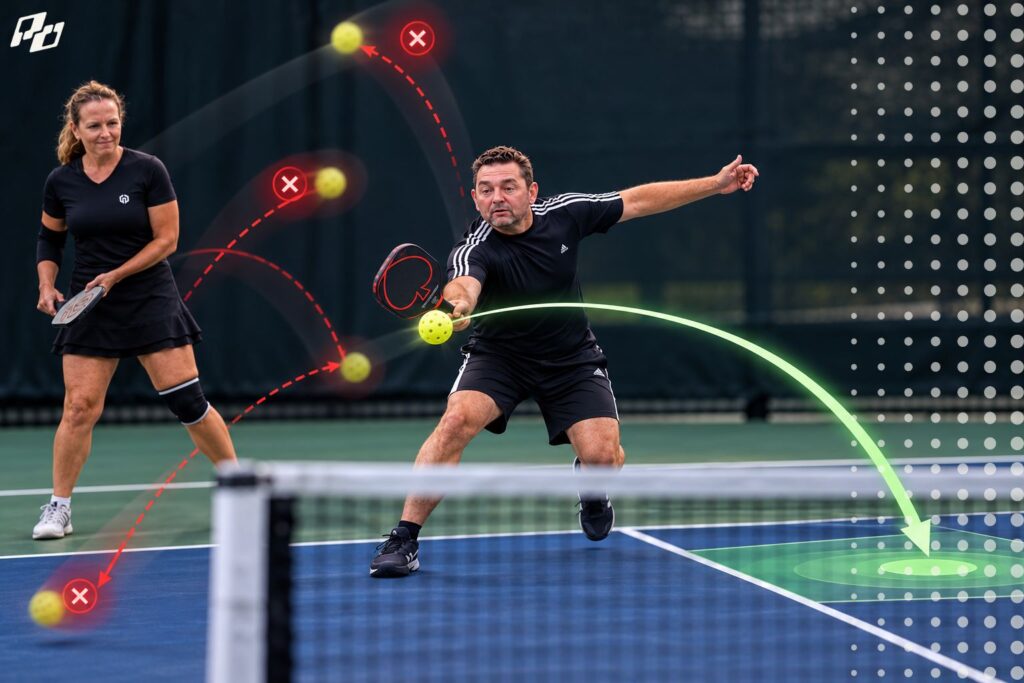
At 3.5, improving faster often means cutting unforced errors before adding new shots. Track your serve, return, neutral-ball, and attack misses, then aim to remove three free points per game. Fewer donations force opponents to earn more—and can move you toward 4.0 faster.
Tennis players hear a version of this all the time: roughly 70% of points end in errors, and only around 30% in clean winners. That exact split varies by event and by how analysts classify forced versus unforced errors, but the broader idea is real: even at the highest levels, far more points end with somebody missing than with an untouched highlight-reel winner. One analysis of major professional events found that more than 70% of men’s points and nearly 77% of women’s points ended in some kind of error.
Pickleball tells a very similar story.
A notational analysis of women’s PPA singles found that 63.7% of points ended in unforced errors. Service faults were only 2.3%, and the authors found that most points were decided through mistakes rather than clean winners.
Now, that is pro women’s singles, not 3.5 rec doubles, so I would not pretend 63.7% is your exact number on Tuesday night.
But the lesson translates beautifully: At 3.5, you probably don’t need three more winners. You need three fewer donations.
That is what I want to help you do here.
Not become passive.
Not dink everything.
Just identify the three or four errors that keep appearing every game and remove enough of them that your opponent has to earn more points.
My practical target for a 3.5 player is simple: Cut 3 unforced errors per game.
If you usually donate seven routine points, get it to four.
If you’re around five, get it to three.
There is no universal scientific “correct” error budget for every 3.5 game, but coaching guidance around this level consistently emphasizes that the jump upward is driven heavily by consistency, shot selection, and reducing unforced errors—not simply adding more weapons.
Here’s where I’d find those three points.
1. Remove One Serve-or-Return Miss
This is the cheapest point you can stop giving away.
A missed serve or routine return does something worse than ending the rally: it prevents the rally from ever becoming useful.
You never get to pressure anyone.
You never get to the kitchen.
You never make them hit another ball.
You simply hand the point or side-out over.
The pro singles data is telling here: service faults were just 2.3% of point endings.
The better players understand something simple: the serve starts the problem; it does not have to solve it.
What I’d do at 3.5
On serves, stop trying to combine:
- maximum pace
- maximum depth
- and a small target
on every ball.
Pick two.
A serve at 80–85% pace that lands deep repeatedly is usually more useful than occasionally crushing one and missing the next.
On returns, make the target even simpler:
- deep
- middle third
- comfortable net clearance
The returner’s biggest advantage is that they can move forward after contact. Don’t throw that away chasing a sideline.
Your target
No more than one combined serve-and-return error per game.
If you currently miss three, there are potentially two of your three saved points immediately.
Cue
“Start the rally first.”
2. Stop Missing the First Neutral Ball
This is a much more 3.5-specific leak.
You’ve survived the serve.
The return is in.
The point has settled.
Then you get a completely manageable third, fifth, dink, or transition ball… and try to make it special. That is where a lot of intermediate errors live.
The player isn’t under real pressure. They’re simply uncomfortable with neutrality. They think: “I should make something happen.”
Sometimes you should. But not every neutral ball deserves acceleration, angle, disguise, or a tiny target.
Use a 90% rule
For a routine neutral ball, choose a shot you believe you can execute roughly 9 times out of 10 from that position.
That could mean:
- a middle dink
- a controlled reset
- a high-margin crosscourt dink
- a basic third-shot target
- a body volley rather than a sideline
This does not mean “play scared.” It means you reserve the lower-percentage shot for a ball that actually justifies the extra risk.
This is one reason coaches describing the 3.5-to-4.0 transition focus so much on decision quality: 3.5 players often have the shots already; they lose points by choosing the wrong one at the wrong time.
Your target
Remove one routine neutral-ball error per game.
That is error No. 2 gone.
Cue
“Routine ball = 90% shot.”
3. Stop Hitting the Third While Your Feet Are Still Arriving
A lot of 3.5 players think their third-shot problem is paddle technique. Sometimes it is actually timing of the body.
Deep return comes in.
You move.
The ball arrives.
You’re still drifting.
And you hit anyway.
Now your spacing is changing during contact.
Your torso is still moving.
Your paddle face has to compensate.
Then the drop goes into the net or the drive sprays wide.
The fix is tiny
Think: move → set → hit
“Set” does not mean freeze for a full second.
It can be a very brief moment where your base is organized and your weight is not still carrying you through the shot.
If your feet are moving because you genuinely have to defend, fine. But if you’re creating the movement yourself by rushing, that is preventable.
Watch coach Tanner Tomassi explain what it means to hit still and how to do it correctly.
Why it matters
A moving contact point adds several variables at once:
- distance to ball
- balance
- paddle face
- swing path
- timing
At 3.5, reducing variables is one of the fastest ways to make a shot more repeatable.
Cue
“Arrive before you hit.”
4. Start Separating Net Errors From Long Errors
This is where we need to get more mathematical.
Do not track “misses.”
Track where they miss.
After one game, write:
NET: 4
LONG/WIDE: 2
That already tells you more than “I made six errors.” Because those two groups usually point to different problems.
Mostly net?
You may be:
- hitting while moving
- taking too little margin
- contacting late
- choosing too ambitious a shot from a poor ball
Mostly long or wide?
You may be:
- overhitting
- using too small a target
- opening the face
- accelerating more than your spin/control can support
Now the practice goal becomes obvious.
If your errors were: 4 net / 2 long, don’t try to “fix your whole game.”
Try to get: 4 net → 2.
That alone removes two donations.
Target selection is a major part of this. Higher-margin targets can reduce errors immediately without any stroke rebuild.
Cue
“Count the miss, then fix the pattern.”
5. Change the Target Before You Change the Swing
This is one of my favorite intermediate fixes.
You miss two forehands wide. Your immediate thought: “Something’s wrong with my forehand.”
Maybe.
But first ask: Where was I aiming?
If your target was six inches from the sideline, your stroke may be perfectly serviceable. Your target was just asking too much of it.
A practical 3.5 rule
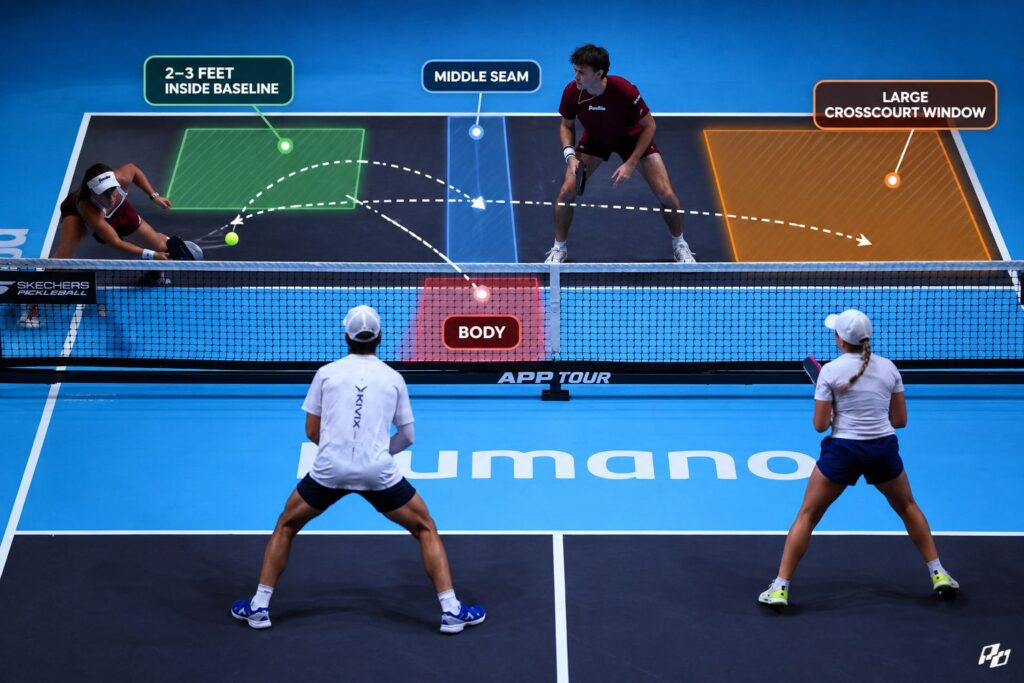
For routine balls, stop aiming at lines. Use zones. Think:
- 2–3 feet inside the baseline
- middle seam
- body
- large crosscourt window
The important distinction is: Safer target does not mean softer shot.
You can hit a strong drive at the middle third.
You can pressure the body.
You can hit a deep return with pace.
You are reducing target risk, not necessarily ball speed. And that is exactly how you lower errors without turning into a passive player.
Cue
“Big target. Same intent.”
6. Make the First Speed-Up Create the Next Ball
This is another place 3.5 players leak points. They speed up and judge the shot by one question: Did it win?
If not, they think it wasn’t aggressive enough. So next time they hit harder. That is backwards.
The first speed-up often does not need to win. It needs to create a predictable counter.
Aim at:
- body
- paddle-side hip
- middle
and use enough pace to create pressure without requiring a perfect target. Then expect the next ball.
That turns: one low-percentage winner attempt
into: pressure → predictable reply → finish
Why this lowers errors
You’re asking less of the first attack.
You don’t need: maximum pace + tiny target + surprise
all at once.
You need to make the opponent uncomfortable enough to give you Ball 2.
Cue
“Jam. Expect. Finish.”
7. Never Pay for the Same Error Twice
This one is mental, but it absolutely belongs in an error article.
You miss a routine dink.
That’s one error.
Then you’re annoyed.
So on the next rally you rip a return at the sideline.
Miss.
Now the original error effectively cost you two points.
This is why errors often come in clusters. The player is not just missing. They are reacting to the miss by changing how they play.
The 3.5 rule
After a clear unforced error, make the next point slightly lower variance.
Not passive.
Just normal.
Think:
✔ deep return
✔ large target
✔ make the third
✔ split before contact
Cue
“One error, not three.”
If this saves just one reaction error per game, you’ve hit your three-point goal.
Here’s the 3-Point Math
Let’s say you normally make 7 true unforced errors in a game. Your goal is not zero. Your goal is:
7 → 4
Find them here:
1 fewer serve/return miss
1 fewer routine neutral-ball miss
1 fewer reaction or low-percentage error
That’s three.
Now, I would not say that automatically turns an 11–8 loss into an 11–8 win. Traditional pickleball scoring, side-outs, and rally context make that arithmetic too simplistic.
But strategically, those three removed errors are enormous.
Because your opponent now has to play three more successful sequences instead of simply accepting three free points.
That is the real value.
The Error Budget I’d Give a 3.5 Player
For one game, track only this:
| Error category | Practical target |
|---|---|
| Serve + routine return errors | 0–1 |
| Routine neutral-ball errors | 1–2 |
| Low-percentage attack misses | 0–1 |
| Reaction errors after a previous miss | 0–1 |
Don’t obsess over perfection.
If your total is seven, chase five.
Then four.
Once four feels normal, see whether you can live around three.
I would treat this as a training benchmark, not an official rating standard. There is no universal published error quota that defines a 3.5 player.
The important part is that you start measuring your own trend.
The Best Drill Might Be a Pencil
Seriously. For three games, don’t change anything. Just tally:
S/R — serve or return
N — neutral-ball miss
A — attack miss
R — reaction error
At the end, look for the largest number. That’s what you work on.
Not the shot that annoyed you most.
Not the spectacular winner somebody else hit.
The category that quietly cost you the most points. That is a much better practice plan.
At 3.5, Improvement Is Often Subtraction
This is the part I think players underestimate.
Going from 3.5 toward 4.0 doesn’t always require adding another serve, learning a new speed-up, or hitting a more aggressive third.
Sometimes the fastest improvement is:
- one fewer return miss
- one fewer unnecessary neutral-ball error
- one fewer hero shot
Three shots.
That’s it.
The tennis world has been talking about this idea for years because the numbers are hard to ignore: points often end through errors far more frequently than clean winners. Pickleball’s available data points the same way.
So next game, don’t count your winners. Count your donations. Then try to remove three.
At 3.5, you probably don’t need three more great shots. You need three fewer bad ones.