To get more pickleball power without swinging harder, relax your grip, create natural paddle lag, contact the ball farther in front, use more leverage, and generate force from the ground up. Better sequencing and cleaner contact can add pace while keeping your swing more controlled and repeatable.
Most rec players try to create more power the same way: swing harder.
That usually works for one or two balls. Then the grip tightens, timing gets late, contact gets messy, and suddenly the “power swing” is also your least reliable swing.
For most 3.0–4.0 players, better power usually comes from something simpler: getting more speed out of the swing you already have.
These five hacks are all easy to test. Each one fixes a different power leak—and none of them requires you to swing out of your shoes.
1. Relax Your Grip Before You Try to Hit Harder
The mistake
You see a sitter and immediately squeeze the handle.
Then the forearm tightens.
Then the shoulder tightens.
Now your swing feels aggressive, but the paddle actually has less freedom to accelerate.
What to do instead
Keep the hand and forearm looser during the swing, then let the grip firm naturally around contact.
You are not holding the paddle like a wet noodle. You just don’t want to clamp down from the start.
A good test is to hit a few drives at about 70% effort and deliberately relax your fingers during the backswing.
What you should feel
The paddle should move through the swing more freely. The arm should feel faster with less effort.
Why it helps
Too much tension can turn a whipping motion into more of a push. You want the paddle to accelerate, not be dragged through contact.
Cue
“Loose first. Firm at contact.”
2. Let the Paddle Trail Behind Your Hand
This is the one that can make a swing feel dramatically faster without making it feel harder.
The mistake
A lot of intermediate players move the hand and paddle together as one stiff unit.
That creates a very “blocky” swing.
What to do instead
As you rotate forward, let the hand lead slightly while the paddle head trails behind.
Then let the paddle catch up through contact.
You are not trying to violently snap the wrist. That is where players get into trouble. The lag should happen because the arm and wrist are relaxed enough for the paddle to trail naturally.
Here’s coach Michael Oakson showing how letting the paddle trail behind the hand creates natural lag—and more paddle-head speed without forcing the swing.
@thepickleballchir Most players KILL their power with a tight grip 🤦♂️ Relax your grip + wrist → SNAP at contact → 🔥 forehand power Use code Dr. Oakson at @slycepickleball to level up 🧢 Drop DRIVE if you want the full breakdown + drills 👇 #pickleball #pickleballtiktok #pickleballislife #pickleballaddiction #pickleballaddict #pickleballtips #pickleballplayers ♬ iPhone 5 – Jaycee,Hal Walker
What you should feel
The swing should feel more like a whip than a shove.
Why it helps
That small delay can increase paddle-head speed and often helps with topspin too.
Cue
“Hand leads. Paddle follows.”
3. Move Contact Forward Before You Add More Effort
This may be the easiest power gain on the entire list.
The mistake
You let the ball get too close to your body.
Now the elbow gets cramped.
The paddle is beside you instead of in front.
And there is nowhere left for the swing to accelerate.
So you swing harder with the arm to compensate.
What to do instead
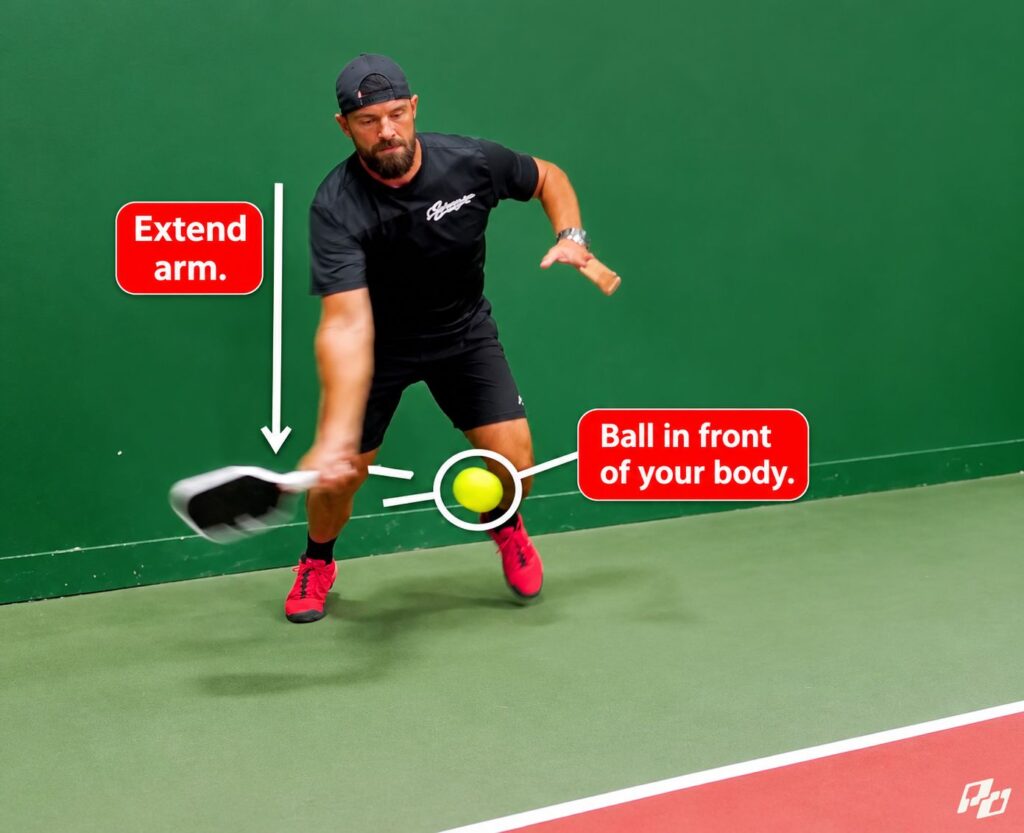
Create enough space with your feet so contact happens slightly in front of your body. Not way out in front. Just far enough that your arm has room to extend through the ball.
If you consistently feel jammed on drives, this is probably the first thing I’d fix.
What you should feel
Cleaner contact.
More room to swing through.
Less effort for the same depth.
Why it helps
A better contact point gives you more usable leverage and lets the body rotate through the shot instead of rescuing it late.
Cue
“Make space first. Add speed second.”
4. Slide Your Hand Slightly Lower on the Handle
This is the easiest gear hack.
The mistake
Some players choke up on the handle all the time.
That can feel controlled, but it also shortens the effective lever.
What to do instead
On serves and drives, slide your hand slightly lower toward the butt cap. Not dramatically. Even a small change can make the paddle feel a little longer and more whippy.
Try half an inch lower and compare it with your normal grip.
What you should feel
More leverage.
A little more paddle-head speed.
A fuller swing without extra effort.
The tradeoff
You may lose a bit of control or hand speed if you go too low.
So this is not: “hold the paddle at the very end.”
It is: “experiment with a slightly longer lever.”
Cue
“Long court, longer lever.”
5. Start the Swing From the Ground, Not the Shoulder
This is the biggest power leak for a lot of intermediate players.
The mistake
The arm starts everything.
The shoulder fires.
The rest of the body comes along late.
Now one relatively small part of the body is trying to create almost all the speed.
What to do instead
Let the swing build in sequence: legs → hips → torso → arm → paddle
Start with a small load into the ground.
Let the hips begin rotating.
Let the torso follow.
Then let the arm deliver the paddle.
The arm still moves fast. It just should not be responsible for creating all the speed by itself:
@goatpaddle Power isn’t about swinging harder—it’s about swinging through. 💥🏓 #pickleballpro #tips #pickleball #coaching #drives ♬ DARK HORSE FLOW – Tyffanne Latifah
What you should feel
The shot should feel heavier even though the arm feels less busy.
Why it helps
You are using more of your body and transferring that energy into the paddle instead of manufacturing everything at the shoulder.
Cue
“Push. Turn. Deliver.”
One Gear Thing Most Players Get Wrong: Power and Pop Are Different
A paddle can feel really lively in counters and hand battles. That’s pop. But that doesn’t always mean it has the most full-swing power.
Power is what you get on bigger swings like drives and serves.
Pop is how quickly the ball jumps off the face on short, compact contact.
If you’re buying online, JustPaddles Paddle Lab is useful. Look at the Exit Velocity number. That tells you how fast the ball leaves the paddle face in their test.
In simple terms: Higher exit velocity = more full-swing power potential.
As a rough guide, paddles around 42–44 mph tend to sit on the stronger power side, while 38–40 mph is usually more moderate or control-oriented.
Then use review language to judge pop.
Words like:
“explosive on counters”
“very lively at the kitchen”
“quick off the face”
usually point to pop.
Words like:
“big serve speed”
“heavy drives”
“easy depth”
usually point to power.
So if you’re shopping online, ask two questions:
How hard does it hit on a full swing?
How jumpy is it on a short swing?
That’s much more useful than just seeing the label “power paddle.”
Foam Can Add Power—But “Full Foam” Doesn’t Tell You How Much
Here’s the useful part for rec players: foam can absolutely help create power, but the word “foam” by itself tells you almost nothing.
Foam changes how a paddle can flex, rebound, stabilize the face, and return energy to the ball. That gives manufacturers more ways to build a powerful paddle—especially in thicker 16mm designs that used to be associated mostly with control.
But two full-foam paddles can still play very differently because foam density, internal cutouts, face layup, shape, swing weight, and balance all change the result. Current lab data shows foam paddles ranging from more controlled models to paddles with exit velocities above 43–44 mph, so “foam” is clearly not one performance category.
Look for exit-velocity or power testing, then check swing weight and shape. An elongated, heavier-swinging foam paddle may give you more leverage and drive power, while a lighter or wider foam model may trade some of that for easier handling and forgiveness.
The simple rule: Foam gives designers more ways to create power. It does not guarantee power.
Buy the measured performance—not the core label.
Thin Doesn’t Automatically Mean More Powerful Anymore
The old shortcut was:
13–14mm = power
16mm = control
That’s much less useful now.
A thinner paddle often still feels firmer and quicker off the face, but modern 16mm paddles can generate serious pace too because brands are tuning face stiffness, rebound, foam, perimeter construction, and swing weight as a system.
So if you’re comparing paddles, don’t use thickness as your power ranking. Use it as just one clue.
A 14mm paddle may feel faster. A 16mm paddle may still hit harder.
Try This: The 70% Power Test
If you want to know which hack actually works for you, don’t swing at 100%. That makes it hard to feel what changed. Hit at about 70% effort.
Then test one thing at a time:
- normal swing
- looser grip
- more natural paddle lag
- contact farther forward
- hand slightly lower
- better legs-to-hips sequencing
Keep the effort the same.
Then ask: Which change gave me more depth or pace without making the swing feel harder?
That’s the one worth keeping.
The Bigger Lesson
Most intermediate players treat power like an effort problem. “I need to swing harder.” But power is usually an efficiency problem.
Can the paddle accelerate freely?
Is contact in front?
Are you using enough leverage?
Is your body sequencing the swing properly?
Are you using a paddle that actually gives you useful rebound?
The best power gain is often the one that feels almost unfair: same effort, heavier ball.
That’s what these hacks are really about.