Most rec pickleball warm-ups do something: a few shoulder circles, some light dinks, maybe a couple drives. You feel warmer. Looser. Ready.
And then the first “real” point happens—someone speeds up at your right hip, you flinch, your feet freeze, and your body does the exact thing you were trying to prevent.
That’s because most players warm up muscles… but skip the phase that actually protects you in pickleball:
The missing phase: reactive neuromuscular prep
In sports science terms, this is the part where you prime neuromuscular control—timing, balance, deceleration, change-of-direction, and quick decision-making—so your joints don’t take the hit when the rally turns chaotic. Injury-prevention warm-ups built around neuromuscular training (balance, control, agility) consistently show meaningful injury-risk reductions in field sports.
Pickleball is basically “tiny-court chaos”: split steps, lateral bursts, abrupt stops, awkward reaches, and surprise pace changes. A warm muscle helps. But it doesn’t automatically give you better braking, better positioning, or better reflexive stability.
The 4 Phases of a “Protective” Warm-Up (and what most players skip)
Many modern warm-up models follow a sequence like RAMP: Raise, Activate, Mobilize, Potentiate.
Rec players usually do Raise/Mobilize… and stop right before the part that matters most for pickleball.
| Phase | What you feel | What it actually changes | If you skip it, you’ll notice… |
|---|---|---|---|
| Raise | warm, light sweat | temperature, blood flow | you start “cold” |
| Activate/Mobilize | looser hips/shoulders | ROM, muscle readiness | you feel stiff/restricted |
| Potentiate | springy, sharp | speed/power readiness | your first few rallies feel slow |
| Reactive neuromuscular prep (the missing one) | “locked in” | decel/control + reaction timing | you get jammed, late, reachy, off-balance |
Dynamic warm-ups are widely used because they can enhance readiness and performance vs. doing nothing or only static stretching.
But readiness isn’t protection unless you also prime the reaction + control layer.
What “Reaction Systems” Means in Pickleball (in plain English)
This isn’t about having fast hands. It’s about what happens right before fast hands:
- Split-step timing (do your feet “land” as they strike?)
- First step direction (do you push the correct way immediately?)
- Deceleration skill (can you stop without collapsing your knee/hip?)
- Balance under perturbation (can you absorb a body-jam speed-up?)
- Decision speed (block, roll, reset… without guessing)
Neuromuscular warm-ups train “movement control” and “dynamic joint stability” so your body can handle unpredictable sport demands.
In pickleball terms: they help you stop doing the panic stuff.
The 10-Minute Pickleball Warm-Up That Actually Protects You
1) Raise (2 minutes)
Keep it simple. You just want heat and rhythm.
- brisk walk + arm swings → light jog in place
- add lateral shuffles (easy speed)
- finish with 10 seconds of quick feet
2) Activate + Mobilize (3 minutes)
Pickleball-relevant joints: ankles, hips, T-spine, shoulders.
- ankle rocks + calf pulses
- walking lunges (short stride)
- leg swings (front/back + side/side)
- scapular push-ups or band pull-aparts
(Dynamic warm-ups typically blend mobility + activation to prepare for sport demands.)
3) Potentiate (2 minutes)
You’re adding a little “pop” so the first hard rally isn’t a shock.
- 2×10 seconds: fast lateral shuffle + stop
- 2×5: short burst to NVZ line, stop under control
- 3 small “bounce hops” → then one quick split step
RAMP-style warm-ups use this phase to prepare for higher intensity outputs.
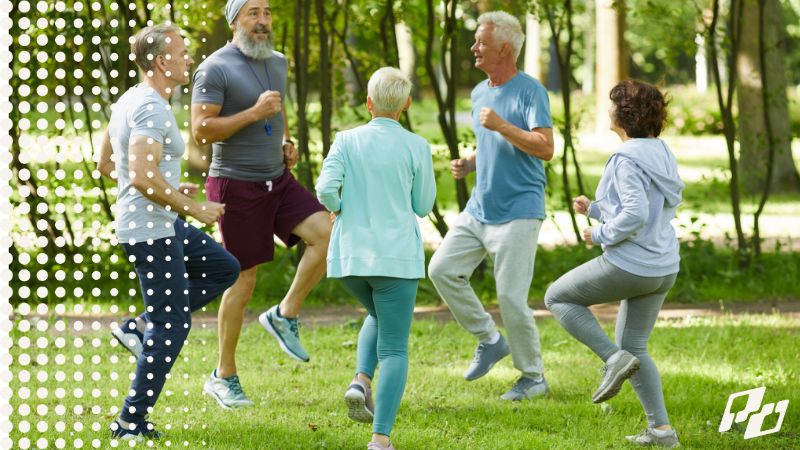
Here are seven quick dynamic warm-ups you can do in under seven minutes to get loose, raise your heart rate, and feel ready to move before the first ball is even hit:
4) The Missing Phase: Reactive Neuromuscular Prep (3 minutes)
This is the injury-protection and performance glue. It’s short—but it’s the difference.
Drill A: Split-step on contact (60 seconds)
With a partner at the kitchen:
- Partner taps the ball (light volley)
- You land your split step exactly on their contact
- Then you take ONE reaction step (left/right) and freeze
Why it works: you’re training timing + first-step correctness—two things that disappear under stress.
Drill B: Mirror shuffle + stop (60 seconds)
Partner faces you. You mirror their lateral movement:
- shuffle 2–3 steps
- partner stops suddenly → you stop under control (no drifting)
- repeat
Focus: quiet feet, hips back, chest steady. This is decel training in disguise.
Drill C: Random cue volley blocks (60 seconds)
Partner stands 7–10 feet away and feeds medium-speed volleys.
They call “block” or “roll” late—right before contact.
You respond with the matching action.
Why it works: this is decision speed. Not drills-for-drills—actual pickleball.
Coach-level cue: If your warm-up never includes “late information,” you’re not warming up pickleball—you’re warming up comfort.
Neuromuscular training warm-ups are designed to improve movement patterns and joint stability under sport-like demands.
What Physical Therapists and Trainers Tend to Emphasize (and why it matters here)
Across PT/training approaches, the recurring themes are:
- balance + proprioception (where your body is in space)
- control under perturbation (can you stabilize when something surprises you?)
- agility mechanics (decel, change-of-direction)
That’s exactly what reactive neuromuscular prep trains. You don’t need fancy equipment. You need a few minutes of controlled chaos.
Common Warm-Up Mistakes Pickleballers Make
“I dinked for five minutes. That’s a warm-up.”
Dinking warms touch, yes. But it rarely warms deceleration, lateral push, or reaction timing—the stuff that blows up knees, calves, and backs when points speed up.
“I stretch and I’m good.”
Static stretching alone isn’t a protective warm-up, and some guidance notes it can negatively affect performance if overdone right before activity.
Use dynamic movement first; save longer static stretching for after.
“I’ll warm up once the game starts.”
That’s the most dangerous version—because your first “real” scramble often happens before your system is ready.
What I Want You to Actually Do
If your warm-up ends the moment you feel loose, you’re stopping too early.
Pickleball doesn’t break bodies because players are stiff—it breaks bodies because the game forces late reactions, awkward stops, and rushed decisions before the nervous system is ready. That’s the gap most rec players fall into.
You don’t need a longer warm-up.
You need a smarter last three minutes.
The goal isn’t to feel warm. It’s to feel connected—to your feet, your balance, and the first move your body makes when something unexpected happens.
Bonus Tips That Make This Stick
- Warm up how you get hurt.
If you’ve tweaked calves, prep deceleration. If you get jammed, prep reaction blocks. Let past issues guide your final drills. - Match the warm-up to the day, not your ego.
Feeling flat? Add more reaction. Feeling jumpy? Slow the last drill down and control stops. - Judge readiness by your feet, not your arms.
If your feet feel quiet and responsive, you’re ready—even if your shoulder doesn’t feel “perfect” yet. - Your first hard rally shouldn’t be your first surprise.
If it is, the warm-up missed its job.
If you take nothing else from this: warm muscles help you play—prepared reactions help you stay healthy.
That last phase is where the difference is made.