If you flinch at the NVZ, you’re not “soft.” You’re human. Flinching is your threat response doing its job—your brain sees a fast object + close distance and chooses self-protection over execution.
The problem is: at the kitchen, that split-second decision turns into pops, dumps, and panic blocks. (Your doc nails this—flinching is usually fear + late prep, not a lack of talent.)
What fixes it isn’t “be brave.” It’s giving your body a repeatable structure so the ball stops feeling like an emergency.
What flinching actually looks like (so you can catch it)
Most rec players don’t notice they’re doing one (or more) of these:
- Paddle drops (hands get low = you’re late = you jab upward = pop-up)
- Head turns / eyes leave contact (you literally stop tracking)
- Shoulders rise (tension = stiff wrists = wild face angle)
- Backpedal (creates rushed contact and makes everything feel faster)
These patterns show up constantly in kitchen “firefights,” and the cure is almost always earlier prep + smaller motion.
Step 1: Remove the “fear of getting smoked” variable
This is the unsexy truth: if you’re genuinely worried about taking one to the face/eye, your nervous system will keep flinching no matter how many cues you memorize.
Two practical fixes:
- Wear eye protection for a few sessions while you retrain your hands (many players report immediate confidence because the threat level drops). The American Academy of Ophthalmology specifically recommends protective eyewear for pickleball.
- Start drills at 60–70% pace and earn your way up. (More on that below.)
That safety layer isn’t “soft.” It’s a training wheel for your nervous system.
Step 2: Fix the #1 mechanical cause of flinching: late readiness
Flinching is often just late positioning disguised as fear.
Your new “kitchen ready” checklist
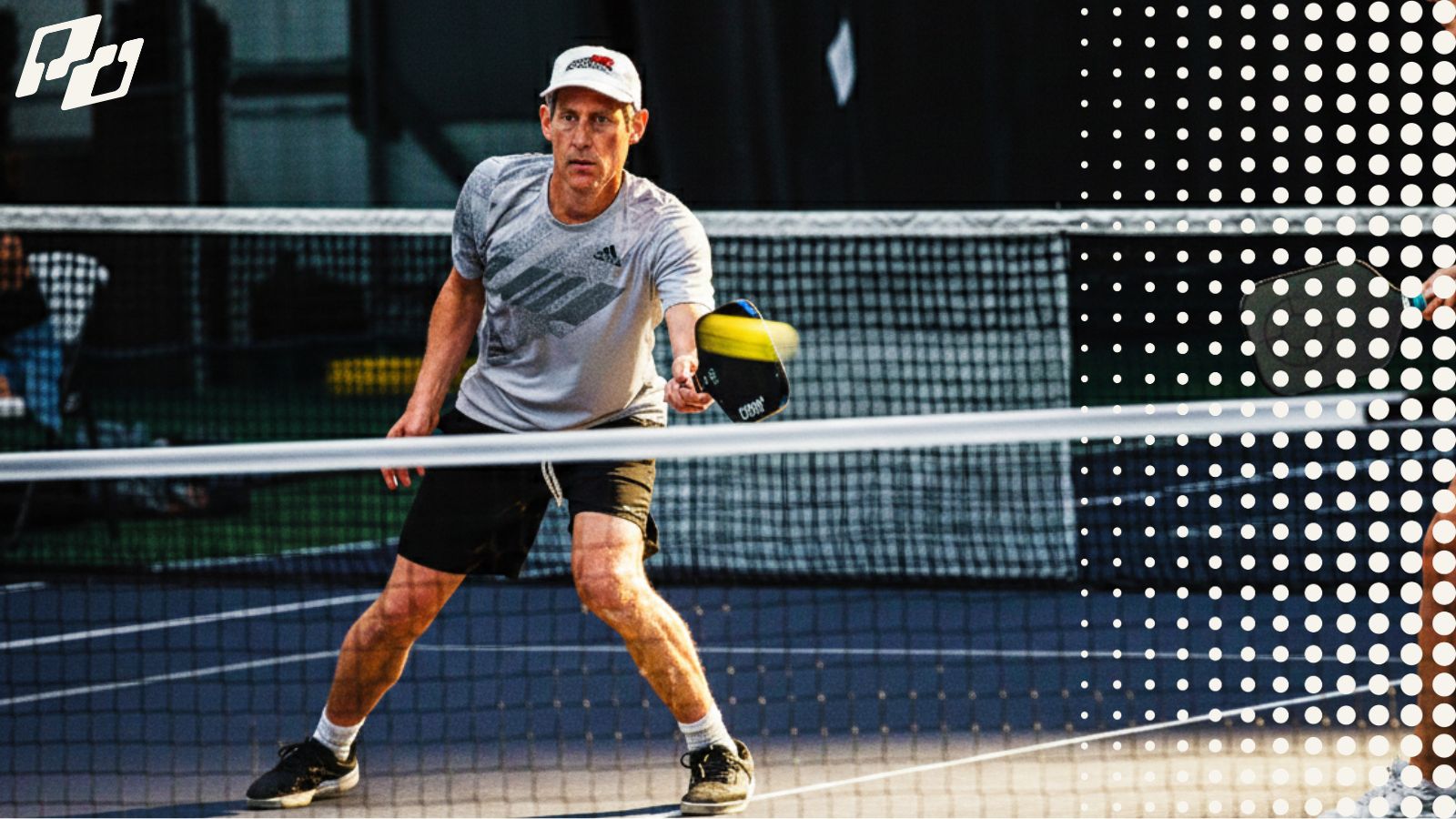
- Paddle up and slightly in front of your chest (not hanging near your waist)
- Elbows lightly in front of your ribs (gives you a compact hinge, not a swing)
- Knees soft, chest quiet (you want stability, not bounce)
- Nose over toes (if your weight is back, you’ll flinch backward)
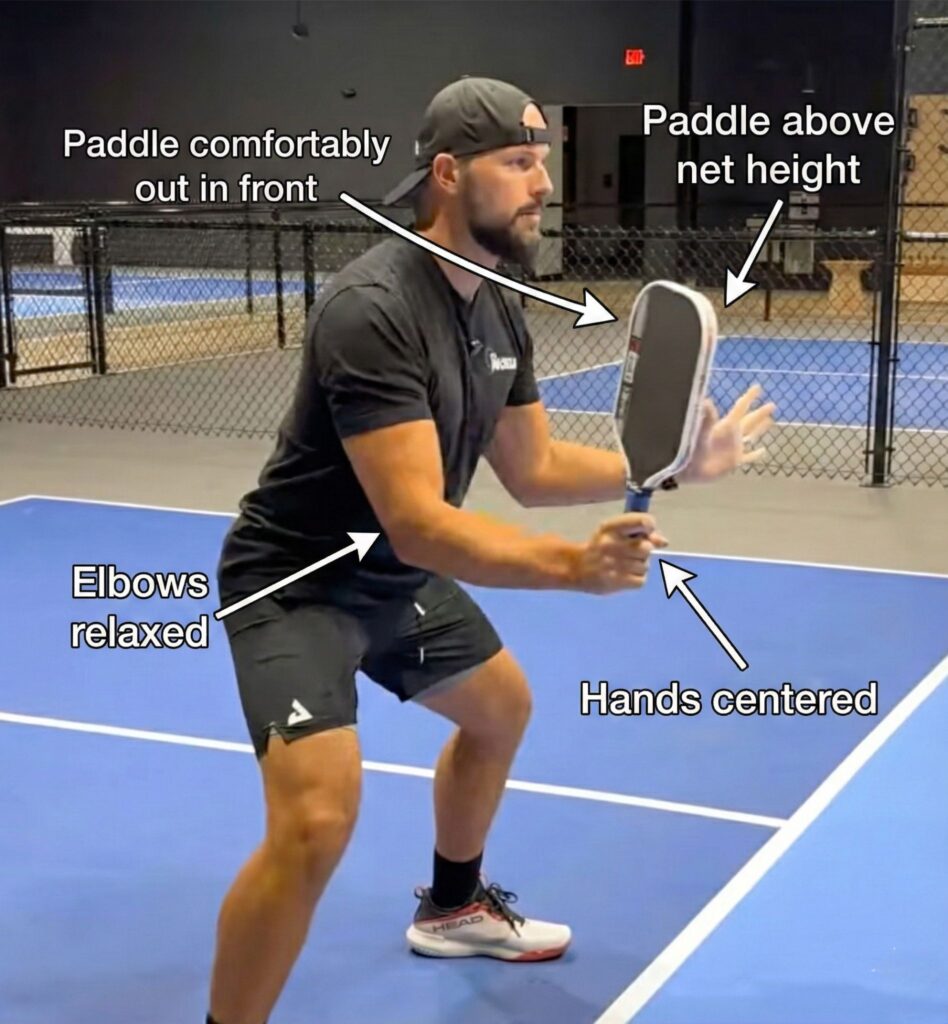
If you do only one thing: keep the paddle living in your vision. When it drops out of your sightline, your body panics and “swats.”
Step 3: Learn the “downward battle” concept (why your blocks pop up)
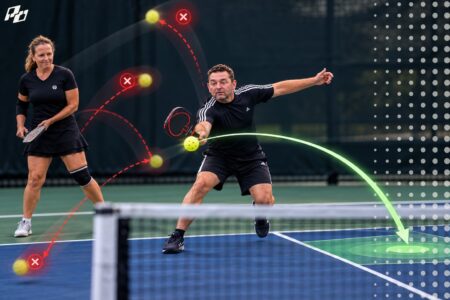
Most kitchen losses aren’t because you didn’t hit hard enough. They’re because you hit up.
A simple truth from hands-battle coaching: the first player who can hit down (or at feet) usually wins.
The fix: close the face slightly and punch forward
Not a swing. A short punch.
Compact punch volley mechanics matter here: paddle out front, tiny motion, reset back to ready.
We recently filmed a video with our pickleball coach, Marko Grgic, on how to counter power at the kitchen line. He breaks down the mechanics step by step—covering swing structure, paddle position, and the ready stance that keeps you stable in fast exchanges:
Step 4: Use a grip-pressure “pulse” so you don’t lock up
A death-grip makes your wrists rigid… and rigid wrists make the paddle face unpredictable. Here’s the simplest pressure pattern:
- Ready: 3–4/10
- Contact: 5–6/10 (brief firming)
- Reset: back to 3–4/10
That tiny “pulse” is often the difference between a calm block and a flinch-swat. (You’ll also see this recommended in volley resources: slight increase at contact to steady the paddle.)
Step 5: Train flinch-proof reactions the right way (progressive exposure)
If you only practice slow dinks, then play speed-ups… your body will treat speed as danger.
The 3-stage drill progression (rec-friendly, actually works)
Stage 1: Wall “block-reset” (solo)
Stand close, volley softly, and keep your paddle in front. Goal is quiet face and no backswing.
Why it works: the wall forces repetition without social pressure.
Stage 2: Partner rapid-fire to the paddle (controlled)
From NVZ line, partner hits medium pace to your paddle, not your body. You just block to middle.
Rule: if you swing, you restart the rep.
Stage 3: “Earn the speed-up” game
Dink crosscourt. Only speed up when the ball is above net height. Everything else is reset.
This builds the most important skill: you don’t panic-attack neutral balls.
Hands-battle content from multiple coaching sources all points to the same theme: compact technique + anticipation + repetition under realistic pace.
The on-court “anti-flinch” script (what to think mid-rally)
When you feel that little panic spike, run this in your head:
- Paddle up.
- Track early. (Don’t wait until it’s on you.)
- Punch forward, not up.
- Reset to ready instantly.
If you want one phrase that helps most rec players: “Quiet body, fast hands.”
Level-specific reality check
- 3.0–3.25: Your goal is survival without pop-ups. Block to big targets (middle) and stop backing up.
- 3.5: Start winning with direction: feet and body jams, not sidelines.
- 4.0: The game becomes read + counter: you recognize shoulder turn cues, you hold your ground, and you take space after your block.
One Last Thing: Flinching Isn’t a Personality Flaw
Flinching at the kitchen line doesn’t mean you’re timid or “bad at hands.” It means your nervous system hasn’t logged enough safe reps at that speed yet. When a ball rockets at you from 14 feet away, your brain defaults to protection. That’s wiring — not weakness.
The fix isn’t hype. It’s exposure and structure. Give yourself controlled hand-battle reps at realistic pace. Keep your paddle above net height. Stabilize your ready position. Focus on clean, predictable contact out in front. Judge success by staying planted and making one controlled touch — not by winning the exchange.
Confidence at the kitchen isn’t personality. It’s familiarity. And familiarity is trained.