If your back’s grumbling but your paddle hand is itching, here’s the good news: you can often keep playing—with guardrails. Think doubles over singles, shorter points, smarter footwork, and zero guilt about tapping out when symptoms climb.
Below is a clear, pickleball-specific plan: a quick decision tree, movement fixes, a warm-up that actually helps, and a two-week ramp so you can build back safely.
Quick Take (Read This Before You Lace Up)
- Don’t play if you have red flags (listed below) or symptoms are marching farther down your leg week to week.
- Play if pain is mild, stable, and trending better—no new numbness, weakness, or “spreading” symptoms.
- Modify (drills + easy doubles) if things feel naggy but settle as you warm up.
Sciatica vs. “Just” Back Pain: What’s the Difference?
Sciatica = irritation of a lumbar nerve root, causing pain/tingle/numbness that starts in the back or butt and runs below the knee (sometimes into the foot/toes).
Non-radiating back pain (no leg symptoms) is usually mechanical—muscle or tendon strain, facet joint irritation, sacroiliac (SI) joint irritation, or discogenic pain that stays local. Facet pain commonly provokes with extension, and SI pain often flares with standing/walking/transitions.
Symptom Map Cheat Sheet
| Likely Source | What It Feels Like | Better With | On-Court Tweak |
|---|---|---|---|
| Disc-dominant sciatica | Electric/tingly pain below knee | Neutral/extension | Feet first, hip hinge; reset instead of twist-and-grab |
| Lumbar stenosis | Achy/heavy legs with upright walking | Flexion (leaning forward) | Short rallies; brief flexion between points |
| Facet pain | Local back ache, worse with extension | Gentle flexion | Overheads tall & rotational |
| SI joint irritation | One-sided low-back/upper butt pain; hates transitions | Reducing asymmetry | Shorten open-stance reach; more neutral stances |
Red Flags: Park the Paddle and Call a Clinician
- New saddle numbness, bladder or bowel changes, or rapidly worsening leg weakness (possible cauda equina—urgent).
- Fever + back pain, history of cancer, major trauma, or progressive neurological deficits.
- Severe, constant night pain that doesn’t ease with position changes.
Can You Play Today? (Decision Table)
| Light | What it means | What to do today |
|---|---|---|
| Green | Pain ≤ 3/10 at rest; symptoms stable or centralizing (less distance down the leg); you can heel-walk & toe-walk 10 m without obvious weakness | Play doubles with edits; keep points shorter; follow warm-up below |
| Yellow | Pain 4–6/10, intermittent tingling, morning stiffness that improves after warm-up; <6 weeks since onset | Drills + easy doubles only; monitor symptoms during/after |
| Red | Symptoms spreading farther down the leg, new numbness/weakness/foot drop, or any red flag | Don’t play; seek care |
Why “centralizing” matters: when symptoms move up the leg toward the back with certain positions/movements, outcomes tend to be better.
Pickleball Moves Most Likely to Aggravate You (and the Fix)
1) Low balls at the kitchen
- Why it bites: Many players round the low back and twist at end range to “scoop” a dink—unfriendly to an irritated disc/nerve.
- Fix: Feet first, hips second, spine last. Take one extra shuffle and hip hinge (butt back, chest tall). If you can’t reach without rounding, reset instead of a hero save.
2) Overheads and big serves
- Why it bites: Deep lumbar extension can provoke facet pain and, in stenosis, narrow the canal.
- Fix: Get pop from legs + rotation. Think “tall and stacked,” contact slightly in front.
3) First-game sprints and hard stops
- Why it bites: Cold tissues + sudden accelerations are the classic “first-game flare.”
- Fix: Earn your speed with a 7–9 minute warm-up and build intensity across the first game.
Warm-Up That Actually Helps (7–9 Minutes)
- Brisk walk 3–4 min.
- Hip hinges × 10 (feel glutes; keep ribs stacked).
- Split-step pops × 20 (light, springy, quiet landings).
- Gentle nerve “sliders” × 10/side: sit tall → slowly extend knee while flexing ankle, then return (no hard pulls). Use as an adjunct, not a stretch contest.
- Directional bias (your “reliever”)
- If you feel better in extension (disc-dominant): prone press-ups × 8–10 to tolerance.
- If you feel better in flexion (stenosis-leaning): knees-to-chest rocks × 8–10, easy range.
- Calf & hamstring isometrics (5×5-sec presses) to prep for starts/stops.
If Your Pattern Is More Sciatica (Disc-Dominant)
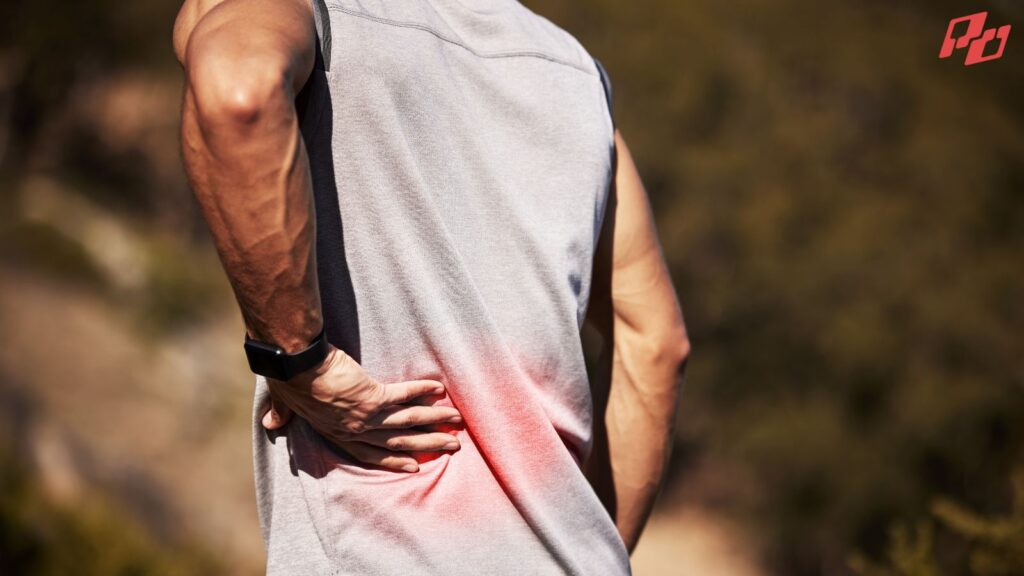
- Play Style: Doubles over singles; start with dinks, blocks, and resets.
- Technique: Keep torso tall on low balls; shorten lunges and arrive earlier with your feet.
- Overheads: Tall + rotate; avoid deep swayback.
- Between Rallies: 15–30 seconds of your “reliever” (often gentle extension).
- Stop Rule: If pain travels farther down the leg or strength drops, you’re done for the day.
If Your Pattern Is Spinal Stenosis
- Play Style: Shorter rallies; more kitchen play, fewer long baseline exchanges.
- Between Rallies: A brief flexion reset (lean on your paddle or the fence for 10–20 seconds).
- Overheads: Break them up; avoid long strings of repeated overhead practice.
- Stop Rule: If standing upright longer starts bringing on heavy, achy legs sooner than usual, downshift or stop.
If It’s “Just” Back Pain (No Leg Symptoms)
A) Facet joint irritation — local ache one/both sides; worse with extension.
- On-court: Overheads tall & rotational, not hyper-arched; more dinks/resets; take small flexion “micro-breaks” if they help.
B) SI joint irritation — one-sided low-back/upper-butt pain; flares with standing/walking and transitions (stairs, sit-to-stand).
- On-court: Shorten your open-stance reach at the NVZ; mix in neutral stances; step under the ball instead of reaching across midline.
C) Muscle strain — pinpoint tenderness after a sudden reach/twist; usually improves with light movement.
- On-court: Keep intensity ~60–70% for a week; favor ball-control (dinks, drops) over full-court chases.
A Two-Week Ramp for Pickleball Players
Week 1 — Earn Your Minutes
- 2–3 short doubles sessions (35–45 minutes), 60–70% intensity.
- Goals: consistent split-step, clean hip hinge on low balls, overheads capped at 3–5 per session.
- Daily: 20–30 minutes easy walk + 8–10 minutes of the warm-up routine.
Week 2 — Add Spice, Not Chaos
- 45–60 minutes doubles; add selective drives and a few aggressive counters only if symptoms stayed stable or centralized in Week 1.
- If any day flares you for >24 hours, step back one level for 2–3 sessions, then re-progress.
Recovery Between Sessions
- Cool-Down Walk: 10–15 minutes (don’t go straight to a long car sit).
- Position Breaks: Use your “reliever” posture a few times later that day.
- Load Journal: Note pain before/after, what you changed, and whether symptoms centralized. Small wins count.
FAQs (Answered Like a Teammate)
Will playing make it worse?
Not if you follow the green/yellow rules. Gentle, symptom-guided play usually beats rest, and controlled doubles often feels better than you expect.
Do I need an MRI right away?
Usually no—unless you have red flags or rapidly worsening weakness. Most players start with active care and reassess around the 6-week mark.
Is stretching my hamstrings good for sciatica?
Skip hard “pull and hold” early on; nerves dislike aggressive tension. Use gentle sliders and let walking be your mobility work.
Any shoe or surface tips?
Choose a court shoe with a stable heel, mild rocker, and a forefoot that bends where your toes do. On very sticky indoor floors, shorten stops and give yourself extra warm-up time.
Quick self-screen before you play?
Try heel-walk (L5) and toe-walk (S1) for 10 m each; if you’re clearly weak, skip play and get assessed.
Bottom Line
- Yes, you can often keep playing—just make it doubles, deliberate, and posture-smart.
- Pick the posture that calms your symptoms and use it between rallies.
- Watch for red flags; don’t try to play them off.
- If you’re not clearly better by ~6 weeks, check in with a clinician and talk next steps.
If you’d like, I can turn this into a printable “Play / Modify / Don’t Play” checklist and a Disc vs. Stenosis Warm-Up card for your club or league.