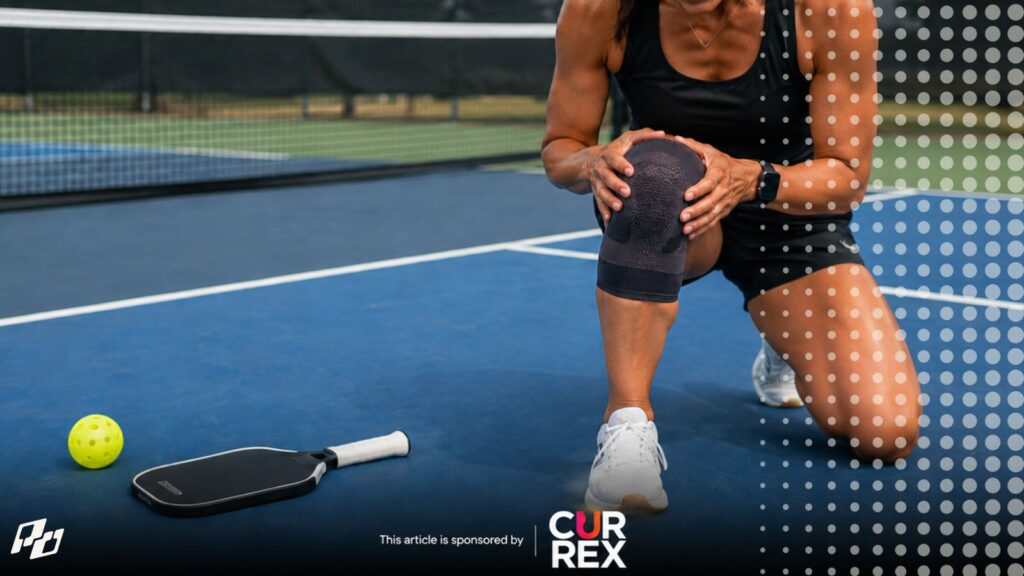
This article is brought to you by CURREX, the performance insoles trusted by the Pickleball Union team. Like us, CURREX is focused on helping players stay comfortable, move better, and keep playing longer. Use code PBUNION20 for 20% off CURREX products on Amazon.
Pickleball has a funny reputation. The court is small. The ball is light. Doubles can look almost leisurely from outside the fence.
Then someone ruptures an Achilles chasing a dink.
Or breaks a wrist falling backward.
Or discovers that the shoulder pain they have been “playing through” is actually a rotator-cuff tear.
A new 2026 study from researchers at Stanford gives us one of the clearest recent looks at the injuries actually showing up in orthopedic clinics. Researchers reviewed 164 pickleball-related injuries from 2019 through 2023, and one thing becomes obvious quickly: pickleball injuries are not dominated by one body part. They come from two very different problems:
explosive movement the body was not prepared for, and repetitive movement the body has been tolerating for too long.
That distinction matters because preventing an Achilles rupture requires a very different strategy from preventing pickleball elbow.
What the Latest Study Found
The Stanford study included injuries involving the knee, foot/ankle, wrist/hand, shoulder, spine, elbow, and hip/thigh.
Here is the simplest snapshot:
| Body Area | Cases in the Study | Standout Diagnosis |
|---|---|---|
| Knee | 52 | Meniscus tears |
| Foot / ankle | 32* | Achilles tears |
| Wrist / hand | 30 | Distal-radius fractures |
| Shoulder | 23 | Rotator-cuff tears |
| Spine | 10 | Radicular pain / stenosis |
| Hip / thigh | 9 | Tendinopathy / strains |
| Elbow | 8 | Lateral epicondylitis |
*The paper reports 32 foot/ankle cases in the abstract and 34 in the detailed results, an inconsistency worth noting.
The number of cases seen at the center also rose sharply—from 10 in 2019 to 59 in 2023. That does not prove pickleball itself suddenly became more dangerous; participation exploded during the same period. But it does show that the injury burden is becoming difficult to ignore.
1. Knee Injuries: The Biggest Category in This Study
The knee accounted for more cases than any other body region.
Among the 52 knee injuries, 67% involved a meniscal tear, with medial meniscus tears more common than lateral ones. ACL injuries, osteoarthritis, patellofemoral problems, and patellar tendon/chondral issues also appeared.
That makes biomechanical sense.
Pickleball is full of:
- short accelerations
- sudden braking
- lateral shuffles
- lunges
- pivots
- reaching with one foot planted
The problem often is not the running. It is decelerating and changing direction while the knee is loaded.
⮕ The underrated fix: train the stop
Most players practice hitting. Very few practice stopping.
Instead of only doing straight-line jogging before play, include:
- lateral shuffle → controlled stop
- forward shuffle → split-step
- short acceleration → deceleration
- lateral lunge → recover
- crossover step → balanced plant
A recent nationwide study of 1,758 pickleball players specifically highlighted the need for neuromuscular warm-ups targeting the trunk and extremities rather than simply restricting play.
Cue: Control the last step, not just the first one.
2. Achilles Injuries: The One I’d Take Most Seriously
The foot and ankle findings are striking.
Half of the foot/ankle injuries in the Stanford study were complete Achilles tendon tears. Those players averaged only 49 years old, and 81% were men. The typical mechanism was explosive: sprinting for a ball, lunging, or pushing hard off one foot.
That is the classic pickleball trap.
You may spend 80% of a rally moving at moderate intensity. Then one short ball demands a maximal push-off with almost no warning.
Your cardiovascular system may feel fine while your tendon is being asked to handle a load it has not experienced all week.
⮕ What actually helps
Warm up the movement you are about to perform. Before competitive play:
- brisk walk or light jog
- calf raises
- low pogo hops if appropriate for you
- controlled forward pushes
- lateral shuffles
- progressive accelerations
Do not go from sitting in the car to chasing a drop shot at full speed five minutes later.
The latest nationwide data also found that people playing three or more times per week had 45% higher odds of reporting injury than those playing up to twice weekly. Less experienced players were also at greater risk. That suggests total exposure and adaptation matter—not just one unlucky step.
3. Wrist Fractures: Often a Fall Injury, Not a Paddle Injury
Wrist and hand injuries were the third-largest group in the Stanford study. The surprising part is what caused them.
60% were distal-radius fractures, and most occurred when players fell while running for a ball. Women accounted for 77% of the wrist/hand cases.
This is not primarily a stroke-mechanics problem. It is a fall-prevention problem.
Players often get hurt while:
- backpedaling for lobs
- crossing their feet while retreating
- lunging farther than they can recover
- reaching for a ball after balance is already lost
This is why experienced coaches constantly discourage blind backpedaling.
- Turn your body.
- Use crossover or shuffle steps.
- And sometimes, let the ball go.
No point is worth reaching so far that your only braking system is an outstretched hand.
For older players in particular, balance and proprioception work off court may be just as valuable as another hour of dinking practice. The Stanford researchers specifically recommend footwear, balance, coordination, and proprioceptive training because falls contributed to several injury groups.
4. Shoulder Injuries: Overheads Are the Warning Sign
Among shoulder injuries, 70% involved rotator-cuff tears.
The most frequently documented mechanism was pain during an overhead shot. That does not mean overheads are inherently dangerous. It usually means a demanding overhead exposes weaknesses that were already there:
- limited shoulder mobility
- poor scapular control
- weak rotator-cuff capacity
- hitting behind the head
- muscling the ball with the arm
- suddenly increasing playing volume
A proper overhead should use the legs, trunk rotation, shoulder, and arm as a sequence.
If the entire smash comes from the shoulder joint, that shoulder ends up doing work the rest of the body should be sharing.
⮕ A useful warning sign
If your shoulder starts hurting specifically on overheads, do not keep smashing through it because the pain disappears on dinks.
That pattern matters.
The 2026 study found that 35% of shoulder cases ultimately underwent surgery, although remember that this was a specialty orthopedic population and therefore likely skewed toward more serious injuries.
5. Pickleball Elbow: Small Sample, Familiar Problem
Only eight elbow cases appeared in the Stanford study, but six of them—75%—were lateral epicondylitis, commonly called tennis or pickleball elbow.
The usual culprit is not one dramatic swing. It is repeated load.
Think:
- squeezing the paddle too hard
- late contact
- excessive wrist action
- repeatedly muscling drives
- suddenly adding several extra playing days
- using a setup that feels too heavy or demanding
The national injury survey reinforces the broader overuse problem: one in three respondents reported continuing to play despite pain.
That may be the most important number in this entire article.
Minor soreness does not always require shutting things down, but pain that keeps worsening as the session continues is information—not an inconvenience to ignore.
6. Hip, Hamstring, and Groin Problems
Hip/thigh injuries were less common in the Stanford sample, but tendinopathy accounted for 67% of those cases.
Proximal hamstring and iliopsoas problems were particularly notable, while some players also sustained hamstring strains or ruptures and hip fractures after falls.
These injuries fit the movement demands of pickleball: reach low, push laterally, decelerate, recover, repeat.
One of the simplest technical changes is to stop solving every wide dink with one giant lunge. Use more small adjustment steps so the final reach remains inside a position you can recover from.
Cue: Move closer first. Reach second.
7. Back Pain: Rotation Adds Up
Most spinal complaints in the Stanford study involved the lower back. Radicular symptoms and spinal stenosis were common diagnoses, and repeated twisting was documented as a mechanism in some cases.
Pickleball involves far more rotation than many recreational players realize:
- serve
- return
- forehand drive
- backhand
- overhead
- reaching dinks
If your hips and thoracic spine do not contribute enough, the lumbar spine may end up absorbing more rotation than you intended.
This is another reason “just use your arm” is poor technique. Better strokes spread force through the kinetic chain.
One Injury Category the Stanford Study Did Not Focus On: Eyes
Musculoskeletal injuries are only part of the current picture.
A 2025 JAMA Ophthalmology study estimated 3,112 pickleball-related eye injuries treated in U.S. emergency departments between 2005 and 2024—including 1,262 in 2024 alone. Direct ball strikes were the most common documented mechanism. Serious injuries included retinal detachment, orbital fractures, hyphema, and globe trauma.
For me, this is one of the easiest risk-reduction decisions in pickleball: wear impact-resistant sports eyewear.
You cannot strengthen your retina with drills.
The Bigger Study Changes the Picture
The Stanford paper tells us what shows up in a specialty clinic. The nationwide 2025 study of 1,758 active players tells us something different: everyday pain and overuse are much more common than medical databases suggest.
That study reported:
- 69% experienced at least one all-complaint injury during the year;
- about two in five experienced an injury that stopped participation;
- roughly one in three continued playing despite pain.
That 69% number includes everything from pain and overuse complaints to more significant injuries, so it should not be interpreted as “69% of pickleball players suffer serious injuries.”
But it reveals a major blind spot.
Emergency-room statistics emphasize fractures and falls. Orthopedic clinics reveal tendon tears and meniscus problems.
Players themselves report a huge amount of nagging pain that never reaches either setting.
The Risk Factor Recreational Players Can Actually Control
The nationwide study found several associations with injury, but two are especially useful:
Players who played at least three times weekly had 45% greater odds of injury, and players with fewer than five years of experience had 50% greater odds than more experienced players. Players who placed low or moderate importance on injury prevention had about double the odds of injury.
That does not mean you should only play twice a week. It means your body needs to be prepared for the amount you play.
A former college tennis player playing four days a week is not loading their tissues the same way as someone who spent 20 years relatively sedentary and discovered pickleball six months ago.
Your pickleball skill can improve faster than your tendons adapt. That mismatch is where trouble starts.
The 10-Minute Warm-Up I’d Rather See
I would skip the five minutes of standing at the kitchen gently dinking and calling it a warm-up.
Before serious play, prepare the movements that actually cause problems:
- 2 minutes: brisk movement, forward/backward and lateral.
- 2 minutes: calf raises, controlled lunges, hip movement.
- 2 minutes: lateral shuffle, split-step, deceleration.
- 2 minutes: progressive shadow swings, including overhead motion.
- 2 minutes: gradually increasing serves, returns, drives, and volleys.
Then play.
The principle matters more than the exact routine:
Increase temperature, move the joints, load the tendons, rehearse the footwork, then add speed.
What I’d Take From the New Injury Data
The biggest lesson is not that pickleball is dangerous.
The 2025 clinical review notes that injury patterns remain broadly comparable to other racquet sports, while pickleball still offers substantial physical and social benefits.
The important lesson is that the sport is more physically demanding than it looks.
A rally may feel easy for 20 seconds and then demand one explosive sprint, one hard plant, one twisting reach, or one overhead at full extension.
That is why the injuries cluster where they do.
So if you want to keep playing for years, I would focus less on generic advice like “stretch before you play” and more on four things:
Prepare to accelerate. Prepare to stop. Build capacity for repeated swings. And stop treating persistent pain as the price of playing.
The safest player is not necessarily the youngest or fittest. It is often the player whose body is prepared for the exact movements pickleball is about to ask from it.