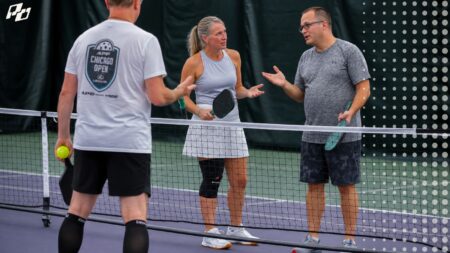
Every rec player knows the feeling: you’re rallying well, your rhythm feels good, and then — thunk — an easy dink dies in the net. Next rally? You overcorrect and blast it long.
It’s maddening, right?
But here’s the hard truth: most misses don’t come from bad technique — they come from bad awareness.
You’re reacting, not recognizing. You’re swinging with habits that were built for comfort, not correction.
If you want to finally break the pattern of unforced errors, it’s time to understand why those mistakes really happen — and how to fix them at their root.
Mistake #1: Late Contact — The Silent Killer of Consistency
Forget spin, mechanics, or paddle brand. The biggest reason rec players miss is simply this: they make contact too late.
Late contact causes everything to fall apart. It turns soft hands into hard rebounds, turns smooth dinks into pop-ups, and turns confident drives into desperate flicks.
When you hit late, three things happen biomechanically:
- Your paddle face opens. You’re catching the ball behind your body, which tilts the face upward — that’s why your shots sail long.
- Your shoulder lifts. Your upper body tries to “help” the ball, robbing your swing of control and rhythm.
- Your contact point rises. You’re hitting as the ball ascends or at the peak, not slightly on the fall — the window for success shrinks dramatically.
The Fix: Front-Load Every Shot
- Move early. Take micro-steps so the ball stays in front of your hitting shoulder. Pros adjust their feet three to five times per shot — not once.
- Stay stacked. Keep your nose and toes pointing toward the contact point. When your upper body rotates too far before contact, the timing collapses.
- Think “reach, don’t wait.” Your arm should extend into contact, not retreat toward your chest.
💡 Pro tip: watch slow-motion clips of Ben Johns or Anna Leigh Waters — every ball they hit is at full extension. That’s not talent; it’s discipline.
Mistake #2: Coming Over the Top — Why You Miss in the Net or Long
If your shots are either dying in the net or sailing out the back, you’re not cursed — you’re just hitting on top of the ball.
This mistake is different from late contact. Here, you might be perfectly on time — but your paddle path is wrong. Instead of brushing under the ball, you’re striking it flat or even slightly downward.
Why It Happens:
- You’re “pushing” through contact instead of brushing up.
- You’re trying to direct the ball with your arm instead of shaping it with your swing path.
- Your chest and shoulders rise during contact, causing your paddle to follow the body — up too soon or down too early.
The Fix: Get Under the Ball and Follow Through
- Start low, finish high. Think “low-to-high” — the paddle starts below the ball and finishes above your shoulder.
- Stay down through contact. Keep your chest slightly over your knees so your upward swing path naturally lifts the ball over the net.
- Follow through fully. Most players decelerate right before contact — don’t. Finish the motion, even on soft shots.
- Relax your grip. A tight grip forces a flat, downward path; a soft grip allows lift and control.
💡 Pro tip: record your dinks or drops in slow motion — if you can’t see space between the paddle and the bottom of the ball at contact, you’re hitting on top of it.
Mistake #3: Paddle Face Drift
When a shot flies long or dives into the net, most players blame their swing speed. But 80% of the time, it’s face control — your paddle angle changed between setup and contact.
Why It Happens:
- You start your backswing late, so you rush through setup.
- Your grip pressure tightens mid-swing (classic sign of tension).
- You “steer” the shot with your wrist instead of letting your forearm and shoulder guide it.
The Fix: Pre-Set the Face
Before the swing even starts, lock in your paddle angle.
- On drives: face square or slightly closed.
- On dinks: slightly open, paddle head below the ball.
- On blocks: open just enough to soften pace, not float it.
Then hold that angle through contact — imagine your paddle gliding along a rail.
💡 Pro tip: every time your paddle’s tip flips up or rolls under mid-swing, that’s a sign your grip is too tight or your timing’s late. Loosen, reset, rebuild.
Mistake #4: Overusing the Arm (and Ignoring the Feet)
When players start missing, they instinctively try to fix the shot with their hands. They push more, flick more, adjust more — and the misses multiply.
That’s because the arm isn’t supposed to create consistency; it’s supposed to transfer it.
Why It Happens:
When you stop moving your feet, your kinetic chain dies. You start compensating with your wrist and elbow, and the shot loses its built-in rhythm.
You might think you’re simplifying — you’re actually overcomplicating.
The Fix: Build from the Ground Up
- Start every swing with a mini step. Every top player does this — a subtle adjustment step that aligns hips, knees, and shoulders.
- Feel your weight shift before the swing. If you’re static at contact, the stroke gets handsy.
- Finish through your body. Even soft dinks should flow through your core, not just your forearm.
💡 Pro tip: count your steps during a rally. If it’s under 4 per point, you’re not moving enough.
Mistake #5: Panic Tempo
Every intermediate player knows this spiral: one bad shot turns into two, then you start hitting faster. Your mind races, your hands rush, and your rally rhythm evaporates.
This is called tempo panic — and it’s the silent killer of consistency.
Why It Happens:
Your brain mistakes frustration for urgency. When cortisol spikes (the stress hormone), your body literally tries to “get it over with” faster. The result? Your timing goes off by milliseconds — just enough to ruin precision.
The Fix: Reset the Tempo
- Breathe before every serve. Slow inhale, quick exhale. It resets timing centers in your brain.
- Dink to the middle. The middle dink is a tempo regulator — it slows down the rally and removes angles that force speed.
- Count your rhythm out loud. “1, 2” on the backswing and contact. It sounds corny — but it works.
💡 Pro tip: pros use what’s called “rhythm management” — consciously slowing foot taps or paddle prep between points to calm their nervous system.
Mistake #6: Ignoring Margin
You can always spot the rec player on tilt: every drive aimed at the sideline, every dink flirting with the net tape.
They’re chasing precision when they should be restoring margin.
Why It Happens:
Intermediate players confuse control with risk. They think accuracy means threading lines.
But at 4.0 and below, consistency is control — the safest shot that still applies pressure wins more points than any highlight-reel winner.
The Fix: Add Margin, Not Fear
- Aim for the middle third. A ball that lands safely in the middle creates more errors than one an inch from the line.
- Add height over the net. Even two inches higher dramatically increases your success rate.
- Win through patterns. Pressure the same seam or hip three times in a row before you change direction.
💡 Pro tip: experiment with “boring targets.” The duller your placement, the more your opponents crumble trying to force theirs.
Putting It All Together: The Between-Point Reset
You don’t need a full rebuild to stop missing — you need a six-second audit between rallies:
- Was I late? Move earlier next point.
- Was my paddle face right? Set it before the swing.
- Was I rushing? Slow down the tempo.
- Was I aiming smart? Add height, aim middle.
That’s it — a mental checklist that works faster than any mechanical change.
The Big Picture: From Fixing Misses to Preventing Them
The best players don’t avoid mistakes; they recover faster.
They know when to stop pressing, when to simplify, when to shift to neutral instead of doubling down.
And the real magic happens when you realize this:
Consistency isn’t a skill — it’s a reaction habit.
You train it by learning what your body does when things go wrong, and how to reset that loop in real time.
So next time you miss, don’t scold yourself. Just smile, step forward, and ask the question that wins games:
“Was I late?”
Odds are, you’ll already know the answer — and you’ll fix it before the next ball crosses the net.