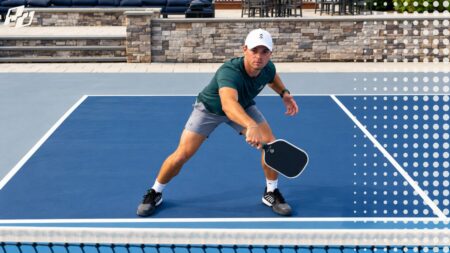


A high-level player recently shared a brutally honest point: when he plays 4.0-level opponents, there are a few holes he sees over and over again — and he goes after them immediately.
That matters for rec players because this is exactly how improvement often works in pickleball. You do not always lose because your opponent hits some impossible pro shot. A lot of the time, you lose because good players keep spotting the same structural mistake, pressing on it, and collecting points until you prove you can fix it.
And the habits he called out are real ones: players who do not cover the middle well, players who get baited by speed-up deception, and players whose backhand-side defense breaks down under pressure.
Those are not random details. They are all connected to a bigger truth about getting from solid rec play to stronger competitive play: better players are not just hitting better shots — they are reading your habits, noticing your overreactions, and making you uncomfortable in very specific ways.
That is why this is such a good topic for 3.5 and 4.0 players. It is not really about copying some flashy pro move. It is about understanding what stronger players see when they look across the net at you.
Why this advice matters so much for 3.5 players
At 3.5, most players already know the basic shots.
⮕ They can dink.
⮕ They can drive.
⮕ They can drop sometimes.
⮕ They can speed up.
⮕ They understand kitchen positioning at least in theory.
But that does not mean they are hard to exploit.
One of the big differences between 3.5 and stronger 4.0+ doubles is that better players start punishing patterns, not just mistakes. Pickleball coaches Barrett and Danea Bass recently made a similar point in their breakdown of what keeps 4.0 players from breaking through: it is often not shot vocabulary anymore, but timing, decision-making, and knowing how to create or recognize pressure.
That is exactly what this advice is about.
The five “holes” here really fall into a few bigger pressure problems:
- bad team spacing
- predictable defensive cheating
- weak backhand-side defense under pressure
- attackable transition balls
- too many readable dinks
If you clean those up, you do not just look smarter.
You become much harder to play against.
Hole No. 1: Poor middle coverage
This is the biggest one, and honestly, it probably costs rec teams more points than they realize.
The advice was simple: many players do not cover the middle effectively. They get pulled wide, then just kind of watch the next ball, leaving the seam exposed. So the better player sees the opening and speeds the ball up through the middle.
That checks out.
Middle coverage is one of the most consistent doubles themes in modern coaching. Middle responsibility is not a rigid “my side / your side” issue — it is about who is best positioned to take away the highest-percentage threat. And PlayPickleball’s 4.0-mistakes piece makes a related point: better doubles players think in patterns and positioning, not just individual shots.
For 3.5 players, the mistake usually looks like this: one player gets pulled a little wide, the partner stays frozen, and now the seam is wide open.
Or the team has the opposite problem: both players lean too far toward “their own” side, and no one takes command of the middle ball.
That is gold for stronger opponents because the middle is often the safest, smartest attack target in doubles.
What 3.5 players should do instead
Start thinking of the middle as a team job, not a painted line no one is allowed to cross.
If your partner gets pulled wide, your job is not to stand still and honor invisible property rights. Your job is to recognize that the seam just got vulnerable and take away the next obvious attack.
A few useful cues:
- Partner pulled? Protect middle.
- One player stretched = seam danger.
- Take away the easiest ball first.
This does not mean panic-poach everything. It means you should slide a little, read the next shot earlier, and make the court feel smaller for your opponents.
That is how better doubles players defend.
Hole No. 2: Cheating middle too early on speed-ups
This second point is more subtle and, honestly, more advanced.
The advanced player said that when he gets a “dead dink,” he likes to drop the paddle tip and create deception before speeding up. Why does that work? Because a lot of opponents are already cheating toward the middle to protect against the obvious speed-up lane — so the disguise helps him go behind them or redirect into the space they just abandoned.
That is very believable, and it fits with what other coaches keep saying: the speed-up is not just about power. It is about setup, disguise, and the defender’s expectations.
This is a huge 3.5 problem because a lot of rec players defend speed-ups emotionally rather than structurally.
They think: “Uh oh, attack might be coming.”
Then they lean early.
They guess.
They cheat to the middle too soon.
And now a better player has exactly what they wanted: a defender who has shown their hand before contact.
Once that happens, the attacker is no longer just hitting a speed-up.
They are hitting a counter to your anticipation.
What 3.5 players should do instead
Do not commit your body too early just because the ball looks attackable.
You do want to be ready for the speed-up. But “ready” is not the same thing as “already leaning.” Good defenders stay balanced long enough to react to the actual contact, not just the possibility of it.
Helpful cues:
- Paddle ready, body neutral.
- Do not guess before contact.
- Read the ball, not the fear.
This is one of the simplest upgrades 3.5 players can make: be ready to defend the attack, but do not donate the answer before the question is asked.
Hole No. 3: Backhand-side defense breaks down under pressure
This is another hole stronger players spot fast, and once they see it, they keep going back to it.
A lot of 3.5 and 4.0 players look reasonably solid in dink rallies until the ball gets sped up at their backhand hip, backhand shoulder, or right into that awkward body-backhand area. That is where the defense often falls apart. The paddle angle gets messy, the feet get stuck, the contact gets jammed, and instead of a clean counter or block, the ball pops up or dies into the net.
Better players absolutely notice this.
They do not just attack randomly. They find the side of your defense that looks less organized and keep testing it until you prove you can handle it. Modern doubles strategy keeps coming back to this same principle: strong players look for the location that creates the weakest reply, not just the fastest attack.
Why this gets punished so often
Because the backhand-side speed-up is uncomfortable for a lot of rec players.
Forehand counters usually feel more natural. Backhand-side counters require cleaner paddle prep, better compact mechanics, and better positioning. If a player is late, upright, or holding the paddle too low, that backhand/body speed-up becomes a real problem.
And once a stronger opponent sees that hesitation, they stop guessing. They just keep feeding the same pressure point.
What 3.5 players should do instead
First, admit if this is your weak spot. A lot of players know it is there but never train it directly.
Then work on:
- keeping the paddle up and in front
- using compact blocks and counters instead of big swings
- recognizing that body-backhand balls are often about survival first, not pretty offense
- staying balanced so you are not defending from a stuck position
Helpful cues:
- Paddle up early
- Short backswing
- Backhand owns this
- Block first, counter later
You do not need your backhand-side defense to become a weapon overnight. But if you can make it less attackable, stronger players lose one of their favorite places to go.
If you keep feeling late, jammed, or exposed in fast exchanges, this one is worth watching — it covers the kind of kitchen defense fixes that make you much harder to attack.
Hole No. 4: Weak transition balls that sit up
This is a huge one, and stronger players absolutely feast on it.
A lot of 3.5 and 4.0 players understand that they are supposed to reset from transition. The problem is that too many of those resets are not really resets — they are soft pop-ups. The ball lands a little too high, a little too shallow, or a little too attackable, and now the opponent is not under pressure at all. They are getting exactly the kind of ball they want.
That is why better players do not just attack bad drives.
They attack weak transition balls relentlessly.
If your reset sits up, hangs, or lands too high above net level, stronger opponents are not thinking, “Nice idea.” They are thinking, “Thank you.”
Why this gets punished so hard
Because the transition zone is where rec players are most vulnerable.
You are moving.
You are often not fully balanced.
Your paddle prep is not always great.
And if the reset is not excellent, you are basically handing the other team a second chance to attack before you are established.
This is one of the clearest differences between stronger and weaker doubles players. Better players do not just survive transition — they make the other team hit one more truly difficult ball.
What 3.5 players should do instead
The goal is not just to “get it back.”
The goal is to make the next ball harder to attack.
That usually means:
- more arc
- softer hands
- better depth into the kitchen
- and less panic when you are on the move
Helpful cues:
- Soft hands, low finish
- Lift, don’t pop
- Kitchen, not attack zone
- Make them hit up
A reset does not have to be pretty.
But it does have to take away the attack.
If your resets keep sitting up or you feel rushed moving through transition, this video does a great job showing how to get forward without feeding stronger players the exact ball they want.
Hole No. 5: Predictable dinks with no real purpose
This one does not always look like a mistake, which is exactly why it is so dangerous.
A lot of rec players can dink well enough to keep a rally going. But stronger players quickly notice when those dinks are just neutral balls with no real intention behind them. Same height. Same pace. Same location. Same rhythm. Again and again.
That kind of dinking feels safe — until you realize you are feeding a better player the exact rally they want.
If your dinks are too predictable, stronger opponents get comfortable fast. They start leaning, shaping their counters earlier, and waiting for the one ball they can speed up or angle off.
Why better players love this
Because predictable dinks are easy to read.
They do not need to guess.
They do not need to move much.
They do not need to feel rushed.
And once a better player feels comfortable in a dink rally, you are usually in trouble.
What 3.5 players should do instead
You do not need to hit miracle dinks.
You just need to make the rally less comfortable.
That can mean:
- changing height a little
- changing pace a little
- moving the ball wider
- jamming the body occasionally
- or holding one a fraction longer before contact
The point is not to get fancy.
The point is to stop being automatic.
Helpful cues:
- Same rally, different look
- Move them, don’t just feed them
- Dink with purpose
- Comfort kills
A good dink is not just one that lands in.
A good dink is one that makes the next ball a little less easy.
The bigger lesson: stronger players are reading you, not just hitting at you
Good players are looking for predictable reactions.
They are asking:
✔ Do you protect the middle late?
✔ Do you cheat too early?
✔ Does your backhand-side defense break down under pressure?
✔ Do your resets sit up?
✔ Are your dinks too readable?
✔ Do you move before contact?
✔ Do you panic when the rally gets slightly weird?
That is what they are exploiting.
So if you are a 3.5 player, the goal is not just to learn these attacking patterns.
The goal is to stop giving away the tells that make them work so easily.
What should 3.5 players train first?
If I were building this into a practical upgrade plan for rec players, I would focus on five things.
1. Train middle coverage with your partner
This is not glamorous, but it is the first fix.
Use simple cooperative drills where one player gets pulled a little wide and the other has to slide and protect the seam.
2. Get better at defending without leaning
Have a partner speed up from dink rallies while you focus on staying balanced until contact.
Not passive.
Not frozen.
Just not prematurely committed.
That is a much more realistic defensive skill than “have faster hands.”
3. Learn to change pace in your own dink game
You do not need to become theatrical about it. But if every dink you hit has the same timing, same tempo, and same visible intent, stronger players will get comfortable against you.
Better players do not just hit good dinks.
They make your feet lie.
4. Train transition resets that actually neutralize
Do not just practice “getting the ball back.”
Practice landing the ball in the kitchen with enough softness and shape that the other team has to hit up.
If your reset drill still produces attackable floaters, it is not done yet.
5. Build more purpose into your dink patterns
Spend time dinking with intention:
- a little wider
- a little lower
- occasionally into the body
- occasionally with a slight hold
- occasionally with a different tempo
You do not need to become fancy.
You just need to become less predictable.
A few practical cues worth stealing
This advice becomes much easier to use if you simplify it into cues.
For middle coverage:
- Protect the seam
- Partner wide, middle alive
- Shrink the court
For defending speed-ups:
- Paddle ready, body neutral
- Don’t guess early
- Balance first
For handling held dinks and tempo changes:
- Quiet feet
- See it late
- Don’t jump first
For transition:
- Lift, don’t pop
- Make them hit up
- Kitchen first
For dink patterns:
- Dink with purpose
- Change the look
- Comfort kills
Those are the kinds of cues that actually help in real points.
So does this advice really work?
Yes — but not because it is some secret 6.0 cheat code.
These are all things other coaches and strategy sources keep pointing to in different language: better players win by reading patterns, shrinking the court, choosing smart attack moments, and making opponents uncomfortable with timing and positioning.
For rec players, the practical takeaway is not: “Cool, I’m going to start dropping my paddle tip dramatically and pausing like a pro.”
The practical takeaway is:
✅ Stop being easy to read.
✅ Cover the middle better.
✅ Do not cheat early.
✅ Stay quieter in dink rallies.
✅ Reset more cleanly.
✅ Stop feeding predictable dinks.
✅ And understand that stronger players are often beating you with reads, not just with pace.
That is the kind of lesson that actually moves players from 3.5 toward real 4.0-level doubles.