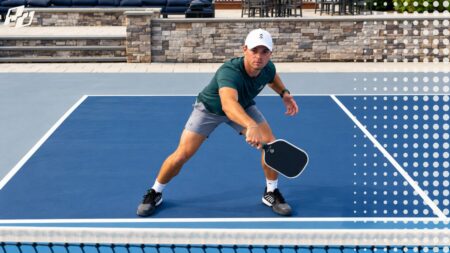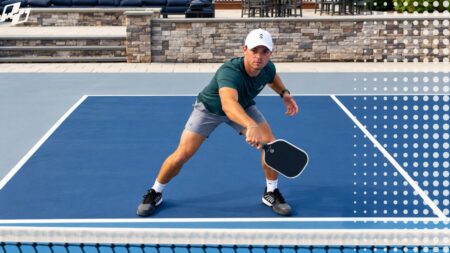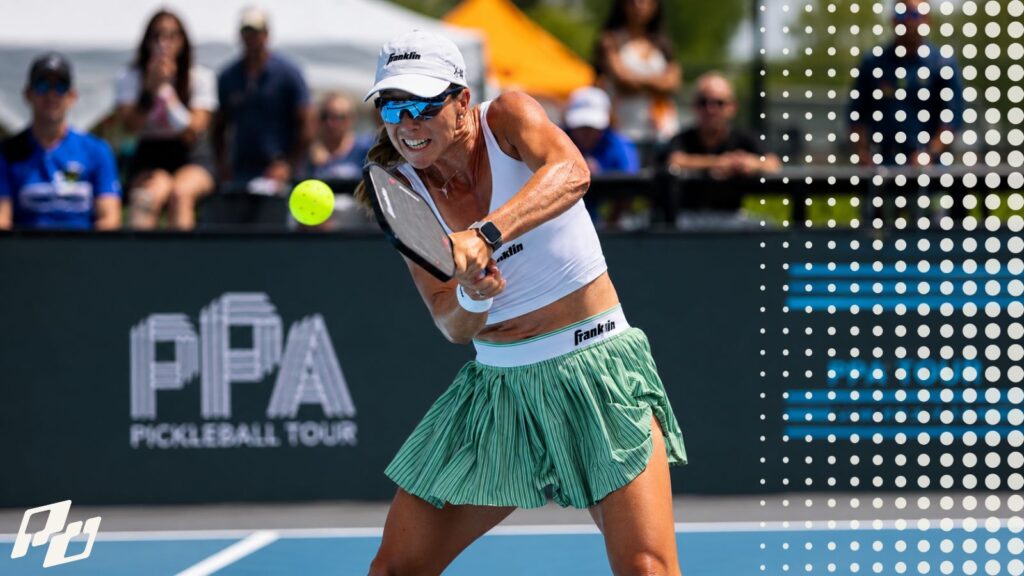
To beat players who sit backhand, stop feeding their paddle with hard, flat speedups. Use a slower, heavier roll into the shoulder or upper-body zone. That higher ball can jam their backhand counter, force awkward contact, and create weak replies or pop-ups for the next shot.
Some intermediate pickleball players look impossible to speed up against.
They stand at the kitchen with their paddle already shifted toward the backhand. Their wrist is firm. Their paddle is out front. Every normal speedup you hit seems to come back faster than it left.
You go hard at them, and they just punch it back.
That is frustrating.
But here is the tactical twist: players who “sit backhand” are not unbeatable. They are just protecting one window really well. If you attack that window the wrong way — usually low, flat, and hard — you are feeding their strength.
The better play is often not harder. It is higher, slower, and more uncomfortable.
Specifically, a heavy roll into the body or paddle-side shoulder can jam the backhand-ready player because it forces them to handle a ball above their ideal counter zone. Instead of giving them a clean backhand punch, you make them deal with a climbing, awkward ball near the shoulder, chest, or chicken-wing area.
That is a very different problem.
And at the 3.5–4.5 rec level, it can be one of the best ways to punish players who are sitting on backhand counters.
What Does “Sitting Backhand” Mean?
“Sitting backhand” means a player sets their ready position slightly toward the backhand side at the kitchen.
They are not necessarily doing anything wrong. In fact, this is often smart. Many good players favor the backhand counter at the kitchen because it protects the middle of the body well, handles speedups into the chicken wing, and keeps the paddle compact.
The chicken wing area is commonly understood as the awkward paddle-side shoulder/armpit zone where a player gets jammed and has to defend with the elbow lifted or cramped.
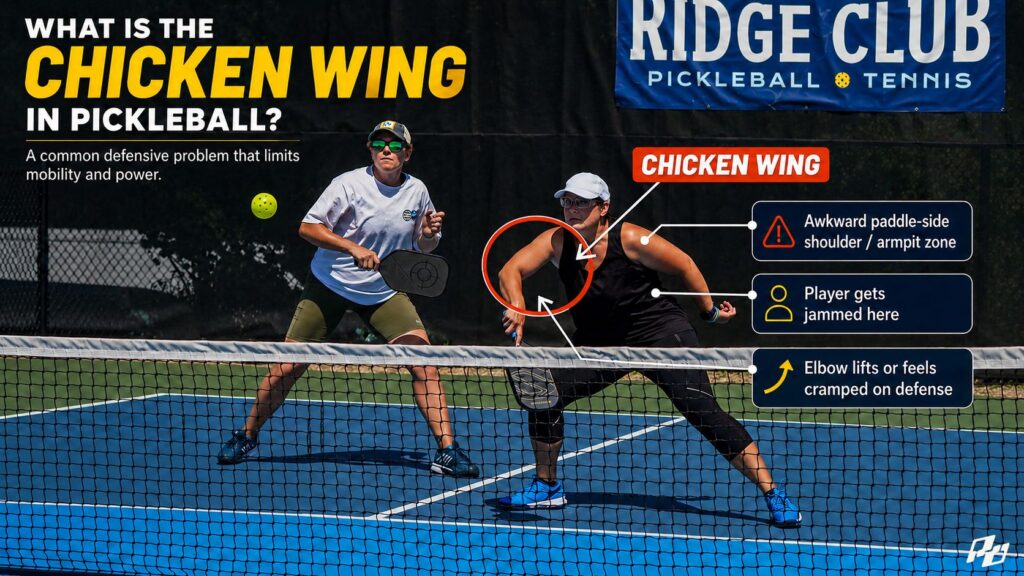
So when a player sits backhand, they are basically saying: “I dare you to speed me up into my counter.”
And if you hit a flat ball into their paddle, they are probably right.
Why Harder Is Often Worse
This is the mistake many intermediate players make. They see a player sitting backhand and think: “I need to hit harder.”
But a hard, flat speedup into a backhand-ready paddle is exactly what that player wants. The faster you hit it, the less they have to create. They simply stabilize the paddle, punch through the ball, and use your pace against you.
That is why some speedups feel like assists.
You think you attacked.
They think you fed them.
The better question is can I make their backhand position uncomfortable?
That is where the higher roll comes in.
The Key Idea: Elevate the Roll Into the Body
The most useful shot against a backhand-sitting player is often a controlled roll that rises into the upper body — especially around the paddle-side shoulder, chest, or upper-rib area.
Not a reckless head-high attack.
Not a body bag.
Not a flat missile.
A shaped, heavy, topspin roll that gets up enough to jam their backhand structure.
Why does that work?
Because the backhand counter is strongest when the ball is in front, around waist-to-chest height, and the player can keep the paddle compact. But when the ball gets higher into the shoulder or upper body, the mechanics get awkward.
Now they have to decide:
Do I block high?
Do I chicken-wing this?
Do I counter down from a cramped position?
Do I let it go?
Do I reset from above my ideal contact point?
That hesitation is the whole point. You are not just attacking their paddle. You are attacking their structure.
Why the Roll Matters
A roll is different from a flat speedup.
A flat speedup travels more directly. If it goes right into their paddle, they can punch it. A roll has shape. It climbs, dips, and carries topspin.
Topspin is created by brushing up the back of the ball, and it helps the ball dive or drop in flight while changing the way it rebounds off the opponent’s paddle.
That matters because a good roll can be slower but heavier.
It does not have to beat the opponent with pure speed. It beats them with height, spin, and location.
A useful way to think about it:
Flat speed gives them pace.
Topspin roll gives them problems.
The Right Ball to Use It On
This shot works best when you get a low-to-medium ball that you can roll upward with control.
That sounds counterintuitive because many players think they should only attack high balls. But this is not a smash. It is a roll.
You are using a low-to-high path to shape the ball upward into the body.
Use it when:
✅ the ball is in front of you
✅ you are balanced
✅ you can brush up the back of the ball
✅ the opponent is sitting backhand
✅ their paddle is low-to-mid and ready to punch
✅ you have room to recover after the shot
✅ your partner is ready for the next ball
Avoid it when:
❌ the ball is too low to lift safely
❌ you are falling backward
❌ your wrist has to save the shot
❌ the opponent is already tall and waiting high
❌ you cannot control the height
❌ you are just trying to blast out of frustration
The cue: Roll from control, not from panic.
Where Exactly Should You Aim?
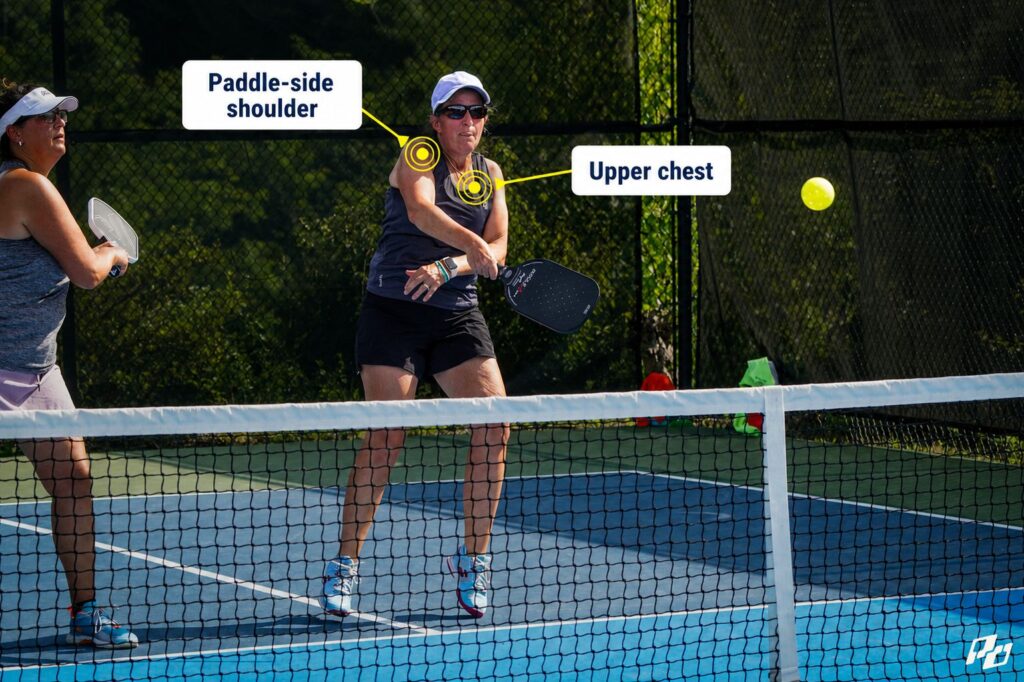
The target is not “the person” in a reckless way. The target is the uncomfortable contact zone.
Good targets include:
✅ paddle-side shoulder
✅ upper chest
✅ dominant-side rib cage
✅ armpit/chicken-wing area
✅ body-side hip if they are too upright
✅ middle seam if both players are backhand-biased
For a right-handed opponent sitting backhand, the paddle-side shoulder or armpit area can be especially awkward because their elbow may flare and their paddle may get trapped.
But be smart. At rec level, you do not need to hit dangerously high or hard. The goal is discomfort, not injury.
A better target cue: Shoulder pocket, not face.
That keeps the intent tactical and safe.
Why a Slower Ball Can Be More Effective
This is the part that feels strange. A slower, higher roll can be harder to counter than a faster flat ball.
Why?
Because the opponent cannot simply borrow your pace. They have to generate their own timing from an awkward height. If the ball is climbing or dipping into their shoulder, they may not be able to stay “on top” of it.
When they cannot get on top of the ball, their counter often floats, clips the net, or pops up.
So instead of trying to beat their hands, you are trying to beat their paddle angle.
That is much smarter.
How to Hit the Shot
For most intermediate rec players, this is usually easier and more reliable as a forehand roll first. The forehand gives you a more natural low-to-high brushing path, easier topspin, and better control over height.
A backhand roll can work too, especially if you have a strong two-handed backhand, but it requires better timing and paddle-face control.
So the simple rule is: use the forehand roll when you can; use the backhand roll only if it is already a reliable shot for you.
1. Start Low and Balanced
You need a stable base. If your legs are tall or your body is drifting backward, the roll becomes wristy and unreliable.
Think of loading your legs slightly, with your weight athletic and ready to move forward.
Cue: Low body, high roll.
2. Contact the Ball in Front
If contact gets too close to your hip, you will scoop. If it gets behind you, you will pop it up or drag it wide.
You want the ball in front enough that you can brush up and forward.
Cue: Meet it early enough to shape it.
3. Brush Up the Back of the Ball
This is the main technical piece.
You are not slapping through the ball flat. You are brushing low-to-high with enough forward movement to send it through the target.
Too much vertical brush and the ball floats.
Too much forward hit and it becomes a flat counter feed.
Too much wrist and the paddle face changes.
The sweet spot is: Up enough to elevate, forward enough to pressure.
4. Aim Through the Shoulder Zone
Do not just roll “at them.” Pick a precise window.
The best version feels like the ball is traveling through the upper-body zone, not randomly toward the torso.
Cue: Roll through the shoulder pocket.
5. Slide Backhand After the Roll
This is the part many players forget.
After you roll into a backhand-sitting player, you must expect the ball to come back. Good players may still block it, counter it, or get a paddle on it.
So after the roll, recover slightly backhand-ready yourself.
Why?
Because if they do counter, the reply often comes back fast through the middle or back into your body. If you admire your attack, you get burned.
That means your paddle returns to the front of your body, slightly backhand-biased, ready for the next exchange.
Cue: Roll, then reload backhand.
The Full Pattern
Here is the pattern in real doubles language:
- Opponent sits backhand at the kitchen.
- You get a controlled dink or slightly low ball.
- Instead of blasting flat, you roll high into the shoulder/body.
- They get jammed or forced into a weak block.
- You slide backhand and prepare for the counter.
- If the ball pops up, you or your partner finish.
- If they block it back, you stay in the rally with advantage.
That is the point.
The Contact-Height Trap
This shot works because the roll gets elevated — but that does not mean every high ball is good.
If you roll too high and too soft, advanced players may step back, let it drop, or counter down on it.
If you roll too low, they punch it.
If you roll too flat, they punch it.
The ideal ball is uncomfortable because it rises into the body with enough pace and spin that they cannot easily step away or reset.
Think: High enough to jam. Firm enough to rush. Low enough to stay safe.
That is the window.
What If They Let It Go?
Good question. If you attack high into the body and the ball is sailing long, better players may simply dodge it.
That is why precision matters. You cannot just aim high and hope.
The roll must have topspin and shape so it stays in or forces a playable contact. If your version keeps flying long, you are probably hitting too flat or finishing too high without enough spin.
Fix:
Brush more.
Aim slightly lower.
Hit with less pace.
Finish through, not up only.
Choose a bigger target.
Cue: Shape before speed.
How Your Partner Should Read It
This shot is not just your shot. It is a team setup. When you roll into the opponent’s shoulder/body, your partner should expect:
✅ weak block
✅ pop-up middle
✅ rushed counter
✅ ball off the tape
✅ defensive reset
Your partner should not crash wildly, but they should become alert.
A good partner cue: Roll means ready.
If your partner knows your roll is meant to create a weak next ball, they can look for the finish.
Common Mistakes
1. Going too hard
Problem: You feed their counter.
Fix: Take off pace and add shape.
Cue: Heavy, not hard.
2. Rolling too low
Problem: The ball sits in their backhand punch zone.
Fix: Elevate it into the upper body.
Cue: Shoulder pocket.
3. Rolling too high
Problem: The ball sails long or becomes easy to dodge.
Fix: Add topspin and aim through the body, not above it.
Cue: Shape it down.
4. Using only the wrist
Problem: The paddle face changes and the ball sprays.
Fix: Use legs, shoulder, forearm, and compact wrist stability.
Cue: Brush with structure.
5. Standing still after the roll
Problem: You get countered while admiring your shot.
Fix: Slide backhand and prepare for the next ball.
Cue: Roll, reload.
6. Using it on the wrong player
Problem: Some players love high body balls and counter them well.
Fix: Test it once or twice. If they handle it, switch targets.
Cue: Read the reply.
How to Practice It
Drill 1: Shoulder-Window Roll
Have a partner stand at the kitchen in a backhand-ready position. Feed yourself or have them feed low balls. Roll toward the paddle-side shoulder zone at 60–70% pace.
Goal: Make the ball land in or near the court while forcing awkward contact.
Drill 2: Roll and Recover
After every roll, immediately reset your paddle to a backhand-ready position. Your partner either blocks softly or counters.
Goal: Attack without losing your defensive shape.
Drill 3: Hard vs High Comparison
Hit five flat speedups into your partner’s backhand-ready zone. Then hit five higher, slower rolls into the shoulder/body.
Notice which one creates weaker replies. This drill teaches the whole lesson.
The Best Cues to Remember
Heavy, not hard.
You want spin and shape, not just pace.
Shoulder pocket.
Aim at the awkward upper-body zone.
Roll from control.
Do not force it while off balance.
Shape before speed.
Topspin keeps the ball from sailing.
Roll, reload.
Slide backhand after attacking.
Attack the structure, not the paddle.
Do not feed their strongest counter lane.