
Most rec players lose control of the rally on the fourth shot, not the return. If the third shot is high, volley it to the feet. If it bounces and sits up, step back and drive it. If it's genuinely good, neutralize it low. The goal isn't a winner — it's making the serving team reset from the hardest part of the court.
Most beginner and intermediate pickleball players spend a lot of time thinking about the third shot.
Third-shot drop. Third-shot drive. Third-shot decision. Third-shot practice. Third-shot panic.
But here’s the uncomfortable truth: a lot of rec players are not actually losing because their opponents hit amazing third shots.
They are losing because their own fourth shot is too polite.
They return deep, get to the kitchen, see the serving team hit a drop, and then… they tap it back. They block it softly. They let it bounce and dink it safely. They make contact from a passive position and accidentally invite the serving team forward.
And just like that, the advantage disappears.
Remember: after the serve and return, the receiving team should usually be the team in control. You returned deep. You got to the non-volley zone first. The serving team is still trying to earn its way in.
Your fourth shot is where you either protect that advantage — or give it away.
That is why “4th ball pressure” is such an important concept for rec players. It is not about crushing every ball. It is about making the serving team hit one more difficult ball from the transition zone instead of letting them stroll forward into a neutral dink rally.
The fourth shot should ask a hard question: Can you reset this while moving?
If the answer is no, you keep control.
What Is the 4th Shot in Pickleball?
The fourth shot is the receiving team’s response to the serving team’s third shot.
The sequence usually looks like this:
- Serve.
- Return.
- Third shot from the serving team — often a drop, drive, or hybrid.
- Fourth shot from the receiving team.
That fourth shot is a huge tactical moment because the receiving team is usually closer to the kitchen line, while the serving team is still deeper in the court or moving through the transition zone.
That means the receiving team has a positional advantage. But positional advantage is not automatic pressure.
You still have to use it.
A weak fourth shot lets the serving team move forward comfortably. A smart fourth shot keeps them stuck in the hardest part of the court — that awkward midcourt area where they have to hit resets, half-volleys, blocks, and soft defensive balls while moving.
That is where many rec players break down.
The Big Mistake: Treating Every Drop Like It Deserves Respect
- A good third-shot drop deserves respect.
- A decent third-shot drop deserves pressure.
- A bad third-shot drop deserves punishment.
Most rec players do not separate those three.
They see the ball dipping and immediately go soft. They think, “Oh, that’s a drop, so I should dink it.” But not every ball that lands near the kitchen is a successful drop. Some are too high. Some hang too long. Some bounce deep enough that you can step in. Some are low but still reachable out of the air. Some are soft but not good enough to let the serving team fully advance.
Your job is to judge the quality of the third shot, not the label.
A drop is not automatically good just because it is soft. A fourth shot is not automatically smart just because it is safe.
The receiving team’s job is not to be polite. It is to protect the kitchen line.
Priority One: Take the Ball Out of the Air When You Can
The best fourth-shot pressure usually starts with one idea: If the third shot is still attackable before it bounces, take it out of the air.
Why?
Because time is the serving team’s oxygen.
When you let the ball bounce unnecessarily, you give them more time to move forward, split-step, organize their feet, and prepare for the next ball. When you take it out of the air, you remove that time.
This does not mean swinging wildly. It means using a firm, controlled volley that keeps the serving team back or forces them to reset from an uncomfortable position.
For rec players, the best fourth-shot volley is often not a winner. It is a “stay back” ball.
Aim at feet. Aim at the inside foot. Aim through the middle seam. Aim into the body if they are moving forward. Make them hit up from the transition zone.
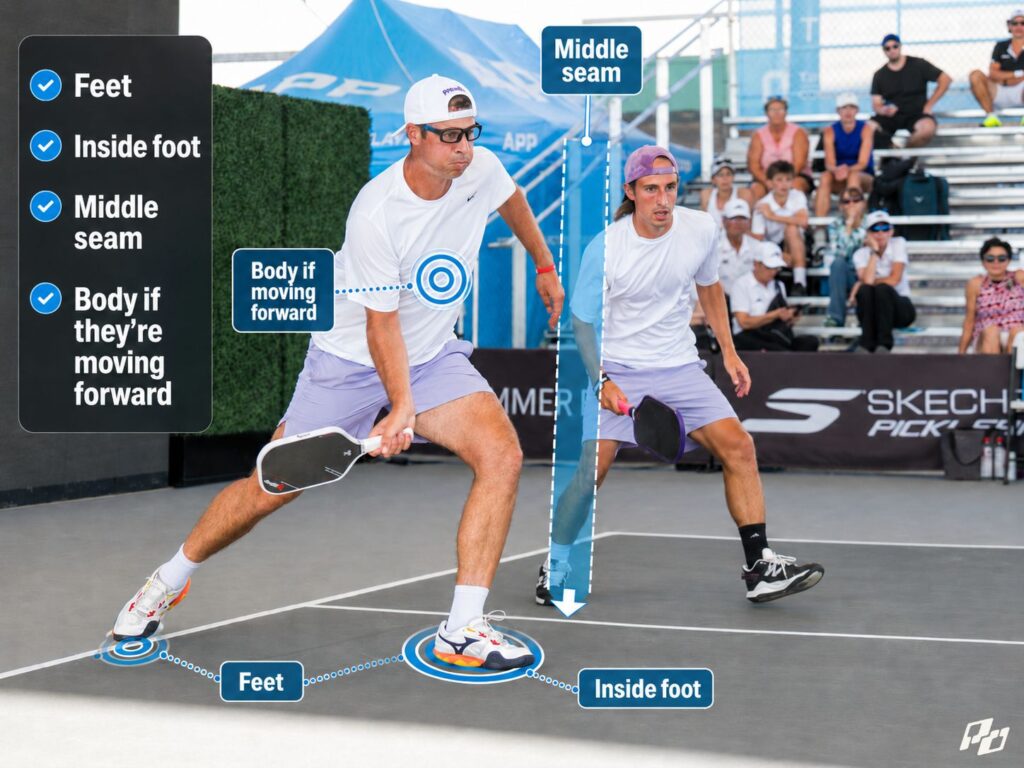
That is the pressure. Not speed for the sake of speed. Pressure through timing, depth, and placement.
If they are moving, make them reset. If they are set, make them defend.
That is much better than just thinking “hit it hard.”
The Roll Volley: The Rec Player’s Best 4th Shot Weapon
For most beginner and intermediate players, the roll volley is the fourth-shot weapon worth building.
A punch volley is fine against a drive. A block volley is useful when you are under pressure. But against a floating or slightly high third-shot drop, the roll volley gives you something better: shape.
Instead of chopping down or slapping flat, you brush up and through the back of the ball with a compact motion. The ball clears the net with margin, dips toward the opponent’s feet, and forces them to hit up.
That dipping shape matters.
⮕ A flat volley can sail long or sit up.
⮕ A roll volley can pressure without needing reckless pace.
The target is usually not the sideline. At rec level, that is where errors live. The better target is the feet of the player moving in, especially near the middle or backhand-side hip.
Think of it as a “heavy push” rather than a full attack.
Your paddle starts slightly below or behind the ball. Your wrist stays quiet. Your contact is in front. Your finish is compact and forward, not giant and tennis-like.
Brush it down to their shoes, not through the back fence.
@pickleballwithtyler Forehand Roll Volley Masterclass In 60 Seconds
♬ original sound – pickleballwithtyler
That one cue helps rec players avoid the common mistake of overhitting the fourth shot just because the ball is high.
If It Bounces, Don’t Automatically Dink
This is where the concept gets more advanced. Many rec players are taught: if the ball lands in the kitchen, dink it.
That is often true. But not always.
If the third shot bounces and sits up, or if it lands deep enough in the kitchen that you can step back and create space, you may be able to hit a firmer topspin shot off the bounce.
This is not a full tennis groundstroke from the baseline. It is more like a compact mini-drive from near the kitchen area after you have backed off the line enough to let the ball drop into a better strike zone.
Why step back?
Because if you stay glued to the kitchen line and try to hit a ball that has bounced near your feet, your swing gets cramped. You end up flicking with your wrist, popping the ball up, or jamming yourself.
- Stepping back creates space.
- Space creates a cleaner contact point.
- A cleaner contact point lets you apply pressure without panicking.
The key is not to retreat lazily. It is a quick adjustment step: off the line, balanced base, compact swing, then recover.
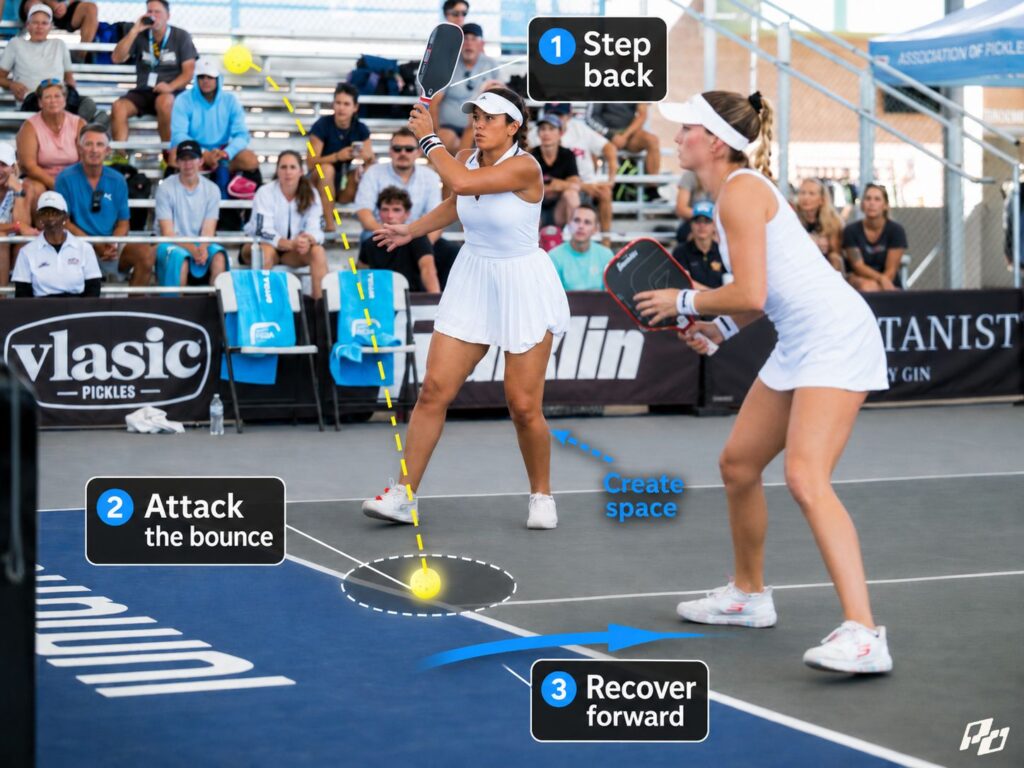
You are not giving up the kitchen. You are borrowing space so you can hit a better fourth shot.
Step back to attack the bounce, then recover forward.
That is very different from backing up because you are scared.
The Real Target: The Transition Zone Reset
Here is the whole point of fourth-shot pressure: You want to make the serving team hit a reset from the transition zone.
That is one of the hardest shots in rec pickleball because the player is usually moving forward, dealing with the ball near their feet, and trying to soften pace without popping it up.
At the beginner and intermediate levels, this is where points leak everywhere.
- Players overrun the ball.
- They reach.
- They half-volley too high.
- They swing at a ball they should absorb.
- They try to drive from their shoelaces.
- They get stuck between “attack” and “reset.”
That is exactly where you want them.
So the fourth shot should not just be “in.” It should be placed to create an uncomfortable fifth shot.
The best targets are:
- The feet of the player moving in.
- The inside foot near the middle.
- The backhand-side hip of the advancing player.
- The middle seam when both players are moving.
- The deeper transition zone if they are still behind the baseline.
Notice what is not on that list: cute sideline winners.
At rec level, you do not need low-percentage targets to create pressure. You need repeatable targets that make opponents hit up while moving.
The Fourth Shot Decision Tree
The fourth shot gets much easier when you stop guessing. Read the third shot and choose from four responses.
- If the third shot is high and reachable out of the air, volley with pressure. Roll it or punch it to the feet. Do not let it bounce just because it is soft.
- If the third shot is low but still reachable out of the air, use a controlled block or soft volley. Keep it low and make them hit from below net height.
- If the third shot bounces but sits up, step back and drive/roll it off the bounce. Create space first. Do not jam yourself on the kitchen line.
- If the third shot is genuinely excellent — low, dipping, and forcing contact below net height — respect it. Dink it back low, preferably with placement that prevents the serving team from attacking the next ball.
The mistake is using the same answer for all four balls. Better players do not have one fourth shot. They have a fourth-shot menu.
The “No Free Ride” Principle
At beginner and intermediate levels, a lot of players are too generous on the fourth shot.
They see the serving team hit a decent drop and they immediately give them a neutral dink. That may feel safe, but it often turns the point even too early.
The receiving team has earned the better position. You returned deep. You got forward. The serving team should not get rewarded with a free entry just because their third shot was “not terrible.”
That is the no free ride principle.
- If their drop is good, neutralize it.
- If their drop is okay, pressure it.
- If their drop is bad, punish it.
This mindset is especially important against teams that rely on soft thirds but do not reset well. Do not let them skip the transition zone. Make them prove they can handle the fifth, seventh, and ninth shots while moving.
A great fourth shot does not have to end the rally. It just has to prevent the serving team from becoming comfortable.
Beginner Version: Keep Them Back Without Over-Swinging
If you are a beginner or early 3.0 player, do not turn this concept into “smash everything.” Your goal is simple: stop handing opponents easy kitchen access. Start with three priorities.
- Take obvious high balls out of the air.
- Aim firm volleys toward feet, not sidelines.
- If the ball bounces, create space before swinging
That alone will make your fourth shot much better.
The biggest beginner mistake is standing frozen at the kitchen line while the ball drops near the toes. Then the player panics, scoops, and pops it up.
If the ball is dropping below your knees, move. Either take it earlier out of the air or step back enough to hit it cleanly after the bounce.
Do not fight the ball from your shoelaces.
If you are jammed, you are already late.
Intermediate Version: Pressure the Player, Not Just the Ball
At 3.5 and above, you need to think beyond “deep” and “hard.” You should be reading the opponent’s movement.
If the third-shot hitter is still behind the baseline:
⮕ Hit deeper and keep them back.
If they are sprinting through transition:
⮕ Aim at their feet or inside hip.
If their partner is crashing too early:
⮕ Go middle or behind the crash.
If both players are split unevenly:
⮕ Use the seam.
The fourth shot is not just a shot. It is a test of their movement quality.
This is where intermediate rec players can gain a real edge. Most opponents can hit a decent drop when they are calm. Fewer can reset well when the next ball is dipping at their feet while they are moving forward.
So do not just hit the ball hard. Hit the ball where their feet are least ready.
Attack their movement, not their paddle.
That is a more advanced way to think.
When You Should Not Apply Heavy Fourth-Shot Pressure
Fourth-shot pressure does not mean forcing offense from bad positions.
If the third shot is excellent — low, soft, and dropping below net height — do not get stubborn. A reckless attack from below the net is exactly how you turn their good drop into your mistake.
- Sometimes the right fourth shot is a soft dink reset.
- Sometimes you should concede neutral.
- Sometimes the best pressure is simply keeping the ball low enough that they still cannot attack.
The goal is not aggression. The goal is control.
Pressure only works when your contact point supports it.
If you are reaching, falling back, contacting below net height, or jammed against the kitchen line, choose control. Make them play another ball.
Pressure from balance. Neutralize from trouble.
That is the line.
The Partner Problem: Both Players Must Read the Fourth Shot Together
In doubles, fourth-shot pressure is not just the hitter’s job. The partner matters too.
If your partner hits a firm fourth shot to the opponents’ feet, you need to expect a pop-up or weak reset. Stay ready. Do not admire the shot.
If your partner takes a ball out of the air and sends it middle, you should squeeze middle with them.
If your partner has to dink a great third-shot drop, you should not overcommit forward expecting an attack. Prepare for a neutral rally.
Many rec teams lose the fourth-shot advantage because one player pressures and the other player watches.
A good fourth shot is often followed by an even better fifth-ball opportunity for your side.
Be ready for that.
If your partner makes them hit up, you move in and look down.
That means expect the next ball to be attackable.
Common Fourth-Shot Mistakes That Keep Rec Players Stuck
1. Letting too many balls bounce
If you can reach the ball out of the air but let it drop, you usually give away time, pressure, and contact height.
2. Trying to crush it to the baseline
The fourth shot does not need to be a winner. A firm ball to the feet is often better than a hard ball that sails long.
3. Attacking from below the net
If your paddle face has to lift the ball, you are not attacking — you are gambling.
4. Going for the sideline too early
Sidelines are tempting, but middle and feet targets win more rec points with fewer errors.
5. Staying glued to the kitchen line
The kitchen line is powerful only if you can make clean contact. If the ball drops near your feet, create space.
6. Forgetting to recover
If you step back to hit off the bounce, recover forward right away. Otherwise, a smart adjustment turns into a retreat.
A Simple Training Focus for Your Next Rec Game
For one full game, do not worry about winning the fourth shot outright.
Instead, track this: Did your fourth shot make the serving team hit the next ball from the transition zone?
That is the metric. Not winners. Not speed. Not whether the ball looked fancy.
If your fourth shot keeps them back, jams their feet, forces a reset, or stops them from reaching the kitchen comfortably, it worked.
If your fourth shot lets them walk in and dink from balance, it failed — even if you made the ball.
That is the shift rec players need.
The fourth shot is not just a reaction. It is the receiving team’s first chance to defend its advantage.
Make the Third Shot Earn Its Reward
The serving team’s third shot is supposed to help them move forward. But it should not guarantee it. That is the whole point.
⮕ If their third shot is excellent, respect it and play low.
⮕ If it is decent, pressure it.
⮕ If it is weak, take time away and make them reset from the hardest part of the court.
Beginner and intermediate rec players do not need a pro-level fourth shot to improve fast. They need a better fourth-shot mindset.
✖️ Stop tapping the ball back because the opponent hit something soft.
✖️ Stop letting average drops become free kitchen passes.
✖️ Stop attacking from bad contact points just because you want to be aggressive.
Take the ball out of the air when you can. Step back when the bounce demands space. Aim at feet and movement, not highlight targets.
And above all, make the serving team earn every inch forward.
That is fourth-shot pressure.