Change ball direction in pickleball when you’re balanced, have comfortable spacing, and can create a clear doubles advantage. Stay crosscourt under pressure, use the middle for safer redirects, and go down the line only when the opponent leans early or leaves the target exposed.
One of the biggest mistakes in doubles is changing direction simply because you’re tired of dinking crosscourt.
You’ve exchanged several crosscourt dinks when you notice your opponent leaning early toward the sideline, or the player directly in front of you drifting too far toward the middle. Suddenly, the down-the-line dink looks tempting.
Sometimes it wins the point. Other times it clips the net, sails wide, or gives the line player an easy speed-up.
That’s because changing direction isn’t about spotting open court. It’s about recognizing when the incoming ball gives you permission to redirect.
The best doubles players don’t change direction because they’re bored with the pattern. They change direction because the new target creates more pressure than the extra risk.
One rule explains almost every good direction change:
Change direction from balance—not from boredom.
Why Crosscourt Is Still the Safest Default
There’s a reason the crosscourt dink is the foundation of doubles pickleball.
A crosscourt dink travels over the lower middle portion of the net and into a much longer landing area than a down-the-line dink. That gives the ball more time and more court to descend into.
In doubles, it also keeps the ball away from the opponent standing directly in front of you, reducing the chance of an easy counterattack.
Crosscourt is usually the best option when:
- you’re stretched
- you’re contacting below your knees
- you’re recovering your balance
- you’re trying to slow the rally down
- your partner is out of position
Crosscourt isn’t passive. It’s simply the highest-percentage direction when you don’t completely control the ball.
The Four Green Lights for Changing Direction
Before redirecting any dink, ask yourself four quick questions.
1. Am I Balanced?
This is the biggest one.
Changing direction requires a stable paddle face. If you’re moving sideways, leaning backward or reaching, the smaller down-the-line window becomes much harder to hit.
If your feet aren’t underneath you, keep the higher-percentage direction.
2. Do I Have Space?
Changing direction shouldn’t require a last-second wrist adjustment. You need enough room for your arm to extend naturally toward the new target.
If the ball crowds your hip or body, continue the ball where it naturally wants to travel or play safely through the middle.
Create direction with your body—not with a wrist flick.
3. Has My Opponent Committed?
The best direction changes happen after you’ve established a pattern. Look for an opponent who is:
- leaning toward the crosscourt exchange
- preparing early for another crosscourt dink
- drifting too far toward the middle
- consistently winning the crosscourt exchange
Once they begin anticipating the next ball, you’ve created an opportunity to redirect.
4. What Advantage Am I Creating?
Every redirect should improve your team’s position. Good reasons include:
- bringing your partner into the rally
- forcing the line player to move
- crowding the opponent’s inside foot
- exposing the middle on the next ball
- breaking a losing crosscourt pattern
If you can’t explain why you’re changing direction, don’t.
The Best Redirect Is Usually Smaller Than You Think
Many recreational players think changing direction means going from one sideline to the other.
Usually it doesn’t.
Some of the best redirects move only two or three feet. For example:
✔️ Outside foot to inside foot
✔️ Wide crosscourt toward the middle
✔️ Middle toward the player directly ahead
✔️ Forehand shoulder toward the opponent’s backhand hip
Those subtle changes often force more awkward contact than a dramatic angle.
Remember: You’re not trying to hit empty court. You’re trying to create an uncomfortable contact point.
Coach Sarah Ansboury explains the mechanics of redirecting the ball through three key tips:
The Middle Is Often the Better Direction Change
Many players assume every redirect should go down the line. In doubles, the middle is often the smarter option.
Why?
Because it creates uncertainty. Even experienced teams occasionally hesitate over who should take a ball through the middle. More importantly, both players lose their favorite crosscourt angles and often make contact from less comfortable positions.
If you’re under only moderate pressure, changing from a wide crosscourt dink into the middle is usually safer than trying to thread the sideline.
Cue
When in doubt, change toward the middle before changing toward the line.
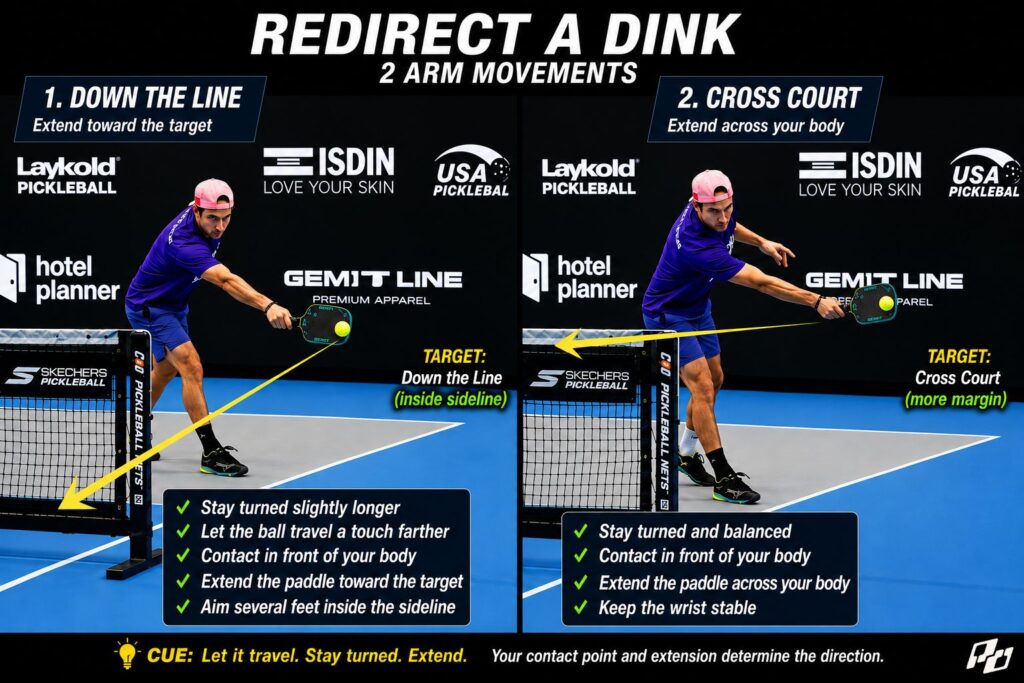
How to Redirect a Dink Down the Line
The down-the-line dink has much less margin than the crosscourt dink, so the mechanics matter.
For a forehand redirect:
- stay turned slightly longer
- allow the ball to travel a touch farther than you would crosscourt
- contact comfortably in front of your body
- extend the paddle toward the target
- aim several feet inside the sideline
Before redirecting, quickly check the player directly in front of you. If their paddle is already high and waiting, keep the ball crosscourt or through the middle instead.
For a backhand redirect, the same principle applies. Keep the wrist stable and let your shoulders, spacing and contact point determine the direction.
Cue
Let it travel. Stay turned. Extend through the target.
Don’t Forget About Depth
Intermediate players think about left and right. Advanced players also think about long and short. Changing depth can be just as disruptive as changing direction.
A deeper dink near the kitchen line forces the opponent to decide whether to volley or back up.
A shorter dink can pull them forward and change their contact height.
One simple pattern is:
Deep crosscourt → Deep crosscourt → Slightly shorter inside-foot dink.
The first two establish rhythm. The third changes both depth and direction.
Just don’t leave it sitting near the net. The goal is to create an awkward contact—not an easy attack.
When to Redirect a Volley Dink
Taking a dink out of the air removes time from your opponents and can make a direction change harder to read.
A soft volley dink is most useful when the ball is within comfortable reach and contact is below or around net height. From there, keep the stroke compact and redirect toward the middle, inside foot, or a less comfortable paddle position.
When contact is clearly above net height, you are no longer limited to a dink. You may have a better opportunity to roll, punch, or speed up the ball—provided you are balanced and the target is available.
The key distinction is:
- Below or near net height: redirect softly and keep the ball unattackable.
- Above net height: consider a more offensive volley.
- Reaching or off balance: let the ball bounce rather than forcing the volley.
If you must lunge, stretch across your body, or contact the ball too close to the paddle tip, taking it out of the air may create more risk than pressure.
Cue
Volley soft below the net. Attack when contact rises above it.
Pro player Callie Jo Smith explains how to use your arm correctly when hitting down the line or crosscourt:
@calliejosmith_pickleball Your target should influence your technique. 🎯 In pickleball, you can’t always use the exact same swing and expect to hit every target effectively. Want to hit down the line? Your contact point, paddle path, and follow-through should help you stay on top of the ball and create a more controlled angle. Want to hit cross court? You’ll need to adjust your swing path and allow your paddle to travel in a direction that creates more angle. Want to hit through the middle? Your body position and paddle angle need to help you drive the ball into that smaller window between opponents. The best players aren’t just reacting to the ball—they’re making adjustments based on where they want the ball to go. Different target = different intention = different technique. Start paying attention to your target before you hit, and your consistency will improve. #Pickleball #PickleballTips #PickleballTraining #PickleballStrategy #PickleballCoach ♬ original sound – Callie Jo Smith
Direction Changes on Speed-Ups
Changing direction on a speed-up is different. The margin is much smaller. Only redirect an attack when:
✔️ The ball is comfortably above net height
✔️ Contact is well in front
✔️ Your feet are set
✔️ You’ve identified a specific opening
✔️ You’re ready for the counterattack
Instead of aiming for the sideline, look for:
- the paddle-side hip
- the elbow seam
- the player who is least prepared
Those targets create awkward counters without demanding perfect accuracy.
Cue
Redirect with a purpose—then expect the next ball back.
Don’t Change Direction From Defense
This is probably the biggest mistake recreational doubles players make. They’re losing the crosscourt exchange, so they try to escape it with a heroic down-the-line dink.
Usually from below their knees.
Usually while stretched.
Usually into the net.
If you’re under pressure, changing direction rarely solves the problem.
- Recover first.
- Get balanced.
- Wait for a ball that gives you options.
The best players don’t force redirects. They earn them.
Bring Your Partner Into the Point
One of the best reasons to change direction isn’t to hit a winner. It’s to improve your partner’s next ball.
A dink toward the opponent’s inside foot or backhand hip often produces a softer reply into the middle, allowing your partner to attack the next shot.
That’s how strong doubles teams build pressure.
Instead of asking, “Can I win this rally?”
Ask, “Can I make my partner’s next ball easier?”
That small mindset shift often leads to much smarter direction changes.
Your Partner Has to Move Too
Changing direction changes the geometry for everyone. If you redirect down the line and your partner doesn’t move, you’ve created a gap instead of an advantage.
As soon as the ball changes direction:
- protect the immediate straight-ahead reply
- recover your paddle quickly
- shift slightly toward the new ball location
- expect your partner to close the middle
A good redirect is a team movement—not just a good shot.
Cue
Move the ball. Then move together.
Here’s a simple, universal strategy that helps you and your partner cover the entire kitchen line without confusion:
A Better Practice Drill
Place three targets in the opponent’s kitchen:
- wide crosscourt
- inside foot
- middle or down the line
Start a cooperative crosscourt dink rally. You’re only allowed to change direction when:
- your feet are set;
- you’re balanced;
- contact is above knee height;
- you can say your intended target before hitting.
After the redirect, play the point live. Award yourself:
- 1 point for choosing the correct ball
- 1 point for hitting your target
- 1 point if the redirect creates a weaker reply
- minus 1 point for redirecting while off balance
This rewards decision-making, not just shot execution.
My Rule for Changing Direction
One thing I’ve learned from watching high-level doubles is that they’re rarely looking for winners from the kitchen.
They’re looking for better next balls.
A good direction change doesn’t have to end the rally. It simply needs to improve your team’s position. Maybe your opponent reaches a little farther. Maybe they lose their favorite angle. Maybe they pop the next dink a few inches higher. Or maybe they simply send the ball into the middle where your partner can attack.
That’s what great doubles players are really chasing.
So don’t ask yourself, “Where can I hit the winner?”
Ask, “How can I make our next ball easier?”
More often than not, that’s exactly what a smart direction change accomplishes.