
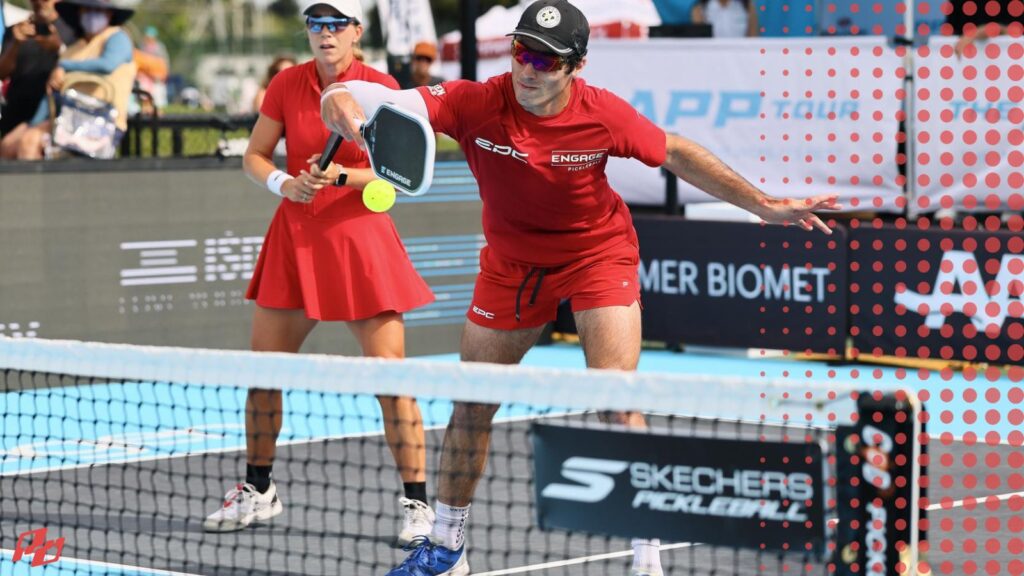
Counter a pickleball banger when you’re balanced and contacting the ball at or above net height. Use a compact punch toward the advancing player’s feet. If you’re stretched, late, or contacting below the net, block or reset instead. High rising attacks may be best left to sail long.
There is one response aggressive pickleball players really do not enjoy. It is not another soft dink. And it is not necessarily trying to outhit them.
It is a firm counter that reaches their feet while they are still moving forward.
A lot of advice about beating “bangers” falls into one of two camps:
Slow everything down.
or:
Hit them harder than they hit you.
Neither is a complete strategy. The better rule is:
Counter when you own the contact. Reset when the ball owns you.
If you understand that difference, hard hitters become much easier to manage.
Why a Hard Counter to the Feet Works So Well
A banger wants the rally played at a height where they can keep swinging forward.
Give them a waist-high ball and they can drive again.
Give them a chest-high ball and they may attack even harder.
Put the ball around their shoes while they are advancing, and the geometry changes. Now they have to hit up.
That can force:
- a reset
- a defensive half-volley
- a weaker fifth shot
- a ball that sits up for your next attack
This is why the best counter is often not the hardest one. It is the one that gets below their strike zone fastest.
But “Always Attack Back” Is Bad Advice
This is the part recreational players need clarified. Offensive and defensive volleys are usually separated by two main things: contact height and body position.
If you are balanced and contacting above the net, you have an offensive ball.
If you are reaching, moving, jammed, or contacting below net height, a defensive block or reset is usually safer.
So when a banger drives at you, do not make the decision before the ball arrives. Read the contact you actually have.
| Your Contact | Best Response |
|---|---|
| Above net + balanced | Firm counter |
| Around net height + stable | Compact punch or controlled counter |
| Below net height | Block/reset |
| Jammed into body | Compact defensive block |
| Late or off balance | Reset |
| Ball rising toward shoulder/head | Consider letting it go |
That is a much better framework than “soften everything” or “fire everything back.”
The Best Time to Counter: They’re Charging Behind the Drive
This may be the single best opportunity. Many stronger bangers no longer hit a third-shot drive and stay at the baseline.
They drive and crash forward, expecting your block to float.
If you automatically drop their drive softly into the kitchen, that can work—but a mediocre block may actually help them. They are already running toward it.
Instead, when you are balanced and the incoming drive gives you a comfortable volley, send a compact counter back toward:
- the leading foot
- the inside hip
- the space directly in front of their feet
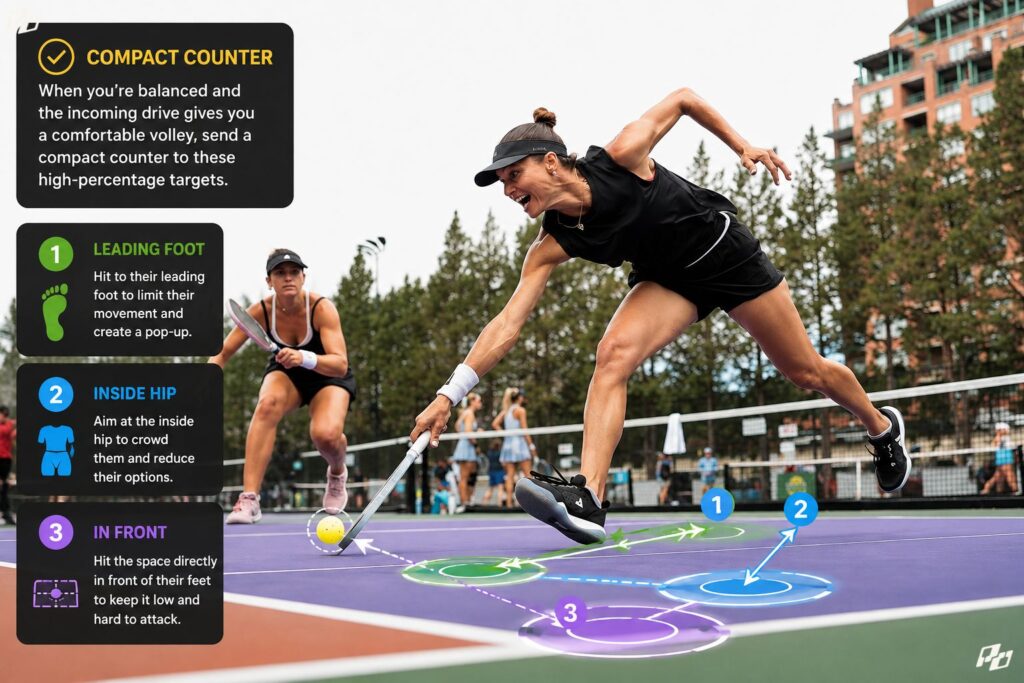
A player moving forward has less time to organize their feet and paddle than one standing still.
Coaches and experienced players distinguish these “banger-plus” players from pure baseline hitters: against someone crashing behind the drive, a firm counter to the body or feet can be more disruptive than a passive block.
Cue
Attack the mover, not the power.
What “Punch Back” Actually Means
Do not interpret this as taking a giant swing. Against pace, your opponent has already supplied most of the energy. Your job is to redirect it.
Use:
- paddle in front
- compact backswing
- stable wrist
- short forward punch
- contact slightly in front
- immediate recovery
A backhand punch volley is especially useful against body drives because it covers a large central window without requiring a grip change or big preparation.
Think:
Firm paddle. Short stroke. Low target.
Not:
Swing harder than they did.
Coach Tanner Tomassi takes the same approach: use the banger’s own power against them instead of trying to slow the game down:
@tanner.pickleball Exact Strategy to Beat Bangers in Pickleball! 🏆💥 ❌ Don’t try to slow down the opponents. ✅ Attack their drives to show that the power doesn’t phase you. ✅ Have an out in front contact point to catch the ball early. #pickleball #pickleballtiktok #pickleballlife #pickleballaddict #pickleballtips ♬ original sound – Tanner.pickleball
Hold Your Ground—But Don’t Turn It Into a Religion
The original advice is right that many recreational players unnecessarily retreat when they see pace.
Backing away can create:
- more court to defend
- awkward balls at your feet
- less offensive positioning
- easier space for the banger to advance
So if you are balanced at the kitchen line, try to hold your position. But there are exceptions.
If a ball jams you badly or your reaction time is consistently overwhelmed, a small adjustment can be reasonable. The important thing is not to drift backward during the opponent’s attack.
Get set before contact. The worst combination is: moving backward + swinging forward.
That is how pop-ups happen.
Cue
Set your base before you use your hands.
We recently filmed a great video with our coach Marko Grgic on how to prepare for and counter incoming power at the kitchen line without popping the ball up or reacting too late:
Your Chest Position Matters More Than It Sounds
The advice to keep your chest forward has merit, but I would describe it as athletic forward balance, not leaning over your toes.
Against pace:
- keep knees flexed
- weight roughly on the balls of the feet
- chest neutral-to-slightly forward
- hips underneath you
- paddle in front.
If you lean backward, your paddle face often opens and the counter floats. If you lunge too far forward, you lose reaction time and become vulnerable to the next ball.
You want to feel loaded, not pitched forward.
When the Soft Block Is Actually the Better Weapon
Bangers also hate a good block. The problem is that recreational players often hit a bad one.
A good block:
- absorbs pace
- lands low
- forces the attacker forward
- prevents another comfortable drive
Use a relaxed grip and almost no swing on a defensive block. Let the opponent’s pace do most of the work.
That is the right response when:
- contact is below net height
- you are stretched
- the drive is too hard to organize an attack
- your partner is out of position
- the hitter is still deep and unlikely to reach a short ball comfortably
So yes, sometimes you absolutely should slow the banger down. Just do it because the ball demands a reset—not because “you should always play soft against power.”
The Most Underrated Response: Let It Go
Hard hitters live on your instinct to touch every fast ball. They know pace makes you panic. Some of their hardest speed-ups are also their least likely to stay in.
If the attacker contacts below net height and the ball is climbing quickly toward your shoulder or head, there is a real chance it is going long.
One of the most effective anti-banger skills is simply developing the confidence to move your torso and let that ball travel.
High-level anti-banger coaching repeatedly emphasizes “high, let it fly” because aggressive players often generate their own errors when defenders stop rescuing bad attacks.
Cue
Low contact + rising fast = think out.
Do not automatically swing just because the ball is coming at you.
Don’t Feed Them the Same Counter Every Time
Once a banger realizes you are punching everything back hard, they can adapt. That is why the best players mix responses.
You might: Counter hard → reset short → counter feet → let the next high ball go.
Now the attacker cannot simply preload for one rhythm. The deeper principle is that bangers thrive on predictability.
If every ball comes back at the same pace and height, they settle in. Make them solve different problems.
The Biggest Mistake Against Bangers Happens Before Their Drive
Hard hitters become most dangerous when you give them the ball they want. That usually means:
- short return
- high dink
- floating reset
- weak middle ball at waist height
So beating a banger begins with denying comfortable contact.
- Deep returns keep them farther from the kitchen.
- Low dinks make speed-ups harder.
- Balls at the feet force them upward.
The best counterattack may be the ball that prevents the drive in the first place.
A Better Drill Than Just “Block Drives”
Have your partner stand in transition and hit controlled drives toward you. Your job is not to use one response. They should vary the feed so you have to decide:
- high + comfortable: counter;
- neutral: punch;
- low: reset;
- rising long: dodge.
After every ball, call your choice before contact: Counter. Block. Out.
This trains the recognition skill that matters in games.
Then have the hitter begin moving forward behind some drives. Now your target changes.
When they stay back, the soft block becomes more attractive.
When they crash forward, the counter to the feet becomes more valuable.
That is real anti-banger training.
What Bangers Actually Hate
They do not universally hate soft shots. And they do not universally hate hard shots. They hate losing the height advantage.
A hard counter at their feet does that.
A perfect reset does that.
A low dink does that.
Letting their shoulder-high speed-up sail long does that.
The mistake is deciding that every hard ball deserves the same response. Instead, ask one question:
Do I own this contact?
If you are balanced, out in front, and at or above net height, punish the drive with a compact counter—preferably at the feet of the player moving forward.
If the ball owns you, absorb it.
And if it is heading long, get out of the way.
That is the part bangers really hate.